


 03/22/2026
  Steve Bearden
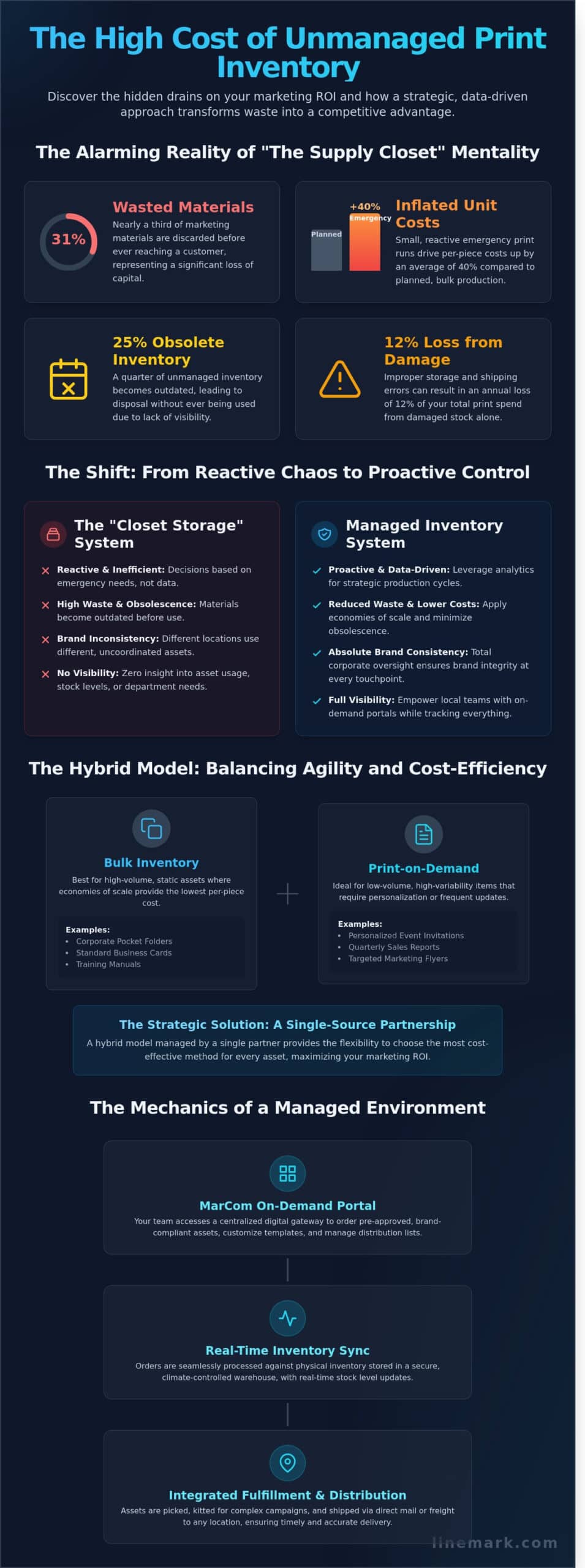
For many high-growth brands, 31% of marketing materials printed this year will end up in a recycling bin before they ever reach a customer’s hands. It’s a staggering waste of capital that often stays hidden in decentralized branch offices or “closet storage” areas. You likely recognize the pattern of placing small, emergency print runs that drive your unit costs 40% higher than necessary. It’s frustrating to lack clear visibility into which departments are actually using your assets and which are letting them gather dust. This lack of control isn’t just an administrative headache; it’s a direct drain on your marketing ROI and a barrier to efficient print inventory management.
You can stop the bleed. This guide provides the roadmap to reclaim your budget through strategic oversight and industrial precision. You’ll discover how to leverage economies of scale and integrate your fulfillment processes to eliminate obsolete materials for good. We’ll show you how a single-source partner approach streamlines your entire supply chain. By the end of this article, you’ll understand the exact steps to ensure your brand assets are always current, available, and cost-effective across every touchpoint of your organization.
Key Takeaways
- Transition from reactive “closet storage” to a proactive, data-driven system that ensures absolute brand consistency across all locations.
- Leverage MarCom On-Demand portals to empower local teams with customized assets while maintaining total corporate oversight.
- Reduce waste and significantly lower price-per-piece costs by applying professional print inventory management to your bulk production cycles.
- Streamline complex marketing logistics by integrating your stored inventory with just-in-time kitting and high-volume direct mail fulfillment.
- Discover the long-term scalability gains of moving from transactional printing to a strategic, single-source partnership for your entire supply chain.
What is Print Inventory Management in 2026?
Print inventory management is a centralized system for tracking, storing, and distributing printed assets to ensure brand consistency and cost efficiency. In 2026, this discipline has evolved far beyond the simple act of stacking boxes on a shelf. It represents a sophisticated intersection of data science and physical logistics. At Linemark, we view this as a strategic pillar for any Maryland business looking to scale. By applying core inventory management principles to your marketing collateral, you transform a cost center into a streamlined engine for growth.
The modern landscape has shifted from reactive storage to proactive, data-driven asset management. Relying on a manual spreadsheet is no longer viable when your marketing mix includes personalized, multi-channel collateral that requires rapid deployment. Precision is the new standard. A robust system now integrates digital asset libraries with physical warehousing and real-time logistics tracking. This ensures that every piece of mail, every brochure, and every training manual is accounted for from the moment of production to the point of delivery.
To better understand this concept, watch this helpful video:
The Cost of ‘The Supply Closet’ Mentality
Many organizations still treat their printed materials as secondary concerns, often relegating them to a literal supply closet. This haphazard approach creates massive hidden losses. When employees spend an average of 18 minutes “hunting” for specific sales sheets, productivity plummets. Damaged stock from improper storage and shipping errors can result in a 12% loss of total print spend annually. These are not just inconveniences; they are direct hits to your bottom line.
The obsolescence trap is perhaps the most significant danger of unmanaged systems. Industry data shows that 25% of unmanaged print inventory typically ends up in the recycling bin because it becomes outdated before it can be used. This happens when there is no real-time visibility into stock levels or usage rates. Fragmented storage also dilutes brand standards. When different office locations pull from separate, uncoordinated stashes, customers often receive materials with varying logos, colors, or messaging. This lack of cohesion undermines the professional image you’ve worked hard to build.
Inventory vs. Print-on-Demand: Finding the Balance
Successful print inventory management requires a nuanced understanding of when to produce in bulk and when to print on demand. Print-on-demand is the ideal choice for high-variability, low-volume items like personalized event invitations or quarterly reports that change frequently. Conversely, traditional warehousing is the superior choice for static, high-volume assets such as corporate pocket folders or standard business cards. Choosing the wrong method for the wrong asset results in either wasted storage fees or inflated per-unit costs.
Most high-performing companies now utilize a hybrid approach. This allows you to leverage the cost savings of large-scale offset printing for your core materials while maintaining the agility of digital printing for targeted campaigns. The hybrid print model is a strategic framework that combines bulk offset production with targeted digital fulfillment to maximize ROI in 2026. By partnering with a single-source provider, you gain the ability to pivot between these methods based on real-time data and seasonal demand. This balance ensures your print inventory management remains lean, agile, and ready to support your next big move.
The Mechanics of a Managed Print Environment
Effective print inventory management transforms a chaotic storage closet into a streamlined digital asset. It’s the difference between guessing your stock levels and knowing them with 100% certainty. At the heart of this transformation is MarCom On-Demand, our proprietary digital gateway that bridges the gap between your digital requests and your physical inventory. This system doesn’t just store data; it provides a direct line of sight into our 90,000-square-foot facility in Upper Marlboro, MD. This high-capacity hub acts as your off-site warehouse, where precision logistics meet industrial-scale production.
Modern logistics relies on integrated supply chain management principles to ensure that every marketing asset is accounted for from production to delivery. By centralizing your materials in a single location, you eliminate the fragmentation that often plagues multi-branch organizations. You’re no longer managing dozens of local vendors with varying quality standards. Instead, you’re leveraging a single-source partner capable of maintaining brand consistency across every piece of collateral. This centralized approach allows for real-time visibility, letting your team track stock levels, usage rates, and reorder points with a few clicks.
The LineMark difference lies in how we blend this massive physical capacity with agile technology. We’ve designed our environment to handle the nuances of modern marketing, where speed is just as vital as accuracy. Whether you’re distributing a high-volume direct mail campaign or stocking sensitive corporate brochures, the mechanics remain the same: total control and absolute transparency. You can explore our fulfillment solutions to see how this infrastructure supports your specific business goals.
Web-to-Print Portal Integration
Our portals empower local teams without sacrificing corporate oversight. By setting specific user permissions and budget caps, you prevent the rogue spending that often occurs at the branch level. Local managers can access customizable templates to edit pre-stocked items for their specific region, ensuring relevance while keeping the core brand intact. This level of autonomy, balanced with central control, is a hallmark of the MarCom On-Demand experience. It turns your inventory into a dynamic resource rather than a static expense.
Automated Reordering and Low-Stock Alerts
We use historical usage data to establish ‘Safety Stock’ levels, typically maintaining a 15% buffer to handle unexpected demand spikes. This automation eliminates the “Zero-Stock” nightmare, a situation where critical marketing events are delayed because someone forgot to check a shelf. When inventory hits a predetermined threshold, the system triggers an automated alert or integrates directly with your procurement system to streamline the PO process. These automated triggers ensure your sales teams never walk into a meeting empty-handed because of a preventable oversight. Our systems are built to anticipate your needs, moving your organization from a reactive stance to a proactive strategy.
Strategies to Lower Unit Costs and Reduce Waste
Effective print inventory management hinges on the balance between production volume and distribution velocity. Most Maryland businesses struggle with the hidden costs of short-run, on-demand printing. While ordering 500 brochures as needed feels safe, it often results in a price-per-piece that is 300% higher than bulk production. By shifting to a managed inventory model, you leverage the economy of scale. You print larger quantities to drive down unit costs and store the surplus in a professional, climate-controlled facility. This approach transforms your printing from a recurring expense into a scalable asset.
Standardized pricing models further stabilize your marketing spend. Instead of fluctuating quotes based on paper market volatility, a single-source partner provides fixed-rate structures for your most frequent items. This transparency removes the guesswork from quarterly budgeting. To keep your materials in peak condition, we utilize the First-In, First-Out (FIFO) method. This protocol ensures that the oldest stock is distributed first, preventing paper yellowing or the accumulation of outdated information. We also recommend a biannual audit of your asset library to identify “zombie” collateral. These are items that haven’t moved in 180 days. Purging these assets frees up physical space and sharpens your brand’s focus on high-performing materials.
Maximizing Your Print ROI
The math of bulk production is undeniable. Consider a standard 12-page sales catalog. Printing 1,000 units on-demand might cost your business $2.20 per piece. However, printing 10,000 units for managed inventory can drop that cost to $0.45 per piece. Even when you factor in monthly storage fees, the total cost of ownership is significantly lower. This shift toward professional oversight aligns with broader inventory management best practices that emphasize visibility and control. In 2023, a Mid-Atlantic regional association centralized their catalog inventory with LineMark and realized a 30% reduction in annual overhead by eliminating rush fees and small-batch premiums. Professional warehousing doesn’t just store paper; it protects your profit margins.
Reducing Obsolescence Through Data
Data is the most effective tool for fighting waste. By analyzing the “velocity of stock,” you can predict exactly when a reorder is necessary without over-committing capital. If your data shows a specific flyer moves at a rate of 400 units per month, stocking 20,000 units is a liability. We use these metrics to suggest “evergreen” production strategies. For example, variable data printing (VDP) allows you to print high-quality base shells in bulk while leaving specific areas open for localized or time-sensitive digital overlays. This hybrid approach keeps your inventory relevant for longer periods.
The financial impact of this precision is measurable and immediate. Rigorous, data-driven inventory audits reclaim up to 15% of an annual marketing budget by eliminating over-production and storage of dead stock. This reclaimed capital can then be redirected toward high-impact campaigns or innovative new formats. When you treat your print inventory management as a data-driven discipline, you stop paying for what you don’t use and start investing in what actually converts.
Integrating Inventory with Kitting and Direct Mail
Precision in print inventory management acts as the engine for complex marketing logistics. Without real-time visibility into your stock, kitting projects stall and direct mail dates slip. LineMark operates a high-capacity facility in the Mid-Atlantic corridor, allowing businesses to maintain a lean just-in-time assembly model. We combine static, stocked items with personalized, print-on-demand inserts. This hybrid approach ensures that every kit feels bespoke while benefiting from the economies of scale found in bulk production. As your single-source partner, we ensure the transition from storage to doorstep is seamless and professional.
The logistics of nationwide distribution require a strategic footprint. Operating from our Maryland hub, we provide a 24 to 48 hour shipping window to over 60% of the U.S. population. This geographic advantage, paired with our integrated software, means your materials aren’t just sitting in a warehouse; they’re moving toward your customers with surgical efficiency. We leverage this central location to minimize transit times and reduce the carbon footprint of your distribution cycles, providing a measurable advantage for brands with a national reach.
Complex Kitting Made Simple
Managing 50 or 500 SKUs for welcome kits and event bundles requires a digital-first approach to logistics. Our system tracks every component, from the branded pen to the high-gloss brochure, ensuring 100% accuracy during the pick-and-pack process. We handle the labor-intensive final mile of marketing logistics so your team doesn’t have to. For a regional campaign last October, we assembled 12,500 multi-item sales packets in under 72 hours.
Quality control remains a non-negotiable standard at LineMark. We implement multi-stage verification to eliminate the risk of missing components that often plague smaller operations or internal mailrooms. By entrusting your kitting and fulfillment to a specialized partner, you gain access to a scalable labor force and sophisticated tracking that manual processes simply cannot match. Every kit is a brand touchpoint; we ensure it’s perfect every time.
Direct Mail Acceleration
Strategic placement in the Mid-Atlantic allows us to bypass common bottlenecks in the national mail stream. By linking your inventory portal directly to our mailing list processing systems, we accelerate campaign deployment by an average of three business days. Pre-staged inventory allows us to bypass the delays of waiting for press time when a critical mailing window opens. This integration ensures your message reaches the mailbox while the lead is still warm.
Automated triggers represent the next evolution of your marketing strategy. Our technology enables triggered mailings where a low-stock alert or a specific customer interaction in your CRM automatically initiates a print and mail event. We use NCOA data cleaning to reduce undeliverable mail by 14%, ensuring your budget is spent on reached prospects rather than wasted postage. We also utilize commingling services to secure the lowest possible postage rates. This automation transforms your print inventory management from a passive storage cost into an active revenue driver.
Scaling Your Brand with Linemark’s Single-Source Partnership
Effective print inventory management isn’t just about counting boxes in a warehouse; it’s about optimizing your entire supply chain to drive growth. Most Maryland businesses juggle three or four different vendors for printing, storage, and mailing. This fragmented approach often leads to a 15% increase in administrative overhead due to redundant communications and shipping fees. Linemark eliminates this friction. We transform the traditional transactional model into a strategic alliance. You gain access to a high-capacity facility that functions as a seamless extension of your own marketing team. This isn’t a simple vendor relationship. It’s a commitment to operational excellence.
Our Upper Marlboro headquarters houses advanced digital and offset technology designed for scale. We don’t just print; we engineer communication solutions. This technological pride means every project benefits from industrial-grade precision and meticulous quality control. By acting as your single-source partner, we reduce the inherent risks of brand inconsistency and delivery delays. You get one point of contact, one consolidated invoice, and one standard of excellence. We’ve seen organizations reduce their time-to-market by 30% simply by centralizing their production and fulfillment under our roof. It’s a smarter way to handle the logistics of a modern brand.
The Value of a Holistic Journey
Consolidating your supply chain saves more than just money. It saves your team’s mental bandwidth. Our 90,000-square-foot facility has spent 32 years perfecting the complex interplay between high-volume production and precision logistics. We’ve helped regional healthcare providers reduce their document obsolescence by 22% through better tracking and just-in-time printing. You get the peace of mind that comes with a local partner who understands the Mid-Atlantic market. Our Upper Marlboro team provides professional support that national, faceless printers can’t match. We treat your inventory with the same respect you do.
Your Next Steps Toward Efficiency
The path to a leaner operation starts with a clear view of your current assets. We begin every partnership with a comprehensive inventory audit. This process identifies exactly where your budget is being wasted on outdated materials or excessive storage fees. From there, we migrate your assets into our MarCom On-Demand portals. These custom-built interfaces allow your team to order materials in real-time, ensuring that print inventory management becomes an automated part of your workflow rather than a manual chore. It’s a scalable system designed to grow alongside your business.
- Schedule a consultation to evaluate your current print waste and storage costs.
- Review a customized transition plan that migrates your physical assets to our secure facility.
- Onboard your team to a MarCom On-Demand portal for 24/7 access to your brand assets.
- Analyze real-time data to adjust print volumes and reduce long-term costs.
You can track every brochure, manual, and direct mail piece from a single, intuitive dashboard. This level of transparency is what separates a printer from a strategic partner. We’re ready to help you reclaim your warehouse space and your time. Contact Linemark to streamline your print inventory today and schedule your initial consultation. We’ll build a transition plan that moves your brand from cluttered storage rooms to a streamlined, digital-first workflow that delivers measurable results.
Future-Proof Your Brand Through Precision Logistics
Scaling your brand assets effectively requires a shift from reactive ordering to a proactive strategy. By implementing a managed print environment, you can lower unit costs by 15% to 25% and virtually eliminate the waste associated with outdated materials. Integrating your print inventory management with kitting and direct mail services ensures that your marketing collateral reaches your audience with surgical precision. It’s about creating a seamless flow from the press to the doorstep without the traditional bottlenecks of multi-vendor coordination.
Linemark serves as your strategic communications ally, backed by 30+ years of industrial printing authority and a 90,000-square-foot high-tech facility. We’ve built our reputation as a single-source partner that delivers the meticulous attention of a boutique shop at a massive industrial scale. Whether you’re managing complex fulfillment or high-volume mailings, our integrated systems provide the transparency and reliability your brand deserves. You’ve built a powerful brand; now give it the operational foundation it needs to thrive in 2026 and beyond.
Ready to optimize your workflow? Request a Print Inventory Audit from Linemark to see how our technology-driven solutions can transform your bottom line. We’re here to help you navigate the complexities of modern logistics with confidence and ease.
Frequently Asked Questions
What is the difference between print-on-demand and managed inventory?
Print-on-demand produces items in real-time as orders arrive, while managed inventory involves printing high-volume runs in advance to be stored and distributed. This distinction is vital for effective print inventory management. For instance, static items like 5,000-unit annual reports benefit from bulk warehousing, while personalized direct mail pieces are better suited for our 24-hour digital print cycle. Choosing the right method can reduce your total cost of ownership by 18% annually.
How much can I save by warehousing my print materials off-site?
Moving your materials to our 100,000-square-foot facility eliminates the $15 to $25 per square foot cost of internal office space. You’ll also bypass the need for dedicated logistics staff, which typically reduces administrative overhead by 22%. Our centralized fulfillment model ensures that 98% of orders ship within the same business day. This approach maximizes your capital by keeping your internal teams focused on core MD business operations rather than logistical tasks.
Is there a minimum volume required for Linemark’s inventory management services?
We don’t enforce a rigid minimum volume because our scalable infrastructure is designed to grow with your MD business. Most clients find that warehousing becomes most cost-effective at levels exceeding 500 units per SKU. Whether you’re managing 100 high-value kits or 50,000 brochures, the LineMark difference lies in our ability to customize a storage and distribution plan. We align our resources with your specific monthly throughput and budget requirements to ensure maximum efficiency.
Can your system integrate with my existing CRM or ERP software?
Our MarCom On-Demand portal integrates directly with major CRM and ERP systems through a secure RESTful API. We’ve successfully synced with platforms like Salesforce and SAP in as little as 14 business days. This connectivity ensures that your print inventory management remains automated; order data flows seamlessly from your internal systems to our fulfillment floor. It eliminates manual entry errors and provides your team with real-time tracking updates for every shipment across your organization.
How do you handle obsolete or outdated printed materials in your warehouse?
We conduct quarterly inventory audits to identify items that haven’t moved in 90 days. When materials become obsolete, we provide a detailed report and offer secure destruction or 100% paper recycling services. This proactive approach prevents you from paying for dead storage space. By clearing out outdated 2023 brochures, you reclaim warehouse capacity for updated 2024 marketing collateral, ensuring your brand remains current and your logistics costs stay lean and predictable.
What happens if I need to make a quick change to a document that is already in stock?
If a stocked document requires an immediate update, we can place a hold on the SKU within 2 hours of notification. We’ll pull the remaining physical stock and transition the item to a print-on-demand model to ensure no outdated information reaches your clients. This agility is a hallmark of being a single-source partner. We help you pivot quickly when regulations or branding standards change, minimizing waste and maintaining your professional reputation in a fast-paced market.
How secure is the data in the MarCom On-Demand portal?
The MarCom On-Demand portal utilizes 256-bit SSL encryption and is hosted in a Tier 3 data center to ensure maximum security. We maintain SOC 2 Type II compliance to protect your sensitive customer data and proprietary marketing assets. Access is controlled through multi-factor authentication and role-based permissions, allowing your MD business to manage global assets with the confidence that your intellectual property is shielded from unauthorized access at every touchpoint in the supply chain.