


 02/27/2026
  Steve Bearden
The trade show floor is a high-stakes arena where every impression counts. You’ve invested significantly in your booth space, and the pressure to deliver a measurable return is immense. Yet the path from concept to a show-stopping display is often fraught with complexity-from navigating a dizzying array of material options to coordinating logistics and avoiding costly errors that can undermine your brand’s presence.
This is where a strategic approach to large format printing for trade shows becomes your most powerful asset. It’s not merely about creating backdrops; it’s about engineering an immersive brand environment that captivates your ideal prospects and drives meaningful engagement. In this 2026 strategic guide, we provide the comprehensive roadmap to transform your booth from a simple display into a high-performance, lead-generating system. You will gain the clarity to select the right graphics, the confidence to manage the process seamlessly, and the strategy to ensure your investment yields powerful results.
Key Takeaways
- Learn to deploy graphics as a primary sales tool engineered to capture attendee attention and communicate value in under three seconds.
- Implement a goal-driven framework that transforms your booth into a cohesive visual system, with each zone designed to achieve a specific marketing objective.
- Discover how to select the most effective materials and display types, ensuring your investment in large format printing for trade shows directly supports your strategic goals.
- Master the critical logistics of production timelines, kitting, and shipping to guarantee a seamless and stress-free execution on the event floor.
Beyond the Booth: Why Strategic Graphics Are Your #1 Trade Show Asset
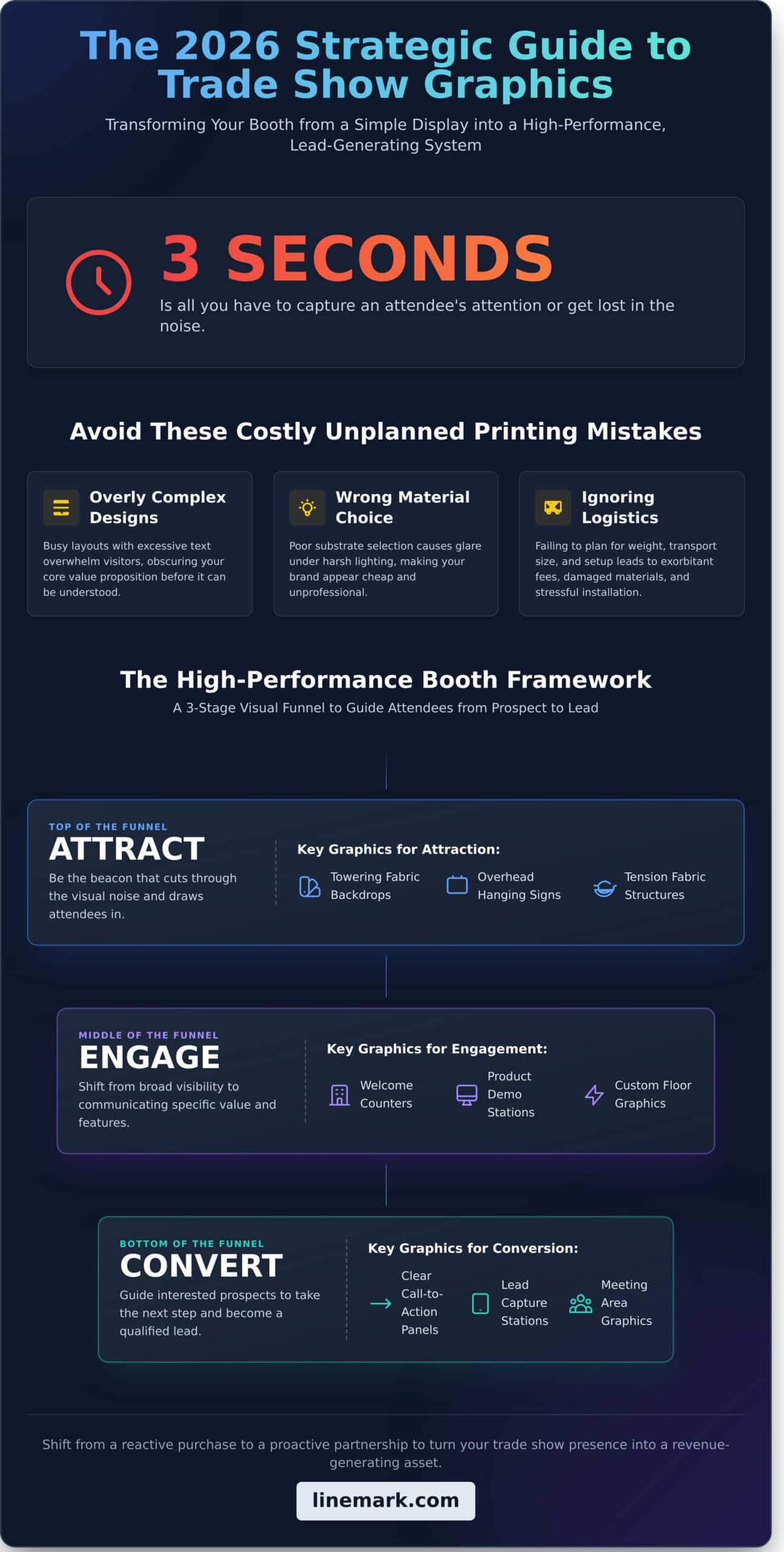
In the high-stakes environment of a trade show, you have approximately three seconds to capture an attendee’s attention. This is the critical window where your brand either connects or gets lost in the noise. Your booth graphics are not mere decoration; they are your primary salesperson, your silent ambassador, and the most powerful tool in your event marketing arsenal. Treating large format printing for trade shows as a last-minute commodity purchase is a costly mistake-one that can lead to diminished brand perception and significant lost opportunities. A strategic approach is not just recommended; it’s essential for achieving a measurable return on your investment.
Defining Your Trade Show Mission
Effective trade show graphics begin with a clearly defined mission. Your primary objective-whether it’s lead generation, high-impact brand awareness, or fostering key networking connections-must dictate every design decision. A goal of lead generation demands clear, concise messaging and prominent calls-to-action. In contrast, a brand awareness play may call for immersive, high-resolution imagery that tells a compelling story. We advise clients to establish key performance indicators (KPIs) for their visual assets, such as a target number of qualified leads scanned or a measurable increase in social media mentions, ensuring every printed panel serves a distinct, strategic purpose.
Common Pitfalls of Unplanned Trade Show Printing
An unplanned approach inevitably leads to predictable and damaging errors. As a single-source partner, we help clients navigate and avoid these common challenges to ensure a flawless execution. The most frequent missteps include:
- Overly complex designs: Busy layouts with excessive text overwhelm visitors, obscuring your core value proposition before it can be understood.
- Inappropriate material selection: Choosing the wrong substrate can result in glare under harsh convention center lighting, making your booth appear cheap and unprofessional. A foundational part of understanding large format printing technology is knowing how different materials perform in specific environments.
- Ignoring logistical realities: Failing to consider the weight, transport size, and setup complexity of your display can lead to exorbitant shipping fees, damaged materials, and stressful, time-consuming installations.
By shifting from a reactive purchase to a proactive partnership, you transform your use of large format printing for trade shows from an expense into a powerful revenue-generating asset.
A Framework for Goal-Driven Trade Show Displays
A successful trade show booth is more than an assembly of banners; it is a meticulously engineered visual system. The most effective exhibitors approach their space as a strategic environment designed to guide visitors through a specific journey. By mapping marketing goals to physical zones within your booth, you can transform your footprint into a powerful lead-generation engine. This is where strategic large format printing for trade shows moves beyond decoration and becomes an integral component of your sales funnel.
We structure this journey around a proven model: Attract, Engage, and Convert. Each stage corresponds to a different zone of your booth and requires a distinct type of graphic to achieve its objective. This framework creates a clear visual hierarchy, ensuring every printed element has a purpose and contributes to your overall ROI.
Graphics for Attraction: The Top of the Funnel
From across a crowded exhibition hall, your booth must project a clear, compelling signal. This is the role of large-scale attraction graphics. Towering fabric backdrops, overhead hanging signs, and tension fabric structures serve as beacons, cutting through the visual noise with a singular, high-level message that answers: “Who are you and what do you do?” The key is bold simplicity. Leveraging strong color theory and strategic lighting ensures your brand stands out and draws attendees in from a distance.
Graphics for Engagement: The Middle of the Funnel
Once a prospect enters your space, the objective shifts from broad visibility to direct value communication. Engagement graphics are found at welcome counters, product demonstration stations, and on interactive displays. Here, the graphics can be more detail-oriented, presenting key features, data points, and specific value propositions. To ensure these critical touchpoints are effective, the prints must be flawless, adhering to the highest printing industry standards for clarity and color fidelity. Use custom-printed floor graphics to direct traffic flow, creating an intuitive path toward these key engagement zones.
Graphics for Conversion: The Bottom of the Funnel
The final stage of the journey is conversion, where interest becomes a tangible lead. This often happens in designated meeting areas or at information counters. Large format printing can create semi-private consultation spaces with branded backdrops or privacy screens. Your graphics in this zone should feature clear, direct calls-to-action (CTAs). Signage prompting visitors to “Scan for a Demo” or “Book a Consultation” provides a frictionless next step. This is also where high-quality printed collateral, like brochures and sell sheets, reinforces your message and travels home with your prospect.
Choosing Your Arsenal: A Deep Dive into Graphic Materials & Types
Selecting the right materials is a critical component of your event strategy. The physical assets you deploy are a direct reflection of your brand’s quality and attention to detail. Your choice of fabric versus vinyl, rigid versus flexible, communicates a message long before your team does. Effective large format printing for trade shows hinges on matching the right product to its function, balancing durability, portability, and ease of assembly to maximize your investment and impact.
Backdrops and Walls: Setting the Stage
Your backdrop is the primary canvas for your brand story. Fabric displays offer a sophisticated, glare-free finish that feels modern and upscale, while traditional vinyl can provide intense color saturation and durability. Key systems include:
- Fabric Pop-Up Displays: Valued for rapid, tool-free assembly and light weight, making them ideal for smaller teams or tight turnarounds.
- Custom Modular Walls: For a more substantial, architectural feel, these systems offer superior customization and a high-end presence that can be reconfigured for future shows.
- Tension Fabric with SEG: For a truly seamless aesthetic, Silicone Edge Graphics (SEG) are a premier choice. The graphic’s edge is sewn with a silicone strip that tucks into the frame, creating a taut, frameless appearance that exudes quality.
Banners and Stand-Alone Displays
Strategic placement of stand-alone graphics guides attendees and delivers key messages with precision. Retractable banners are tactical tools, perfect for flanking an entrance or highlighting a specific promotion due to their small footprint and quick setup. To dominate the event airspace and ensure visibility from across the hall, large hanging banners are indispensable. At counters and kiosks, custom-cut rigid signs made from materials like Sintra or Gatorboard provide a durable, professional surface for detailed information.
Environmental and Experiential Graphics
Transform your rented footprint into a fully branded environment. Durable, slip-resistant floor graphics can direct traffic, create intrigue, and reinforce your brand underfoot. Maximize every surface by using temporary window clings and column wraps to extend your visual presence beyond the booth’s core structure. Finally, cohesive details like branded tablecloths, runners, and even custom furniture coverings integrate your identity into every element, presenting a polished and unified brand experience.
The Hidden Half: Mastering Logistics, Shipping, and Setup
Spectacular graphics command attention, but their impact is entirely dependent on what happens after they leave the press. The success of your large format printing for trade shows hinges on flawless execution-a complex process of logistics, shipping, and on-site management. Overlooking this critical phase can lead to costly delays, damaged materials, and a diminished return on your investment. A strategic approach transforms potential chaos into a streamlined, predictable operation.
The key is to view printing and logistics not as separate tasks, but as an integrated project managed with precision from day one.
Pre-Show Planning & Production
A proactive timeline is your most valuable asset. Work backward from the show’s opening day to establish non-negotiable deadlines for design, proofing, and production. To avoid costly reprints and rush fees, ensure your team submits press-ready files-typically high-resolution, print-ready PDFs with proper bleed and color profiles. Partnering with a print provider who understands event logistics is crucial. They can anticipate shipping windows, recommend durable materials, and provide customized crating solutions that protect your investment during transit.
This is particularly true for companies in the manufacturing sector that need to transport and display large-scale products; to see how a leading manufacturer approaches its event presence, you can discover Choice Bagging Equipment.
On-Site Execution: Installation & Dismantle
Navigating the trade show floor requires a clear understanding of the rules. Most major convention centers operate under strict union labor jurisdictions, dictating who can assemble your booth and handle materials. This directly impacts your budget through drayage-the fee for moving your freight from the loading dock to your booth space. To manage these costs effectively:
- Budget for Drayage: This is a mandatory material handling fee, often calculated by weight. Factor it into your budget early.
- Plan Your Setup: Create a clear, step-by-step plan for your installation team to maximize efficiency and minimize on-site labor hours.
- Pack with a Purpose: When the show ends, carefully dismantle and pack your graphics in their original custom cases. Proper storage prevents damage and extends the lifespan of your displays for future events.
By mastering these logistical components, you ensure the powerful graphics you invested in are displayed perfectly. For a truly seamless process, consider a single-source partner who manages the entire lifecycle of your project. Discover the Linemark difference and let our integrated solutions handle the complexity for you.
From Concept to Convention: Partnering with a Single-Source Expert
Navigating the complexities of trade show preparation-from material selection and printing to kitting and shipping-can strain even the most organized marketing teams. Juggling multiple vendors introduces risk and inefficiency. The solution is to consolidate these critical functions with a single-source partner who understands the entire lifecycle of your event materials. This strategic approach transforms the process of large format printing for trade shows from a logistical challenge into a streamlined, reliable system.
The Linemark Difference: A Consultative Approach
We don’t just print your graphics; we engineer a successful outcome. Our experts act as an extension of your team, providing strategic guidance on everything from material durability for multi-show use to cost-effective substrates that align with your budget. This consultative process ensures your vision is executed flawlessly, integrating directly with your event marketing workflow to eliminate guesswork and guarantee brand consistency from the first proof to the final installation.
Integrated Services for Seamless Execution
A successful trade show presence relies on more than just stunning visuals. It requires precise execution across every stage of the process. Linemark provides a fully integrated suite of services designed to de-risk your event preparation and maximize your impact on the show floor.
- State-of-the-Art Printing: Our advanced G7 Master Qualification ensures your brand colors are vibrant, accurate, and consistent across all materials, from fabric backdrops to rigid signage.
- Kitting & Fulfillment: We assemble your entire booth-in-a-box, kitting large format graphics with brochures, promotional items, and other collateral for a single, organized shipment.
- Nationwide Logistics: We manage the complex logistics of shipping to any convention center in the country, ensuring your materials arrive on time and in perfect condition.
- Inventory Management: For recurring shows, we can store, manage, and redeploy your booth assets, saving you time, money, and storage headaches.
Stop managing vendors and start managing results. Partner with Linemark to engineer your next trade show success.
Elevate Your Presence: Your Strategic Partner in Trade Show Success
Success on the 2026 convention floor is not a matter of chance; it is the direct result of meticulous strategy. Your trade show presence hinges on more than just a great design-it requires a goal-driven framework, a deep understanding of materials, and flawless logistical execution. Transforming this complex blueprint into a commanding booth experience demands a mastery of large format printing for trade shows, from initial concept to final installation.
This is where a true strategic partner makes the difference. With over 30+ years of experience, LineMark serves as your dedicated single-source printing and fulfillment ally. Our advanced large format technology ensures every element is produced with absolute precision, while our integrated logistics handle the complexities from our facility to the show floor. We manage the entire process, allowing you to focus on what matters most: connecting with your audience. Start Planning Your High-Impact Trade Show Booth Today. Let’s build an experience that captivates, communicates, and converts.
Frequently Asked Questions About Large Format Printing for Trade Shows
How much does a typical trade show booth display cost?
Trade show display costs vary widely based on scale and complexity. A simple banner stand may cost a few hundred dollars, while a comprehensive 10×10 booth with custom graphics can range from $2,000 to $10,000+. Factors like hardware systems, material selection, and graphic size dictate the final investment. We provide transparent, itemized quotes to align with your budget and objectives, ensuring a solution with maximum impact and a clear return on investment.
What is the best and most durable material for a trade show backdrop?
For a superior blend of durability and visual impact, dye-sublimated fabric is the industry-leading choice. This material is lightweight, reducing shipping and drayage costs. It is also inherently wrinkle-resistant and can even be machine washed, ensuring your backdrop remains vibrant and professional show after show. Its non-glare, matte finish provides a premium look under bright convention hall lighting, making it an ideal long-term asset for your event marketing.
How far in advance should I order my large format printing for a trade show?
We recommend initiating your project at least 3-4 weeks before your event’s ship date. This timeline provides an adequate buffer for the crucial stages of design consultation, file pre-flighting, proofing, production, and transit. Planning ahead for your large format printing for trade shows ensures a seamless process, eliminates rush fees, and guarantees your materials arrive on schedule, ready for a flawless execution on the show floor.
What file format and resolution are required for high-quality large format printing?
For optimal quality, we require vector files (AI, EPS, PDF) for logos and text to ensure infinite scalability without loss of clarity. For photographic elements, high-resolution raster files (TIFF, PSD) are necessary. All artwork should be submitted at a minimum of 150 DPI at its final print size and designed in CMYK color mode. Adhering to these specifications is critical for achieving the crisp, vibrant graphics your brand deserves.
Can you print custom shapes and sizes for trade show displays?
Absolutely. Our advanced production capabilities include precision CNC routing and die-cutting, allowing us to create custom shapes and sizes that break the standard rectangular mold. This technology empowers your brand to create truly unique, attention-grabbing displays, from custom-cut logos to uniquely shaped backdrops and standees. We transform your creative vision into a tangible, high-impact reality, ensuring your booth stands out from the competition.
What are the most common design mistakes to avoid with trade show graphics?
The most common design errors include using low-resolution imagery, which results in pixelated, unprofessional prints. Another is information overload; a cluttered design with too much text is unreadable from a distance. Finally, poor color contrast can render your message invisible under trade show lighting. We recommend a clear visual hierarchy with a single, compelling call-to-action to maximize engagement and lead generation from the aisle.
What is drayage and how does it affect my trade show budget?
Drayage, or material handling, is the mandatory fee charged by the event venue to transport your exhibit materials from the loading dock to your booth space and back. This fee is typically calculated based on weight, often with a minimum charge per 100 pounds. Understanding drayage is critical for accurate budgeting, as it can be a significant and unexpected expense. Opting for lightweight materials like fabric can substantially reduce these costs.
How do I care for and store my trade show graphics between events?
Proper care extends the life of your investment. Fabric graphics should be rolled, never folded, to prevent hard creases and stored in a protective bag. Most can be spot cleaned or machine washed on a gentle cycle. Rigid graphics should be transported in durable, padded cases to prevent scratches and impact damage. Always store all components in a cool, dry environment away from direct sunlight to maintain color integrity between events.