

 11/25/2026
 Steve Bearden
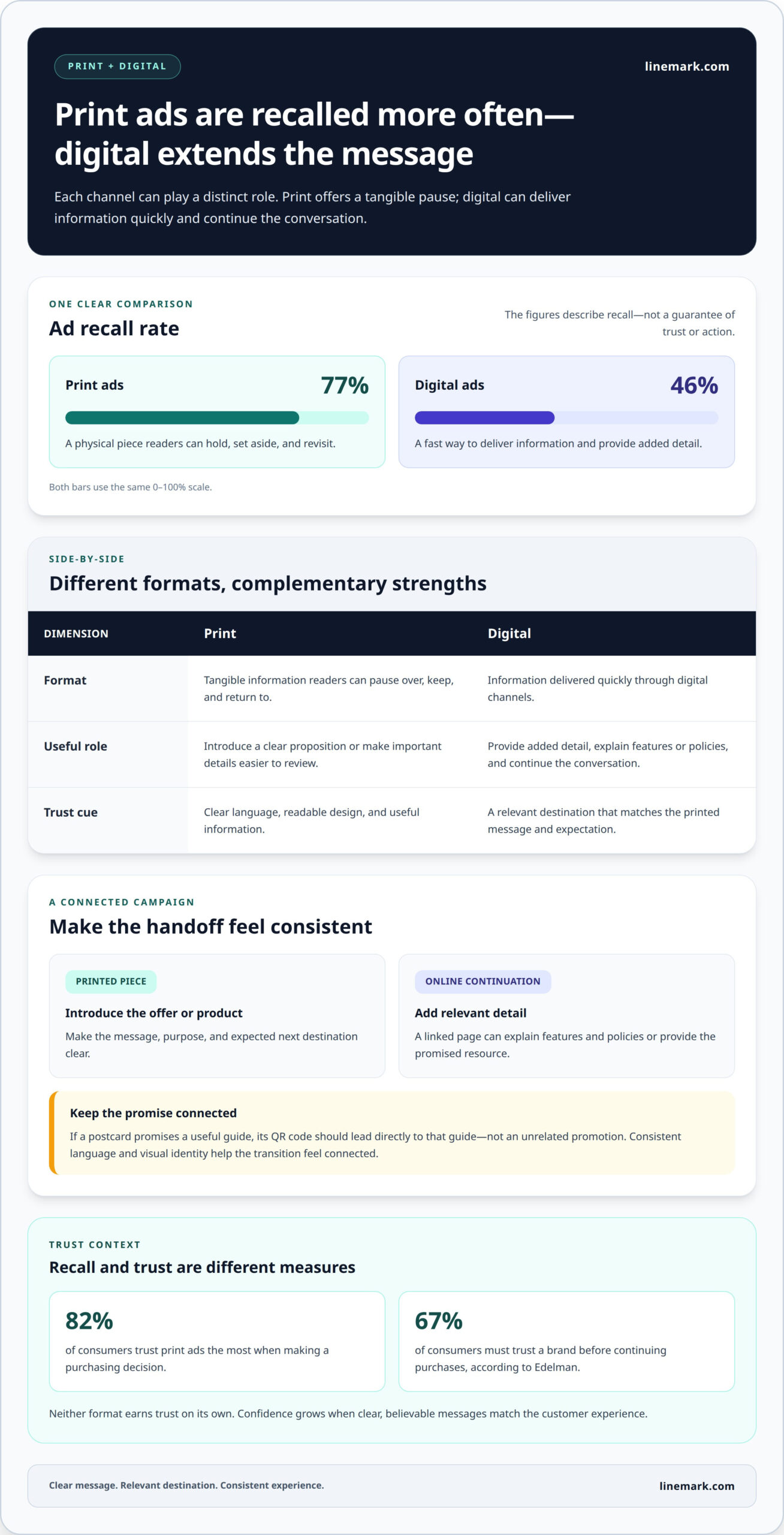
Print can make brand communication feel clearer and more credible by giving people a focused, tangible way to absorb a message. 82% of consumers trust print ads the most when making a purchasing decision. Understanding how print builds brand trust starts with that sense of attention and clarity, then depends on whether the message delivers on the promises it makes.
Digital channels offer speed and reach, but a constant stream of screens and notifications can make messages harder to notice. Print gives information a physical format readers can pause over, keep, and revisit. The format alone does not earn trust: clear language, readable design, and consistency with a brand’s actions matter just as much.
This article explains how print can ease digital fatigue, support attention and understanding, and make important details easier to find. It also shows how thoughtful print design can communicate a brand’s values and expectations clearly, making each piece a useful part of a consistent customer experience.
Key Takeaways
- Recognize how consistent follow-through turns a brand’s promises into lasting customer confidence.
- Explore ways to align print and digital messages so each channel reinforces the same brand experience.
- See how readable typography, clear structure, and thoughtful spacing help people find and understand key information.
- Learn how printed materials can communicate policies, expectations, and brand values with greater transparency.
What Is Brand Trust?
Brand trust means having confidence that a company intends and is able to deliver on its promises. Print can support that confidence when its messages are clear, consistent, and credible.
Consumer Skepticism and Trust in Print
Consumer skepticism is caution about advertising claims and whether a brand will follow through. It matters because a polished message cannot substitute for reliable products, service, and honest communication. 82% of consumers trust print ads the most when making a purchasing decision. Edelman reported that 67% of consumers must trust a brand before continuing purchases. Print can provide space to explain an offer, its limits, and what customers can expect.
Print and Digital Credibility
Print and digital marketing use different formats, but both build credibility through consistent, believable messages. Digital channels deliver information quickly; print gives readers something physical to keep and revisit. Neither format earns trust on its own. The best choice depends on the audience and the information being shared. Brochures, direct mail, and magazine advertising can all work when the content suits readers and supports the brand’s wider communication.
Perceived Brand Credibility and Legitimacy
Perceived credibility is a reader’s judgment that a brand seems dependable and capable. Consistent type styles, readable text, and professional printing can make materials feel organized and considered. For example, a brochure that explains services clearly gives readers specific details to assess. These signals do not prove a company will deliver. Trust grows when the customer experience matches the expectations set by advertising.
No single print format builds trust with every audience. The right fit depends on the message and readership. A targeted magazine placement, informative brochure, or relevant direct mail piece can support credibility when it provides useful, accurate information.
Brands can use brochures to explain services, mailers to share timely updates, or magazine ads to reach readers through relevant content. A small business can keep a print piece focused on one audience, one clear message, and one useful next step. This makes the communication purposeful without relying on a broad, unfocused campaign.
Assess trust by reviewing customer engagement, sentiment, and experience measures such as Net Promoter Score. Consider these signals alongside repeat purchases, reviews, and referrals to see whether customer responses reflect the brand’s promises.
Print as a response to digital fatigue
Digital fatigue can make another on-screen message easy to overlook. A printed piece offers a tangible pause: readers can hold it, set it aside, and return when ready. This change of pace can make a campaign feel more considered, especially when the message needs attention. Print does not replace digital communication. It gives brands another way to reach people when repeated screen exposure competes for focus.
Recall figures offer one point of comparison: print ads achieve a 77% recall rate, while digital ads achieve 46%. These figures describe recall, not a guarantee of trust or action. Still, being remembered can give a message more opportunity to support confidence and credibility. A print campaign can carry one clear proposition, then use digital channels to provide added detail or a next step.
Consistency across channels matters. If a postcard promises a useful guide, its QR code should lead directly to that guide, not an unrelated promotion. A personalized URL can bring readers to a page tailored to the printed offer. Social media can extend the conversation, while consistent language and visual identity make the transition feel connected.
Integration works best when each format has a clear role. A mailer can introduce a product, while a linked page explains its features and policies. A magazine ad can direct readers to a relevant online resource. In every case, the printed message should make the destination and purpose clear. Setting expectations reduces friction and helps create a coherent brand experience.
For a campaign that bridges physical materials and digital content, digital printing options can support printed communications. The useful starting point is the audience’s needs: decide what the printed piece should communicate, then make its online continuation consistent, accessible, and relevant.
Attention, comprehension, and retention
Readers notice typography before they read the first sentence. One practical way print builds brand trust is by making the main message easy to scan. In a product guide, a clear headline can introduce a benefit, while a nearby caption explains a feature. Readers can connect the claim with its supporting detail instead of searching through unrelated copy.
Comprehension also depends on how information is grouped. A membership brochure, for example, can put eligibility, benefits, and renewal details in separate sections. Short labels help readers find answers to immediate questions. This structure is especially useful when people need to compare options or understand what a service includes before deciding what to do next.
For longer documents, navigation helps readers stay focused. A table of contents in a corporate book can point to relevant chapters, while descriptive section titles make specific information easier to find again. These cues reduce the effort of moving through the material, even for readers who do not read every page in sequence.
Pairing an important point with a useful example can help readers retain it. A catalog might place a product description beside an image and key specifications, keeping related information together. Readers can revisit the same spread later instead of relying on memory. Clear visual grouping keeps details connected to the original message.
Consistent materials give readers familiar cues. Repeating section labels or a recognizable page structure in a brochure and follow-up guide helps people find their way. This is another way print builds brand trust: readers encounter a clear, dependable communication pattern instead of a new layout that makes every interaction harder to navigate.
Print as a tool for clear communication and transparency
Paper, design, and printing choices shape a reader’s first impression. Quality paper stock, professional photography from creative studios like The Photography Co, clean typography, and clear messaging can make a piece feel polished and easier to understand. These qualities influence brand perception, but they do not prove a company’s claims. Credibility depends on accurate information and an experience that matches the printed promise. Clear details show how print builds brand trust through transparent communication.
Transparency starts with useful details. A printed service guide can explain what a service includes, what customers should expect, and which policies apply. A product brochure can describe materials or sourcing practices when they matter to a purchasing decision. Specific statements give readers something concrete to consider. Broad claims without supporting details can leave people unsure what a brand means.
Clear communication also means explaining decisions and acknowledging mistakes. If an organization changes a service process, for example, a mailed notice can explain what changed, why, and what customers should expect next. If an earlier message contained an error, a correction should identify the inaccurate detail and provide the right information. This direct response shows how print builds brand trust by making accountability visible.
Printed materials can make important information easier to find. A clear headline identifies the subject, while subheads separate policies, expectations, and contact details. A warranty document, for instance, should distinguish its applicable terms from promotional copy. Thoughtful page organization supports informed decisions by helping readers find relevant details without working through a crowded block of text.
The strongest approach connects each printed statement to a real business practice. A company that describes its values in an annual report should reflect those values in its decisions and customer interactions. That alignment turns print from a set of attractive claims into a practical record of what the organization says and does. For clear, transparent communications, plan your commercial printing with Linemark.
Linemark
Linemark helps organizations create clear, consistent printed communications suited to their audiences and goals. For a campaign that needs to carry the same message across customer touchpoints, Linemark’s commercial printing and Direct Mail services can support the work. Custom Book Printing and Large Format Graphics provide options for sharing detailed information or making a message visible in a physical space. The right format depends on what readers need to understand, remember, or do next. Discuss your audience, content, and communication goals with Linemark to shape a print program that fits.
Make Your Next Print Touchpoint Count
Set a communication goal before choosing a format. Identify what customers need to know, what they should remember, and what action should follow. This focus keeps each printed piece relevant rather than adding another message without a clear purpose. Understanding how print builds brand trust means treating every touchpoint as part of an ongoing relationship, not a standalone impression.
Then match the format to the task. Custom Book Printing can present in-depth information, Direct Mail can deliver a message to an audience, and Large Format Graphics can communicate in a physical setting. Linemark can help align the format with your communication goals and the experience you want customers to have.
Bring your audience, message, and intended next step into the planning conversation. Contact Linemark to discuss print, and move forward with a clear plan for your next customer touchpoint.
Frequently Asked Questions
How does print advertising build brand trust?
Print advertising can build trust when its claims are specific, relevant, and supported by the customer experience. For example, a membership mailer can clearly explain renewal options and what each includes. This gives recipients concrete information to assess instead of a broad promise. Trust strengthens when the organization consistently delivers what the mailer describes, in later communications and customer interactions.
What research shows print marketing is more trusted than digital advertising?
Some reported findings favor print, but trust and recall are different measures. The figures discussed in this article include a reported preference for trusting print ads and separate recall rates for print and digital ads. Recall shows whether people remember an advertisement, not whether they believe it. Interpret these measures carefully: neither establishes that print is more credible for every audience or campaign.
How can businesses measure the trust impact and ROI of print campaigns?
Track campaign response alongside customer sentiment and experience measures. A unique QR code or personalized URL can link a printed piece to a specific online action, and campaign-coded inquiries can provide another response signal. To assess trust, review feedback, engagement, repeat purchases, and measures such as Net Promoter Score. Compare these indicators over time, then weigh campaign costs against attributable outcomes to assess ROI.
What risks or drawbacks can print campaigns create for brand trust?
Print can undermine confidence when it contains outdated details, unclear conditions, or claims the organization does not fulfill. A renewal postcard with an incorrect deadline, for example, can frustrate recipients and weaken confidence in later messages. Poor readability or crowded layouts can also obscure important terms. Before distribution, align the approved copy, offer details, and customer-facing process so the printed promise matches people’s experience.
How can small businesses use print marketing to build trust cost-effectively?
Focus each print piece on one audience, one clear message, and one useful next step. Use readable design and accurate, relevant details, and keep the print message consistent with any linked digital content.