

 06/14/2026
  Steve Bearden
Why should your brand’s physical presence feel like a logistical liability the moment it’s packed into a shipping case? You’ve likely experienced the frustration of a display that arrives with stubborn wrinkles or colors that simply don’t match your established identity. Achieving professional results with fabric pop-up display printing requires more than just a frame and some cloth. It demands industrial-grade precision and a strategic approach to large-format graphics. We understand that in a high-volume environment, your equipment needs to be as agile and sophisticated as your marketing strategy.
It’s a common challenge to balance the need for lightweight portability with the demand for a premium, high-impact aesthetic. This 2026 guide will help you discover how to leverage professional fabric pop-up displays to create a portable, high-durability brand presence that scales with your business goals. We’ll examine the shift toward dye-sublimation technology, modular design systems, and the benefits of centralized asset management. By the end of this article, you’ll know how to transform your event presence into a streamlined, conversion-ready tool that reflects your operational excellence.
Key Takeaways
- Transition from rigid panels to high-performance tension fabric for a sleek, professional presence that simplifies event logistics.
- Master the science of fabric pop-up display printing to achieve deep color saturation and long-term durability through advanced dye-sublimation techniques.
- Determine the ideal frame configuration and sizing to ensure your brand remains visible and impactful regardless of the venue’s constraints.
- Maximize your marketing budget by leveraging interchangeable graphics and centralized fulfillment for a truly scalable, multi-event strategy.
- Implement proactive storage and maintenance habits to protect your investment and maintain a “like-new” appearance across high-frequency show circuits.
Why Fabric Pop-Up Displays are the Standard for 2026 Events
In 2026, the demand for agility in event marketing has reached a new peak. A fabric pop-up display utilizes a tension fabric graphic stretched over a collapsible aluminum frame to achieve maximum portability. This design offers a sophisticated brand presence without the logistical burdens of traditional booth hardware. We’ve observed a decisive shift from heavy, rigid panels to high-performance polyester. This material choice aligns with modern brand aesthetics and the growing corporate focus on sustainable, reusable assets that can be deployed across multiple venues with ease.
To better understand the mechanical simplicity of these systems, watch this helpful video:
The Evolution of Portable Signage
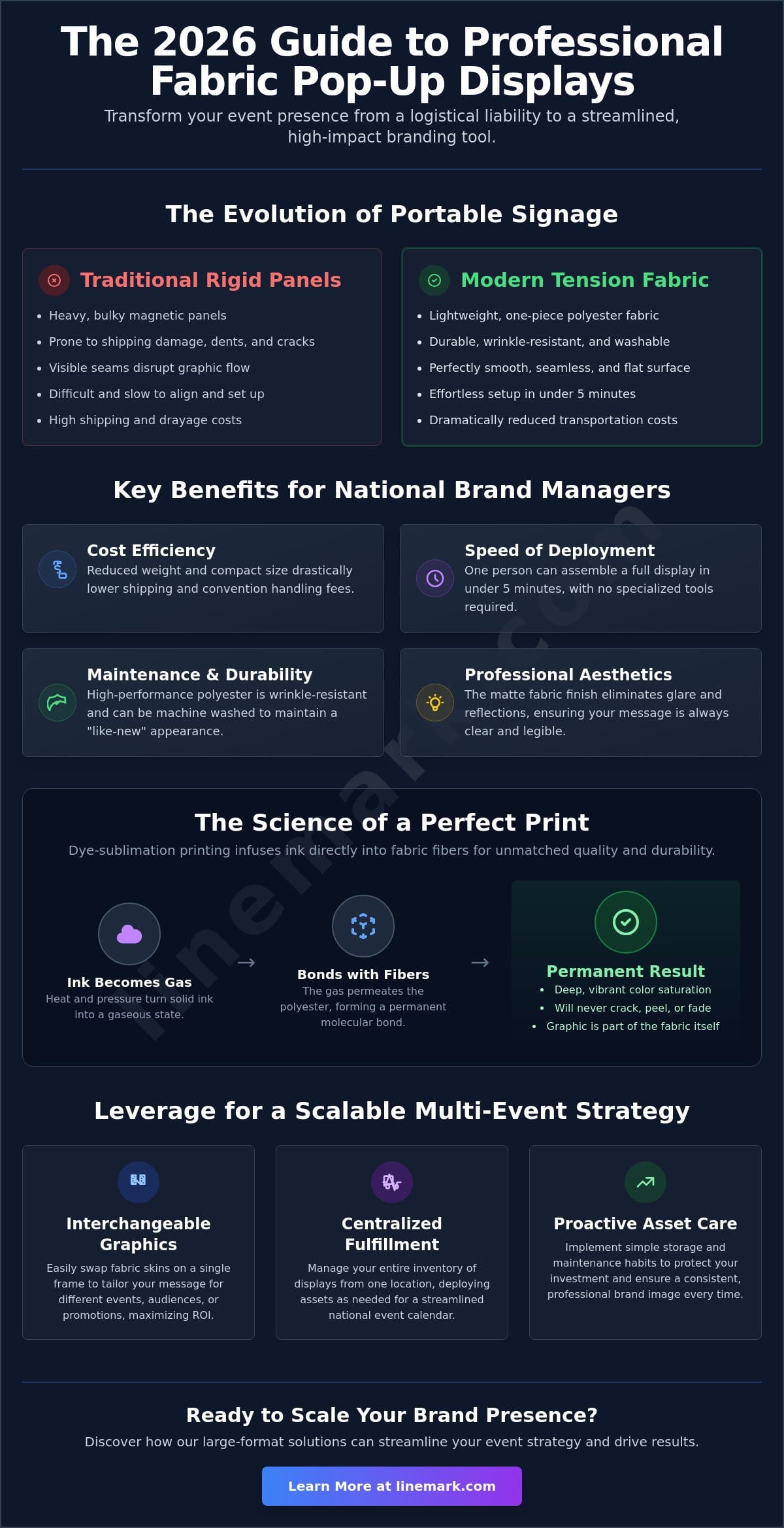
Traditional portable displays often relied on heavy magnetic panels that were difficult to align and prone to damage. Modern fabric pop-up display printing has transformed the industry by introducing lightweight, one-piece fabric skins. These graphics attach to the frame securely, creating a perfectly flat surface that looks like a custom-built wall. Because the fabric is under tension, it eliminates the visible seams that once plagued large-scale graphics. The precision of the Dye-sublimation printing process ensures that even the most complex brand colors are reproduced with absolute fidelity, making high-resolution digital printing the standard for professional presentations.
Key Benefits for National Brand Managers
Managing a national event calendar requires a focus on operational excellence and cost control. Fabric pop-ups provide a strategic advantage by significantly reducing shipping and drayage expenses. Their compact volume allows for standard courier shipping, avoiding the high costs of freight services. The high-performance polyester used in these displays is inherently wrinkle-resistant and can be laundered if it becomes soiled during transit. This durability ensures a “like-new” appearance across dozens of shows. Consider these operational advantages:
- Cost Efficiency: Reduced weight translates directly to lower transport and handling fees at convention centers.
- Maintenance: Washable materials ensure your brand remains pristine regardless of the environment.
- Speed of Deployment: A single team member can complete a full setup in under five minutes without specialized tools.
Strategic brand positioning also involves managing environmental factors like lighting. In high-glare conference halls, traditional vinyl or PVC materials often create distracting reflections that obscure your message. The matte finish of tension fabric provides a non-reflective surface that maintains legibility under harsh overhead spotlights. This clarity ensures your messaging remains the focal point of the booth, providing a refined and professional backdrop for meaningful client interactions.
The Technical Anatomy: Tension Fabric and Dye-Sublimation Printing
The structural integrity of a high-impact display depends on the interplay between precision-engineered hardware and advanced textile chemistry. While the visual appeal captures attention, the underlying technology ensures that your brand remains consistent across dozens of deployments. Professional fabric pop-up display printing relies on dye-sublimation, a process that avoids the surface-level adhesion common in traditional inkjet methods. By applying heat and pressure, the ink transforms into a gas and bonds directly with the polyester fibers. This molecular integration creates a graphic that’s essentially part of the fabric itself, preventing the cracking or peeling often seen on vinyl alternatives.
The aluminum accordion frame serves as the skeletal system for this technology. It’s designed to expand and lock into place instantly, providing the necessary tension to pull the fabric taut. This tension is what creates the smooth, flat surface required for professional branding. When you partner with a provider that understands Large Format Graphics, you ensure that the hardware and the textile are perfectly calibrated for a seamless fit every time.
The Superiority of Dye-Sublimation
Dye-sublimation offers a continuous tone output that achieves photographic quality even at massive scales. Because the dye is embedded within the fibers, the color saturation remains deep and vibrant through repeated folding and shipping cycles. This resilience is a hallmark of industrial-grade production. Dye-sublimation is a molecular bonding process for permanent graphics. This ensures your brand colors don’t just sit on the surface; they withstand the rigors of the national event circuit without losing their original punch.
Choosing the Right Fabric Weight
Selecting the correct textile involves a careful balance of opacity, weight, and elasticity. Technical specifications like GSM (grams per square meter) and denier determine how the fabric performs under stadium or conference hall lighting. High-density knits provide the necessary opacity to block out the frame’s internal structure while maintaining enough stretch to eliminate wrinkles. Consider these technical requirements for your next project:
- Fabric Memory: Superior polyester blends possess “memory,” allowing the material to return to a perfectly flat state every time the frame is expanded.
- Fire-Retardant Certification: Most major venues require NFPA 701 compliance. Ensuring your graphics meet these safety standards is non-negotiable for trade show participation.
- Light-Blocking Properties: For booths with backlighting or bright rear-facing windows, specialized blockout layers prevent shadows from interfering with your graphic’s clarity.
Understanding these specifications allows marketing managers to move beyond basic aesthetics and focus on long-term performance. The combination of a robust aluminum frame and high-GSM tension fabric creates a display that is both lightweight for transport and substantial in its physical presence. It’s a technical solution designed for the demands of high-volume, professional environments.
Strategy: Choosing the Right Configuration for High-Impact Branding
Straight vs. Curved Frame Dynamics
Straight frames are the standard for marketers who need to maximize every square inch of their exhibit space. They sit flush against venue walls, providing a clean, architectural back wall that serves as a perfect backdrop for product demonstrations or lead capture stations. Straight configurations are particularly effective when you want to present a unified, continuous graphic across a wide area. They provide a modern, minimalist look that mirrors the operational excellence of your business.
Conversely, curved frames offer an immersive, focal-point effect. They draw the viewer’s eye toward the center of the display, making them ideal for smaller footprints where you want to create a sense of intimacy or a “booth-within-a-booth” feel. When designing for curved systems, it’s critical to place logos and key messaging centrally. This prevents the “wrap-around” distortion that can occur on the edges, ensuring your brand identity remains legible from multiple sightlines. By orienting your graphics toward the primary traffic flow, you ensure your investment delivers the highest possible engagement rate.
Standard sizing options like 8ft, 10ft, and 20ft allow you to adapt to any venue footprint. For island booths or open-concept events where traffic approaches from all sides, double-sided printing is essential. It transforms a simple wall into a 360-degree branding tool, doubling your visibility without increasing your physical footprint. This versatility makes these systems a centralized solution for diverse event needs.
Backlit Fabric: The 2026 Trend
The shift toward immersive and experiential booths has made backlit fabric displays a major trend for 2026. By integrating internal LED arrays, you can make your graphics pop even in dimly lit or over-saturated exhibit halls. This technology isn’t just about brightness; it’s about creating contrast and depth that static displays can’t match. Technical precision is required to select light-diffusing fabrics that prevent “hot spotting,” the distracting visible dots of light behind the graphic. While backlit hardware requires a slightly different logistical approach, the ROI is often justified by increased booth traffic and visibility. A glowing display acts as a visual magnet, guiding visitors from initial attraction to meaningful conversations.
Logistics and Lifecycle: Durability, Storage, and Graphic Swaps
Managing a portfolio of event assets requires a focus on the total cost of ownership rather than just the initial purchase price. A strategic investment in high-quality fabric pop-up display printing allows for a modular approach where the hardware remains a constant while the messaging evolves. This lifecycle management ensures that your brand remains agile without requiring a complete reinvestment for every new campaign or product launch. By treating your display as a long-term asset, you can maximize its utility across dozens of events and multiple years of service.
The resilience of polyester graphics is a key factor in this longevity. Unlike vinyl, which can crease permanently or delaminate, tension fabric is designed for repeated handling. However, maintaining a pristine appearance requires a disciplined approach to maintenance. If a graphic becomes soiled during a high-traffic show, most industrial-grade textiles can be machine washed on a cold, gentle cycle and air-dried. This ability to refresh the material ensures your brand always projects an image of meticulous attention to detail.
Sustainable Signage: Reusing Your Hardware
One of the most significant advantages of tension fabric systems is the “graphic-only” update. Swapping fabric skins on an existing aluminum frame is a straightforward process that can be completed in minutes. You simply detach the existing graphic from the frame’s attachment points and align the new skin, starting from the top corners. This hardware-reuse strategy offers substantial environmental benefits by reducing the amount of aluminum and plastic entering the waste stream. It also provides a clear cost advantage, as subsequent graphics are significantly less expensive than purchasing a full kit. When ordering replacements, it’s vital to ensure frame compatibility, as different manufacturers may utilize varying tensioning methods or attachment strips.
Best Practices for Shipping and Storage
The rigors of nationwide freight transport can be brutal on marketing materials. To protect your investment, always utilize hard-shell shipping cases rather than soft bags for long-distance transit. These cases prevent the aluminum frame from being crushed or bent under the weight of other cargo. When packing the graphic, fold it neatly with the printed side facing inward to prevent surface abrasions. Never store fabric while it’s damp, as this can lead to mildew that ruins the dye-sublimation bond. Proper tensioning removes 90% of transport-related wrinkles. This means that even if the fabric looks slightly creased upon unpacking, the tension of the frame will pull the surface smooth within minutes of setup.
For organizations managing a national fleet of displays, the complexity of tracking and maintaining assets can become overwhelming. Centralized Kitting & Fulfillment ensures that every regional team receives a inspected, professional kit that’s ready for immediate deployment. This level of logistical precision eliminates the risk of missing components or damaged graphics, allowing your team to focus on engagement rather than troubleshooting equipment.
Scaling Your Presence with Linemark’s Large Format Solutions
Linemark positions itself as more than a service provider; we’re a strategic communications ally. We don’t view fabric pop-up display printing as an isolated transaction. Instead, we integrate these high-impact visuals into a broader ecosystem of Large Format Graphics and commercial print. This integration ensures that your brand’s presence at a regional trade show is just as polished and precise as the materials coming out of your corporate headquarters. With over 30 years of industrial expertise, we provide the scale and reliability needed to manage complex, multi-site marketing initiatives without sacrificing the meticulous attention to detail your brand deserves. Our operational excellence is built on a foundation of technological pride and a deep understanding of the nuances of modern marketing logistics.
Centralized Asset Management
MarCom On-Demand is the engine behind this scalability. It allows your regional teams or distributed sales forces to order displays and supporting materials on-demand through a secure, customized portal. This centralized approach guarantees brand integrity by ensuring that every piece of signage is produced by a single, high-capacity partner. You no longer have to worry about inconsistent color matching or varying material quality across different vendors. We understand the business challenge of managing distributed assets. Our nationwide distribution capabilities and kitting services reduce fulfillment headaches, ensuring your assets arrive exactly where they’re needed, right on time, every time.
The Linemark Advantage: Beyond the Print
Consistency is the cornerstone of professional branding. Your fabric display should be a perfect color match for your direct mail campaigns and corporate brochures. When these elements are out of sync, it creates a subtle sense of friction for the customer and erodes brand authority. Linemark eliminates this risk by managing your entire print portfolio under one roof. Our comprehensive services extend to inventory management, providing a centralized destination for all your physical marketing needs. This holistic journey transforms your event presence from a series of individual tasks into a streamlined, high-tech solution for growth. By leveraging our production breadth, you gain a partner that understands how to scale your message as your business goals evolve.
Ready to elevate your event presence? Contact Linemark for a custom large format quote today.
Elevate Your Brand for the 2026 Event Circuit
Investing in sophisticated tension fabric systems is more than a design choice; it’s a commitment to operational excellence. We’ve explored how dye-sublimation technology and strategic configurations like backlit displays transform your booth into a conversion-ready environment. By prioritizing hardware reuse and centralized logistics, you ensure your marketing budget works harder across every event on your calendar. High-quality fabric pop-up display printing serves as the anchor for this agile approach, providing a wrinkle-free, professional aesthetic that arrives ready for immediate deployment.
Linemark supports this vision with our 90,000-square-foot high-capacity production facility and 30+ years of industrial printing expertise. Our team acts as a strategic communications ally, using the MarCom On-Demand portal to streamline your inventory management and nationwide fulfillment. You deserve a partner that understands the nuances of modern logistics as well as it understands color precision. We’re ready to help you navigate the complexities of high-volume production with confidence and ease.
Streamline your event signage with Linemark’s Large Format Graphics and step into your next show with the security of a well-oiled machine.
Frequently Asked Questions
What is the difference between a tension fabric display and a standard pop-up?
A tension fabric display utilizes a single, continuous piece of polyester cloth that stretches over a collapsible frame to create a seamless surface. Standard pop-up displays typically rely on multiple rigid panels attached with magnetic strips. Tension systems are significantly lighter and eliminate the common issue of misaligned panel seams, providing a more modern and architectural aesthetic for your brand.
Can I machine wash the fabric graphic if it gets dirty?
Yes, most high-performance polyester graphics used in fabric pop-up display printing are machine washable. You should use a cold, gentle cycle and allow the material to air-dry to preserve the dye-sublimation bond. This ability to refresh the graphic ensures your display maintains a pristine, professional appearance across a long event calendar without the need for constant replacements.
How do I prevent wrinkles in my fabric pop-up display during shipping?
The best way to prevent wrinkles is to fold the graphic neatly with the printed side facing inward before placing it in a hard-shell case. While some minor creasing is inevitable during transit, the inherent tension of the expanded aluminum frame pulls the fabric taut. This mechanical tension removes the vast majority of wrinkles within minutes of setup, resulting in a smooth, flat presentation.
Is it possible to buy just the fabric graphic if I already have a frame?
Yes, ordering a “graphic-only” replacement is a strategic way to update your messaging while leveraging your existing hardware investment. This modular approach is a core advantage of modern display systems, allowing you to scale your presence across different campaigns cost-effectively. It’s vital to verify your frame’s specific dimensions and attachment method to ensure a perfect, high-tension fit for the new skin.
Are fabric pop-up displays fire-rated for trade show use?
Most professional-grade tension fabrics are NFPA 701 certified for flame retardancy. This certification is a standard requirement at major convention centers and municipal event venues across the country. Ensuring your materials meet these safety regulations is essential for compliance and prevents costly logistical delays during the booth inspection process at high-profile trade shows.
How long does it typically take to print and ship a custom fabric display?
Standard production for a custom display typically ranges from three to five business days after artwork approval. Shipping times depend on your location and the selected freight method, but centralized production facilities can often expedite this timeline for urgent projects. Large-scale operations with integrated kitting and fulfillment services provide the reliability needed to meet tight marketing deadlines with precision.
What file resolution is required for high-quality large format fabric printing?
High-impact fabric pop-up display printing requires a minimum resolution of 100 to 150 DPI at the final output size. We recommend using vector-based formats for logos and typography to ensure crisp edges at massive scales. Providing high-resolution source files prevents pixelation and ensures that your brand’s visual identity remains sharp and authoritative even from a distance.
Can one person set up a 10ft or 20ft fabric pop-up display alone?
Yes, the collapsible aluminum accordion frame is specifically engineered for single-person assembly in under five minutes. Because the fabric skin often remains attached to the frame during storage, the setup process involves simply expanding the structure and locking the internal connectors. This ease of use reduces on-site labor requirements and allows your team to focus on attendee engagement rather than booth construction.