

 03/07/2026
  Steve Bearden
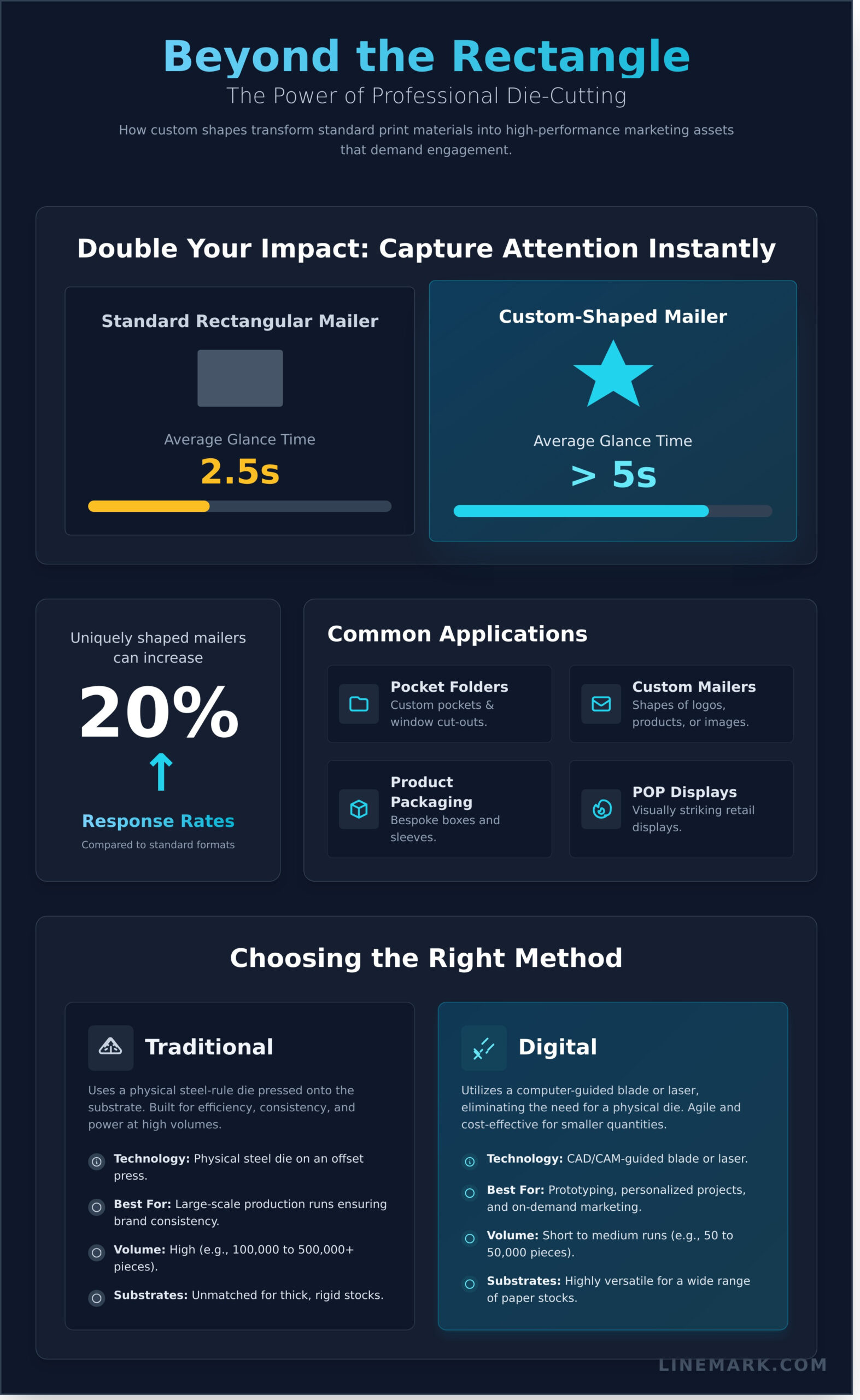
A standard rectangular mailer gets an average glance time of just 2.5 seconds before being discarded. A custom-shaped piece, however, can hold a recipient’s attention for over 5 seconds, effectively doubling your opportunity for impact. It’s the physical difference between being seen and being immediately forgotten.
You already invest significant resources in compelling copy and eye-catching graphic design. It’s inefficient when those efforts are dismissed simply because the format fails to break through the clutter. This is where professional die-cutting services provide the critical advantage, transforming your print materials into high-performance marketing assets that demand engagement. This guide will demonstrate how to achieve precision finishing that elevates your brand, all while navigating common concerns like complex file prep, tooling costs for short runs, and managing multiple vendors.
We’ll explore how to prepare your designs for flawless execution and integrate your uniquely shaped pieces into a seamless print, fulfillment, and mailing strategy, ensuring your project is handled with expert guidance from start to finish.
Key Takeaways
- Discover how custom shapes can dramatically increase marketing engagement and move beyond the limitations of standard rectangular formats.
- Understand the key criteria for selecting a partner for professional die-cutting services to ensure project scalability and eliminate logistical risks.
- Gain insight into the technical process and learn how different paper stocks and coatings affect the precision and quality of the final cut.
- Master the essential design best practices for setting up a proper dieline to ensure your creative vision is executed flawlessly.
What are Die-Cutting Services in Commercial Printing?
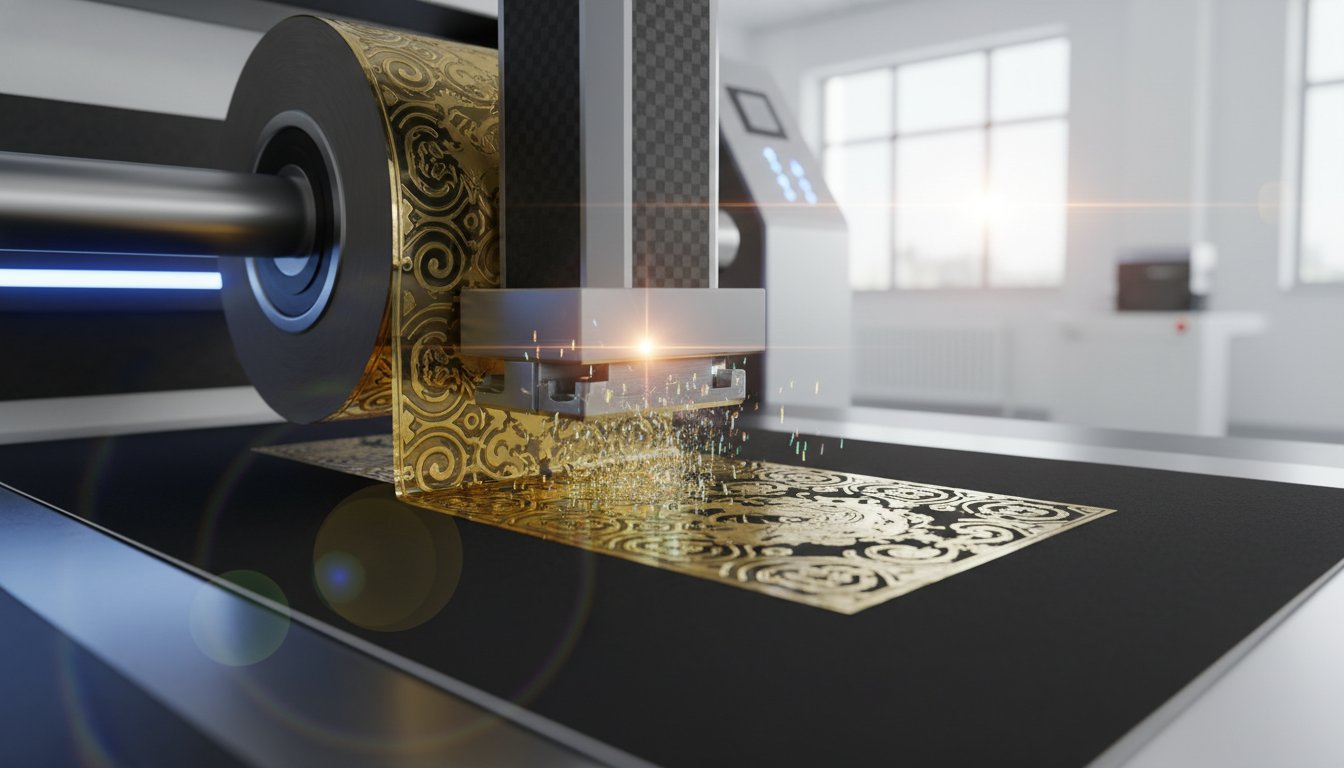
In commercial printing, die-cutting is the precision process of using a specialized tool, or “die,” to cut paper, cardstock, and other substrates into custom shapes. It’s the engineering that transforms a standard rectangular sheet into a memorable brand asset. While a standard guillotine cutter produces straight lines, die-cutting liberates your design from the 90-degree angle, enabling curves, windows, and unique silhouettes that capture attention instantly.
This escape from the rectangle delivers a measurable competitive advantage. In direct mail, a crowded and critical marketing channel, differentiation is paramount. Industry analysis from the Data & Marketing Association has shown that dimensional or uniquely shaped mailers can increase response rates by up to 20% compared to standard formats. The reason is simple: tactile marketing. A custom-shaped piece engages the senses, requires physical interaction, and tells a story before a single word is read. It doesn’t just convey a message; it creates an experience.
The applications for professional die-cutting services are integral to modern marketing and brand logistics. They are the engine behind materials designed to stand out and perform a specific function. Common examples include:
- Pocket Folders: Featuring custom-shaped pockets, unique closures, or branded window cut-outs.
- Custom-Shaped Mailers: Postcards or brochures cut into the shape of a logo, product, or symbolic image.
- Product Packaging: Creating bespoke boxes and sleeves that perfectly fit a product, enhancing the unboxing experience.
- Point-of-Purchase (POP) Displays: Engineering structurally sound and visually striking displays that command retail space.
The Anatomy of a Custom Die
The foundational process of Die cutting most often relies on a steel-rule die, a marvel of simple engineering. It consists of sharp, pre-bent steel rules embedded in a durable plywood base, mapping the exact shape of your design. This tool is then pressed with immense force onto the substrate to execute one of three primary functions: cutting through the material, creasing it for a perfect fold, or perforating it for an easy tear-off. Creating a custom die is an investment in long-term brand consistency, ensuring every single piece across a run of 100,000 or more is absolutely identical.
Traditional vs. Digital Die-Cutting
Choosing the right method depends entirely on project scale and strategic goals. Traditional die-cutting, using a physical steel die on an offset press, is built for efficiency at high volumes and is unmatched for its ability to cut through thick, rigid substrates. It’s the definitive solution for large-scale production. In contrast, digital die-cutting uses a computer-guided blade or laser, eliminating the need for a physical die. This makes it an agile, cost-effective solution for short-run prototyping, personalized projects, and on-demand marketing needs. As you plan your 2026 marketing goals, a single-source partner providing both die-cutting services can scale your project from a 50-piece test run to a 500,000-piece national campaign seamlessly.
The Technical Process: How Precision Shapes are Created
Transforming a creative concept into a tangible, uniquely shaped product is a process defined by precision engineering. It’s where digital design meets industrial mechanics. The quality of professional die-cutting services hinges on a meticulous workflow that guarantees consistency from the first piece to the 500,000th. This journey begins not on the press floor, but with a digital file.
A designer’s vector-based artwork is the blueprint, processed through CAD/CAM (Computer-Aided Design/Computer-Aided Manufacturing) software to map out every cut, score, and perforation. This digital plan guides lasers in cutting a pattern into a die board, into which sharp steel rules are precisely bent and fitted. This process adheres to exacting industry benchmarks, like those established by the International Association of Diecutting and Diemaking, ensuring every die is built to tolerances measured in thousandths of an inch. The final result is a custom tool, a physical stamp engineered for one specific job.
Of course, the tool is only part of the equation. Material selection is critical. A die calibrated for a flexible 80# text stock will perform differently on a rigid 120# coated cover stock. Thicker substrates require more pressure and potentially thicker steel rules to achieve a clean cut without bruising or cracking the paper fibers. Similarly, coatings like soft-touch laminates or UV gloss can alter how the paper reacts to the die. Our technicians calibrate the press for each specific substrate, ensuring optimal results.
Perfect alignment, or “registration,” is non-negotiable. We print small markers on the press sheet that are invisible in the final product. High-speed optical sensors on our die-cutting equipment read these markers on every sheet, making micro-adjustments in real-time to ensure the die strikes in the exact same spot, maintaining a positional tolerance of less than 1/64th of an inch. To maintain the integrity of the sheet as it moves through the press at speeds up to 10,000 impressions per hour, we strategically place tiny “nicks” or “bridges” along the cut line. These minuscule uncut points hold the shape in place, preventing it from detaching prematurely. They are removed during a final “stripping” stage, leaving a perfectly finished piece.
Flatbed vs. Rotary Die-Cutting
The scale and material of a project dictate the technology we deploy. Flatbed die-cutting uses a simple, powerful up-and-down stamping motion, ideal for heavy substrates like 24pt board for packaging or large-format retail displays. For high-volume projects, rotary die-cutting is the speed leader. A curved die is fixed to a cylinder, allowing for a continuous cutting motion that is exceptionally efficient for producing millions of labels, stickers, or direct mail components.
Specialized Finishing Techniques
Our die-cutting services extend beyond simple shapes to include a range of integrated finishing capabilities that add function and impact:
- Kiss Cutting: This technique is the secret behind sticker sheets. The die cuts through the top layer of adhesive-backed paper (the facestock) but only “kisses” the backing paper (the liner), leaving it intact for easy peeling.
- Scoring and Debossing: We use scoring rules to create crisp, clean fold lines for brochures, presentation folders, and boxes. Debossing presses a design into the paper, adding subtle, high-end texture to logos or patterns.
- Integrated “Pop-Up” Features: For truly memorable direct mail, we engineer complex die-cuts and scores that create three-dimensional, interactive elements when the piece is opened. Creating these features requires deep engineering expertise; you can consult with our production specialists to explore interactive concepts for your next campaign.
Choosing the Right Die-Cutting Partner for Your Project
The success of a custom-shaped marketing piece depends on more than a great design. It rests on the capabilities of your production partner. Choosing the right vendor for die-cutting services is a strategic decision that impacts your project’s timeline, budget, and final quality. The key isn’t just finding a company with a die-cutter; it’s about selecting a single-source partner with the infrastructure, expertise, and integrated systems to manage your project from digital file to final delivery.
A true partner offers a seamless extension of your own team. They eliminate logistical headaches and provide the operational confidence you need to execute ambitious campaigns. Look for four critical pillars: industrial capacity, single-source accountability, rigorous quality control, and integrated fulfillment.
Industrial Capacity Meets Boutique Precision
Your project’s scope shouldn’t be limited by your partner’s floor space. A state-of-the-art, 90,000-square-foot facility ensures your job, regardless of size, never hits a production bottleneck. This industrial-scale capacity, backed by over 30 years of experience serving the Mid-Atlantic print market, provides unmatched scalability. We handle everything from a few thousand intricate annual reports for a local non-profit to a multi-million-piece national rollout for a Fortune 500 company with the same meticulous attention to detail. This is where scale meets precision.
Logistics and Distribution Integration
The single greatest risk to a multi-step project is shipping semi-finished materials between separate vendors. Sending printed sheets from a printer to a different finishing house invites damage, delays, and communication breakdowns. A single-source partner eliminates this risk entirely. Your project stays under one roof, managed by one team, ensuring a single chain of custody and unwavering accountability. This process starts with ensuring your creative files are perfectly prepared; following established Design Best Practices for Flawless Die-Cut Results allows our ISO-compliant quality systems and seasoned machinists to transform your vision into a physical product without error.
This integrated approach dramatically shortens lead times and boosts your return on investment. When printing, die-cutting, kitting, and mailing all happen in one streamlined workflow, you gain significant efficiencies. For direct mail campaigns, this consolidation has a direct and measurable impact on your total cost per piece. This streamlined process directly impacts your campaign’s bottom line, a factor we detail in our guide to Direct Mail and Fulfillment Service Fees. Your finished product moves from the die-cutter directly to our mailing and fulfillment department, getting into the hands of your audience faster.
Design Best Practices for Flawless Die-Cut Results
The transition from a digital concept to a tangible, precisely cut marketing piece depends entirely on technical preparation. A brilliant design can fail during production if the file isn’t built to the exacting standards of the die-cutting process. The single most effective strategy to guarantee success is also the simplest: consult your print partner before you finalize your layout. This one step can eliminate up to 90% of common pre-press errors that lead to delays and budget overruns.
Your design file requires a dedicated “dieline” to guide the cutting equipment. This is a vector path that tells the machine exactly where to cut, score, or perforate. For optimal results, set this up on a separate, clearly labeled layer in your design software, typically named “Dieline.” The line itself should be a 0.5pt or 1pt stroke set to a unique spot color (100% Magenta is the industry standard) and configured to “Overprint Stroke.” This ensures the dieline is visible to our pre-press team but won’t appear in the final printed artwork.
Custom shapes demand more breathing room than standard rectangular cuts. While a 1/8-inch (3mm) bleed is standard for most print projects, we recommend extending it to 1/4-inch (6mm) for die-cut pieces to accommodate any minor shifts during cutting. Similarly, establish a 1/4-inch safety zone inside the dieline. All critical text, logos, and contact information must stay within this “live area” to avoid being accidentally trimmed. The physics of paper also play a role; avoid designing sharp, acute angles (less than 30 degrees) or intricate curves with a radius under 1/16-inch. These tight geometries create stress points that can cause the substrate to tear or fray, compromising the quality of the final product.
Paper and Substrate Selection
Your choice of paper directly impacts the structural integrity of the finished piece. Paper has a grain direction, and folds made parallel to the grain are crisp and clean. Folds against the grain are prone to cracking. We also analyze how coatings interact with cut edges. High-gloss UV can sometimes chip on a sharp cut, whereas a soft-touch matte laminate is more forgiving. Understanding these nuances is key. Learn more about Gloss vs. Matte vs. UV: Choosing a Print Finish to make an informed decision.
File Preparation Checklist
A properly built file is the blueprint for a perfect final product. Our professional die-cutting services rely on clean, accurate files to deliver the precision your brand deserves. Before submitting your design, run through this final checklist:
- Vector Paths Are Non-Negotiable: Your dieline must be a vector path, not a raster image. Vector paths are mathematical equations that create smooth, scalable lines for the cutting die to follow. A raster image is made of pixels and lacks the necessary data for a clean cut.
- Clearly Mark All Actions: Use distinct line styles within your dieline layer to communicate different actions. A solid line typically indicates a cut, a dashed line signifies a score or fold, and a dotted or dot-dash line represents a perforation.
- Maintain Minimum Distances: The material between two separate cut lines is called the “web.” To prevent this web from tearing or collapsing during production, maintain a minimum distance of at least 1/8-inch (3mm) between any two cut lines.
Executing these technical steps correctly is the difference between a project that impresses and one that disappoints. Ready to ensure your design is production-ready? Upload your files for a complimentary technical review by our pre-press experts.
The Linemark Difference: Integrated Communications Solutions
A custom shape is powerful. But its real value is unlocked when it’s part of a seamless, scalable communications strategy. At Linemark, die-cutting isn’t an isolated task; it’s a fully integrated capability within a larger production and logistics engine. We move beyond the role of a simple vendor to become your strategic ally, transforming complex print and fulfillment challenges into streamlined, measurable results. This is the Linemark difference.
Our strategic location in the Mid-Atlantic isn’t an accident. It’s a logistical advantage. From our facility, we can reach over 65% of the United States population within a two-day ground shipping window. This proximity to major distribution networks means your time-sensitive, die-cut marketing materials, from intricate mailers to event signage, arrive faster and more cost-effectively. Speed and precision are built into our geography.
Our expertise in providing comprehensive die-cutting services is magnified by our deep capabilities in related fields. Imagine perfect-bound books with custom die-cut covers that reveal a glimpse of the first page, or large-format retail displays cut into precise, brand-specific shapes that command attention. We integrate die-cutting with our core strengths in custom book manufacturing and high-impact graphics, ensuring every component of your project works in perfect concert. This holistic approach guarantees that your most ambitious creative concepts are executed flawlessly, from start to fulfillment.
The most effective projects grow from collaboration, not transactions. We position ourselves as your single-source partner, dedicated to understanding your objectives before the first sheet of paper is cut. This partnership model involves a consultative process where our team works with yours to optimize design for production, recommend cost-saving materials, and plan for efficient distribution. We don’t just take orders; we build solutions.
MarCom On-Demand and Custom Shapes
Empower your regional teams without sacrificing brand integrity. Our MarCom On-Demand portal allows authorized users to order pre-approved, custom-shaped marketing assets 24/7. This automated system ensures every die-cut piece, from pocket folders to direct mailers, adheres to strict brand standards. It’s centralized control with decentralized access. Streamline Marketing with a MarCom On-Demand Portal and put brand consistency on autopilot.
Ready to Start Your Custom Project?
Complex projects demand expert guidance. When you request a quote from Linemark, you initiate a consultative partnership. We’ll analyze your design, discuss material options, and map out a production plan built for precision and scalability. Our commitment to technological excellence means we invest in the equipment and expertise to deliver superior results, every time. Let’s build something exceptional together. Partner with Linemark for Your Next Die-Cut Project.
Transform Your Vision into a Tangible Reality
Die-cutting isn’t just a final touch; it’s a strategic decision that transforms standard print into a tactile, memorable brand experience. The key to success lies in both meticulous design preparation and selecting a partner with proven technical mastery. When executed correctly, a unique shape elevates your packaging, direct mail, or marketing collateral from forgettable to truly impactful, ensuring it captures attention in a crowded marketplace.
Achieving this level of precision requires a unique combination of technology and expertise. At Linemark, our expert die-cutting services are the culmination of over 30 years of industrial print authority, all housed within our 90,000 sq. ft. high-capacity facility. As your dedicated single-source partner, we manage the entire lifecycle of your project, from initial print to complex finishing and final mailing logistics, ensuring absolute cohesion and quality control.
Don’t let a standard rectangle define your brand’s potential. Let’s discuss how we can bring your most ambitious designs to life. Request a Consultative Die-Cutting Quote to begin your project with a team dedicated to precision.
Frequently Asked Questions About Die-Cutting
What is the standard turnaround time for custom die-cutting services?
Our custom die-cutting services typically add 2 to 4 business days to a standard project timeline. This window allows for the precise fabrication of the custom steel die and the physical press time required for the cutting process. Projects involving exceptionally intricate designs or non-standard substrates may require an additional day for specialized setup and quality assurance. Your Linemark project manager will provide a detailed, integrated schedule ensuring full transparency from kickoff to delivery.
Can die-cutting be used on large-format graphics and signage?
Yes, die-cutting is a highly effective finishing process for large-format graphics and signage. We utilize advanced digital cutting tables, or CNC routers, for these applications. This technology enables precise contour cutting on rigid substrates up to 2 inches thick, including foam board, PVC, acrylic, and aluminum composites. It’s an ideal solution for creating custom-shaped retail displays, dimensional lettering, and event signage that captures attention and reinforces your brand identity.
What is the difference between kiss cutting and thru-cutting?
The primary difference between the two techniques is the depth of the cut. Thru-cutting, which is the most common form of die-cutting, slices completely through the material to create a separate, custom-shaped piece like a folder or door hanger. Kiss cutting is a more delicate process that cuts only through a top laminate layer, leaving the backing paper intact. This method is used exclusively for producing peel-and-stick items like sticker sheets and vinyl decals.
Do I need to pay for a new die every time I reorder the same project?
No, you don’t have to pay for a new die when reordering an identical project. The creation of a custom steel-rule die is a one-time tooling investment. After its initial use, we securely archive your die for all future print runs. Our dies are engineered for durability, capable of producing over 100,000 impressions with consistent precision. This makes reordering your custom marketing collateral both cost-effective and efficient, reducing turnaround times on subsequent jobs.
What substrates can be die-cut besides standard paper?
Our die-cutting capabilities extend to a diverse range of substrates well beyond standard paper and cardstock. We regularly process materials like corrugated cardboard, chipboard, pressure-sensitive vinyls, flexible magnets, and various plastics up to 0.06 inches thick. The same precision is also essential for creating custom embroidered patches, a specialty of manufacturers like Better Emblem Company Ltd.. This versatility allows us to produce everything from custom packaging and durable point-of-sale displays to unique promotional items. We provide a truly integrated solution for even the most complex material requirements.
How much does custom die-cutting add to the cost of a printing project?
The cost added by our die-cutting services depends on the design’s complexity and the project’s volume. A simple die may increase the total project cost by 10-15%, while a highly intricate design could add 30% or more. The initial die creation is a fixed, one-time fee, so the per-piece cost of this service decreases significantly as the order quantity increases. Our detailed quotes always separate printing and finishing costs for complete financial clarity.
Can Linemark help with the design of my dieline?
Yes, our in-house prepress department provides expert support for dieline design and verification. A technically perfect dieline is crucial for a flawless final product. Our specialists will review your artwork to ensure the dieline is a continuous, closed vector path and properly configured in the file. We can also build a dieline based on your concept or refine an existing one to optimize it for production, preventing costly errors and ensuring your vision is executed perfectly.
Is die-cutting available for custom book covers?
Absolutely. Die-cutting is a powerful technique for creating engaging and high-impact custom book covers. We can produce intricate cut-out windows on paperback or case-bound covers that reveal a graphic on the book’s first page, or we can shape the entire cover into a unique silhouette. This finishing touch adds a tactile and visual dimension that elevates the perceived value of annual reports, product catalogs, and special edition publications, making your document stand out immediately.