

 03/03/2026
  Steve Bearden
The final decision in bringing a high-impact print project to life is often the most critical: the binding. Yet, navigating the world of professional book binding services can be a complex challenge, filled with technical jargon and the constant pressure to balance cost with a durable, high-quality finish. The fear of choosing a binding that fails under use or undermines your brand’s credibility is a valid concern-one that can overshadow the significant investment you’ve already made in your content and design.
This comprehensive guide for 2026 is engineered to eliminate that uncertainty. We will demystify the core methods, from saddle-stitch to case binding, providing the clarity you need to move forward with confidence. Our goal is to equip you with the knowledge to select the perfect finish that elevates your project’s function, durability, and professional impact. You will learn to make a strategic choice that transforms your document into a powerful communication tool, ensuring your message is not only seen but felt.
Key Takeaways
- Move beyond simple page assembly by understanding how binding directly impacts your document’s durability, usability, and professional presentation.
- Learn to differentiate between common binding methods to match the right finish and function to your specific project goals, from event programs to archival reports.
- Select the optimal book binding services by evaluating your project’s required lifespan and aligning your graphic design for a flawless, production-ready file.
- Uncover the strategic advantages-from superior quality control to streamlined logistics-of integrating your printing and binding with a single-source partner.
Understanding Book Binding: More Than Just Holding Pages Together
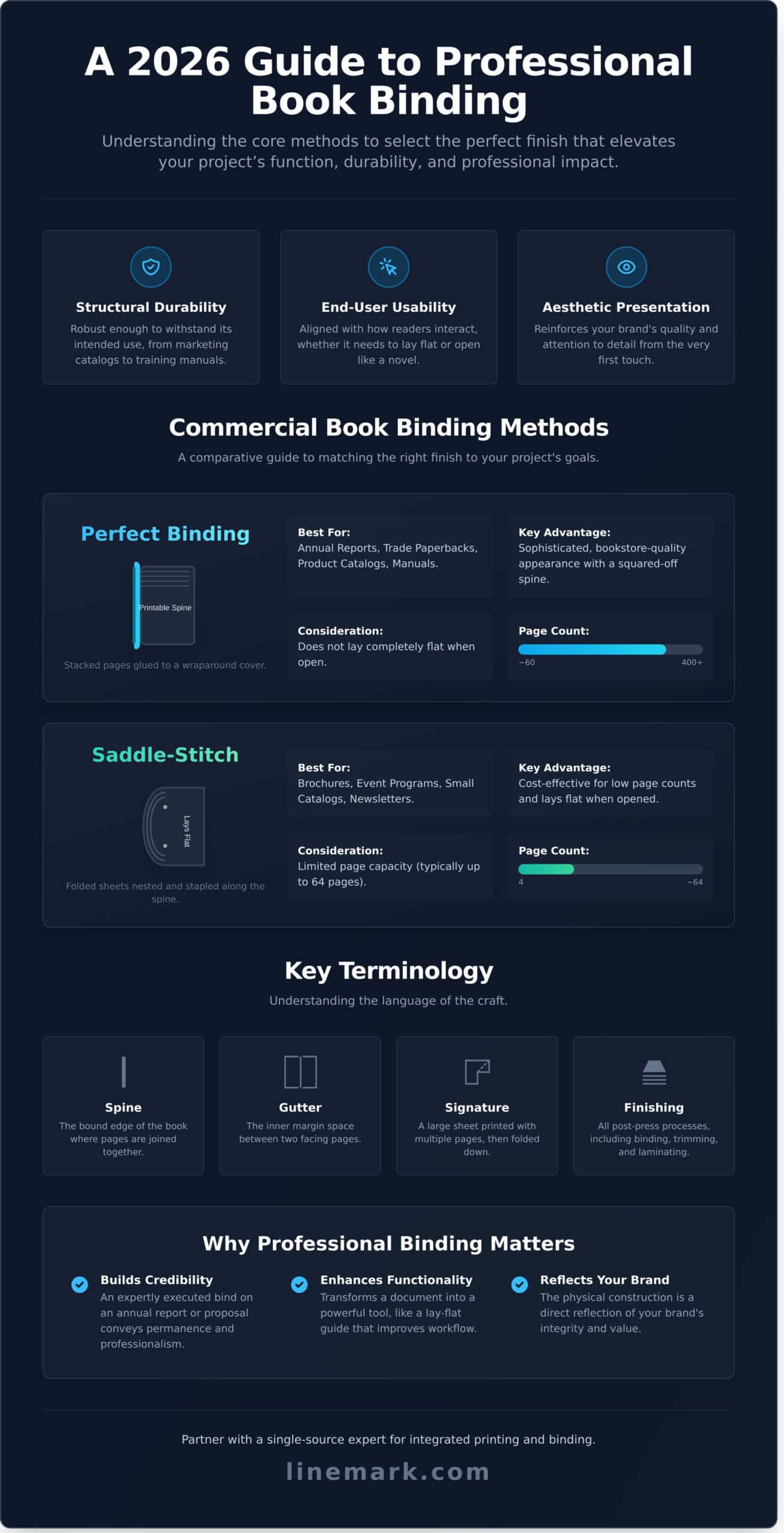
Book binding is the critical final step in professional document production, a precise process that transforms loose printed sheets into a cohesive, functional, and impressive final product. Far more than simply holding pages together, the binding method you choose is a strategic decision that directly impacts your document’s durability, usability, and aesthetic appeal. Selecting the right professional book binding services ensures your message is not only read but also respected.
A successful bind accomplishes three core objectives, each contributing to the overall effectiveness of your printed materials:
- Structural Durability: The binding must be robust enough to withstand its intended use, whether it’s a frequently referenced training manual or a high-impact marketing catalog.
- End-User Usability: The format should align with how the reader will interact with the document. Does it need to lay flat for hands-free use, or open easily like a traditional novel?
- Aesthetic Presentation: The final look and feel of the book-from the spine to the cover-reinforces your brand’s quality and attention to detail.
At Linemark, we engineer binding solutions across three primary families: adhesive (like perfect binding), stitched (like saddle-stitching), and mechanical (such as coil or wire-o). Each category offers distinct advantages for specific applications.
Why Professional Binding Services Matter
The physical construction of your document is a direct reflection of your brand’s integrity. A durable, expertly executed bind on an annual report, proposal, or product catalog builds immediate credibility and conveys the permanence of your message. Functionality is equally vital; the right binding transforms a standard document into a powerful tool, from lay-flat technical guides that improve workflow to elegant booklets that are a pleasure to read and handle.
Key Terminology You Should Know
To navigate your options effectively, it helps to understand the language of the craft. These terms, many of which are rooted in the long and detailed history of bookbinding, are fundamental to discussing your project’s specifications:
- Spine: The bound edge of the book where the pages are joined together.
- Signature: A large sheet printed with multiple pages that is folded down to form a small group of pages in the final book.
- Gutter: The inner margin space between two facing pages, where the paper is secured into the binding.
- Finishing: A collective term for all post-press processes, including binding, trimming, laminating, and other embellishments.
Ultimately, the binding you select is not a minor detail-it is an integral component of your communication strategy. A thoughtful choice enhances the reader’s experience, protects the document’s contents, and elevates your brand’s perceived value from the very first touch.
A Comparative Guide to Commercial Book Binding Methods
Selecting the right binding method is a critical decision that directly impacts the functionality, durability, and perceived value of your printed materials. The choice dictates how your document opens, how long it lasts, and the professional image it projects. As your single-source partner in Maryland, we provide scalable book binding services tailored to your project’s specific objectives, ensuring the final product aligns perfectly with your brand standards and logistical needs.
Understanding the core differences between each method is the first step toward a successful outcome. From sleek corporate reports to durable training manuals, each style is engineered for a specific purpose.
Perfect Binding: The Professional Paperback Standard
Perfect binding is the industry benchmark for softcover books, delivering a clean, high-end finish. In this process, collated pages are stacked, the spine edge is milled, and a strong, flexible adhesive is applied to secure the pages to a wraparound cover. The result is a flat, printable spine ideal for titles and branding.
- Best For: Corporate annual reports, trade paperbacks, product catalogs, and manuals with higher page counts (typically 60+ pages).
- Key Advantage: Creates a sophisticated, bookstore-quality appearance with a professional, squared-off spine.
- Consideration: This binding style does not allow the book to lay completely flat when open.
Saddle-Stitch: For High-Impact, Low-Page-Count Documents
For projects that demand efficiency and cost-effectiveness without sacrificing quality, saddle-stitching is the optimal solution. The process involves nesting folded sheets one inside the other and then stapling them through the centerfold with wire staples. It’s a fast and reliable method for shorter documents, ideal for high-volume marketing collateral.
- Best For: Marketing booklets, event programs, newsletters, and brochures (typically under 80 pages, in multiples of four).
- Key Advantage: Lays relatively flat for easy reading and is the most economical binding option available.
- Consideration: Lacks a printable spine and is limited by page count to maintain structural integrity.
Coil & Wire-O Binding: For Functionality and Frequent Use
When lay-flat functionality is non-negotiable, mechanical binding methods like Coil and Wire-O are the superior choice. Both involve punching holes along the edge of the pages and inserting a fastener-either a durable plastic coil (spiral) or a double-loop metal wire (Wire-O). This comprehensive guide to book binding types provides a great visual comparison of these functional styles. They are engineered for frequent reference and hands-free use.
- Best For: Training manuals, presentations, notebooks, calendars, and cookbooks.
- Key Advantage: Allows pages to rotate 360 degrees and lay perfectly flat, enhancing usability.
- Consideration: It is a more premium option than saddle-stitching, with a higher cost per unit.
While these options cover most business needs, Case Binding (hardcover) offers the ultimate in durability and perceived value for high-stakes, long-lasting publications. Partnering with expert book binding services ensures your project is produced with precision and is perfectly suited for its intended purpose.
How to Choose the Right Binding Service for Your Project
Selecting the right finish for your printed project is a critical decision that impacts its usability, durability, and perceived value. To navigate the options effectively, it’s essential to approach the selection of book binding services with a clear, strategic framework. This process ensures the final product aligns perfectly with your goals and brand standards. Before diving into specifics, a thorough understanding of the fundamentals is key. This complete guide will offer an excellent technical overview of book binding techniques as we explore the options. We recommend evaluating your project against these core decision factors.
Decision Factor 1: Page Count and Paper Thickness
The physical specifications of your document are the first technical constraint. Saddle-stitching is ideal for low-page-count booklets, while perfect binding provides a clean, professional spine for thicker publications. Remember that heavier paper stock will reduce the maximum page count for certain methods, as the folded pages can become too bulky. Use these general guidelines as a starting point:
- Saddle-Stitch: 8-64 pages
- Perfect Binding: 48-250+ pages
- Coil & Wire-O Binding: 16-300+ pages
Decision Factor 2: Durability and Use Case
Consider how your document will be used. A single-use marketing brochure has different durability needs than a corporate annual report meant for long-term reference. For materials that require frequent handling and need to lay completely flat-such as training manuals or cookbooks-coil and Wire-O bindings offer superior durability and functionality. Their construction is engineered to withstand constant page-turning without compromising the spine’s integrity.
Decision Factor 3: Budget vs. Brand Perception
Your binding choice is an investment in your brand’s quality, not merely a production cost. While saddle-stitching is highly cost-effective for large-scale mailers, a sleek perfect-bound spine elevates the perceived value of a high-stakes proposal or marketing book. The tactile quality and professional finish of premium book binding services communicate a commitment to excellence before a single word is even read, reinforcing the value of the content within.
Preparing for Production: Design and Finishing Considerations
Selecting a binding method is more than a logistical choice; it is a foundational design decision that dictates how your audience will interact with the final product. At LineMark, we bridge the gap between creative vision and production reality, ensuring your design is optimized for your chosen binding from the very first proof. This foresight prevents costly errors and elevates the quality of the finished piece.
Designing for the Gutter and Crossovers
The single most overlooked aspect of print design is the gutter-the inner margin where pages meet the spine. For perfect bound books, a significant portion of the page is consumed by the adhesive, requiring a generous gutter margin (typically 0.5” to 0.75”) to prevent text from disappearing into the spine. As page count increases, so must this margin. For images that cross over a two-page spread, designers must account for this loss to maintain visual continuity. While lay-flat options like spiral or wire-o binding are more forgiving, critical elements should still be kept clear of drilled holes or the central fold.
Elevating Your Project with Professional Finishes
The tactile experience of a book is as important as its visual content. Our comprehensive book binding services are complemented by a suite of finishing options designed to protect your project and enhance its impact. A heavier cover stock (100-130#) provides a sturdy, professional foundation, which can be further enhanced:
- Lamination: Available in gloss or matte, lamination adds a durable, protective layer that resists moisture and scuffs. A soft-touch matte laminate offers a uniquely luxurious feel.
- Specialty Coatings: A spot UV coating can be applied to specific elements, like a logo or photograph, creating a striking contrast between high-gloss and matte surfaces.
- Foil Stamping & Embossing: For a truly premium look, foil stamping adds metallic brilliance, while embossing (raising) or debossing (recessing) elements provides a sophisticated, three-dimensional texture.
As your single-source partner, we integrate these design and finishing considerations into the production workflow, guaranteeing a final product that is both flawlessly executed and strategically impactful. To learn how our integrated solutions can benefit your next project, contact our team of experts in Maryland.
Partner with Linemark for Integrated Printing and Binding
Choosing the right binding is a critical final step, but it doesn’t have to be a complex one. When your project demands precision from the first print to the final bound edge, partnering with an integrated provider is the most effective path to success. At Linemark, we move beyond being a simple vendor to become a strategic communications ally, managing every detail of your project under one roof.
The Single-Source Advantage: Quality Control and Efficiency
Coordinating separate printers and binderies introduces risk, delays, and potential inconsistencies. The Linemark difference lies in our single-source model. By managing the entire production lifecycle in-house, we ensure absolute quality control over color, registration, and finishing. This integrated approach streamlines timelines, eliminates logistical hurdles, and provides you with a single, accountable partner dedicated to bringing your vision to life, from file to finish.
From Annual Reports to Training Manuals: Our Expertise
Our state-of-the-art facility is equipped to handle the full spectrum of binding needs. We provide expert guidance and execution for a diverse range of projects, ensuring the final product aligns perfectly with your goals. Our comprehensive book binding services are trusted for:
- High-impact corporate and annual reports
- Durable training manuals and educational materials
- Professional catalogs and product lookbooks
- Elegant non-profit fundraising booklets
Whether you require a high-volume run or a custom, complex project, our team has the experience to recommend and deliver the ideal binding solution.
Start Your Project with a Professional Consultation
Your project deserves more than a generic quote; it deserves a tailored strategy. Let our team’s deep industry knowledge work for you. We can assess your document’s purpose, audience, and budget to identify the most effective and impressive binding method. Move forward with confidence, knowing your project is in capable, steady hands.
Consult with our print experts to find the ideal binding for your project.
Elevate Your Project with Integrated Printing and Binding
Selecting the right binding is a critical decision that defines your project’s durability, usability, and professional impact. As we’ve explored, the ideal finish is a strategic choice-one that balances aesthetic appeal with practical function. Understanding the nuances between methods is the first step, but aligning that choice with your project’s unique goals is what ensures the final product not only looks exceptional but also delivers an optimal user experience.
This is where a true single-source partner provides a decisive advantage. For over 30 years, Linemark has delivered comprehensive book binding services integrated directly with our state-of-the-art printing solutions. Our advanced in-house binding and finishing capabilities mean your project is managed with meticulous attention to detail under one roof. We eliminate logistical complexities and ensure seamless execution, transforming your vision into a tangible, high-quality product with confidence and precision.
Ready to bring your publication to life with a flawless finish? Consult with our print experts to find the ideal binding for your project. Let’s build something remarkable together.
Frequently Asked Questions About Book Binding
What is the most cost-effective book binding method?
Saddle-stitching is typically the most economical option for publications with lower page counts, such as booklets, magazines, and event programs, generally under 64 pages. For thicker documents, plastic coil (spiral) binding provides a cost-effective and durable solution. Our team analyzes your project’s specific page count, volume, and intended use to recommend the optimal binding method that aligns with your budget while upholding our rigorous quality standards.
What is the difference between spiral binding and Wire-O binding?
The primary difference lies in the material and spine appearance. Spiral binding utilizes a single, continuous plastic coil threaded through round holes, offering excellent durability and flexibility. In contrast, Wire-O binding uses a series of double-wire loops crimped through square or rectangular holes. This method provides a more formal, metallic finish and allows pages to align perfectly when opened, making it a preferred choice for professional presentations and calendars.
How many pages do I need for perfect binding?
To create a strong, printable spine, perfect binding generally requires a minimum of 28 to 40 pages. The exact minimum depends on the paper’s thickness, or “caliper,” as a thicker paper stock will achieve the necessary spine width with fewer pages. This method produces the clean, squared-off spine characteristic of softcover books, making it an ideal solution for corporate reports, catalogs, and literary journals.
Can you print on the spine of a saddle-stitched book?
No, it is not possible to print on the spine of a saddle-stitched publication. This binding method involves folding sheets and stapling them along the center crease, which results in a sharp fold rather than a flat, printable spine surface. For projects that require spine text for shelving and easy identification, we recommend perfect binding, case binding, or certain lay-flat options as superior alternatives.
What is the most durable type of book binding for heavy use?
For maximum durability and longevity, case binding (hardcover) is the industry standard. This process involves sewing pages together into signatures and then adhering them to a rigid cover board, creating a resilient final product. It is the preferred method for textbooks, library editions, and commemorative books intended for lasting use. Our comprehensive book binding services also include Smyth-sewn options for superior strength and lay-flat functionality in softcover formats.
How should I prepare my design files for a book printing project?
To ensure a seamless production workflow, all design files should be submitted as a single, high-resolution PDF with pages in correct reading order. Key technical requirements include a 0.125-inch (1/8″) bleed on all edges, embedded fonts, and all images at a minimum of 300 DPI. Following these specifications ensures your project moves efficiently through our prepress system. Our team can provide custom templates to optimize your files for our advanced book binding services.
What does ‘lay-flat’ binding mean and when should I use it?
Lay-flat binding describes any method that allows a book to open a full 180 degrees and remain flat without being held down. This functionality is critical for materials designed for hands-free use and reference. Common lay-flat styles include spiral, Wire-O, and Smyth-sewn binding. We strategically recommend this feature for cookbooks, technical manuals, workbooks, and musical scores, where user convenience and accessibility are paramount.
Does the type of paper I choose affect my binding options?
Absolutely. Your paper selection is a critical factor that directly influences your binding options. The paper’s weight and thickness determine the book’s overall flexibility and spine width. For instance, saddle-stitching is best suited for lighter paper stocks to prevent page “creep,” while perfect binding requires a minimum spine thickness for the adhesive to create a durable bond. Our experts partner with you to align your paper choice with the most effective binding solution.