

 11/05/2026
 Steve Bearden
A reactivation campaign has a different purpose from a standard nurture sequence: it gives an inactive customer a focused reason to reconnect. Effective reactivation campaigns for dormant customers use engagement and purchase behavior to identify when a personal follow-up, including direct mail, may be appropriate.
It’s easy to keep sending the same nurture messages after a customer stops engaging. A behavior-triggered approach gives you a clearer path: identify meaningful signs of inactivity, tailor the message to the customer’s history, and coordinate follow-up across channels. This guide explains how to distinguish dormant customers from active prospects, shape a relevant win-back message, and time direct mail alongside digital outreach. You’ll also learn how to assess responses and decide when continued contact is no longer useful.
Key Takeaways
- Set a dormancy threshold that reflects your customers’ buying cycle, then choose the outreach channel to fit their history and likely needs.
- Segment inactive customers by past purchases and engagement so you can prioritize relevant, valuable opportunities.
- Personalize win-back messages around prior interactions and give each contact a clear next step.
- Use customer behavior to trigger coordinated follow-up, including direct mail when a physical message suits the relationship.
1. What are dormant customers?
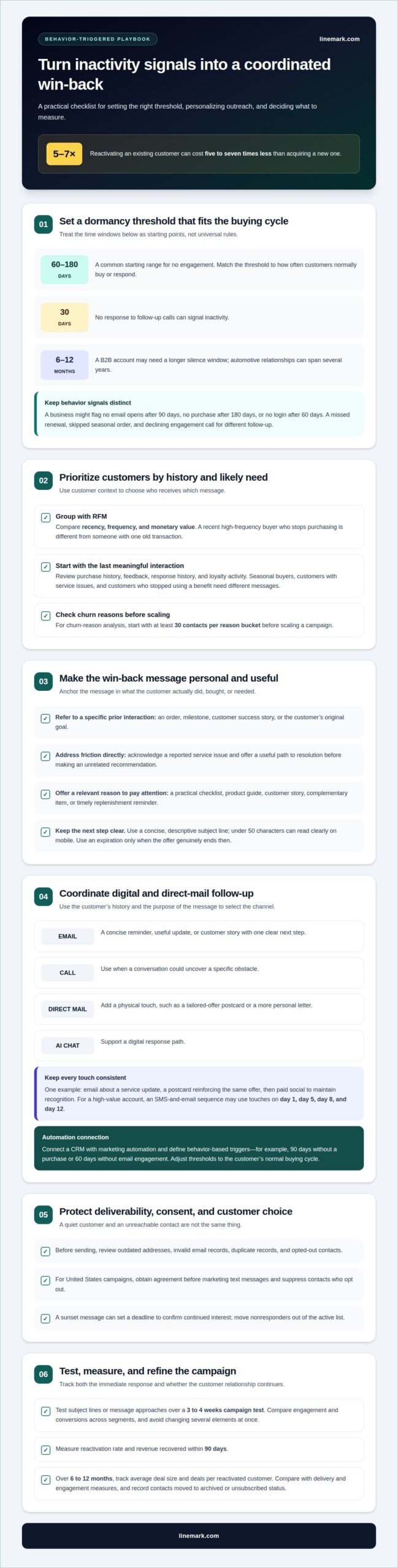
A dormant customer has stopped purchasing or responding within a period that matters to the business. Many businesses use 60 to 180 days without engagement as a starting point, while 30 days without a response to follow-up calls can signal inactivity. Match the threshold to the buying cycle: a B2B account may need 6 to 12 months of silence, while automotive relationships can span several years.
Choose the channel to suit the customer’s history and your message. Use email for a concise reminder or useful update, and a call when a conversation could uncover a specific obstacle. Direct mail adds a physical touch, such as a tailored-offer postcard or a letter with a more personal message. AI chat can support a digital response path. For example, a short re-engagement email might share a relevant customer success story and invite the reader to take one clear next step.
Coordinate channels rather than sending unrelated messages. For example, send an email about a service update, follow with a postcard reinforcing the same offer, then use paid social to maintain recognition. For a high-value account, an SMS-and-email sequence could use touches on day 1, day 5, day 8, and day 12. Keep each contact consistent, and make the next action easy to understand.
Value-added content gives dormant customers a reason to pay attention beyond a discount. Share a practical checklist, product guide, or customer story related to their previous purchase. Before sending, review the database for outdated addresses, invalid email records, and contacts who have opted out. Use a clear subject line and relevant sender name, then monitor delivery and engagement. These steps help distinguish a quiet customer from a message that never reached them.
2. Why is it crucial to reactivate an inactive customer?
Reactivating an existing customer can cost five to seven times less than acquiring a new one. The opportunity is strongest when outreach reflects why each person stopped engaging instead of treating every inactive customer alike. Segmenting by purchase history and engagement helps you focus on accounts with a relevant reason to return.
Set inactivity thresholds around the buying cycle and customer behavior. A business might flag a customer after 90 days without email opens, 180 days without a purchase, or 60 days without a login. Treat these as separate signals, not interchangeable rules. A missed renewal, a skipped seasonal order, and declining email engagement call for different follow-up.
RFM segmentation groups customers by recency, frequency, and monetary value. For example, a recent high-frequency buyer who stops purchasing differs from someone with one old transaction. Rank each segment using its purchase history and engagement, then tailor outreach to its likely needs. For churn-reason analysis, start with at least 30 contacts per reason bucket before scaling a campaign.
Audit the customer database before launching: remove duplicate records, flag invalid contact details, and separate opted-out contacts. Review purchase dates, response history, and loyalty activity together. A loyalty program can encourage repeat engagement with relevant milestones or member updates. If a customer has stopped using a benefit, explain its value clearly rather than sending a generic reminder.
For United States campaigns, obtain customers’ agreement before sending marketing text messages, and suppress contacts who opt out. A sunset message can set a deadline for confirming continued interest, then move nonresponders out of the active list. These steps keep campaign records aligned with customer choices. A coordinated customer outreach plan can connect segment insights with consistent communications.
3. Personalized win-back messaging and product recommendations
Start with the customer’s last meaningful interaction, not a generic “we miss you” message. Use past purchases, customer feedback, and engagement tracking to build relevant segments. For example, someone who bought a seasonal item may respond to a reminder before that season returns. A customer who reported a service issue needs acknowledgment and a useful path to resolution first.
Make each check-in specific. Refer to a previous order, milestone, or customer success story, then offer one clear next step. A value-reminder email can explain how a product supports the customer’s original goal. If satisfaction fell after a particular experience, address that concern directly instead of making an unrelated recommendation.
Keep subject lines concise, descriptive, and tied to the message. A subject line under 50 characters can read clearly on mobile screens. Offers work best when they match purchase history, such as a complementary item or a timely replenishment reminder. A genuine 14-day expiration can add a clear decision point, provided the offer actually ends then.
Build the campaign in stages: define a dormant segment, choose a customer-specific message, and select a relevant offer or helpful resource. Test subject lines or message approaches with a 3 to 4 weeks campaign test, then compare engagement and conversions across segments. Avoid changing several elements at once, so results can inform the next version.
Measure reactivation rate and revenue recovered within 90 days, then track average deal size and deals per reactivated customer over 6 to 12 months. Compare campaign results with delivery and engagement measures, and record contacts moved to archived or unsubscribed status. This shows whether a message generated a return purchase and whether the relationship continued beyond the initial response.
4. Automating direct mail based on customer behavior
Automated direct mail turns customer activity into a timely, coordinated response. Connect a customer relationship management system (CRM) with marketing automation, then define behavior-based triggers. For example, flag a record after 90 days without a purchase or 60 days without email engagement. Those thresholds are starting points; adjust them to fit the customer’s normal buying cycle.
Build targeting rules that distinguish a lapsed customer from someone between expected purchases. Use order dates, product categories, past responses, and account value to decide who receives a mailer. A customer past their usual reorder window might receive a reminder postcard. A long-standing account with a different buying pattern may call for a more personal letter and a relevant check-in.
Set the workflow before production. When a record meets the trigger, confirm the mailing address is usable, check contact preferences, and select the matching creative version. Suppress customers who have already purchased, responded, or opted out of that communication. This prevents an automated mail piece from arriving after the customer has already acted.
Coordinate the mail drop with digital follow-up. An email can introduce the same value proposition, while paid social reinforces it for the intended audience. Keep the message consistent across channels, but give each touch a distinct role. For example, the mailer can present the detailed offer, while the email provides a concise reminder and response path.
Track delivery, responses, conversions, revenue recovered, and contacts moved to archived or unsubscribed status. Compare results across customer segments and trigger types, then refine timing, message, and format. Direct mail engagement can occur within 10–14 days of a reactivation campaign, so review early response alongside longer-term outcomes. This measured loop gives each lapsed customer a relevant chance to reconnect without sending repeated, untargeted mail.
Linemark: Custom Book Printing
Linemark helps organizations turn customer behavior insights into coordinated print communication. When a win-back strategy calls for a physical touchpoint, Linemark’s Direct Mail service can deliver a focused offer, customer story, or useful reminder to selected lapsed buyers.
When a campaign needs a substantial resource rather than a brief mailer, Linemark’s Custom Book Printing can produce a guide or publication that offers lasting value. Commercial Printing also supports campaign materials that keep messaging consistent across customer touchpoints. Choose the format based on your audience, outreach purpose, and the action you want recipients to take.
Bring your campaign goals and audience needs to Linemark to discuss a print approach that fits your re-engagement plan.
Make the Next Customer Touchpoint Count
Turn customer insight into a physical experience that feels relevant, useful, and consistent with your brand. Well-planned reactivation campaigns for dormant customers can make direct mail part of a broader relationship, rather than an isolated reminder. Start with one audience segment and one clear action, then use response data to guide what comes next.
Linemark supports campaign execution with Direct Mail, Custom Book Printing, and Large Format Graphics. A targeted mail piece can prompt a response, a printed guide can provide deeper value, and graphics can reinforce a campaign in a physical environment. Choose the format that suits the message and customer relationship.
Bring your campaign goals and audience priorities into a focused planning conversation. Contact Linemark to plan your campaign, and take the next step toward reconnecting with buyers through purposeful communication.
Frequently Asked Questions
How does a reactivation campaign differ from a standard nurture sequence?
A reactivation campaign addresses a customer who has gone quiet, while nurture communication supports an ongoing relationship. Reactivation campaigns for dormant customers should offer a specific reason to reconnect, such as a new use for a previously purchased product. For example, a training provider might send a former participant an updated course guide instead of another general newsletter. The goal is a meaningful return action, not routine engagement.
How many touchpoints should a reactivation sequence include?
A four- to six-touchpoint sequence gives a campaign room to make its case without contacting people indefinitely. Vary the purpose of each touch: introduce a useful update, share relevant proof, present an appropriate offer, and close with a sunset message. If the customer responds or unsubscribes, stop the remaining scheduled outreach and update the record.
What are dormant customers?
Dormant customers are former buyers or account holders whose expected activity has stopped. The definition depends on the relationship: a repeat-order business can look for a missed reorder, while a professional association might notice that a member no longer registers for events. Use the customer’s normal behavior as your reference point, rather than treating every quiet contact as lost.
What does your CRM engagement data actually tell you about lapsed customers?
CRM data shows recorded behavior, not why a customer disengaged. A missed renewal, unopened emails, and a recent support case suggest different possible barriers. Review those signals alongside order history and recorded feedback before choosing a follow-up. If the record shows only silence, treat it as a reason to test a relevant message, not proof of lost interest.
What tools can you use to deploy your campaign effectively?
A CRM can organize purchase and response history, while a marketing automation platform can trigger email and flag eligible records. Direct mail workflows can connect approved audience data with personalized print pieces and fulfillment. Together, these tools help coordinate reactivation campaigns for dormant customers across print and digital channels. Keep audience definitions, campaign messaging, and suppression rules aligned to prevent conflicting outreach.
Why is it crucial to reactivate an inactive customer?
Reactivation can preserve a relationship that already has useful context, such as prior preferences, order requirements, or service history. That context helps shape a more relevant interaction than a first-contact message to an unfamiliar prospect. It also gives a business a chance to learn whether a customer’s needs have changed, resolve an outstanding concern, or recognize that the relationship has ended.