

 11/03/2026
 Steve Bearden
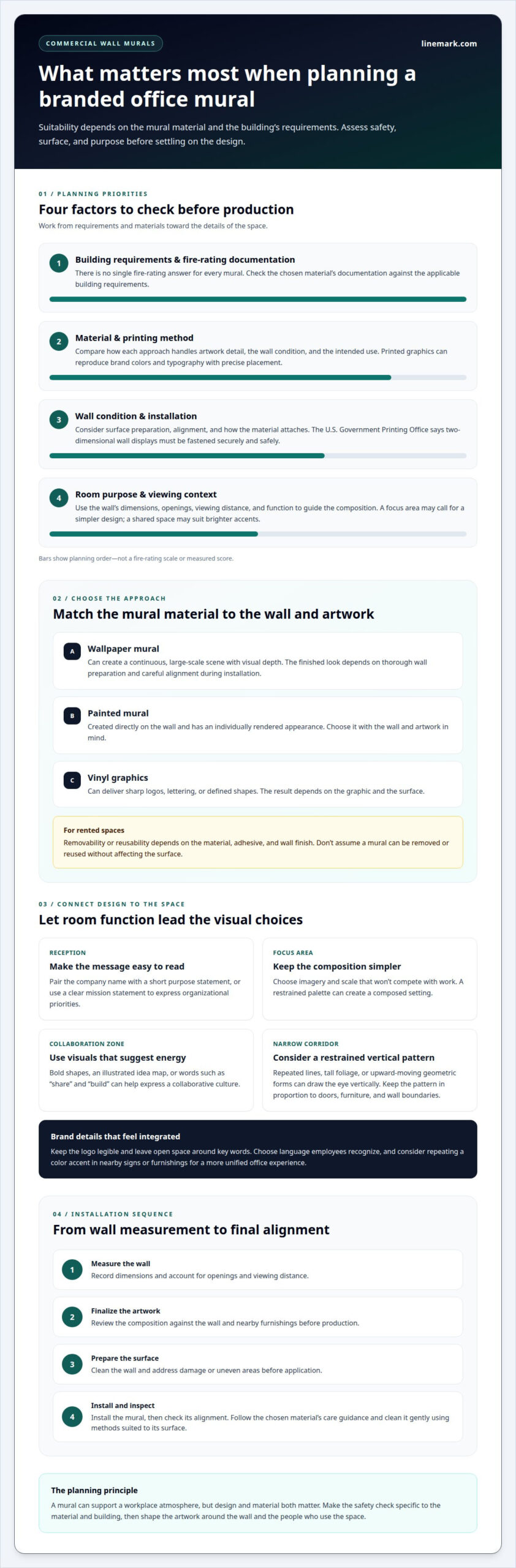
A branded wall can do more than decorate an office: it can make a company’s identity part of the everyday environment. Corporate office wall murals aren’t automatically fire-rated; suitability depends on the material and the building’s applicable requirements. Both design and material matter.
Safety considerations don’t have to limit the creative direction. Custom typography, brand colors, logos, and imagery can turn a wall into a cohesive expression of what an organization does and how it wants its workplace to feel.
This guide explains how to assess fire-rating considerations, shape a mural around brand elements, and choose an approach that suits the space and its purpose. It also explores how personalization can connect a mural to the people who use the office, from focused work areas to shared break spaces.
Key Takeaways
- Make material suitability part of mural planning so the design aligns with the building’s safety requirements.
- Use the wall’s location and purpose to create a workplace atmosphere that supports focus, energy, or shared creativity.
- Bring brand colors and typography into the composition to make key messages visible and consistent with your identity.
- Personalize each space with imagery and details that reflect the people who use it, not just the organization’s logo.
Are corporate wall murals fire-rated for commercial safety compliance?
There’s no single fire-rating answer for every mural: suitability depends on the material and the building’s requirements. Design choices also influence how office spaces feel and function, including their effect on employee morale and productivity.
Mural Materials and Printing Methods
Choose materials and printing methods based on the wall, artwork, and installation conditions. Printed wallpaper can carry detailed imagery across a broad surface, while painted designs are created directly on the wall. Printed graphics can reproduce brand colors and typography with precise placement. Compare each approach for its handling of artwork detail, wall condition, and intended use. For safety, review the material’s fire-rating documentation against applicable building requirements. According to the U.S. Government Printing Office, two-dimensional wall displays must be fastened securely and safely.
Wallpaper, Painted, and Vinyl Options
Wallpaper murals can create continuous, large-scale scenes that add visual depth to a corridor or meeting room. Their finished look depends on thorough wall preparation and careful alignment during installation. Painted murals have an individually rendered appearance, but are applied directly to the wall. Vinyl graphics can deliver sharp logos, lettering, or defined shapes; the result depends on the graphic and surface. In rented spaces, consider how the material attaches and comes away. Don’t assume every mural can be removed or reused without affecting the surface.
For a made-to-measure design, start with the wall’s dimensions, openings, and viewing distance. Then choose an idea suited to the space, such as a mission statement in reception or a calming pattern near workstations. Large-scale forms and layered imagery can make a flat wall feel more dimensional. Color also shapes a room’s character: a restrained palette can create a composed setting, while brighter accents can energize a shared creative space. A thoughtful environment may support morale, but a mural alone can’t determine productivity.
Plan installation in sequence: measure the wall, finalize the artwork, prepare the surface, then install the mural and inspect its alignment. Preparation includes cleaning the wall and addressing damage or uneven areas before application. For maintenance, follow the care guidance for the chosen material and clean it gently using methods suited to its surface.
In rented spaces, removable or reusable suitability depends on the material, adhesive, and wall finish. Businesses seeking designers and installers can look for commercial mural specialists serving their area, then compare portfolios for workplace-scale projects and installation experience.
Can office murals be customized with branding or logos?
Yes. Office murals can incorporate a company logo, brand colors, and messaging. Choose imagery that reflects the workplace’s purpose, such as a product illustration near a client meeting area or a values statement in a shared hallway. The design should feel integrated with the interior, not pasted onto it.
A dull or unpleasant office can dampen mood and hinder creativity. A planned mural can turn a blank wall into a visual cue that helps employees feel inspired. For example, an imaginative landscape in a shared studio can suggest experimentation, while a clear mission statement in reception can express organizational priorities.
Start by identifying the room’s function and the response you want from its users. Then match the mural’s imagery, color, and scale to that goal. In a focus area, choose a simpler composition that won’t compete with work. In a collaboration zone, bold shapes or an illustrated idea map can create an energetic atmosphere.
Vertical patterns can create an illusion of height, making them useful in rooms where the ceiling feels low. Repeated lines, tall foliage, or upward-moving geometric forms draw the eye vertically. Keep the pattern in proportion to doors, furniture, and wall boundaries. A narrow corridor, for instance, may suit a restrained vertical design better than a dense, all-over pattern.
Use these steps to guide the design:
- Define the room’s purpose, such as focus, collaboration, or welcoming visitors.
- Select brand colors and logo placement, keeping important details easy to see.
- Choose imagery that supports the intended mood, such as abstract forms for a creative studio.
- Review the composition against the wall and nearby furnishings before production.
A cohesive workplace can energize employees and inspire imagination, but the mural should serve the people using each space. For a wall-specific concept, explore custom wall mural options as part of planning the visual environment.
Murals featuring typography and brand colors
Typography and color make a brand visible throughout the workspace. A mural can connect a company’s visual identity with the atmosphere of daily work.
Murals That Reinforce Brand Identity
Start with the brand elements employees and visitors should recognize. A reception mural might pair the company name with a short purpose statement, while a meeting room could feature a product illustration in established brand colors. Keep the logo legible and leave enough open space around key words. This balance makes the design feel intentional rather than like an oversized advertisement. Repeating a color accent in nearby signs or furnishings can also create a more unified office experience.
Corporate Culture Through Branded Murals
Branding communicates more than a logo; it can express how a company works. For example, a mural in a collaboration area might pair words such as “share” or “build” with shapes that suggest movement. A quieter workspace could feature a brief values statement and restrained color. Choose language employees recognize and can connect to real behaviors. That link makes the mural a visual expression of culture, not simply a decorative display.
Typography should suit the viewing distance. A headline across a hallway wall needs clear letterforms and concise wording, while a closer reading area can accommodate smaller supporting text. Before finalizing the layout, check how doors, furniture, and sightlines intersect the design. A phrase placed behind a conference table, for instance, may be obscured during meetings.
Use a simple review sequence: select the message, match it to approved brand colors, then test the layout against the actual wall. View the design in the room’s lighting and from its main entry point. If the mural includes several colors, assign each a role, such as background, headline, or accent. This keeps the composition consistent and helps create a cohesive workplace without making every wall identical.
Custom office murals and personalization
A custom mural works best when it reflects the people and purpose of its space. Start with one question: what should employees or visitors notice, feel, or remember here? A reception wall might introduce the company’s story, while a team room could celebrate shared projects. That decision gives the artwork a clear role beyond decoration.
Netflix commissioned a mural of contemporary hieroglyphs on the sixth floor of its building. The example shows how a visual language can make a workplace feel specific to its organization. A workplace lunchroom, by contrast, could use food-focused doodles to create a lively break space. Each design can draw on its setting rather than applying the same generic treatment everywhere.
Personalization can come from local details, not just logos. A company might feature an illustrated neighborhood map, sketches inspired by employee-submitted ideas, or imagery connected to a team’s work. In reception, these elements can make a meaningful first impression on visitors. In a shared lounge, playful references can make the room feel more welcoming.
Build the concept with a focused process:
- Identify the audience and purpose for each wall.
- Choose a story, place, or shared idea to guide the artwork.
- Gather visual references, such as local landmarks or team sketches.
- Adapt the composition to doors, furniture, and sightlines.
- Review a design proof in context before production.
Personal touches should still work at room scale. A detailed illustration may suit a lounge wall viewed up close, while a broad graphic can read more clearly across a corridor. Painted artwork offers an expressive, hand-rendered character; printed designs can organize complex imagery across a larger surface. Let the wall’s role, viewing distance, and workplace story guide the choice.
Turn a meaningful workplace story into a wall concept with custom wall mural planning.
Linemark: Custom Book Printing
Linemark helps organizations coordinate print communications through Large Format Graphics and Commercial Printing. Turn to Linemark when workplace messaging needs to connect with broader materials, such as printed publications or campaign pieces that share the same visual identity.
For example, a company can align its office’s visual direction with a printed report or book to create consistency across physical touchpoints. Linemark’s Custom Book Printing, Direct Mail, Large Format Graphics, and Commercial Printing can support different parts of that communications program. The right combination depends on what your organization needs to produce and where audiences will encounter it.
To discuss a print project that supports your workplace communications, contact Linemark.
Turn the Mural Concept Into a Clear Project Brief
Before production, bring together the people who will shape and use the space. Define the message each wall should communicate, identify who needs to approve the artwork, and gather the practical details that affect execution. A focused brief keeps design decisions connected to workplace needs instead of scattered across separate conversations.
For corporate office wall murals, plan the creative direction and material requirements together. This gives stakeholders a shared reference for reviewing the visual concept and its intended setting. It also creates a stronger foundation for coordinating the mural with other workplace communications, from printed materials to the broader visual environment.
Linemark can help move an office mural project forward as part of your communications planning. Contact Linemark about your office mural to discuss the project. With a clear brief and a unified team, your workplace vision can take shape with purpose.
Frequently Asked Questions
Are these murals durable for high-traffic commercial areas?
Murals can suit busy areas when the material, installation, and care match the setting. A corridor near reception faces different contact and cleaning demands than a quiet office wall. Consider how people move through the space, whether carts or chairs might brush the surface, and how the mural will be cleaned. These conditions guide material selection and maintenance planning.
Do murals help improve workplace atmosphere?
A mural can influence how a workplace feels, but it can’t guarantee a change in morale or productivity. For example, a lively design in a break area can distinguish it from desk-focused work zones. A quieter image near a shared workspace may feel less distracting. Choose imagery and color based on how people use the room, then consider employee feedback before finalizing the concept.
Where can you apply the corporate office murals collection?
Murals can be applied to suitable interior walls in reception areas, meeting rooms, corridors, and lunchrooms. Each wall has a different role: reception may welcome visitors, while a corridor can carry a visual theme between departments. Plan around doors, signs, furniture, and circulation paths. The wall’s surface and installation method also affect where a mural is appropriate.
What are popular corporate office wall mural designs and styles?
Common styles include geometric patterns, abstract imagery, nature-inspired scenes, illustrated workplace themes, and concise typography. A company might use a map-inspired graphic in a collaboration room or a subtle pattern in a quiet work area. Choose a style that fits the room’s purpose and the organization’s visual identity. Consider viewing distance, surrounding furnishings, and how much visual detail the space can comfortably support.
How long does office mural installation take, and how long do murals last?
Installation time and mural lifespan depend on the wall’s size and condition, the material, design complexity, and preparation. A clear wall with a straightforward layout presents different demands from a surface requiring repairs or careful alignment around fixtures. Traffic, cleaning methods, and exposure to wear also affect longevity. Plan installation around access to the space, allowing time for surface preparation and a final inspection.
What fire safety, building code, and accessibility rules apply to office wall murals?
Requirements depend on the building and the rules that apply to its location and use. Review the mural material’s fire-rating information against applicable building requirements, and keep the artwork clear of required signs, exits, and accessible routes. The U.S. Government Printing Office states that two-dimensional wall displays must be fastened securely and safely. Include building management in placement and installation planning.