

 10/01/2026
  Steve Bearden
The most premium-looking specification isn’t always the right one. For lookbook printing for fashion brands, the best choices depend on what the piece needs to do: introduce a collection to buyers, support a launch, or create a lasting brand impression. Paper and finish matter, but they need to work with the photography, page count, audience, quantity, and delivery plan.
A printed lookbook must present garments and colors in a way that feels true to your brand. Getting there takes more than selecting a paper stock. Print method, binding, artwork setup, color expectations, and approvals all need to align before production begins.
This 2026 buying guide will help you choose practical specifications and a production partner that fits your goals. You’ll learn how to weigh paper, binding, and finishes, compare digital and offset printing, prepare files for review, and coordinate quantities and delivery. The result can be a polished, brand-consistent lookbook built around your campaign and audience.
Key Takeaways
- Start with the lookbook’s purpose and audience so its format supports how it will be used.
- Compare size, page count, paper, binding, finish, and quantity as connected choices, not isolated specifications.
- Assess digital and offset printing against your run size, need for multiple versions, schedule, and finishing requirements.
- For lookbook printing for fashion brands, confirm file setup, color expectations, proofing steps, and delivery details with the printer before production.
- Share your use case, quantity, specifications, artwork status, and schedule when assessing a production partner.
Lookbook printing for fashion brands: start with the job the book must do
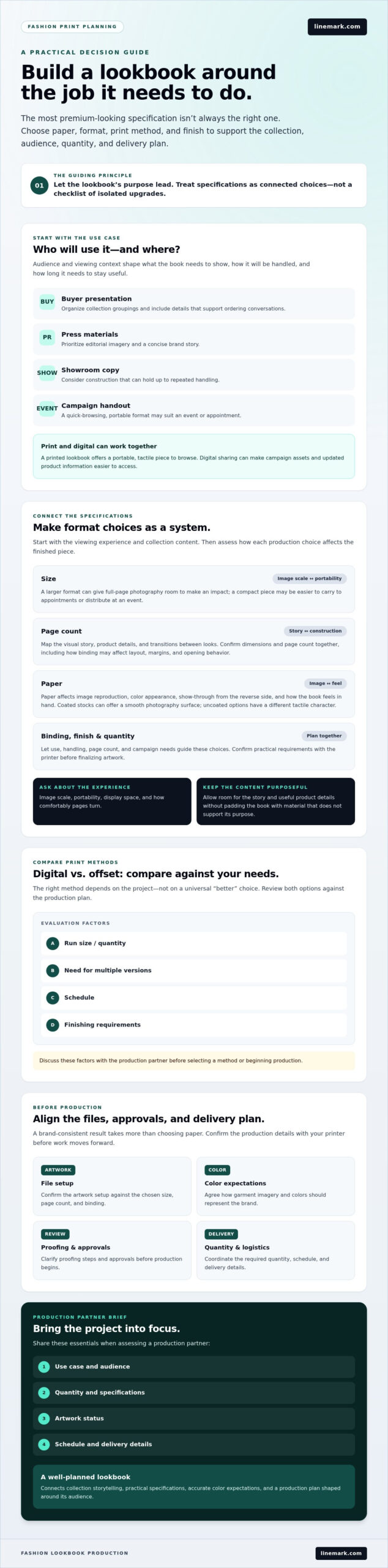
A printed fashion lookbook is a curated visual presentation of a brand or collection, bringing garment imagery, product details, and brand identity together in a physical piece. For lookbook printing for fashion brands, begin by deciding who will use the book, where they’ll view it, and how long it needs to stay useful. Those answers shape the content and production plan.
A buyer presentation may need clear collection groupings and details that support ordering conversations. Press materials may prioritize editorial imagery and a concise brand story, while showroom copies need to hold up to repeated handling. Campaign handouts may be designed for quick browsing and portability. The same artwork won’t necessarily serve each purpose equally well.
This short tutorial offers a look at assembling a fashion lookbook file. Treat its design workflow as one part of planning, and confirm print specifications with your production partner.
What should a fashion lookbook achieve?
A strong lookbook connects the collection’s visual story with the information its audience needs. Sales teams can use it to guide a presentation; buyers can review looks and product details; press can refer to brand context and imagery; customers can explore the campaign. A catalog, by contrast, generally emphasizes broader product listings and specifications. If storytelling leads and exhaustive product data takes a back seat, a lookbook is likely the closer fit.
Keep the viewing context in mind. An appointment copy may be handled across a table, while a mailed piece must travel easily and make sense without a presenter. A publication meant to support a full season may need different durability and content flexibility from a handout for a single event. Let the use case guide the format, page count, and construction rather than choosing a finish first. For a grounding in physical construction, see this overview of bookbinding methods.
When does a printed lookbook make sense?
Print can be useful at in-person presentations, showrooms, appointments, and events, or as part of mailed brand materials. It gives readers a portable, tactile piece to browse, while digital sharing can make campaign assets and updated product information easier to access. Neither format is universally better. A printed lookbook can work alongside digital assets, with the physical piece telling the collection story and online channels carrying additional details or current information.
Before production, define the piece’s role: sales tool, buyer presentation, press reference, showroom copy, or campaign handout. That decision gives your team a sound basis for choosing specifications.
Choose lookbook size, page count, paper, and binding around the collection
Specifications should support the collection’s images and the way readers will handle the finished book. A large format can give full-page photography room to make an impact, while a compact piece may be easier to carry to appointments or distribute at an event. Page count affects how the story unfolds and which binding options may be practical, so confirm production requirements before finalizing artwork.
How should brands choose lookbook size and page count?
Start with the viewing experience. Will a buyer review spreads at a desk, a sales representative carry copies between meetings, or will the lookbook sit on a showroom table? Consider image scale, portability, display space, and how comfortably the pages turn.
Then map the collection’s content. Allow enough space for the visual story, product details, and transitions between looks without padding the book with material that doesn’t support its purpose. Ask the printer to assess the proposed dimensions and page count together, including how binding may affect the layout, margins, and opening behavior.
Which paper and binding choices support fashion photography?
Paper affects how images reproduce, how colors appear, how much content shows through from the reverse side, and how the lookbook feels in hand. Coated stocks can provide a smooth surface for photography; uncoated options offer a different tactile character. Neither is automatically right for every collection. Review available stocks and finishes with the printer, considering the imagery, viewing environment, intended use, and desired feel.
Binding also shapes the experience. A booklet-style binding may suit a simpler presentation, while a thicker book may call for another construction approach. Compare options for page count, durability, ease of opening, and the impression you want the piece to make. Confirm that your preferred stock, finish, format, and binding are available for the project before locking the file.
- Dimensions: Match image scale to how the book will be held, carried, or displayed.
- Page count: Pace the collection story and product information, then check binding requirements.
- Paper: Review image reproduction, opacity, and hand feel against actual samples.
- Binding and finish: Balance opening behavior, durability, and presentation needs.
- Quantity: Estimate copies for each audience and use, including any versions that may be needed.
If color and paper appearance are critical, request a relevant physical sample or proof and review it under conditions similar to where the lookbook will be seen. A screen preview alone may not show how a particular stock handles the image. For a coordinated production discussion, explore Linemark’s commercial printing and custom book capabilities, and confirm project-specific options directly.
Digital vs. offset lookbook printing: compare quality, quantity, and flexibility
For lookbook printing for fashion brands, the choice between digital and offset printing depends on more than copy count. Consider how many versions you need, your image and color expectations, the preferred stock and finish, and the production schedule. Ask the printer to assess the complete specification rather than assuming one process is automatically faster or better.
| Factor | Digital printing | Offset printing |
|---|---|---|
| Run size | Can be a practical option for shorter runs; confirm project fit. | May suit larger runs with the same content and specifications. |
| Schedule | Ask about current capacity and the requested delivery date. | Confirm setup, production, finishing, and delivery timing. |
| Versioning | May accommodate multiple content versions; verify workflow and quantities. | Often best evaluated for consistent content across the run. |
| Consistency | Review proofing and color controls for the specific press and job. | Discuss color expectations and how consistency will be monitored. |
| Finishing | Check compatibility with the chosen stock and finishing options. | Confirm that the planned binding and finish fit the production setup. |
Digital and offset printing use different production workflows, so they may not produce identical results. The outcome depends on the equipment, paper, files, color management, and finishing choices. A project-specific proof and review with the printer can help you assess the result before production.
When might digital printing fit a lookbook project?
Consider digital printing for a smaller quantity, a test edition, or several versions tailored to different buyers, campaign stages, or other audiences. It may also make sense if collection details are still changing, but confirm how late revisions affect the schedule and file approval. Ask the printer to review image quality, color expectations, selected stock, binding, and finishes together. Don’t assume every paper or finish is available on every digital setup.
When might offset printing be the better fit?
Offset printing may fit a larger run when each copy shares the same content and specifications. Evaluate it alongside the campaign schedule, paper choice, finishing plan, and required color consistency. A high-volume run can involve different setup considerations from a short one, so ask for a recommendation based on the actual project rather than a universal quantity threshold. Share the final quantity and specifications when comparing options.
Before deciding, request a clear comparison that includes the proposed process, proofing approach, available stock and finishes, schedule, and delivery requirements. That gives your team a practical basis for balancing visual intent, flexibility, and production needs.
Prepare fashion lookbook files, approve proofs, and plan delivery
A clear production workflow gives the brand team and printer shared checkpoints before the lookbook moves into production. For lookbook printing for fashion brands, confirm file requirements early, then assign responsibility for content approval, proof review, and delivery coordination.
- Brief the printer. Share the audience, use case, quantity, format, requested schedule, and any delivery or distribution needs.
- Get current file specifications. Request the printer’s templates and export requirements before artwork is finalized. Confirm bleed, image resolution, color setup, fonts, transparency, and how linked images should be supplied.
- Check the handoff. Review image permissions, spelling, product details, page order, and approved brand assets. Make sure the supplied files follow the printer’s instructions.
- Review the proof. Check content, image placement, color expectations, and finishing details. Confirm the proof type and which elements it represents before approval.
- Approve and coordinate delivery. Consolidate feedback through one decision-maker, then confirm quantity, packaging, destination, and required delivery date.
What should a fashion brand confirm before submitting files?
Don’t rely on assumptions from a previous printer or project. File preparation requirements can vary with the production method, format, and finishing plan. Get the current specifications directly from the selected printer, including guidance for color profiles and export settings. Resolve content questions before handoff, especially image permissions, product names, and page sequence. A complete, checked submission helps the production team review the files against the agreed project requirements.
How can teams manage proofs and delivery with fewer surprises?
Name one person to collect comments and confirm final approval. Dispersed feedback can lead to conflicting edits, so consolidate corrections before returning them. Ask what the proof lets you assess, and review it against the approved content and production plan. If color or paper appearance is especially important, ask which proofing option is appropriate for the project.
Delivery planning starts with the destination and how copies will be used. Confirm the required arrival date, packaging, and whether copies should go to one location or multiple destinations. Storage, kitting, or nationwide distribution may be relevant for some projects; confirm whether those capabilities fit your requirements and schedule. For related production considerations, read the custom book printing guide.
For a coordinated discussion of your lookbook’s print, finishing, and delivery requirements, talk with Linemark about your project.
Select a lookbook printing partner and scope your project confidently
The right production partner should understand both the visual priorities and the practical requirements of your lookbook. Evaluate communication, relevant print capabilities, proofing, production capacity, and delivery as one coordinated process. A printer’s recommendation should respond to your project brief, not rely on a one-size-fits-all specification.
What should brands ask a lookbook printer?
Use these questions to assess fit before you commit:
- Production options: Which print methods, binding options, stocks, and finishes can support the proposed format and page count?
- Proofing and quality: What proofing options are available, what can each proof confirm, and how are production checks handled?
- Workflow and capacity: What file requirements, approval milestones, and production schedule apply to this project? Can the printer accommodate the requested quantity and delivery date?
- Fulfillment details: Who is responsible for packaging, storage, and distribution, and what information is needed to coordinate delivery?
- Relevant experience: Can the printer share examples of comparable work, if it has verified projects relevant to your specifications?
When requesting a quote, provide the audience and use case, quantity, dimensions, page count, preferred paper and finish, artwork status, and target schedule. Note any versioning or delivery needs as well. A complete brief helps the printer assess the work and identify questions before production planning advances.
How can Linemark support a print project?
Linemark offers digital and offset printing, custom book printing, and binding and finishing. These capabilities may suit a fashion lookbook, but confirm the project’s format, stock, binding, proofing needs, schedule, and distribution plan directly. Linemark also offers storage and nationwide distribution, which may be relevant when a brand needs copies held or delivered as part of a coordinated plan.
For recurring or distributed marketing materials beyond a single lookbook, explore MarCom On-Demand to consider how ongoing print needs could be coordinated. For a single project, bring your brief and specifications to the printer and confirm scope, production milestones, and delivery responsibilities before approving the plan.
Ready to review the details? Discuss your printing project with Linemark and confirm whether its capabilities fit your lookbook requirements.
Build a lookbook that carries your campaign forward
Strong lookbook printing for fashion brands starts with a clear purpose. Match the format, paper, binding, and print method to the audience and campaign, then confirm file requirements, proofing steps, and delivery details with your production partner. These decisions help create a polished piece that represents your brand consistently and works in the setting where it will be used.
Linemark’s commercial and custom book printing capabilities may support lookbook projects, alongside binding and finishing, storage, and nationwide distribution. Founded in 1985, Linemark brings more than 30 years of experience and operates from a 90,000-square-foot production facility. Confirm your project’s specifications, schedule, and distribution needs directly with the team.
Discuss your lookbook printing requirements with Linemark and explore a production plan tailored to your campaign. With a clear brief and the right partner, you can move forward with confidence and give your collection a considered print presentation.
Frequently Asked Questions
What is lookbook printing for fashion brands?
Lookbook printing for fashion brands creates a physical, curated presentation of a brand or collection. It combines garment photography, product details, and brand identity in a format readers can browse and keep. Unlike a catalog focused on extensive product listings, a lookbook often prioritizes visual storytelling. Brands may use printed copies for buyer presentations, showroom appointments, press materials, events, or campaign handouts, depending on the audience and communication goal.
What size should a fashion lookbook be?
Choose a size based on how readers will view and handle the lookbook. Larger pages can give photography more room, while a compact format may be easier to carry to appointments or distribute at events. Consider display space, image layouts, portability, and how the book opens. Before setting artwork dimensions, ask the printer to confirm available formats and any production requirements tied to your selected size and binding.
Should a fashion brand choose digital or offset lookbook printing?
Digital printing may suit shorter runs, test editions, or multiple versions with different content. Offset printing may fit larger quantities of a consistent edition. Neither method guarantees the same result across different presses, stocks, or finishes. Compare the options using your quantity, schedule, image and color expectations, and finishing needs. Ask the printer to recommend a process for your complete specification rather than relying on a general quantity threshold.
How many pages should a fashion lookbook have?
Set the page count according to the collection’s breadth, the story you want to tell, and the available imagery and product information. Each spread should contribute to the presentation rather than extend it without purpose. Also consider how page count affects binding, opening behavior, and the overall feel of the book. Ask the printer to confirm which binding options and production requirements fit your planned page count before completing the layout.
How should images be prepared for lookbook printing?
Prepare images using the printer’s current file specifications, since requirements can vary by project and production method. Confirm image resolution, bleed, color setup, file format, and export settings before submitting artwork. Check that linked images are included or packaged as requested, and review image placement and cropping in the proof. Also verify image permissions and make sure the final selection supports the intended page sequence and visual story.
Can a commercial printer store and distribute fashion lookbooks?
Some commercial printers offer storage and distribution, but availability and project scope should be confirmed directly. Linemark lists storage and nationwide distribution among its capabilities, alongside commercial printing and custom book printing. Ask whether the printer can support your required quantity, packaging, destinations, and schedule, and clarify who manages each delivery step. Storage or distribution may be useful for staged campaigns, but isn’t necessary for every print project.
What should I ask a lookbook printer before requesting a quote?
Share the intended audience and use, quantity, dimensions, page count, preferred paper and finish, artwork status, and required schedule. Ask which print methods and binding options suit the brief, what proofing is available, and what file specifications apply. Confirm production milestones, quality checks, packaging, storage, and delivery responsibilities. If relevant, ask for examples of comparable work the printer can verify. A clear brief helps the printer evaluate fit and identify open questions.