


 09/29/2026
  Steve Bearden
What if the time spent finding, sorting, and assembling materials is costing more than the kit itself? Understanding how kitting services save time and money starts with looking beyond assembly labor to the full fulfillment process. Kitting isn’t automatically cheaper; the value depends on whether it reduces effort, errors, inventory friction, and shipping complexity together.
If your team coordinates separate vendors and handoffs, it can be difficult to see what each shipment really costs or where delays begin. That’s a familiar challenge, and a lower per-kit estimate alone won’t tell you whether outsourcing makes sense.
This guide shows you how to assess kitting’s impact on labor, errors, inventory, and delivery, then compare internal and outsourced costs using consistent assumptions. You’ll learn which recurring tasks can be consolidated, how to build a fair comparison from real order activity, and which service and process indicators to track before choosing a partner. The goal is a clearer view of whether kitting fits your operation and where coordinated print and fulfillment may simplify the work.
Key Takeaways
- Map every step and handoff in your current process to spot recurring work that could be consolidated into a planned kit.
- Use approved component lists, repeatable assembly instructions, and quality checks to make fulfillment more consistent.
- To assess how kitting services save time and money, compare the full cost of internal and outsourced workflows using the same scope and assumptions.
- Establish a baseline, run a pilot, and track measures such as labor hours per kit, order accuracy, rework, and cycle time.
- Ask prospective partners about capacity, quality controls, inventory visibility, and reporting, including how printed materials can be coordinated with fulfillment.
How kitting services save time and money when fulfillment work is fragmented
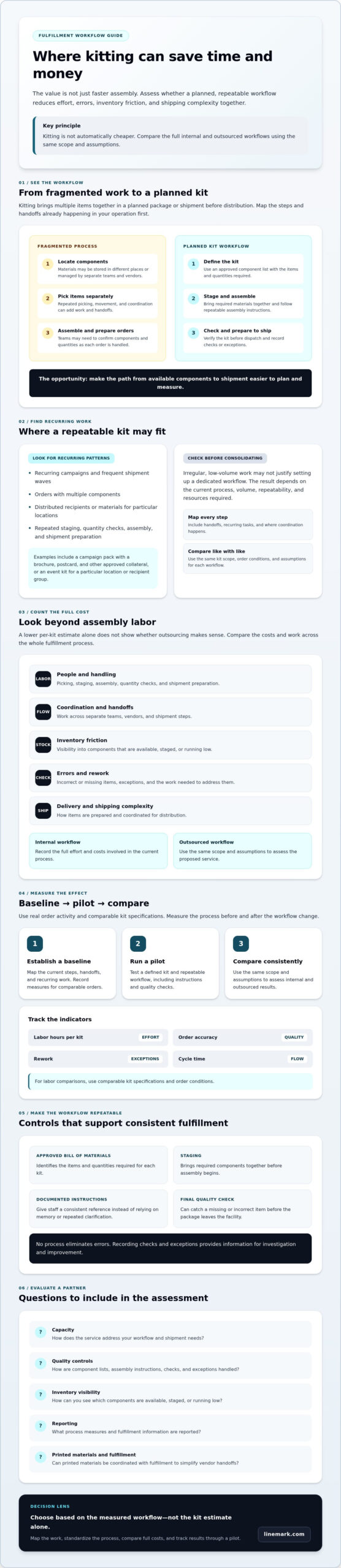
Understanding how kitting services save time and money starts with mapping the work behind each shipment. Kitting means assembling multiple items into a planned package or shipment before distribution. Instead of locating components, picking them separately, assembling each order, and preparing it to ship, a team can bring those tasks together in a repeatable workflow.
That matters when materials are stored in different places or managed by separate teams and vendors. Each handoff can add coordination, movement, and opportunities for confusion. Kitting can reduce handling, but it doesn’t guarantee a lower total cost; the result depends on the workflow, volume, repeatability, and resources your current process requires.
For a broader view of how these activities fit together, see this overview of the order fulfillment process. To see how kitting and staging work in practice, watch this video:
The opportunity is in the steps that happen repeatedly: staging components, checking quantities, assembling the specified items, and preparing completed kits for shipment. When printed materials and fulfillment are coordinated, campaign teams may also have fewer vendor handoffs to manage. The goal isn’t simply to assemble faster. It’s to make the path from available components to a shipment easier to plan and measure.
Which recurring tasks can kitting consolidate?
A defined kit specification gives teams a shared reference for what belongs in each shipment. For example, a campaign pack might combine a brochure, postcard, and other approved collateral; an event kit might bring together materials intended for a particular location or recipient group. Repeatable instructions help reduce the need to confirm components and quantities from scratch for every order wave.
When does kitting create the most opportunity?
Look first at recurring campaigns, orders with multiple components, distributed recipients, or frequent shipment waves. These patterns can make repeatable staging and assembly especially useful because the same tasks recur across orders. By contrast, irregular, low-volume work may not justify setting up a dedicated workflow. Compare the current process with the proposed one, including labor, handling, coordination, and shipping, before assuming savings.
How kitting services reduce handling, errors, and fulfillment delays
A reliable kitting workflow turns a list of components into a controlled sequence of steps. It starts with an approved bill of materials (BOM), which identifies the items and quantities required for each kit. Components are then staged, assembled to the specification, checked, and prepared for dispatch. For a campaign combining printed collateral and other materials, a clear process helps teams confirm that the correct versions and quantities move together.
Each control point supports the next. Staging brings the required components together before assembly begins, while documented instructions give staff a consistent reference instead of relying on memory or repeated clarifications. A final check can catch a missing or incorrect item before the package leaves the facility. No process eliminates errors, but recording checks and exceptions gives teams useful information for investigation and improvement.
How a standardized kitting workflow saves staff time
Repeatedly picking each item for each order can mean extra movement, task switching, and decisions about where materials belong. A defined kit, assembled against a verified component list, gives staff a repeatable path. Staging the required materials together and placing clear work instructions at the assembly point can reduce unnecessary searching. To assess the effect, track labor minutes per kit before and after the workflow change, using comparable kit specifications and order conditions.
Inventory visibility also supports the workflow. Knowing which components are available, staged, or running low helps teams plan replenishment before assembly is due, rather than searching for a missing item at the last minute. For printed campaigns, coordinating production schedules with kitting and distribution planning can help align collateral availability with fulfillment needs.
How quality checks help limit rework and shipment issues
Build checks into the process rather than relying on a quick glance at the end. Depending on the kit specification, verify component identity, quantity, version, and package completeness. If an item is unavailable or a kit fails a check, record the exception and its resolution. This creates a traceable basis for investigating incomplete shipments and identifying recurring process gaps.
Documented kit specifications give every assembly and check a consistent reference, helping teams produce repeatable results and investigate exceptions. That consistency is central to understanding how kitting services save time and money, but measure the impact rather than assuming it. Compare labor time, throughput, accuracy, and rework across similar order waves. If you’re assessing a workflow that combines printed materials and fulfillment, explore kitting and fulfillment capabilities as one part of your evaluation.
Does outsourcing kitting save money? Compare the total cost, not labor alone
Outsourcing shifts work and costs; it doesn’t automatically reduce them. A service fee may exceed the internal work it replaces, especially if your current process is efficient or the project is irregular. To judge how kitting services save time and money, compare the full cost of producing and dispatching completed kits, not just assembly labor.
Use the same order volume, kit specification, service requirements, and time period for both options. Include comparable shipping destinations and assumptions about rework. A model month of actual orders can help keep the comparison grounded in your operating conditions.
| Cost category | In-house estimate | Outsourced estimate |
|---|---|---|
| Labor and oversight | Receiving, locating components, assembly, packing, quality checks, supervision, and coordination | Quoted service scope, exception handling, your team’s vendor management, and communications |
| Space and inventory | Workspace, storage, inventory administration, and any equipment used | Storage terms, inventory access, reporting, and onboarding or data preparation |
| Materials and shipping | Packaging supplies and shipping for completed kits | Packaging included or billed separately, freight, and shipping for completed kits |
| Quality and transition | Rework, incomplete kits, process setup, and ongoing adjustments | Setup work, transition effort, documented quality checks, and exception processes |
Which costs belong in an in-house kitting estimate?
Count staff time across the entire workflow, not only the minutes spent assembling each kit. Include time spent receiving and locating components, checking quantities, packing, and inspecting completed orders. Add packaging supplies, equipment, workspace, storage, inventory administration, and management oversight. Separate direct costs from shared overhead, and state how you allocate shared resources so the estimate is transparent and repeatable.
Which costs and trade-offs belong in an outsourced estimate?
Review what the quote includes, then identify costs that sit outside its scope: onboarding, data preparation, storage, freight, packaging, and exception handling. Ask how you’ll access inventory information, who manages discrepancies, and how turnaround expectations and communication responsibilities are defined. These terms affect operational control as well as cost.
Only compare cost per completed kit after confirming that both options deliver the same kit, quality checks, service level, and shipping outcome. If printed collateral is part of the project, clarify how print production and fulfillment coordination are handled. The better choice is the one whose total cost and process fit your requirements, not simply the option with the lower assembly line item.
How to calculate whether kitting services save your business time and money
To determine how kitting services save time and money in your operation, compare a documented baseline with a clearly scoped alternative. Use the same time period, order volume, kit requirements, and service expectations for both. Credible savings require a defined baseline and equivalent scope.
Use this five-step method:
- Establish a baseline. Record current order volume, component count, labor time, fulfillment duration, errors, and corrections.
- Define the scope. Specify kit contents, packaging, quality checks, destinations, shipping requirements, and who handles exceptions.
- Collect comparable estimates. Apply the same assumptions to internal and outsourced options, including labor, storage, materials, freight, coordination, and rework.
- Run a pilot. Test a representative kit against agreed quality, timing, and reporting requirements.
- Review the results. Compare the pilot with the baseline, investigate differences, and decide whether the process merits wider use.
Calculate cost per correctly completed and dispatched kit by dividing the total in-scope cost for the chosen period by the number of kits that meet the agreed requirements and ship during that period. Include rework and exception costs. Track labor hours per kit, throughput, order accuracy, rework, inventory variance, and cycle time alongside cost. These measures help show whether a lower cost reflects a more effective workflow or simply a change in volume or kit complexity.
Which baseline metrics should teams record first?
Use consistent definitions. For example, decide whether labor time includes supervision and quality checks, and define when cycle time starts and ends. Assign an owner to each measure so information is gathered the same way throughout the evaluation. Note seasonal peaks, campaign changes, and shifts in the kit mix, since these can distort a simple before-and-after comparison.
How can a pilot test the assumptions safely?
Select a representative kit and agree in advance on its specification, acceptable quality, timing expectations, and reporting. Keep unrelated process variables stable where practical, then compare results with the baseline. Review exceptions and their effect on recipients as well as labor and cost. A pilot should reveal both measurable gains and operational issues that need resolving before broader adoption.
If you’re planning an evaluation involving printed materials and fulfillment, discuss your kitting project scope with Linemark.
Choosing a kitting and fulfillment partner for repeatable savings
A partner should fit the work you need done, the controls your team expects, and the way campaign requirements change. Use your own kit specifications and performance measures to assess the relationship, rather than relying on broad claims about speed or scale. The right questions can reveal whether a provider’s process supports repeatable results and gives your team the visibility it needs.
What should you ask before selecting a kitting provider?
Clarify how responsibilities and exceptions will be handled before work begins. Ask prospective providers:
- How are kit specifications documented, approved, and updated when components or versions change?
- What quality checks confirm component identity, quantity, version, and package completeness?
- How can our team view inventory status and order progress, and how are exceptions and fulfillment results reported?
- Who approves substitutions and campaign changes, and who is responsible for replenishment and shipping coordination?
- What capacity is available for our expected order patterns, and how is a change in volume or scope communicated?
Request clear definitions for reporting measures such as completed orders, exceptions, and inventory status. Confirm how often information is shared and who reviews it. Those details help your team identify issues early and assess whether the service is meeting the requirements established during evaluation.
How can an integrated print and fulfillment workflow help?
Campaigns that include printed collateral may involve production, storage, kitting, and distribution planning. Coordinating these activities can reduce the number of separate handoffs your team manages, while helping align material availability with campaign needs. The practical benefit depends on the project scope and how responsibilities are defined, so confirm which steps a provider will handle and what remains with your team.
Linemark’s confirmed services include commercial printing, direct mail, kitting and fulfillment, storage, and nationwide distribution. For campaign planning context, explore the direct mail marketing strategy guide and the MarCom On-Demand guide. Together, they can help frame questions about printed materials, campaign requirements, and distribution without assuming that coordination alone guarantees savings.
Ultimately, how kitting services save time and money depends on a well-defined fit between your workflow and the partner’s scope. Once you’ve set your evaluation criteria, you can discuss your kitting and fulfillment project with Linemark and review the requirements for your operation.
Turn your kitting evaluation into a clearer operating plan
Kitting can simplify fulfillment when it consolidates repeatable work, but reduced handling alone doesn’t prove lower total cost. The clearest way to assess how kitting services save time and money is to compare equivalent scopes, account for the full workflow, and measure results against a documented baseline. Track labor, throughput, accuracy, rework, inventory variance, and cycle time, then use a representative pilot to test your assumptions.
Partner fit matters, too. Confirm how kit specifications, quality checks, inventory visibility, exceptions, and reporting will work before committing. For campaigns that include printed materials, coordinating printing, direct mail, kitting, storage, and nationwide distribution may help bring preparation and fulfillment into a more unified process. With decades of industry experience and expansive facilities, Linemark is equipped to handle complex fulfillment demands smoothly and efficiently.
Ready to assess the requirements for your operation? Discuss your kitting and fulfillment requirements with Linemark. With a clear scope and measurable criteria, you can make a confident decision about the next step for your fulfillment process.
Frequently Asked Questions
How do kitting services save time and money?
Kitting can save time by combining recurring tasks such as staging components, assembling packages, checking contents, and preparing shipments. Understanding how kitting services save time and money requires looking at the whole workflow: reduced handling, staff coordination, avoidable errors, and delays may all contribute. The result depends on order volume, kit complexity, current processes, service scope, and shipping needs. Compare a documented baseline with equivalent post-kitting costs before claiming financial savings.
Is outsourcing kitting cheaper than doing it in-house?
Not necessarily. Outsourcing may reduce internal labor, workspace needs, and coordination, but provider fees, storage, onboarding, shipping, and exception handling also affect the total. Compare identical kit specifications, order volumes, and service expectations for both options. Include the same time period and shipping assumptions. If your current process is simple or infrequent, keeping the work in-house may be more practical than introducing a new workflow.
What costs should I include when comparing kitting services?
Include internal labor, supervision, workspace, storage, packaging materials, inventory administration, shipping, and rework. For an outsourced option, account for service fees, onboarding, storage terms, freight, data preparation, and exception handling. Use consistent assumptions and a defined time period so the comparison reflects equivalent work. Comparing an hourly labor rate with a provider fee alone can hide differences in scope and leave important parts of the total cost uncounted.
How can I measure time saved by a kitting provider?
Record the time your current team spends receiving and locating components, assembling kits, checking contents, and preparing shipments. After a process change, track the same tasks for comparable orders. Measure labor time per completed kit, order cycle time, rework, and throughput. Also note changes in order volume, kit complexity, or campaign requirements. This context helps distinguish process improvements from results caused by unrelated changes in the work.
Does kitting reduce order errors?
A documented kitting process can make component lists, quantities, versions, and quality checks more consistent. That may help teams catch missing or incorrect items before dispatch, but kitting doesn’t guarantee error-free orders. Measure order accuracy and rework using agreed definitions. Ask a provider how it verifies kit contents, records exceptions, and reports issues. Reviewing these records can help identify recurring problems and guide practical process improvements.
What types of businesses benefit most from kitting services?
Kitting may suit organizations that regularly combine several items into campaign packs, event materials, sample packages, or customer shipments. It can be useful when multiple teams or vendors handle components before dispatch, especially if the work follows repeatable specifications. The fit depends on volume, storage needs, and fulfillment requirements. For occasional, simple orders, compare the effort of setting up a kitting workflow with the likely operational benefit before deciding.
What should I ask a kitting and fulfillment provider before choosing one?
Ask how the provider documents kit specifications, manages version changes, checks quality, and reports inventory status, order progress, exceptions, and fulfillment results. Clarify who approves substitutions, coordinates shipping, manages replenishment, and communicates campaign changes. Request a clearly scoped estimate and agree on service measures before a pilot. These questions help you compare providers on workflow fit and accountability, not just a headline fee.