

 09/21/2026
  Steve Bearden
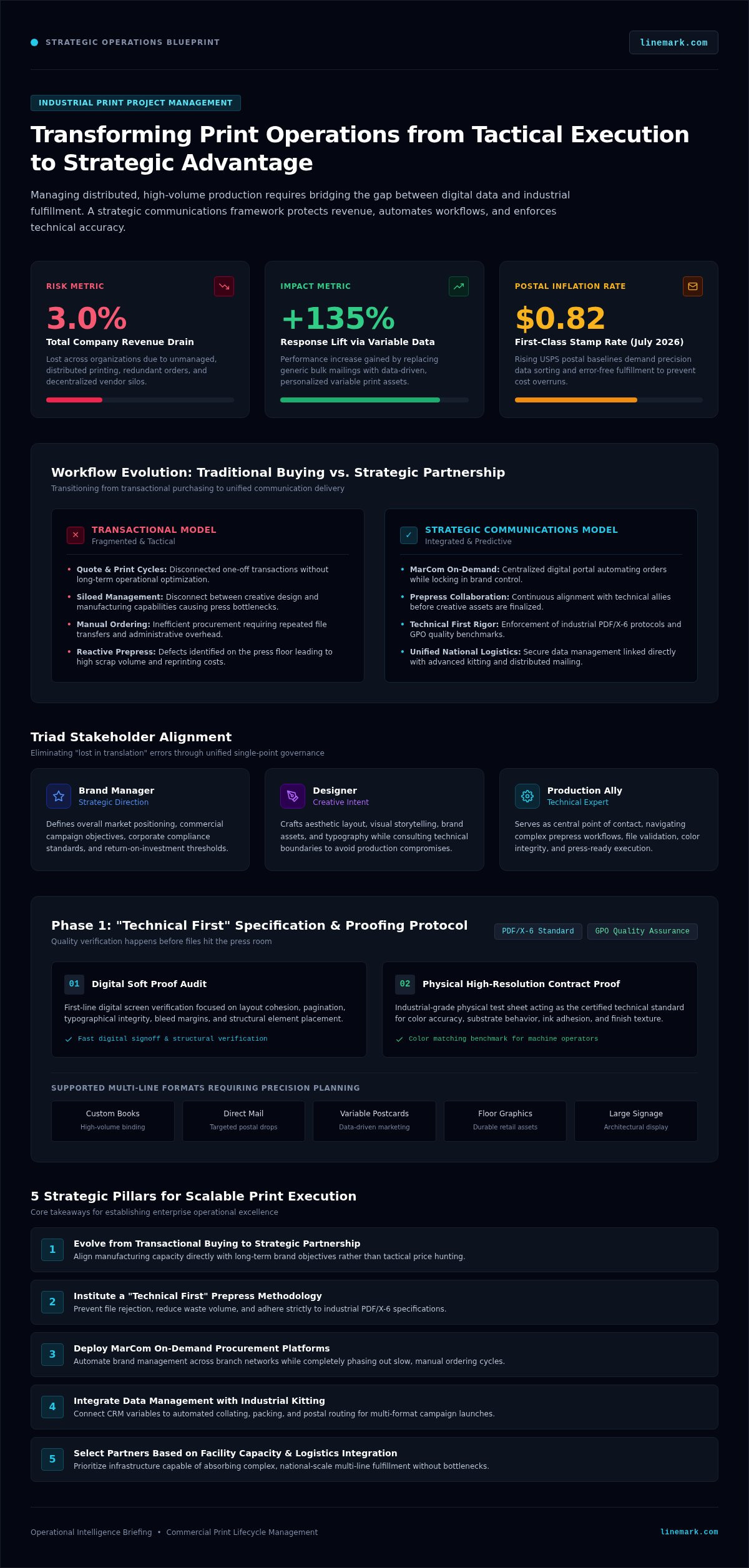
Did you know that unmanaged, distributed printing can drain up to 3% of a company’s total revenue? In a high-stakes production environment, a single technical oversight or a missed shipping window doesn’t just waste paper; it erodes your bottom line and compromises brand integrity. You’re likely juggling the pressure of rising USPS postage rates, which hit $0.82 for First-Class stamps in July 2026, while trying to maintain precision across books, signage, and direct mail. Mastering print project management best practices is no longer a tactical box to check. It’s a strategic necessity for any organization that values operational excellence and predictable results.
We understand the frustration of managing multiple production lines and the anxiety that comes with high-volume fulfillment. It’s a complex landscape where data-driven marketing meets industrial logistics. This guide provides the professional frameworks you need to eliminate production errors and reduce per-unit costs. We’ll walk through the technical specifications of PDF/X-6 standards, the integration of variable data printing for a 135% response lift, and the logistics of national kitting and distribution. By the end, you’ll have a repeatable roadmap to transform your print operations into a streamlined, high-performance engine.
Key Takeaways
- Evolve from transactional print buying to a strategic partnership model that aligns production with long-term marketing goals.
- Master print project management best practices through a “Technical First” methodology that prevents file rejection and minimizes material waste.
- Leverage MarCom On-Demand technology to automate brand management and replace inefficient, manual ordering cycles.
- Optimize logistics by integrating secure data management with sophisticated kitting processes for unified, high-volume campaign delivery.
- Identify the infrastructure requirements necessary to scale complex projects, prioritizing partners with significant facility capacity and integrated distribution.
Mastering Print Project Management: Why Strategy Beats Execution
In an era of rapid digital saturation, the physical touchpoint remains a powerful tool for brand differentiation. Effective print project management is the holistic oversight of design, production, and distribution. It ensures that your message doesn’t just look good on a screen but performs perfectly in the hands of your audience. Many businesses suffer from the high cost of siloed management. When design and logistics are disconnected, you face production bottlenecks and avoidable waste. Print project management is the critical link between brand vision and physical delivery.
Adopting modern print project management best practices transforms the production process into a competitive advantage. You aren’t just buying paper; you’re building a strategic communications partnership. This collaborative approach moves beyond the transactional “quote and print” model, focusing instead on long-term efficiency and brand consistency. It positions your organization to handle high-volume projects with the meticulous attention to detail usually reserved for boutique shops.
To better understand how technical setup impacts the final result, watch this helpful video:
The 2026 Landscape of Commercial Printing
The current market landscape prioritizes speed and personalization. Data-driven print materials, such as variable data postcards, now drive significantly higher response rates than generic blasts. Managing these complex assets requires a partner capable of handling national-scale marketing campaigns without sacrificing detail. Advanced technology now allows for rapid production cycles, but it requires a sophisticated understanding of technical requirements to succeed. Scalability isn’t just about volume. It’s about maintaining precision across diverse formats like custom books, floor graphics, and direct mail.
Key Stakeholders in the Print Lifecycle
Cohesion starts with identifying roles. The Brand Manager provides the strategic direction, and the Designer crafts the aesthetic. The Production Ally serves as the technical expert who navigates prepress production workflows to ensure every file is press-ready. Having a centralized point of contact is vital for complex, multi-line orders. It eliminates the confusion of managing multiple vendors and keeps all parties aligned. This unified partnership is a signature of modern operational excellence. It ensures your project moves from a business challenge to a concrete, scalable solution without the risk of “lost in translation” errors. Using established print project management best practices ensures that all stakeholders remain synchronized throughout the project journey.
Phase 1: Precision Planning and Technical Specification Mastery
Success in large-scale production isn’t determined on the press floor; it’s decided during the planning phase. Adopting a “Technical First” approach is one of the most effective print project management best practices to prevent costly reprints and production delays. You shouldn’t wait until the design is finalized to consult your production ally. Early collaboration allows you to align creative intent with the physical capabilities of industrial machinery. This proactive spirit ensures that your files meet the rigorous benchmarks often found in GPO quality assurance and paper specifications, which set the standard for industrial reliability and material performance.
Proofing is the final safeguard in high-volume commercial printing. It isn’t just a formality; it’s a technical audit. Whether you’re reviewing a digital soft proof or a physical high-resolution contract proof, you’re looking for color accuracy and layout integrity. A single error at this stage can multiply into thousands of wasted units. To maintain precision, your technical checklist must include:
- Color Profiles: Target press-specific ICC profiles like GRACoL 2013 to ensure color consistency across different machines.
- Bleed and Safety: Maintain a minimum 0.125-inch bleed on all exterior edges and keep critical text within a 0.25-inch safe zone.
- Resolution: Ensure all continuous tone images are exactly 300 DPI at 100% reproduction size to avoid pixelation.
- Rich Black: Use a balanced formula, typically 60% Cyan, 40% Magenta, 40% Yellow, and 100% Black, for large dark areas to prevent a washed-out appearance.
Defining Project Scope and Specifications
Choosing the right production method depends on your specific goals. Offset printing offers lower per-unit costs for massive runs, while digital printing excels in speed and variable data integration. For large format graphics, substrate selection is critical. You’ll need durable, weather-resistant materials for outdoor banners, whereas indoor murals might prioritize matte finishes to reduce glare. If your project involves custom book printing, your choice of binding, such as perfect binding or case binding, will dictate the final aesthetic and long-term durability.
Building an Accurate Production Timeline
A realistic timeline is your best defense against missed deadlines. Always factor in buffer days for technical adjustments and unexpected proofing cycles. Offset runs require significant drying time before they can move to binding or finishing. If you’re using specialized coatings or digital foils, these add essential steps to the production journey. Finally, integrate nationwide shipping and fulfillment into your calculations to ensure the product arrives exactly when needed. If you’re ready to start your next project with a partner who values precision, consider how a centralized production facility can streamline your entire workflow.
Optimizing Workflows: Traditional Production vs. MarCom On-Demand
The traditional “Quote-Order-Print” cycle often acts as a bottleneck in high-velocity marketing environments. This manual approach relies on repetitive data entry, fragmented communication, and long wait times for approvals. Transitioning to automated workflows is a cornerstone of modern print project management best practices. By utilizing a centralized digital asset library, you ensure that brand consistency is maintained across every department and location. This eliminates the risk of using outdated logos or incorrect color palettes, protecting your brand equity at scale.
For organizations with distributed teams, MarCom On-Demand provides a sophisticated solution that balances local agility with corporate control. These portals allow users to customize pre-approved templates for localized needs while strictly adhering to your core brand standards. This automation significantly reduces administrative overhead, allowing your team to focus on strategy rather than manual order processing. When managing direct mail assets through these systems, the software can even enforce USPS commercial mail physical standards, ensuring every piece is optimized for automation and the lowest possible postage rates before it ever reaches the press.
The Benefits of Web-to-Print Portals
Web-to-Print portals offer more than just an ordering interface; they provide a comprehensive management system for your entire collateral library. Real-time inventory tracking allows you to monitor usage patterns and avoid the panic of a stock-out. Role-based permissions ensure that only authorized personnel can place orders, giving you granular control over your marketing spend. Automated reordering triggers can be set to alert your production ally when stock levels hit a specific threshold, ensuring seamless continuity for essential items like brochures and catalogs.
When to Choose Custom Production Over On-Demand
While on-demand portals excel at managing standardized inventory, certain high-complexity projects still require a bespoke approach. Massive offset runs for annual reports or complex catalogs often benefit from the custom engineering and lower per-unit costs found in traditional production. Similarly, one-off large format graphics for a specific trade show or a unique wall mural installation require individual attention to substrate selection and site-specific logistics. Balancing your standard inventory on a portal with specialized, high-impact marketing kits ensures you maintain both operational efficiency and creative impact. Integrating these diverse needs into your print project management best practices ensures your organization remains agile and responsive to market opportunities.
The Logistics of Success: Data Management, Kitting, and Fulfillment
The final phase of any complex campaign lies in its physical distribution. Implementing print project management best practices at the logistics stage prevents the “last mile” failures that often derail otherwise perfect campaigns. For high-volume direct mail initiatives, your data management strategy is just as critical as your ink-on-paper quality. Secure data handling ensures that sensitive information remains protected while reaching the correct recipient. Variable data printing turns a generic mailer into a personalized conversion tool by tailoring images and offers to individual recipient profiles. When these personalized pieces are ready, the kitting process begins, which involves the sophisticated assembly of diverse print items into a single, cohesive package. National fulfillment capabilities are essential here, providing the infrastructure needed for rapid, synchronized distribution across the country.
Variable Data Printing (VDP) Best Practices
Precision in VDP starts with rigorous data hygiene. To claim maximum postage discounts and reduce waste, your lists must undergo CASS Cycle O validation and NCOALink processing. According to July 2026 industry benchmarks, dynamic personalization via VDP produces an average 135% response lift compared to generic blasts. Achieving this requires mapping data fields precisely to creative assets during the design phase. Your production ally should employ strict quality control protocols, including data-to-print audits, to ensure every name and address aligns perfectly with the intended personalized content. This meticulous attention to detail transforms a standard mailing into a high-performance marketing asset.
Streamlining Kitting and Fulfillment
Successful fulfillment depends on the seamless integration of inventory management with physical pick-and-pack services. By centralizing these operations, you can reduce scrap and warehouse holding fees by an average of 20% to 40%. Refining your print project management best practices should include a transition from bulk warehousing to on-demand kitting. This strategy allows you to combine standard stock items with specialized, high-impact materials only when an order is triggered. Strategic warehousing near major distribution hubs further lowers shipping costs and shortens transit times. Real-time tracking and reporting provide the visibility you need to manage multi-location distribution with confidence, ensuring every kit arrives on schedule. Learn how integrated kitting and distribution can scale your next national campaign.
Scaling with Confidence: Choosing a Strategic Communications Partner
Selecting a production partner is the final, most consequential decision in your campaign lifecycle. Even the most robust internal print project management best practices will fail if your production ally lacks the physical capacity to execute your vision. You need an organization that functions as a strategic communications ally, moving beyond simple ink-on-paper to provide a unified, high-capacity solution. Industrial authority is built on infrastructure. A 90,000-square-foot facility isn’t just a number; it represents the ability to house offset presses, digital lines, large format graphics production, and automated kitting under one roof. This centralization eliminates the logistical friction of moving parts between multiple vendors, ensuring your project remains under a single, rigorous quality control protocol from inception to nationwide delivery.
Assessing Technical Capability and Capacity
A capable partner must offer a versatile technology stack. Look for a mix of high-volume offset capabilities for cost-efficiency and industrial-scale digital printing for variable data agility. This ensures you can scale from a targeted local mailing to a massive national campaign without switching providers. Verify that binding, finishing, and fulfillment are handled in-house. When these processes are fragmented, lead times stretch and the risk of error increases. Additionally, prioritize partners who demonstrate a commitment to data security and modern software integration, such as proprietary MarCom On-Demand portals. These tools allow you to manage your brand assets with the same precision you apply to your digital marketing channels.
The Long-Term Value of an Integrated Ally
The most successful organizations move from “per-project” thinking to an annual communications strategy. An integrated ally understands your brand’s nuances and proactively suggests ways to optimize your spend. This might include leveraging USPS promotions to offset the cost of premium specialty finishes or adjusting paper weights to meet strict postal tolerances. With over 30 years of experience, Linemark provides the seasoned expertise and agile problem-solving required to navigate the complexities of 2026 marketing logistics. We function as a centralized destination for your diverse needs, transforming the production process from a transaction into a premium, holistic journey. Our high-touch service ensures your project is in steady, capable hands, allowing you to focus on growth while we handle the precision of delivery. Adopting these print project management best practices alongside a high-capacity partner ensures your brand remains impactful and efficient. Partner with Linemark for your next complex print project.
Transforming Strategy into Scalable Print Success
Mastering the 2026 print landscape requires more than just high-quality equipment; it demands a unified vision that bridges the gap between creative design and national fulfillment. By implementing these print project management best practices, your organization can move from a fragmented, reactive approach to a streamlined, proactive partnership. Centralizing your production within a high-capacity environment ensures that every technical specification, from color profiles to variable data mapping, is handled with industrial precision.
Linemark brings 30+ years of industrial print expertise to every project, operating out of a 90,000-square-foot production facility to ensure your work scales without friction. Our integrated MarCom On-Demand technology empowers your team to protect brand integrity while automating the ordering process. This isn’t just about printing; it’s about building a robust communications engine that drives growth and reduces operational waste.
Don’t let production complexity slow your marketing momentum. Streamline your print projects with Linemark’s expert management and experience the confidence that comes with a seasoned strategic ally. Your next major campaign is ready for the precision it deserves.
Frequently Asked Questions
What are the most common mistakes in print project management?
The most frequent failures include disconnected communication between design and production teams, which leads to technical errors and missed deadlines. Neglecting print project management best practices during the file preparation stage often results in incorrect bleeds or low-resolution images that stall the press. Additionally, failing to account for mailing logistics early in the process can lead to significant postage overages and distribution delays that compromise the ROI of high-volume campaigns.
How do I choose between offset and digital printing for my project?
Your choice depends primarily on the project volume and the need for personalization. Offset printing is the industrial standard for massive, static runs like catalogs or annual reports because it offers the lowest per-unit cost at scale. Digital printing is the superior choice for shorter runs or projects requiring variable data printing. It provides faster turnaround times and allows for deep customization, making it ideal for targeted direct mail and personalized marketing collateral.
What is the difference between kitting and simple fulfillment?
Kitting is the specialized process of assembling multiple distinct items into a single, cohesive package before distribution. This might include combining a brochure, a personalized letter, and a promotional item into one branded box. Fulfillment is the broader logistical operation that encompasses secure warehousing, order processing, and nationwide shipping. While fulfillment gets the product to the destination, kitting ensures the recipient receives a curated, high-impact experience that reflects your brand’s attention to detail.
How can I ensure brand consistency across different print materials?
Maintaining consistency across diverse materials like wall murals and newsletters requires a centralized digital asset library. By utilizing a MarCom On-Demand portal, you ensure that every department uses the same approved logos, fonts, and color palettes. It’s also critical to work with a partner who uses standardized ICC color profiles across both digital and offset machinery. This unified approach prevents the visual drift that often occurs when managing projects across fragmented, uncoordinated vendor networks.
What data security standards should I look for in a print partner?
When handling sensitive mailing lists, you must verify that your partner follows rigorous data security protocols. Look for certifications such as SOC 2 compliance or HIPAA standards if your organization is in the healthcare sector. A professional print ally should utilize secure file transfer protocols (SFTP) and maintain encrypted environments for all data-driven projects. Ensuring your partner has a dedicated focus on data hygiene and security protects your organization from liability and maintains the trust of your audience.
How does a MarCom On-Demand portal save money on print management?
A MarCom On-Demand portal reduces costs by automating the administrative tasks associated with traditional ordering cycles. It eliminates the need for massive inventory warehousing by enabling just-in-time production, which slashes scrap and obsolescence rates. These portals allow corporate teams to control marketing spend across national offices while ensuring every piece produced adheres to established print project management best practices. This efficiency transforms print from a variable expense into a controlled, strategic asset for the brand.
What is the typical lead time for a high-volume custom book printing project?
Typical lead times for high-volume custom book printing generally range from two to four weeks, depending on the complexity of the binding and finishing requirements. Simple softcover projects might move through a 90,000-square-foot facility faster than case-bound books that require specialized drying times and custom materials. It’s essential to factor in buffer days for technical audits and proofing cycles to ensure the final product meets your quality expectations without compromising your distribution deadline.
Why is variable data printing important for direct mail ROI?
Variable data printing is critical because it transforms a generic mailing into a high-performance conversion tool. According to 2026 industry data, personalized content can produce a 135% lift in response rates compared to static mailers. By tailoring images and offers to individual recipient behavior, you create a more relevant and engaging experience. This precision reduces the cost per acquisition and ensures your marketing budget is focused on the most impactful physical touchpoints for your audience.