


 09/18/2026
  Steve Bearden
Can a high-volume print campaign actually be the catalyst for your corporate sustainability goals rather than a hurdle to overcome? For too long, the industry has operated under the false assumption that recycled materials and sustainable processes result in a duller, lower-quality finished product. You likely feel the mounting pressure to reduce your brand’s carbon footprint while maintaining the impeccable standards of your custom books and direct mail. It’s a difficult balance to strike, especially when national-scale fulfillment is on the line. By integrating modern eco-friendly commercial printing services into your strategy, you can finally align your high-capacity production needs with your environmental commitments.
This 2026 guide provides a clear roadmap for optimizing the intersection of industrial production and environmental stewardship. You’ll discover how advanced print technology and data-driven logistics, such as MarCom On-Demand, eliminate waste and optimize every stage of the lifecycle. We’ll provide a framework for evaluating green print partners and demonstrate how centralized production in a high-capacity facility can significantly reduce logistics-related emissions. From the chemistry of the inks to the efficiency of the distribution model, we’re outlining a path toward sustainable production that strengthens your brand’s impact without sacrificing its aesthetic integrity.
Key Takeaways
- Understand how sustainable production has evolved into a holistic lifecycle approach that balances material sourcing, energy efficiency, and waste management.
- Discover how modern eco-friendly commercial printing services utilize bio-derived inks and ethical substrates to deliver high-volume projects without compromising on color or quality.
- Learn to leverage variable data printing and digital on-demand technology to eliminate redundant inventory and reduce the carbon footprint of direct mail campaigns.
- Explore how centralized digital asset management through MarCom On-Demand streamlines distributed marketing and prevents unnecessary print waste.
- Identify the strategic advantages of a centralized 90,000-square-foot production hub in optimizing logistics and lowering total environmental impact.
What Defines Eco-Friendly Commercial Printing in 2026?
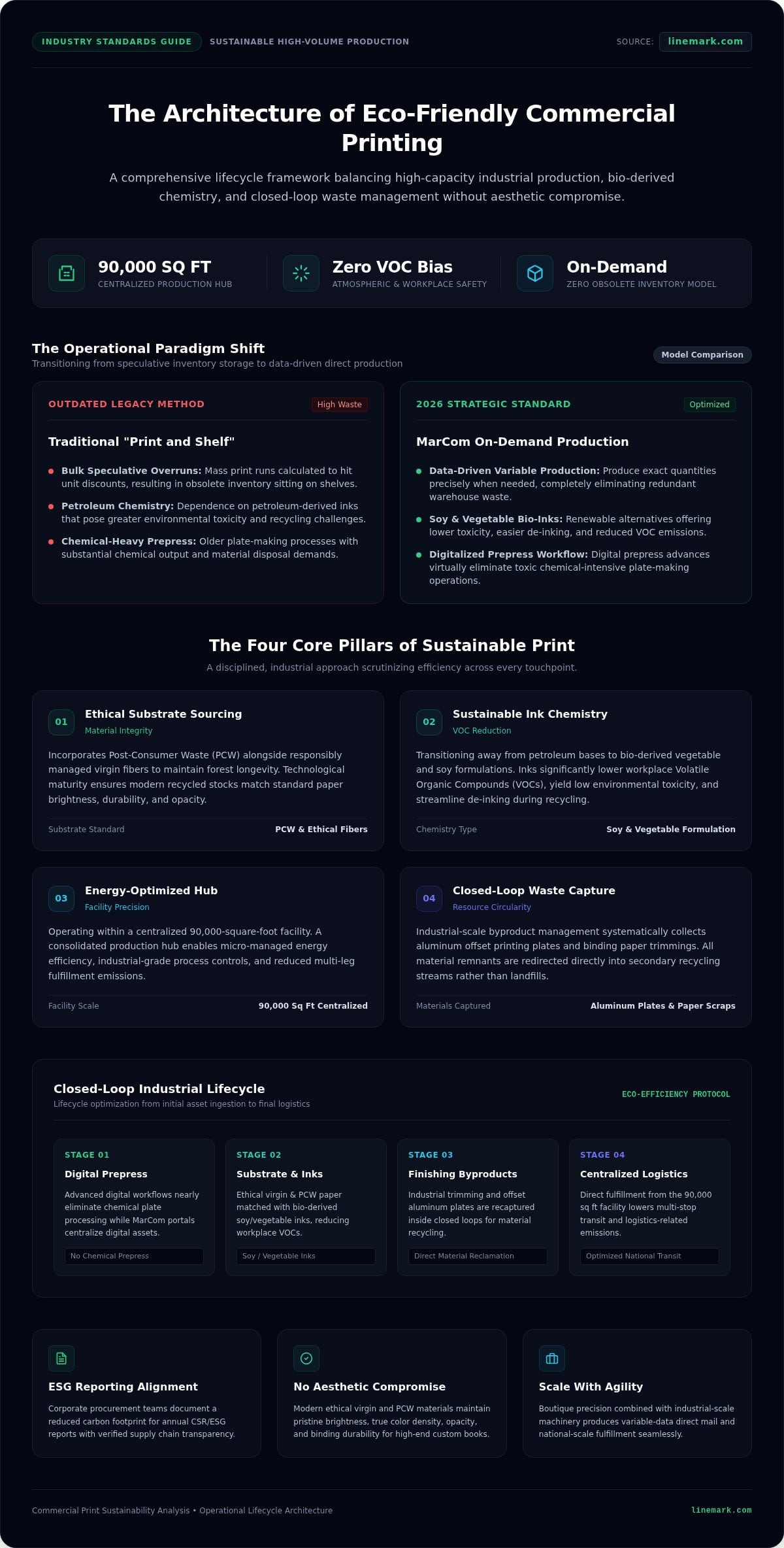
The definition of eco-friendly commercial printing services has evolved far beyond the simple selection of recycled paper. In 2026, sustainability is a holistic operational framework that encompasses material sourcing, energy consumption, and aggressive waste management. High-capacity production facilities now view environmental impact through a comprehensive lifecycle lens. This means analyzing every touchpoint from the initial digital file to the final logistics of national fulfillment. A centralized 90,000-square-foot production hub allows for a more controlled environment where energy efficiency and waste streams can be managed with industrial precision.
Modern print environments prioritize the reduction of Volatile Organic Compounds (VOCs) to ensure safer workspaces and a cleaner atmosphere. This shift is paired with the rise of on-demand production as a fundamental pillar of sustainability. By utilizing data-driven systems like MarCom On-Demand, organizations can produce exactly what they need, exactly when they need it. It’s a method that eliminates the outdated “print and shelf” model that often leads to massive amounts of obsolete inventory and wasted resources.
The Evolution of Sustainable Print Technology
Digital advancements have fundamentally transformed prepress operations by nearly eliminating the chemical-heavy plate-making processes of the past. The industry has largely transitioned from petroleum-based inks to vegetable and soy-based alternatives, which offer easier de-inking during recycling and lower environmental toxicity. Sustainable printing is the integration of renewable resources and waste-minimizing technology. These innovations allow a large-scale facility to operate with the precision of a boutique shop while maintaining industrial-scale output. It’s about using technology to ensure that high-volume projects don’t come at a high environmental cost.
Why Corporations are Prioritizing Green Printing
Strategic communications now play a critical role in Environmental, Social, and Governance (ESG) reporting. Corporate procurement teams aren’t just looking for a vendor; they’re looking for a strategic partner that can document a reduced carbon footprint for their annual reports and marketing collateral. Consumers increasingly demand transparency and ethical supply chains, making the choice of a print partner a reflection of brand values. Aligning your print strategy with these expectations doesn’t just satisfy a checklist; it builds long-term customer loyalty and reinforces your position as a forward-thinking market leader. This transition from transactional buying to a collaborative partnership ensures that every direct mail campaign or custom book project supports the client’s broader growth objectives.
The Core Pillars of Sustainable Printing Practices
Executing high-volume print projects with an environmental focus requires more than just a “green” label. It demands a disciplined approach to industrial production where every component of the process is scrutinized for efficiency. True eco-friendly commercial printing services are built upon four fundamental pillars: ethical substrate sourcing, sustainable ink chemistry, energy-optimized facilities, and rigorous waste stream management. When these elements work in unison, the result is a production cycle that supports corporate sustainability goals without compromising the precision or scale required for national campaigns.
Modern facilities now utilize closed-loop systems to handle byproduct materials. Aluminum plates used in offset printing and paper scraps from the binding process aren’t simply discarded; they’re captured and redirected into recycling streams. This industrial-scale recycling, combined with energy-efficient equipment in a centralized 90,000-square-foot facility, creates a streamlined operation that lowers the total carbon footprint of every project. It’s an optimization of resources that mirrors the operational excellence expected by sophisticated marketing teams.
Substrates and Material Innovation
The choice of material is the most visible aspect of a sustainable project. While post-consumer waste (PCW) remains a staple, the industry has expanded to include responsibly managed virgin fibers that ensure forest longevity. Modern recycled stocks have reached a point of technological maturity where they match the brightness, opacity, and durability of standard papers. This innovation extends to large format graphics, where recyclable banners and murals now provide high-impact visuals without the long-term environmental cost of traditional plastics. Selecting the right substrate is a strategic decision that balances tactile quality with environmental responsibility.
Eco-Friendly Finishing and Binding
The final stages of production often present the greatest challenges for recyclability. Traditional UV coatings, while durable, can complicate the de-inking process during recycling. Choosing aqueous coatings provides a similar level of protection and sheen while remaining much friendlier to recycling systems. In the realm of binding & finishing, the transition to sustainable adhesives ensures that custom books are both sturdy and eco-conscious. These technical nuances are where a strategic print partner adds the most value, helping you navigate complex material specifications to ensure your finished product is as responsible as it is professional. By focusing on these details, you ensure that the entire lifecycle of your printed materials aligns with your brand’s commitment to the planet.
Digital vs. Offset: Which is Greener for High Volumes?
Choosing between digital and offset technologies is a strategic decision that directly affects a project’s environmental footprint. While digital is often praised for its “plate-free” process, high-volume offset printing remains highly competitive when evaluated through a lifecycle lens. The key lies in the break-even point where the efficiency of a long run overcomes the initial carbon investment of setup and plate production. Modern eco-friendly commercial printing services leverage both technologies to ensure that every campaign, whether it’s a few hundred custom books or a million postcards, is produced with the lowest possible waste.
Consolidating these operations within a 90,000-square-foot facility offers a distinct logistical advantage. Centralized production minimizes the carbon emissions associated with moving materials between multiple sites. This integrated approach ensures that quality control and sustainability standards remain consistent throughout the production cycle, from the first sheet to the final shipment.
The Sustainability of High-Volume Offset Printing
Modern sheet-fed offset presses have undergone significant technological refinements to minimize paper spoilage. Advanced automated make-ready systems allow for faster ink-to-paper balance, which dramatically reduces the amount of “setup” paper typically discarded. The materials used in this process are also increasingly sustainable. Aluminum printing plates are 100% recyclable, and the industry’s shift toward vegetable-based and soy-based inks has made the final printed product easier to de-ink during the recycling process. For massive runs, the speed and scale of offset printing provide an energy efficiency that digital cannot yet match on a per-unit basis.
Digital Printing and Waste Reduction
Digital printing excels in its ability to eliminate the physical overhead of plates and the associated chemistry of traditional prepress. This technology is the backbone of on-demand production models that prevent the creation of obsolete inventory. One of the most significant environmental advantages of digital technology is its support for Variable Data Printing (VDP). This capability allows for a more targeted approach to communication.
- Personalized Targeting: Using VDP in direct mail ensures that content is relevant to the recipient, which increases response rates and reduces the volume of unwanted mail.
- Precision Fulfillment: Digital systems allow for “just-in-time” production, meaning you only print what you need for a specific window of time.
- Reduced Chemical Footprint: The absence of plates and traditional fountain solutions simplifies the manufacturing process and reduces waste streams.
By selecting the technology that best fits the volume and goals of your project, you ensure that high-impact communication doesn’t lead to high-impact waste. This technical precision is what allows a brand to scale its reach while maintaining its commitment to environmental stewardship.
Strategic Waste Reduction with On-Demand Portals
Sustainability in the modern print environment isn’t just about what happens on the press; it’s about how resources are managed before they ever reach the production floor. Strategic waste reduction is achieved by shifting from a speculative “print-and-warehouse” model to a precise “print-to-order” workflow. For organizations with distributed teams, the traditional method of bulk ordering often leads to significant obsolescence. When marketing collateral becomes outdated while sitting on a shelf, the environmental and financial costs are substantial. By utilizing sophisticated eco-friendly commercial printing services, brands can implement centralized digital asset management to ensure that only the most current and necessary materials are produced.
Centralizing these operations within a 90,000-square-foot production and distribution hub further optimizes the process. This scale allows for sophisticated kitting and fulfillment strategies that reduce the total number of shipments required. When production, inventory, and distribution happen under one roof, the logistics-related carbon footprint is naturally minimized. This isn’t just an operational improvement. It’s a strategic alignment of marketing goals with environmental stewardship.
Streamlining the Supply Chain
Implementing marcom on-demand portals fundamentally changes how corporations manage their physical storage footprint. Instead of maintaining massive warehouses filled with aging paper stocks, teams can order materials as they are needed. This just-in-time approach prevents paper aging, where stored materials become yellowed or damaged over time, leading to additional waste. Real-time reporting tools within these portals allow marketing executives to track usage patterns across the entire organization. This visibility makes it possible to identify specific waste-reduction opportunities and adjust production volumes to match actual demand, ensuring that every print run is lean and purposeful.
Personalization as a Sustainability Strategy
Personalization is often viewed solely as a marketing tactic, yet it serves as a powerful sustainability strategy. By using variable data, every printed piece is tailored to the specific needs and interests of the recipient. This relevance leads to higher engagement rates, which means fewer materials end up in the recycling bin without being read. Data-driven printing ensures that zero resources are wasted on unread materials. When each postcard or brochure has a higher probability of conversion, the environmental impact per successful interaction is significantly lowered. It’s a method that values quality of engagement over sheer volume of output. To see how these tools can optimize your next campaign, explore our centralized print and fulfillment solutions.
Partnering with Linemark for Sustainable Communication
Selecting a partner for high-volume production requires a shift in perspective from a transactional vendor relationship to a strategic communications alliance. At Linemark, we operate a 90,000-square-foot facility designed as a centralized hub for high-tech, efficient production. This scale allows us to provide eco-friendly commercial printing services that don’t force a compromise between your sustainability goals and your need for national-scale fulfillment. By housing production, binding, and fulfillment under one roof, we significantly minimize the transit requirements that typically inflate a project’s carbon footprint.
Our 30+ years of industrial experience translates into a level of precision that serves as a primary defense against waste. Production errors are the hidden enemy of sustainability; every misprint or incorrect shipment represents a double consumption of energy and materials. We’ve refined our workflows to ensure that complex, high-volume projects are executed with the meticulous attention to detail usually reserved for boutique shops. This reliability ensures that your resources are used efficiently, protecting both your budget and your environmental commitments.
Industrial Capability Meets Precision Detail
Working with a high-capacity provider offers a unique advantage for the modern supply chain. Our integrated service model-encompassing everything from initial digital printing to nationwide distribution-creates a leaner, more responsive cycle. This integration means fewer hand-offs between third-party vendors and a more transparent view of your project’s lifecycle. We’re committed to leveraging advanced technology, such as variable data systems and on-demand portals, to benefit both our clients and the environment. This forward-thinking approach transforms your print strategy into a catalyst for corporate growth rather than a logistical challenge.
Getting Started with Your Sustainable Print Project
Transitioning to a more responsible print strategy doesn’t have to happen all at once. We recommend a phased approach that starts with a thorough assessment of your current needs and waste-reduction opportunities:
- Conduct a Print Audit: Evaluate your current inventory and usage patterns to identify areas where on-demand production can replace bulk ordering.
- Material Consultation: Collaborate with our experts to select substrates and finishing techniques that align with your brand’s aesthetic and environmental standards.
- Unified Strategy: Move toward a centralized communication model that utilizes data-driven personalization to increase engagement and reduce total print volume.
This collaborative journey ensures that your transition to eco-friendly commercial printing services is both seamless and effective. By aligning your high-volume projects with our technical production capabilities, you create a sustainable communication model that is built for the future. We’re ready to act as your strategic partner, helping you navigate the nuances of modern marketing and logistics with confidence and precision.
Scaling Impact Through Responsible Production
Aligning high-volume print requirements with corporate sustainability goals is no longer a trade-off between quality and environmental ethics. It’s a strategic optimization of technology and logistics. By leveraging advanced digital and offset capabilities, you ensure that every campaign is lean, purposeful, and precise. Integrating eco-friendly commercial printing services into your workflow reduces the carbon footprint of your direct mail and custom book projects while maintaining the aesthetic standards your brand demands.
Success in 2026 relies on a strategic communications ally that understands the complexities of modern marketing. With over 30 years of industrial print authority and a 90,000-square-foot high-tech facility, we provide the centralized infrastructure needed to minimize transit waste and maximize efficiency. Our comprehensive MarCom On-Demand integration allows your team to produce only what is necessary, eliminating the burden of obsolete inventory. It’s time to transform your production cycle into a catalyst for sustainable growth. Partner with Linemark for your next sustainable print project and lead your industry with confidence.
Frequently Asked Questions
What makes a printing service truly “eco-friendly”?
A truly eco-friendly commercial printing service adopts a comprehensive lifecycle approach to production. This includes sourcing ethical substrates, utilizing bio-derived inks, and optimizing energy consumption within a high-capacity facility. It’s also about managing waste streams effectively, such as recycling aluminum plates and paper scraps. By centralizing these operations in a 90,000-square-foot hub, a provider can significantly reduce the carbon emissions associated with logistics and multi-site transit.
Is sustainable printing more expensive than traditional methods?
Sustainable printing doesn’t have to carry a higher price tag. While certain specialty recycled papers may have a slight premium, the transition to on-demand production models often results in significant total cost savings. By eliminating obsolete inventory and reducing warehousing needs, you’re only paying for the materials that actually reach your audience. Modern efficiencies in digital and offset technology ensure that eco-friendly commercial printing services remain competitive with traditional methods.
Does using recycled paper affect the quality of high-volume book printing?
Modern recycled paper technology has evolved to match the brightness, opacity, and durability of standard virgin stocks. You don’t have to worry about a drop in aesthetic quality for your high-volume custom book projects. These materials handle high-speed offset and digital presses with precision. The result is a professional, high-quality finished product that aligns perfectly with your brand’s commitment to environmental stewardship without compromising on tactile feel.
How does on-demand printing help the environment?
On-demand printing is a fundamental pillar of modern sustainability because it eliminates the waste inherent in speculative bulk ordering. Instead of printing thousands of items that might become obsolete on a warehouse shelf, you produce exactly what is required for current demand. This “just-in-time” manufacturing reduces paper consumption and energy use. It also simplifies inventory management, ensuring that your resources are focused on active marketing efforts rather than storage.
What are the benefits of vegetable-based inks over petroleum-based ones?
Vegetable-based and soy-based inks offer several environmental advantages over traditional petroleum-based options. They release significantly fewer Volatile Organic Compounds (VOCs) into the atmosphere, creating a safer production environment and reducing air pollution. These inks are also much easier to remove during the de-inking process of paper recycling. This improves the quality of the recycled fiber produced, making the entire print lifecycle more circular and efficient.
Can large format graphics like wall murals be made with sustainable materials?
Sustainable materials are now widely available for large format graphics, including wall murals and floor graphics. You can choose from a range of recyclable banner materials and PVC-free substrates that offer the same durability and color vibrancy as traditional plastics. These innovations allow you to create high-impact environmental graphics for your facility or events while ensuring that the materials can be responsibly managed at the end of their useful life.
How does variable data printing contribute to sustainability?
Variable Data Printing (VDP) contributes to sustainability by increasing the relevance and effectiveness of every printed piece. When content is personalized to the recipient’s specific needs, engagement rates rise and the likelihood of the material being discarded unread decreases. This precision allows you to achieve your marketing goals with a lower total volume of printed collateral. It’s a data-driven approach that prioritizes the quality of communication over sheer quantity.
What should I look for when auditing a print partner’s sustainability practices?
Look for a centralized production model that integrates printing, binding, and fulfillment under one roof to minimize transit emissions. Verify their waste stream management protocols for recycling industrial byproducts like aluminum plates and paper trimmings. You should also evaluate their investment in on-demand technology and digital asset management portals. A partner with 30+ years of industrial experience will have refined these processes to ensure precision and eliminate production errors.