

 09/06/2026
  Steve Bearden
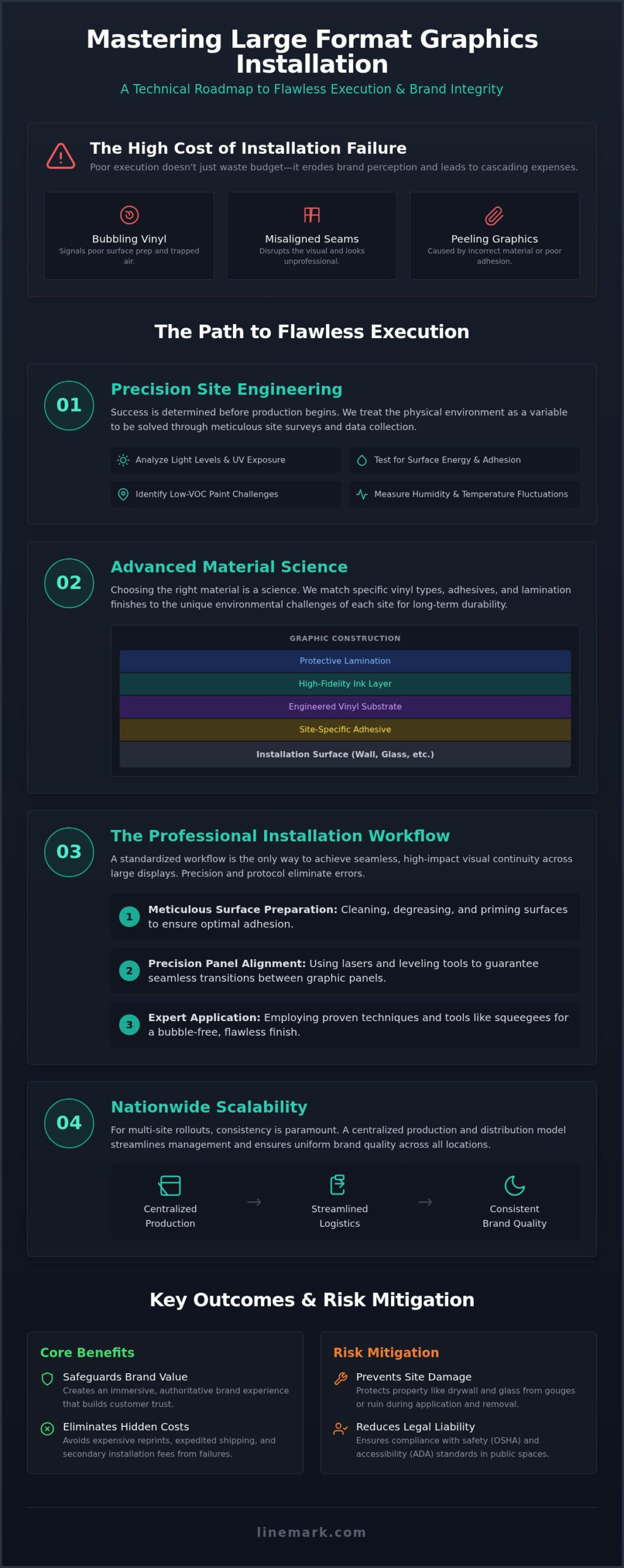
The most expensive part of your brand’s visual identity isn’t the premium substrate or the high-fidelity ink; it’s the cost of doing the job twice. You’ve likely felt the frustration of a major store opening or event rollout compromised by bubbling vinyl, misaligned seams, or graphics that begin to peel within weeks. It’s a common struggle when the meticulous precision of the design phase fails to translate during the final large format graphics installation. These technical failures don’t just waste budget, they erode the perceived quality of your brand in the eyes of your customers.
We understand that you need a strategic ally who treats every project as a feat of engineering. This guide provides the technical roadmap to master complex installations, ensuring flawless execution and high-impact displays across every site. We’ll examine the critical variables of material science, site preparation, and the streamlined project management required to maintain consistency in a demanding 2026 market. From understanding modern outgassing standards to managing nationwide logistics, you’ll gain the insights needed to move from production to the final squeegee stroke with total confidence.
Key Takeaways
- Expert large format graphics installation is a specialized technical trade that safeguards your brand’s perceived value and eliminates the hidden costs of project failure.
- Flawless execution depends on a precision phase of site surveys and surface engineering to address environmental variables before production even begins.
- Matching the right material science, such as specific vinyl types and lamination finishes, to your site’s unique challenges ensures the long-term durability of environmental graphics.
- A standardized workflow involving meticulous surface preparation and panel alignment is the only way to achieve seamless, high-impact visual continuity across large displays.
- Leveraging a centralized production and distribution model allows for consistent brand quality and streamlined management across complex, nationwide multi-site rollouts.
Why Professional Large Format Graphics Installation is Critical for Brand Integrity
Professional large format graphics installation isn’t merely a final step in a marketing campaign; it’s a specialized technical trade that requires a deep understanding of material science and structural engineering. While modern wide-format printing technology allows for breathtaking resolution and color accuracy, those assets are only as effective as their execution on the wall, floor, or window. A single misalignment or a trapped air bubble doesn’t just look sloppy. It signals a lack of attention to detail that customers subconsciously project onto your entire organization. When you invest in high-capacity production, the installation must match that caliber to preserve your brand’s authority.
Choosing a low-cost installation route often leads to expensive cascading failures. If a graphic fails due to poor surface preparation, the cost of a reprint, expedited shipping, and a second installation crew far exceeds the initial “savings.” Beyond the budget, there’s the risk of permanent site damage. Inexperienced installers can gouge drywall or ruin expensive glass coatings during the application or removal process, leading to facility repair costs that weren’t in the project scope. Expert teams eliminate this volatility through standardized protocols and precision tools.
The Psychology of Environmental Graphics
Environmental graphics function as the strategic intersection of architecture and marketing, transforming physical spaces into narrative-driven brand environments. When a wall mural is installed with surgical precision, it creates an immersive experience that builds immediate authority. Conversely, visible seams or peeling edges create visual noise that erodes trust instantly. In a market where over 83% of retail dollars are still spent in physical locations, the tactile quality of your space remains a primary driver of customer perception. Flawless execution ensures that your environment speaks as clearly as your digital presence.
Risk Mitigation and Liability
Professional installers bring more than just squeegees; they bring essential risk management. High-traffic environments require strict compliance with national safety standards, such as OSHA 29 CFR 1910.145 for accident prevention signage. Failure to adhere to these or ADA mounting requirements can result in significant legal liability and heavy fines, which are scheduled for inflation-based increases in early 2026. A strategic partner ensures that every floor graphic is slip-resistant and every window display is securely anchored. This protects both your brand and your visitors from preventable accidents. Large format graphics installation in public spaces is a matter of safety as much as it is a matter of style.
The Precision Phase: Site Surveys and Surface Engineering
Successful execution begins weeks before the first drop of ink hits the substrate. Engineering the installation site is as critical as the production phase itself. We treat the physical environment as a variable to be solved, not just a surface to be covered. By conducting a meticulous site survey, we identify potential failure points early, ensuring the final product integrates perfectly with the architecture. The success of any large format graphics installation is determined by the data gathered during this preliminary stage.
A comprehensive survey evaluates more than just width and height. Our teams analyze light levels to determine UV exposure risks and test for surface energy to ensure long-term bonding. We align our processes with technical standards championed by the International Sign Association (ISA) to maintain industrial-grade reliability. This data-driven approach allows us to recommend specific materials tailored to the unique humidity and temperature fluctuations of each location. Partnering with a strategic ally for a professional site survey ensures these variables are managed long before the first panel is printed.
The Science of Adhesion
Modern interior design often utilizes low-VOC (Volatile Organic Compound) paints. While environmentally friendly, these coatings are engineered to repel dirt and stains, which often means they also repel adhesives. We perform standardized “tape tests” and use adhesion promoters to verify surface readiness. Outgassing is another critical factor. Installing graphics on freshly painted walls before they’ve fully cured leads to catastrophic bubbling as gases escape the paint. We typically require a cure time of at least three weeks to ensure the substrate is chemically stable for successful application.
Logistics and Access Planning
High-impact displays often require high-altitude solutions. We coordinate the complex logistics of scaffolding, scissor lifts, and specialized hardware to reach difficult elevations safely. This planning phase includes navigating national building codes and specific landlord requirements for retail environments. To minimize disruption to your operations, we often schedule “after-hours” installations. This allows our teams to work with the precision required for nationwide large format graphics installation while your business remains fully functional during peak hours.
Material Science: Matching Graphics to Environmental Challenges
Selecting the right material is an engineering decision that dictates the success of your large format graphics installation. We don’t just look at the design; we analyze the chemical and physical properties of the substrate. For long-term environmental graphics, cast vinyl is the industrial standard. It’s manufactured through a process that ensures dimensional stability, meaning it won’t shrink or pull away from edges over time. In contrast, calendered vinyl is a cost-effective solution for short-term retail promotions on flat surfaces where long-term conformability isn’t required.
Lamination provides the essential protective layer that preserves your brand’s visual integrity. Gloss finishes enhance color depth for high-impact displays, while matte finishes are preferred for interior wall murals to eliminate glare from harsh corporate lighting. In high-traffic public areas, anti-graffiti laminates allow for easy cleaning without damaging the underlying print. Our 90,000-square-foot facility ensures that every batch of material is consistent, preventing the color shifts that often plague decentralized production models.
Indoor vs. Outdoor Durability
Outdoor signage faces the constant threat of UV degradation and extreme weather. We utilize UV-stable inks that maintain their vibrancy for up to 48 months, effectively doubling the traditional replacement cycle. For floor graphics in retail environments, safety is the primary metric. We specify materials with high slip-resistance ratings, such as UL 410 or ANSI A136.1, to ensure compliance and visitor safety. Corporate interiors require a different set of standards, including fire ratings like ASTM E84 and low-emitting certifications to maintain indoor air quality and meet building codes.
Removability and Long-Term Performance
The lifecycle of a campaign determines the adhesive technology we select. Permanent adhesives are engineered for the life of the building, while removable adhesives allow for clean strikes after a 90-day promotion. Choosing the wrong adhesive can lead to substrate damage during removal, which we identified as a primary hidden cost in earlier sections. For a deeper look at these technical specifications, consult The Ultimate Guide to Large Format Graphics. Proper lamination also plays a role here; it adds the structural rigidity needed to pull panels off in large pieces rather than small, labor-intensive fragments.
The Professional Installation Workflow: A Step-by-Step Guide
Execution day is the culmination of our engineering phase. It requires a disciplined, repeatable process to ensure the technical integrity of the display. Every large format graphics installation follows a strict sequence to eliminate the risks of bubbling or misalignment that we’ve discussed previously. We don’t just stick graphics to walls; we bond them through a series of technical maneuvers designed for industrial-grade durability.
Preparation begins with chemical cleaning. Dust and oils are the primary causes of premature adhesion failure. We use industrial-grade solutions, typically a 70% isopropyl alcohol mixture, to neutralize the substrate surface and remove any residual chemical films. Once the surface is chemically receptive, we conduct a “dry fit.” This step allows the team to verify the scale against the actual wall dimensions and identify any architectural obstacles, such as outlets or trim, before the adhesive liner is removed.
We utilize both wet and dry application techniques based on the specific environmental challenges. Dry installs are the standard for most wall murals, while wet installs are often reserved for window graphics where repositionability is critical for bubble-free clarity. Our installers use specialized squeegees with felt edges to apply consistent pressure, moving from the center outward to evacuate all air and ensure a perfect bond.
Precision Alignment and Seam Management
Laser levels and plumb lines are mandatory for maintaining vertical accuracy over long spans. For multi-panel murals, we utilize a precision overlap, often a 1-inch bleed, to ensure the visual narrative remains unbroken. This technique accounts for minor wall irregularities that could otherwise cause a “stair-step” misalignment across a fifty-foot wall. Managing corners and outlets requires a surgical touch, using heat to conform the vinyl without overstretching the material.
Finishing Touches and Quality Control
Post-heating is the secret to long-term durability. By heating the vinyl to its “set” temperature, usually between 180 and 200 degrees Fahrenheit, we lock its memory to the new surface. This prevents the material from attempting to return to its original flat state, which is a common cause of edge curling. Edge sealing is the final defense, applying a transparent liquid or tape to the perimeter in high-traffic areas. This ensures your large format graphics installation remains flawless until the day it’s scheduled for removal. If you’re managing a complex rollout, you need a partner who values this level of technical detail. Connect with our precision installation team to ensure your brand displays are executed with industrial authority.
Nationwide Scalability: Managing Multi-Site Graphic Rollouts
Scaling a visual identity across a national footprint introduces a layer of logistical complexity that local vendors simply cannot navigate. While a single large format graphics installation requires technical precision, a multi-site rollout requires an integrated supply chain. The primary challenge for national brands is maintaining visual equity; a wall mural in one region must possess the exact color profile and material quality as its counterpart thousands of miles away. Achieving this level of consistency requires moving away from fragmented local sourcing in favor of a centralized production model. We don’t just print; we manage the entire lifecycle of your visual assets.
Our 90,000-square-foot facility serves as the strategic hub for these large-scale operations. By centralizing production, we eliminate the color shifts and substrate variations that occur when different shops use different ink sets or media batches. This industrial capacity allows for a unified national launch where every asset is produced under identical conditions. We then leverage our nationwide distribution and installation capabilities to ensure the final application meets our rigorous standards, regardless of the site location. This steady, controlled approach builds the security you need when your brand’s reputation is on the line across hundreds of sites.
Standardizing the Visual Experience
Color fidelity is a non-negotiable component of brand authority. We utilize standardized installation kits that include specific technical instructions and proprietary tools to ensure identical results across every site. This process is streamlined through our integrated MarCom On-Demand portals, which allow marketing executives to order materials and track installation status in real-time. For a deeper dive into managing these distributed assets, see our MarCom On-Demand: Strategic Guide. This technological integration ensures that your field teams and corporate office remain in perfect alignment.
The Role of a Strategic Communications Ally
We view our role as more than just a transactional print vendor; we act as a strategic communications ally. This means providing holistic project stewardship from the initial site survey to the final quality sign-off. Our seasoned project managers handle the coordination of multiple teams, navigating the building codes and access requirements discussed in earlier sections to deliver total peace of mind. This synergy between massive production capacity and precision installation teams is the catalyst for your brand’s growth. Partner with Linemark for your next national graphics project to ensure your large format graphics installation is handled with industrial authority and meticulous care.
Elevating Your Brand Through Technical Precision
Mastering the engineering behind your visual environment is the only way to ensure your brand’s authority remains intact across every location. We’ve explored how the synergy between site surveys, material science, and a disciplined workflow eliminates the hidden costs of project failure. Every large format graphics installation should be treated as a strategic project rather than a transactional task. When you prioritize technical precision, you protect your investment and build lasting customer trust.
With 30+ years of industrial print and logistics expertise, we provide the holistic project management required for complex national rollouts. Our 90,000-square-foot high-tech facility supports massive production volumes while maintaining the meticulous attention to detail of a boutique shop. You don’t have to navigate the complexities of nationwide distribution and site preparation alone. Scale your brand with professional nationwide installation from Linemark to ensure your high-impact displays are executed flawlessly every time. Your brand’s vision is too valuable to leave to chance; let’s build something exceptional together.
Frequently Asked Questions
How long does it take to install large format wall graphics?
The duration of a large format graphics installation varies based on the total square footage and site complexity. A standard single-wall mural typically requires three to five hours for a two-person team. More complex projects involving high-altitude access or multiple architectural obstructions require additional time. We provide detailed timelines during the project management phase to ensure your facility’s operations don’t experience unnecessary downtime.
Can large format graphics be installed on any surface?
Most architectural surfaces can accommodate graphics, provided the correct material and adhesive are selected. We install on drywall, glass, brick, and even finished concrete. However, surfaces with high texture or low-surface energy coatings require specialized testing and adhesion promoters. Our preliminary site survey identifies these challenges to ensure the material choice matches the structural reality of your environment before production begins.
What is the difference between cast and calendered vinyl for installation?
Cast vinyl is a premium material that remains dimensionally stable and conforms to irregular surfaces like rivets or textured walls. It’s the industrial standard for long-term environmental graphics. Calendered vinyl is thicker and less flexible, making it ideal for short-term retail promotions on flat surfaces. Choosing the wrong type leads to edge curling or shrinking; we always specify the material based on the campaign’s intended lifecycle and location.
How do I prepare my walls for a professional graphic installation?
Preparation begins with ensuring the wall is clean and free of dust, oils, or loose paint. New walls must be allowed to cure for at least three weeks to prevent outgassing, which causes catastrophic bubbling. We recommend avoiding stain-resistant paints that contain silicone or Teflon, as these materials repel standard adhesives. Our team manages the final chemical cleaning on the day of the install to ensure a perfect bond.
Will professional graphic installation damage my paint when removed?
Professional installation shouldn’t damage your paint if the substrate was properly cured and the correct adhesive was selected. We use removable adhesives for short-term campaigns and permanent options for long-term displays. If the paint bond to the drywall is weak, some lifting might occur during removal. Our teams utilize controlled heat during the strike process to soften the adhesive and minimize the risk of surface damage to your facility.
What happens if a large format graphic begins to peel or bubble?
Peeling or bubbling is typically a symptom of improper surface preparation or environmental stressors like extreme humidity. If you notice these issues, it’s critical to address them immediately before the adhesive loses its integrity. We stand by our technical execution and provide project management support to troubleshoot and resolve any material failures. Our focus on precision during the initial application phase is designed to prevent these issues from occurring.
Do you provide nationwide installation services for multi-site companies?
We provide comprehensive nationwide large format graphics installation services for corporations and associations across the United States. Our 90,000-square-foot facility serves as a centralized production hub, ensuring color consistency across all locations. We coordinate local teams through a unified project management system, allowing you to manage a national rollout through a single strategic ally rather than multiple local vendors. This ensures a seamless visual experience at every site.
Are floor graphics safe for high-traffic retail environments?
Floor graphics are highly effective and safe when they utilize specialized laminates with verified slip-resistance ratings. We specify materials that meet industrial safety standards, such as UL 410, to ensure they remain secure in high-traffic retail spaces. These graphics are engineered to withstand heavy foot traffic and cleaning equipment without lifting. This provides a high-impact visual that doesn’t compromise the safety of your customers or your staff.