


 09/01/2026
  Steve Bearden
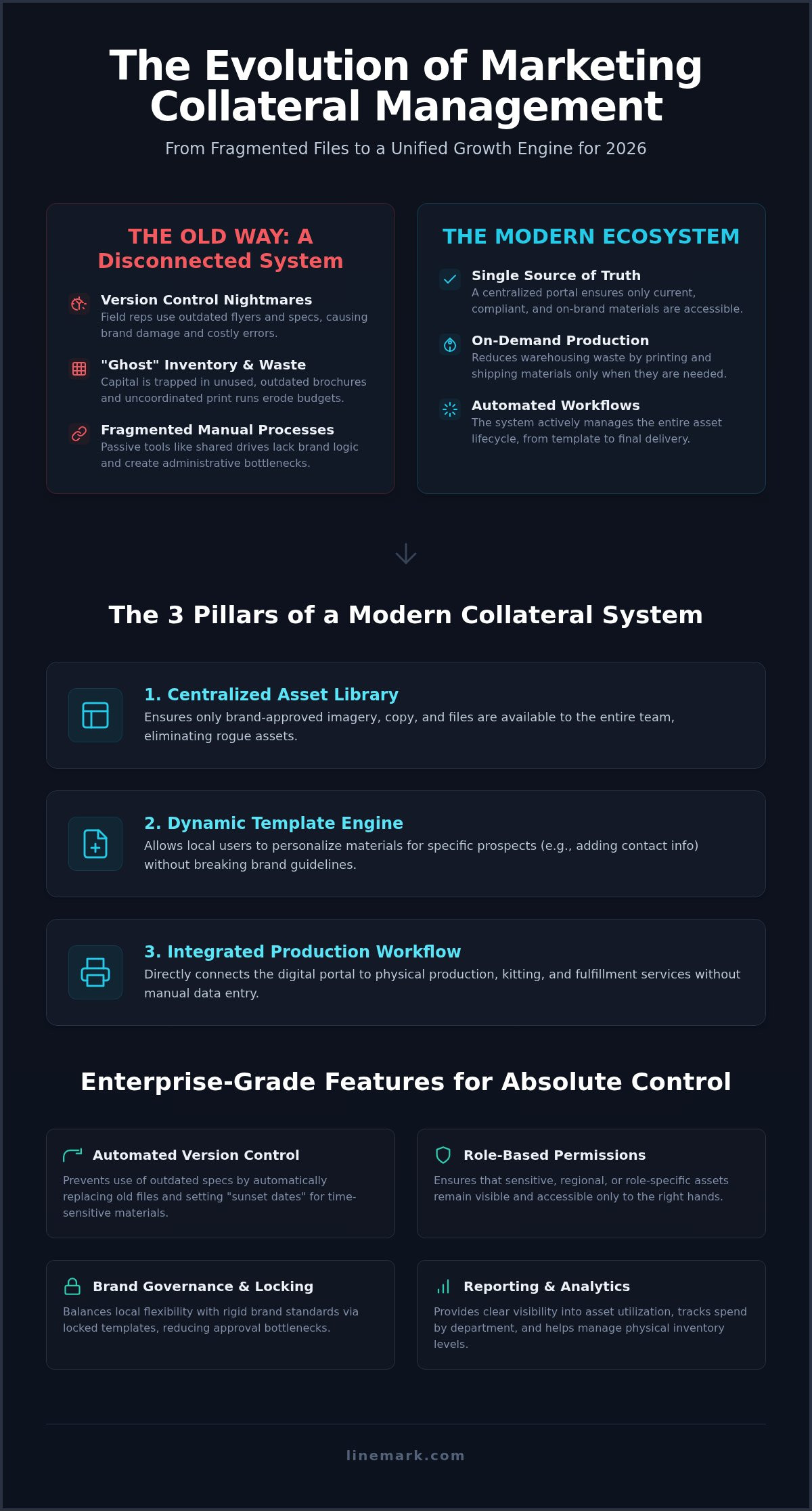
How much capital is your organization leaking through “ghost inventory” and outdated sales brochures that should have been recycled years ago? It’s a common frustration to discover a field representative is still using a legacy flyer, or to realize that uncoordinated, small-batch print runs are quietly eroding your quarterly budget. You likely recognize that the disconnect between your digital assets and physical fulfillment isn’t just an administrative headache; it’s a barrier to scalable growth. Implementing robust marketing collateral management software is no longer a luxury for high-volume operations, but a strategic necessity for brand governance.
We understand that precision in logistics is just as vital as the creative design itself. This 2026 strategic guide promises to help you master the complexities of distribution while maintaining absolute control over your brand identity. We’ll examine how to transition from fragmented manual processes to a unified, tech-enabled partnership. You’ll see how our MarCom On-Demand portal creates a single source of truth, automating workflows from the initial template to the final doorstep delivery. We’ll preview the path toward significant waste reduction and a streamlined operation that functions like a well-oiled machine.
Key Takeaways
- Understand why modern brand governance requires an integrated ecosystem that evolves beyond simple digital storage to manage the entire asset lifecycle.
- Discover how enterprise-grade marketing collateral management software automates version control and role-based permissions to eliminate the use of outdated materials.
- Identify the benefits of a “Web-to-Print” workflow that connects your digital portal directly to physical production and kitting services.
- Master a step-by-step implementation strategy, from conducting a thorough collateral audit to establishing logical tagging for your entire library.
- Explore how a 90,000-square-foot production facility provides the industrial power needed to back your digital portal and scale your brand impact.
What is Marketing Collateral Management Software?
At its core, marketing collateral management software is a centralized platform built to store, customize, and distribute brand assets with surgical precision. It represents the natural evolution of Digital Asset Management (DAM). While a traditional DAM might act as a digital library for static files, a modern collateral ecosystem functions as an active engine for growth. The foundational concept of marketing collateral has expanded to include everything from digital sales decks to large format graphics, requiring a system that handles both with equal capability.
Static file folders like Dropbox or Google Drive fail at enterprise scale in 2026 because they are fundamentally passive. They don’t understand brand logic. They can’t enforce version control or trigger a physical print order. For a high-capacity operation, these tools are often the source of version control nightmares and administrative waste. The distinction lies in the transition from passive storage to active workflow management, where the software understands the destination of the asset, not just its location.
The Core Components of Modern Collateral Systems
Effective systems rely on three pillars. First, a centralized asset library ensures only brand-approved imagery and copy are available to the team. Second, dynamic template engines allow local users to personalize materials for specific prospects without breaking brand guidelines. Finally, these platforms must offer direct integration with production workflows. This allows a user to move from a digital template to a physical product through a portal like MarCom On-Demand without manual data entry or redundant emails.
Why 2026 Demands a Unified Approach
The modern business environment is increasingly fragmented. Distributed workforces now require 24/7 access to physical materials across various regions, making centralized control a logistical necessity rather than a luxury. Brand governance has also become more complex in a multi-channel world. Relying on a unified approach allows organizations to shift toward on-demand production. This reduces warehousing waste and ensures that your physical inventory is as agile as your digital strategy. It transforms your marketing logistics from a cost center into a strategic advantage that scales with your growth.
Key Features of Enterprise-Grade Management Platforms
Enterprise-grade marketing collateral management software is defined by its ability to enforce order across chaotic, high-volume environments. It’s not enough to host a file; the system must dictate who can see it and when it should expire. Role-based permissions ensure that sensitive or regional-specific assets remain in the right hands, while automated version control prevents the costly mistake of sales teams distributing outdated specs. By setting “sunset” dates on specific brochures or catalogs, administrators can guarantee that only current, compliant materials are available for production.
Brand Governance and Template Locking
One of the most powerful aspects of modern platforms is the ability to balance local flexibility with rigid brand standards. Template locking allows a field representative to update contact information or a local offer while keeping the core design, logo placement, and typography untouchable. This reduces the traditional “approval bottleneck” because the guardrails are built directly into the software. It ensures every piece of collateral, from a simple postcard to complex annual reports, meets professional standards without requiring a manual review for every single order. Strengthening the connection between headquarters and the field is a proven method for Ending the War Between Sales and Marketing, as it empowers teams with the tools they need while protecting the brand’s integrity.
Reporting and Analytics for ROI Tracking
Data-driven decision-making is essential for scaling marketing logistics. High-tier platforms provide visibility into which assets are actually being utilized by field teams and which are gathering digital dust. By monitoring spend across different departments or regions, organizations can identify inefficiencies and prune underperforming collateral from the library. This level of insight is particularly valuable when managing physical inventory. Real-time tracking for items stored in fulfillment centers prevents overstocking and stockouts, ensuring that capital isn’t tied up in unused paper.
Integrating Variable Data Printing (VDP) takes this a step further by automating personalization at scale. When your marketing collateral management software is backed by a centralized production facility, these automated workflows move seamlessly from a digital click to a physical shipment. This integrated approach ensures that your marketing spend is directly tied to measurable output and physical distribution efficiency.
The Critical Bridge: Connecting Digital Portals to Physical Production
Software is an essential brain for your marketing operations, but it remains incomplete without the muscle of physical production. Many organizations invest heavily in marketing collateral management software only to find their teams still struggling with manual spreadsheets and fragmented vendor communication. The true value of a digital portal is realized when it acts as a direct bridge to a high-capacity production facility. This integration removes the friction between a creative file and a finished product, ensuring that your brand’s physical presence is as agile as its digital assets.
Centralizing production through a single partner guarantees color consistency and quality control across diverse formats. Whether you’re producing annual reports or window graphics, a unified facility ensures that your brand colors remain precise regardless of the substrate. This holistic approach eliminates the risk of color shifting that often occurs when managing multiple local print shops. It transforms your collateral from a collection of disparate items into a unified brand experience. When your digital portal and production floor speak the same language, you eliminate the “lost in translation” errors that plague traditional workflows.
Automating the Print Procurement Process
Traditional print procurement is often bogged down by redundant emails and manual data entry. By implementing marcom on-demand, organizations can streamline high-volume commercial printing through a simplified web-to-print workflow. This automation allows field teams to order exactly what they need, when they need it, drastically reducing the inventory overhead associated with massive, static print runs. It’s a move from speculative storage to responsive, on-demand execution. This shift doesn’t just save money; it ensures that your team always has the most current brochures and catalogs without the waste of outdated stock.
Strategic Fulfillment and Nationwide Distribution
A sophisticated management system must extend beyond the printing press to include integrated kitting & fulfillment. Strategic distribution ensures that complex kits reach their destinations intact and on schedule. Software triggers can even automate direct mail campaigns, sending personalized postcards to prospects based on CRM data. This capability ensures that large format graphics, floor graphics, and banners reach multiple locations simultaneously. It creates a synchronized brand launch across the country without the administrative burden of manual tracking or local coordination. Your marketing collateral management software should be the catalyst that turns complex logistics into a streamlined competitive advantage.
Implementation Strategy: Rolling Out Your Management System
Successfully transitioning to a unified system requires more than just a software license. It demands a methodical approach to ensure your digital portal aligns perfectly with your physical production needs. Effective adoption of marketing collateral management software begins with a clear understanding of your existing inventory. You can’t manage what you haven’t measured, and you can’t govern what you haven’t consolidated.
The first step involves a comprehensive collateral audit. You must identify “rogue” assets—those unapproved or outdated brochures and flyers floating around in local sales offices or saved on individual hard drives. By purging legacy logos and messaging, you establish a single source of truth for your brand guidelines. This isn’t just about cleaning house; it’s about prioritizing high-impact items for conversion into dynamic templates that your team will actually use.
Setting up the digital library requires logical taxonomies and tagging. If a sales representative can’t find a brochure in three clicks, they’ll likely revert to non-compliant files. Simultaneously, you must define user roles and approval hierarchies. Deciding who has the authority to trigger a high-volume print run or customize a direct mail piece is essential for maintaining brand governance without creating new administrative bottlenecks.
Phase 1: Asset Consolidation and Brand Audit
This phase is the foundation of your brand’s future agility. By identifying the most frequently used items, you can prioritize which assets to transition into your digital portal first. This process removes the fragmentation between digital libraries and physical inventory. It ensures that every user, regardless of their location, is pulling from the same approved repository, which significantly reduces the risk of brand dilution.
Phase 2: Technical Integration and Training
Phase 2 bridges the gap between your marketing collateral management software and your operational reality. Connecting the portal to your existing CRM or ERP system allows for automated data flow, which is critical for the Variable Data Printing (VDP) discussed in previous sections. Training your field users is the final step. They must understand the “self-service” model—how to order their own brochures or catalogs without corporate intervention while staying within the pre-governed guardrails.
We recommend pilot testing with a single department or region before a national rollout. This allows you to refine the workflow and gather data on initial KPIs, such as system adoption rates and administrative time saved. Once the pilot proves the ROI, the full-scale implementation becomes a logical progression toward operational excellence. If you’re ready to move from transactional printing to a holistic, tech-enabled partnership, consult with our strategic specialists to begin your implementation journey.
Scaling Brand Impact with MarCom On-Demand
MarCom On-Demand represents the intersection of software agility and industrial power. While many platforms focus solely on the digital interface, we back our marketing collateral management software with a 90,000-square-foot production facility. This infrastructure ensures that every order placed through your digital portal is executed with the precision of a high-capacity operation. It’s the difference between a simple SaaS tool and a strategic communications ally that understands the nuances of modern marketing and logistics. By centralizing your assets, you move away from transactional printing and toward a holistic partnership designed for growth.
Future-proofing your marketing operations requires a system that scales as fast as your business. Our tech-driven solutions are built to handle high-volume projects without sacrificing the meticulous attention to detail found in boutique shops. This steady, controlled approach builds a sense of security for your team. You aren’t just buying a service; you’re entering a unified partnership where we act as a centralized destination for your diverse needs. This journey transforms your collateral from a logistical burden into a streamlined competitive advantage.
The Linemark Partnership Model
Our model is grounded in over 30 years of industrial experience and technical production expertise. We’ve refined the process of moving from complex data to finished physical products, leveraging a rich history in custom book printing and commercial production. This expertise allows us to handle high-volume projects that would overwhelm standard vendors. A centralized production hub ensures that your direct mail campaigns, signage, and annual reports maintain absolute quality. We also offer consultative support for complex, multi-component marketing kits, ensuring every piece of the puzzle fits perfectly before it reaches its destination.
Achieving Operational Excellence
Operational excellence is the benchmark of a well-oiled marketing machine. By integrating your digital library with our physical fulfillment services, you eliminate the administrative friction that delays campaigns. Many organizations report that moving to an integrated model can reduce turnaround times by up to 40%. The cost-efficiency of combining large format graphics with automated fulfillment cannot be overstated. It reduces waste and ensures that your capital is invested in materials that actually reach the field. Now is the time to transform your marketing logistics into a growth engine that delivers results with industrial precision.
Elevate Your Brand’s Operational Efficiency
Mastering the complexities of modern brand governance requires a shift from passive storage to active, integrated workflows. The implementation of a robust marketing collateral management software ecosystem ensures that your distributed workforce always utilizes current, brand-approved materials. By bridging the gap between digital portals and physical production, you eliminate the administrative bottlenecks and hidden costs of uncoordinated print runs. This holistic approach transforms your marketing logistics from a cost center into a scalable engine for growth.
We back your strategic journey with a 90,000-square-foot high-tech production facility and more than 30 years of enterprise communications expertise. Our nationwide fulfillment and logistics network provides the industrial power needed to handle high-volume projects with boutique-level attention to detail. It’s time to move beyond transactional vendor relationships and embrace a unified partnership built on precision and technological innovation. Your organization’s growth depends on an agile, reliable supply chain for your brand assets.
Ready to see how our tech-driven solutions can streamline your operations? Schedule a MarCom On-Demand Demo with Linemark today and take the first step toward masterly brand control. We look forward to building a more efficient future together.
Frequently Asked Questions
What is the difference between DAM and marketing collateral management software?
A Digital Asset Management (DAM) system serves primarily as a passive repository for storing and organizing files. Marketing collateral management software goes further by integrating active workflows for customization and distribution. It bridges the gap between a digital file and physical fulfillment. While a DAM might house a logo, this software allows a field representative to personalize a brochure and trigger a professional print run with industrial precision.
How does marketing collateral software ensure brand consistency?
The software maintains brand integrity through rigid template locking and automated version control. Administrators can lock core design elements like logos and typography while allowing local users to update contact details. Version control features automatically sunset outdated materials, ensuring that sales teams don’t accidentally distribute legacy flyers. This centralized control prevents brand dilution across a distributed workforce and guarantees that every piece of collateral meets professional standards.
Can this software handle both digital and physical print materials?
Yes, modern platforms are designed to manage the entire lifecycle of both digital and physical assets. Users can download digital sales decks for immediate use or order physical items like catalogs, brochures, and banners. By connecting a digital asset library to a 90,000-square-foot production facility, the software enables a seamless transition from a cloud-based design to physical kitting and nationwide fulfillment.
Is marketing collateral management software scalable for small businesses?
While these systems are highly scalable, they provide the most significant value to organizations managing high-volume or complex marketing needs. Small businesses with growing logistics requirements can leverage marketing collateral management software to professionalize their brand governance. It allows smaller teams to function with the operational excellence of a much larger corporation by automating manual data entry and streamlining the procurement of commercial printing services.
How long does it typically take to implement a MarCom On-Demand portal?
The implementation timeline for a MarCom On-Demand portal typically depends on the depth of your initial collateral audit and asset consolidation phase. Most organizations can expect a full rollout within 30 to 90 days. This period involves setting up logical taxonomies, defining user roles, and integrating the portal with existing workflows. Starting with a pilot program in a single department often accelerates the overall adoption and identifies specific technical requirements early.
Does the software integrate with existing CRM platforms like Salesforce?
Integration with CRM platforms like Salesforce is a core feature of enterprise-grade systems. This connection is essential for executing Variable Data Printing (VDP) campaigns, where prospect data triggers personalized direct mail or brochures. By syncing your marketing collateral management software with your CRM, you eliminate manual data entry and ensure that your physical outreach is as data-driven and targeted as your digital marketing efforts.
How do I calculate the ROI of a collateral management system?
You can calculate ROI by measuring the reduction in administrative hours, warehousing costs, and print waste. Organizations often see significant savings by moving from speculative large-batch printing to on-demand production models. Additionally, tracking the usage rates of specific assets allows you to prune underperforming materials from your library. This data-driven approach ensures that your marketing budget is invested in collateral that actually drives engagement and sales.
What security measures protect our sensitive digital assets?
Security is maintained through role-based permissions and secure, encrypted data hosting. These measures ensure that only authorized personnel can access sensitive brand assets or trigger high-volume production orders. By centralizing assets in a controlled environment, you mitigate the risk of data leaks associated with fragmented file-sharing methods. This level of protection is vital for maintaining the integrity of annual reports and proprietary sales materials across a national distribution network.