

 08/26/2026
  Steve Bearden
A book’s physical construction often speaks louder than the words on its pages, serving as a silent ambassador for your brand’s commitment to excellence. You understand that the tactile weight of a premium volume creates a level of authority that digital platforms cannot replicate. Yet, many professionals face the frustration of inconsistent quality from consumer-grade services, where structural failures and poor finishing compromise the final message. When your project demands durability and prestige, standard hardcover book printing isn’t enough; you need a solution rooted in industrial precision and technical expertise.
This guide empowers you to master the nuances of professional case binding and manufacturing in 2026. You’ll learn how to interpret complex terminology and select the right materials to ensure your high-volume projects withstand heavy use while maintaining a sophisticated aesthetic. We will examine the essential steps for choosing a manufacturing partner that functions as a strategic ally, moving beyond simple transactions to create a streamlined, high-tech production journey that delivers scalable results for your organization.
Key Takeaways
- Identify why case binding is the definitive manufacturing standard for prestigious legacy publications and high-impact corporate reports in 2026.
- Differentiate between Smyth sewing and adhesive binding to choose the structural architecture that guarantees long-term durability for high-use projects.
- Master the unit economics of professional hardcover book printing to determine the exact tipping point for transitioning from print-on-demand to high-volume commercial production.
- Secure technical precision in your design by mastering the specific layout requirements for case-wrapped covers and integrated dust jackets.
- Leverage a strategic manufacturing ally with in-house binding and finishing to streamline your logistics and ensure consistent quality across large-scale distributions.
The Architecture of Professional Hardcover Book Printing in 2026
Professional hardcover book printing represents the definitive manufacturing standard for projects requiring a sense of permanence and authority. It’s the preferred choice for legacy publications, annual reports, and premium catalogs because it commands attention in a way digital media can’t. The history of bookbinding shows how this method evolved to protect valuable knowledge, and that mission remains central to modern production. Case binding is the process where a printed interior block is glued into a rigid, pre-formed cover.
Tactile quality matters. The psychological impact of a book’s weight and rigidity directly influences how a reader perceives your brand’s authority. When a client holds a heavy, well-constructed volume, they instinctively associate that physical stability with your organization’s reliability. It’s a strategic move that turns a simple document into a lasting asset.
To better understand the technical assembly involved in this process, watch this helpful video:
Why Hardcover Outlasts All Other Binding Methods
Hardcover construction builds a physical barrier against environmental wear and tear. While paperbacks often succumb to shelf friction and humidity, rigid boards prevent page-curl and spine-cracking over time. This structural integrity is essential for high-use books like technical manuals or reference guides. The initial investment pays off through extreme durability. A book that stays pristine for decades maintains its message long after softcover alternatives have frayed. It’s about protecting the lifecycle of your content through superior industrial engineering. Our approach focuses on precision at every stage, ensuring the case is perfectly aligned with the block for a flawless finish.
Hardcover as a Strategic Communication Tool
Branding isn’t just visual; it’s tactile. In 2026, the physical weight of a book provides a psychological anchor for the reader. It suggests stability and long-term vision. Organizations use premium binding to differentiate corporate reports from the clutter of standard mail. For instance, trade associations often choose hardcovers for member handbooks to ensure the resource remains a desktop staple rather than a disposable item. This structural rigidity signals that the content inside is worth preserving. When planning a large-scale project, understanding the architecture of hardcover book printing helps you align your production goals with your brand’s strategic growth. Positioning your brand as a leader requires a strategic communications ally who understands these nuances of modern marketing and logistics.
Advanced Binding Techniques: Case Binding, Smyth Sewing, and Structural Integrity
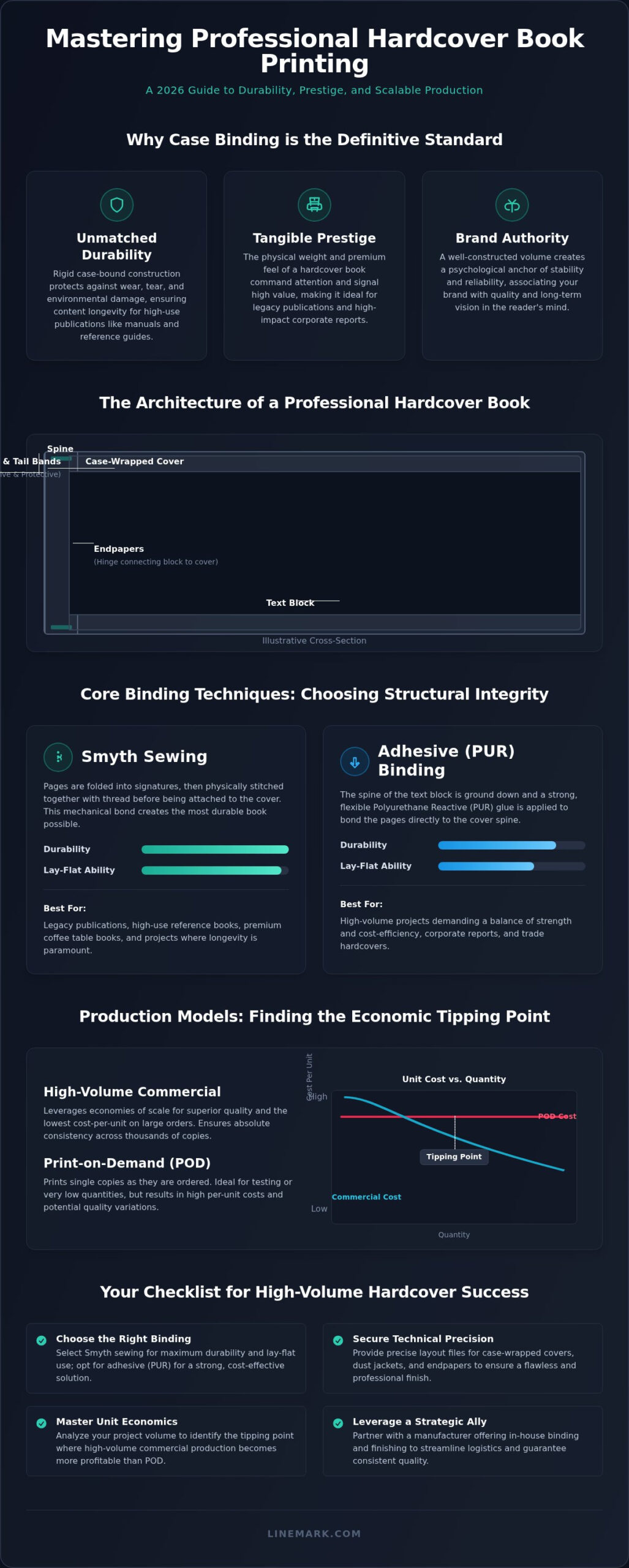
The structural integrity of professional hardcover book printing relies on more than just high-quality paper. It’s an assembly of precision components working in unison. At the core are the binders’ boards, which provide the rigid architecture. These are joined to the text block using endpapers, which serve as the primary hinge. High-end production often incorporates German case binding techniques to ensure these joints don’t fail under repeated use. While standard adhesive binding uses polyurethane reactive (PUR) glue for efficiency, it lacks the mechanical bond found in traditional, high-durability methods.
Beyond the glue, professional finishing includes the addition of headbands and tailbands. These small fabric accents at the top and bottom of the spine might look decorative, but they play a vital role in hiding the glue and protecting the spine’s edges from dust and wear. For organizations seeking this level of precision, exploring advanced binding & finishing options ensures the final product meets industrial standards. This meticulous attention to detail is what separates a standard book from a prestigious corporate asset.
The Smyth Sewing Advantage
Smyth sewing remains the pinnacle of durability. In this process, individual signatures, or folded groups of pages, are stitched together with high-tensile thread before the block is glued into the case. This creates a mechanical pull-strength that adhesive alone can’t match. It’s particularly critical for books with heavy 100lb text stock or high page counts where the weight of the paper puts immense stress on the spine. A major operational benefit of this method is the lay-flat capability. Reference books and technical manuals benefit from staying open on a desk without the reader needing to hold the pages down. This ensures the book’s spine doesn’t crack even after years of frequent consultation.
Cover Material Innovations for 2026
In 2026, material selection has expanded beyond traditional cloth. Faux leather and premium linen remain popular for their executive appeal, but custom-printed wraps are the modern standard for branded communications. These wraps allow for full-color graphics to be laminated directly onto the boards. Modern laminates, including scuff-resistant matte and soft-touch finishes, provide a protective layer that resists fingerprints and moisture. Sustainability is also a priority. Manufacturers now offer recycled board cores and FSC-certified papers to align with corporate environmental goals. This shift ensures that high-impact hardcover book printing remains an eco-conscious choice for forward-thinking organizations.
Commercial Scale vs. Print-on-Demand: Choosing Your Production Model
Commercial scale production offers a level of precision and cost-efficiency that consumer-grade print-on-demand (POD) services cannot match. While POD is effective for testing concepts or printing single copies, the unit economics shift dramatically as your project scales. For a 500-book run in 2026, POD costs typically range from $8 to $25 per book. In contrast, professional offset hardcover book printing for the same volume drops to between $3 and $6 per copy. This price gap widens at 1,000 copies, where offset costs can fall as low as $3.00 per unit. These savings allow organizations to reinvest capital into higher-quality materials or broader distribution strategies.
The “tipping point” for transitioning to commercial production usually occurs around the 500-copy mark. Beyond mere cost, POD services often lack the structural rigor required for high-use books. They typically offer limited paper selections and basic finishing options. Professional manufacturing adheres to the ANSI/NISO/LBI Standard for Library Binding, ensuring that your books survive the friction of the shelf and the hands of your readers. For high-impact projects, relying on custom book printing ensures you aren’t forced to compromise on technical specifications.
When to Choose Digital vs. Offset for Hardcovers
Digital printing serves as an agile solution for short-to-medium runs, typically between 100 and 300 copies. It offers fast turnaround times without the setup costs of traditional plates. Modern high-end digital presses now rival offset quality, providing crisp text and vibrant color reproduction. However, offset remains the gold standard for high-volume projects. It provides the lowest possible unit cost and the greatest flexibility for specialized inks or unique paper stocks. Choosing between them depends on your specific volume requirements and lead times.
The Scalability Factor in Commercial Production
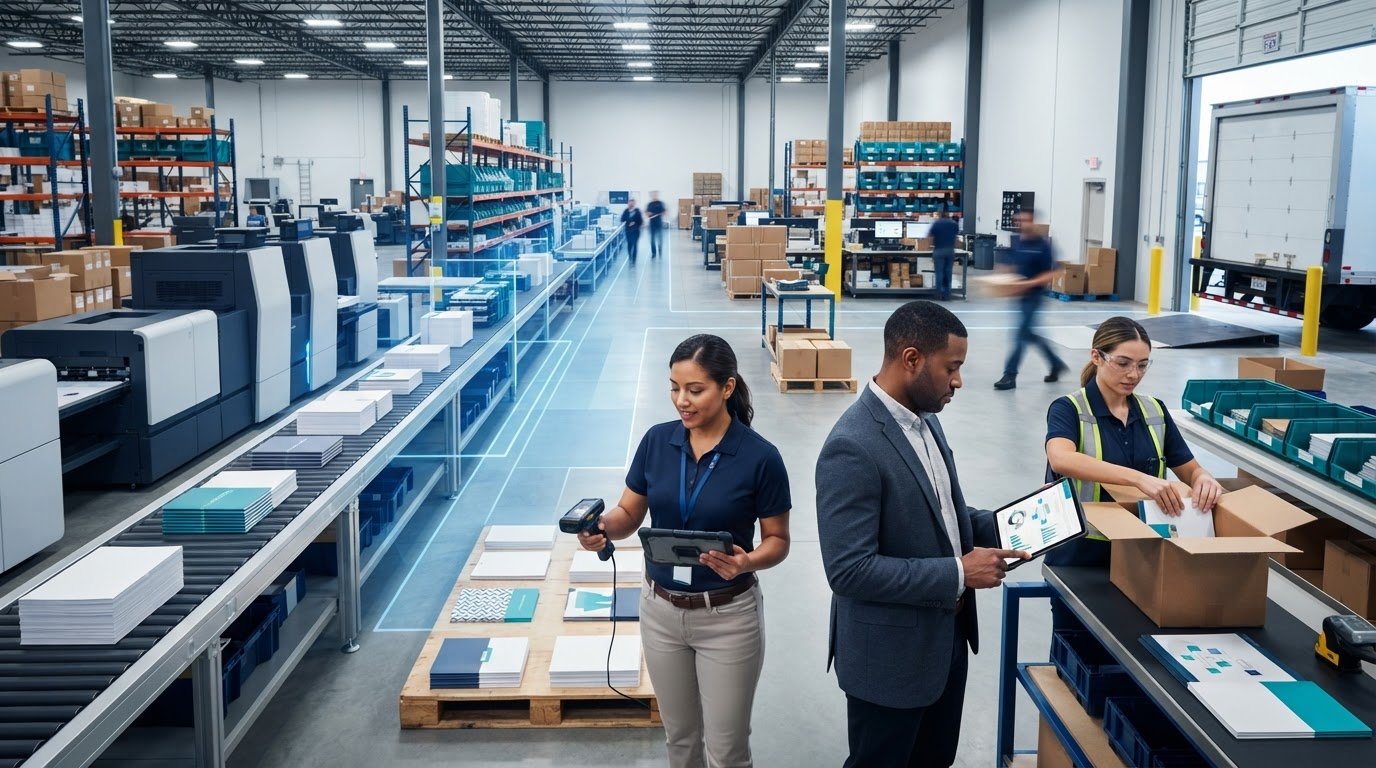
Managing consistency across thousands of copies requires industrial-grade infrastructure. A 90,000-square-foot production facility provides the operational breadth needed to handle complex kitting and national fulfillment alongside manufacturing. This scale ensures that the first book in a run is identical to the five-thousandth. Advanced data-driven strategies also allow for variable data printing within hardcover formats, enabling personalized content for key stakeholders. This blend of high-capacity output and boutique attention to detail positions a strategic manufacturer as a catalyst for your organization’s growth.
Design Specifications for Hardcover Success: From Dust Jackets to Endpapers
Technical precision is the foundation of high-impact hardcover book printing. Unlike softcover projects, where the cover is trimmed flush with the pages, a case-bound volume requires a rigid shell that extends beyond the text block. This architectural difference demands a specific approach to file preparation. To ensure your files meet industrial standards, follow our detailed guide on how to prepare a book for printing. Successful production begins with high-resolution PDF/X-4 files and a clear separation between your interior block and cover spread.
Calculating spine width is the most critical technical step. This measurement isn’t arbitrary; it’s a direct result of your page count and the paper’s Pages Per Inch (PPI) rating. For example, a 200-page book using 70lb matte paper will have a significantly different spine than one using 80lb gloss stock. Miscalculating this by even a fraction of an inch can cause your spine typography to shift onto the front or back cover. Precision is non-negotiable for a professional result. If you’re ready to start your project with expert guidance, contact our technical team today to discuss your custom specifications.
Mastering the Cover Spread
The cover spread for a case-wrapped book includes the front cover, back cover, spine, and the “wrap” area. While standard bleed is usually 0.125 inches, case wrapping requires a much larger bleed, often between 0.625 and 0.75 inches. This extra material wraps around the rigid binder’s board and is tucked under the endpapers. You must also account for the hinges, or joints, which are the vertical indentations where the cover opens. Avoid placing critical text or fine details within these hinge areas. Spine typography should be centered with at least 0.0625 inches of clearance on either side to prevent visual misalignment after the binding process is complete.
Interior Layout and Finishing Touches
Interior paper selection defines the tactile experience of the book. While 70lb text is a standard for many corporate volumes, upgrading to 80lb or 100lb stock provides a more opaque, premium feel that eliminates “show-through” from the reverse side of the page. Endpapers act as the bridge between this interior block and the rigid cover. These are typically made from a heavier, durable stock and can be left plain or printed with custom patterns to enhance brand identity. To elevate the final product, consider specialized finishes like foil stamping or debossing. These techniques add a three-dimensional quality to the cover that signals industrial authority and attention to detail. Spot UV can also be used to highlight specific design elements, creating a sophisticated contrast between matte and gloss surfaces.
Strategic Partnership: Executing High-Volume Hardcover Projects with Linemark
Executing a large-scale hardcover book printing project requires more than a standard print vendor; it demands a strategic communications ally. In 2026, the complexity of global supply chains and the need for rapid market entry mean that your manufacturing partner must offer more than just ink on paper. We position our 90,000-square-foot production facility as a centralized hub where industrial precision meets agile problem-solving. This scale allows us to handle complex, high-volume orders with the meticulous attention to detail usually reserved for boutique shops, ensuring your brand’s authority is never compromised by manufacturing inconsistencies.
Control is the cornerstone of quality. By maintaining comprehensive in-house binding & finishing capabilities, we eliminate the logistical bottlenecks and risks associated with third-party outsourcing. This integrated approach significantly reduces lead times and provides a single point of accountability for your project’s structural integrity. Whether you are producing thousands of annual reports or a series of premium catalogs, our unified process ensures that every volume meets the same rigorous standards of excellence from the first copy to the last.
Integrated Logistics and Nationwide Fulfillment
Success in modern marketing often depends on what happens after the books leave the press. Our centralized production model streamlines the entire supply chain by integrating manufacturing with nationwide fulfillment. We don’t just print your books; we manage the distribution journey. This includes kitting hardcover volumes with other marketing collateral for targeted direct mail campaigns or managing complex inventory for national associations. By housing your physical assets in our digital asset libraries, you gain real-time visibility into your stock levels, allowing for smarter, data-driven replenishment strategies that support your organization’s growth potential.
The Linemark Advantage: Tech-Savvy Production
With over 30 years of industrial experience, we’ve built a reputation for handling the most demanding high-capacity projects in the industry. We don’t view our role as a simple transaction. Instead, we offer a collaborative partnership that begins at the design phase and extends through final distribution. For organizations managing ongoing book needs, we encourage the use of a marcom on-demand portal. This high-tech solution allows your team to manage distributed marketing materials and book inventory from a single, streamlined interface, ensuring brand consistency across all channels.
Your high-impact book projects deserve a partner that values precision and operational excellence as much as you do. We are ready to act as the catalyst for your next major release. Contact Linemark for a custom hardcover book printing quote today and experience a holistic journey from concept to doorstep.
Elevating Your Brand Architecture Through Industrial Precision
Professional hardcover book printing is more than a manufacturing choice; it’s a strategic investment in your brand’s lasting authority. You’ve seen how precision engineering, from Smyth sewing to meticulous spine calculations, ensures your projects withstand the test of time. Moving beyond the limitations of print-on-demand allows your organization to capture significant cost efficiencies while maintaining a level of tactile quality that digital formats simply can’t match. This commitment to structural integrity signals a standard of excellence to every reader who holds your volume.
Success in 2026 requires a partner that understands the intersection of high-capacity production and complex logistics. We leverage over 30 years of commercial printing expertise within our 90,000-square-foot production facility to transform your vision into a prestigious physical asset. Our integrated kitting and nationwide fulfillment services ensure your books reach their destination with the same precision used to create them. We are ready to serve as your strategic communications ally, providing the scalable solutions necessary for your next high-impact project.
Get a Professional Quote for Your Hardcover Book Project and begin your journey toward operational excellence. Your project is in capable, steady hands.
Frequently Asked Questions
What is the difference between case binding and hardcover book printing?
Case binding is the technical industrial process used to create hardcover books. While “hardcover” refers to the final product’s rigid exterior, case binding describes the specific method of wrapping a printed or cloth cover around heavy binder boards before attaching the interior page block. In the context of professional hardcover book printing, these terms are often used interchangeably to signify a premium, durable construction standard suitable for legacy publications.
How much does it cost to print a hardcover book at scale?
Unit costs for hardcover manufacturing decrease significantly as production volume increases. While short-run digital projects carry a higher per-book price, high-volume offset runs provide substantial economies of scale for corporate clients. Factors influencing the final investment include page count, paper weight, and specialized finishing options like foil stamping. We recommend requesting a tailored quote to align the manufacturing model with your specific budgetary and distribution requirements for 2026.
What is Smyth sewing, and do I need it for my project?
Smyth sewing is a premium binding technique where page signatures are stitched together with high-tensile thread. This creates a mechanical bond that is far more durable than standard adhesive. You should consider Smyth sewing for high-use reference materials, heavy paper stocks, or books with high page counts. It also provides a superior lay-flat capability, which enhances the reader’s experience for technical manuals and corporate legacy volumes.
What is the minimum order quantity for custom hardcover book printing?
We specialize in scalable solutions that accommodate both medium-run digital projects and high-volume offset productions. Our infrastructure is designed to support professional organizations and corporate clients rather than single-copy consumer needs. For most custom projects, we focus on quantities that ensure the unit economics are favorable for your organization’s growth. Contact our team to discuss how your specific volume aligns with our industrial-grade production capabilities and 90,000-square-foot facility.
How do I calculate the spine width for a hardcover book?
Spine width is calculated by multiplying the number of pages in your interior block by the paper’s Pages Per Inch (PPI) value. For example, if you are using a 70lb matte text stock, the PPI will differ from a 100lb gloss stock. In professional hardcover book printing, you must also account for the thickness of the binder boards. We provide technical templates to ensure your cover spread aligns perfectly with your chosen paper specifications.
Can I print a custom design on the actual hardcover or do I need a dust jacket?
You can choose either option or combine them for a multi-layered presentation. A printed case wrap allows your custom graphics to be laminated directly onto the rigid boards for a modern, durable finish. Alternatively, you can select a cloth or faux-leather cover with foil stamping and add a removable dust jacket. In 2026, many organizations prefer the case wrap for its resilience and high-impact visual appeal in busy commercial environments.
How long does the hardcover printing and binding process take?
Production timelines vary based on the complexity of the project and the total volume required. Hardcover manufacturing involves multiple specialized stages, including interior printing, case making, and the final casing-in process. While digital runs can be completed faster, high-volume offset projects with specialized finishes require a more detailed schedule. Our centralized facility is engineered for efficiency, ensuring your timeline is managed with industrial precision from the initial design to final distribution.
Does Linemark handle shipping and fulfillment for large book orders?
Yes, we offer comprehensive nationwide fulfillment and integrated kitting services. Our role extends beyond manufacturing to act as a strategic logistics ally for your organization. We can manage your ongoing inventory through digital asset libraries and distribute books directly to stakeholders or branch locations. This unified approach reduces your administrative burden and ensures that your high-volume projects are delivered with the same quality control used during the manufacturing process.