


 08/10/2026
  Steve Bearden
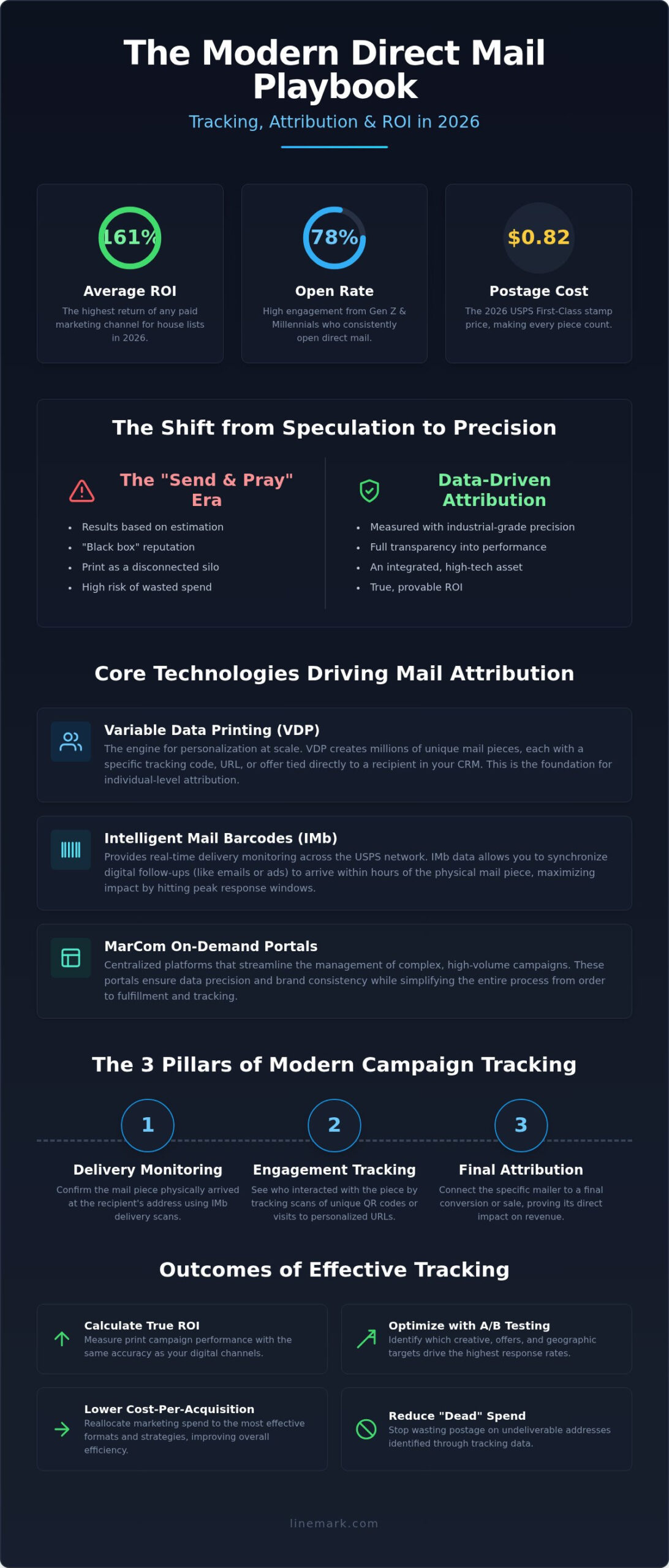
Did you know that direct mail sent to house lists is currently generating an average ROI of 161%, the highest of any paid marketing channel in 2026? Despite these impressive numbers, many marketing leaders still struggle with direct mail campaign tracking, often treating print as a disconnected silo rather than a data-driven asset. You likely feel the pressure to prove every cent of your postage spend, especially with the 2026 USPS First-Class stamp price at $0.82. It’s a common frustration to see high engagement from Gen Z and Millennials, who open mail at a 78% rate, yet fail to capture that momentum within your digital CRM.
We understand that bridging the gap between a physical mailbox and a digital checkout requires more than just a simple QR code. This guide provides a clear framework for attributing sales to specific mail pieces, helping you lower your cost-per-acquisition through industrial-grade precision. You’ll learn how to master technologies like Variable Data Printing and MarCom On-Demand portals to create a seamless, traceable journey for every recipient. We’re moving past the “send and pray” era into a future where every piece of mail is a measurable, high-tech catalyst for business growth.
Key Takeaways
- Learn how Variable Data Printing (VDP) serves as the technical foundation for individualized tracking codes that bridge the gap between physical mail and digital attribution.
- Master modern direct mail campaign tracking techniques, including the use of Intelligent Mail Barcodes (IMb) for real-time delivery monitoring across your entire distribution network.
- Transition from basic response metrics to advanced ROI calculations that prioritize conversion rates and customer lifetime value over simple engagement rates.
- Use tracking insights to perform A/B testing on creative elements and optimize geographic targeting to significantly lower your overall cost-per-acquisition.
- Discover how centralized portals like MarCom On-Demand streamline the management of complex, high-volume campaigns while ensuring industrial-grade data precision.
What is Direct Mail Campaign Tracking?
Direct mail campaign tracking is the systematic process of embedding unique identifiers into print assets to monitor their journey from the production floor to the final customer conversion. In the evolving landscape of direct marketing, this technology transforms a traditional postcard or catalog into a traceable digital asset. It’s no longer enough to simply “drop” mail; sophisticated brands now require a granular view of how their physical investments perform in a digital world.
In 2026, the industry has shifted from passive mail to active data. With USPS metered postage rates for letters now at $0.78, every square inch of paper must carry its weight. Direct mail campaign tracking provides the transparency needed to justify these marketing budgets. It relies on three fundamental pillars: delivery monitoring to confirm the mail reached the recipient, engagement tracking to see who interacted with the piece, and final attribution to prove the sale. This visibility ensures that print is never a disconnected silo but a high-performance engine within your broader strategy.
The Shift from Speculation to Precision
For years, traditional print carried a “black box” reputation where results were often estimated rather than measured. Modern commercial printing has dismantled that perception. By utilizing data-driven strategies, we replace speculation with industrial-grade precision. High-capacity facilities now integrate tracking software directly into the production workflow, ensuring that every piece is accounted for before it even leaves the building.
Multi-channel marketers are returning to mail as a high-intent channel because it offers a physical presence that digital ads cannot match. Tracking allows you to see exactly when that physical presence triggers a digital response. This precision turns direct mail into a strategic tool that complements your CRM data, providing a more holistic view of the customer journey than ever before.
Why Tracking is Non-Negotiable for ROI
Without robust tracking, optimizing a campaign is impossible. Tracking allows you to identify exactly which creative versions or offers trigger the highest response rates. For instance, you might find that a personalized 5-digit presort postcard outperforms a standard letter, allowing you to reallocate funds to the most effective format. This data also helps reduce “dead” spend by identifying undeliverable addresses, ensuring you don’t waste postage on mail that never reaches its destination.
Mail attribution is the definitive link between a physical touchpoint and a final digital sale. By establishing this connection, you can calculate your true return on investment with the same accuracy as your digital search or social media campaigns.
Core Technologies Driving Mail Attribution in 2026
The success of modern direct mail campaign tracking depends on a sophisticated stack of integrated technologies that turn physical paper into a digital beacon. We utilize a combination of logistics-based tracking and recipient-level engagement tools to provide a complete picture of performance. From the initial production phase to the moment a customer scans a code, every step is recorded. This technological foundation ensures that your marketing efforts are transparent and measurable at every stage of the journey.
Intelligent Mail Barcodes (IMb) and Delivery Data
Knowing exactly when a mail piece reaches its destination is critical for omnichannel synchronization. By leveraging various USPS tracking methods, marketers can coordinate high-impact email follow-ups to arrive within hours of the physical delivery. This precision allows you to predict peak response windows based on geographic delivery scans. It’s vital to distinguish between “out for delivery” and “delivered” status. The former tells you the mail is on the truck, while the latter confirms it’s in the hands of your customer, allowing for perfectly timed digital reinforcements.
Variable Data Printing as a Tracking Engine
At the heart of individualized attribution is variable data printing. This technology enables the production of millions of unique pieces, each featuring a specific coupon code or identifier tailored to the recipient. VDP allows for hyper-personalized tracking at an industrial scale, ensuring that every response is tied back to a specific record in your CRM or ERP system. This level of detail helps our partners move beyond aggregate data. It allows them to understand the exact behavior of high-value segments and adjust their strategy accordingly.
PURLs and Dynamic QR Codes
Personalized URLs (PURLs) and dynamic QR codes serve as the primary bridges between the physical and digital customer journey. While a PURL provides a unique landing page for a specific individual, dynamic QR codes act as versatile action drivers that can be updated even after the mail is sent. These tools allow for real-time engagement tracking, capturing mobile-specific data that informs your future marketing spend. If you’re looking for a strategic communications ally to implement these tools, focusing on the integration of these technologies is the first step toward true attribution. By bridging the physical-to-digital gap, you transform every mail piece into a source of actionable marketing intelligence.
Calculating ROI: Turning Mail Data into Marketing Intelligence
The core objective of direct mail campaign tracking is to transform raw delivery data into actionable marketing intelligence. To calculate your true return on investment, we use a standard industrial formula: (Revenue – Campaign Cost) divided by Campaign Cost. While this math seems simple, the quality of the data you input determines the accuracy of your results. By moving beyond a simple headcount of mailers sent, we focus on the revenue generated from every physical touchpoint.
Tracking delivery scans allows us to calculate the “cost per delivered piece” rather than just the “cost per sent piece.” This distinction is vital for high-volume operations. If a percentage of your mail is undeliverable due to poor data hygiene, your actual cost for reaching a customer is higher than your initial estimates. Refined tracking ensures you only pay for the impressions that actually land in a mailbox. Implementing a comprehensive direct mail campaign strategy requires this level of logistical oversight to maintain lean, efficient operations.
Response Rates vs. Conversion Rates
A high response rate can often be a vanity metric if it doesn’t lead to a transaction. We monitor “micro-conversions,” such as PURL visits or QR code scans, as indicators of interest. However, the final conversion remains the ultimate goal. For example, a non-profit campaign might see high engagement but low donation totals, whereas a corporate B2B mailer might yield fewer scans but significantly higher contract values. Establishing these benchmarks for your specific industry vertical allows you to evaluate performance based on bottom-line impact rather than surface-level activity.
Multi-Channel Attribution Models
Direct mail rarely acts in isolation. It often creates a “halo effect,” where a physical piece prompts a user to search for your brand online or engage with a social ad. Modern direct mail campaign tracking helps assign weighted credit to print within these multi-touch journeys. We use match-back reports to reconcile your final sales lists with the original mailing files, providing definitive proof of which mailers drove which purchases. Match-back reports are the essential tool that reconciles your internal sales data with your external mailing lists to identify the exact point of conversion. This integrated approach allows you to see the full value of your print spend across all digital and physical channels.
Optimizing Your Campaign Based on Tracking Insights
Optimization is the logical evolution of measurement. Once you establish a robust system for direct mail campaign tracking, the resulting data serves as a strategic roadmap for refining your future investments. You don’t have to wait for the next quarter to see what worked. Real-time insights allow you to pivot your strategy, ensuring your budget is always allocated to the most productive channels and creative versions. This proactive approach turns every mailing into a learning opportunity that sharpens your competitive edge.
Geographic optimization is one of the most immediate benefits of tracking. By analyzing delivery-to-conversion ratios, you can identify specific regions where your message resonates most deeply. Instead of a blanket nationwide drop, you can double down on high-performing zip codes while pausing spend in areas with diminishing returns. This precision reduces wasted postage and ensures your 90,000-square-foot facility production capacity is focused on the highest-probability leads.
The Power of A/B Testing in Print
A/B testing is no longer reserved for digital banners. By using unique tracking codes, you can test postcard sizes against traditional letter packages to see which format drives more scans. You might discover that a specific headline or offer triggers a 20% higher scan rate in one demographic versus another. Iterating on call-to-action (CTA) placement based on this scan data allows you to refine the physical layout for maximum impact. Rapid-response tracking enables these mid-campaign adjustments, allowing you to tweak the second half of a large-scale mailing based on the performance of the first.
Digital Retargeting and the Integrated Journey
The most sophisticated marketers use direct mail as the high-impact anchor of a multi-channel digital campaign. By syncing your mail tracking data with Facebook or Google ad pixels, you can create a “surround sound” effect. When a scan is recorded but no purchase is made, you can automatically trigger digital retargeting ads to that specific recipient. This ensures your brand remains top-of-mind across all platforms. Timing these digital ads to coincide with the exact moment of mail delivery significantly increases the likelihood of conversion. This integrated journey transforms a single piece of mail into a persistent, multi-touch marketing engine.
To see how these tracking insights can transform your ROI, consult with a Linemark expert today to build your next data-driven campaign.
Integrated Direct Mail Fulfillment: The Linemark Advantage
Measurement and optimization represent the strategic side of a campaign, but the physical execution determines whether those digital links actually function in the field. High-performance direct mail campaign tracking requires a production partner capable of managing extreme complexity at scale. When you are deploying millions of unique tracking codes or dynamic QR codes, there is no room for logistical error. We act as a strategic communications ally, ensuring that every data point translates perfectly from your digital CRM to the physical printed page. Our 30+ years of industrial production experience allow us to anticipate the nuances of modern marketing and logistics before they impact your ROI.
MarCom On-Demand: Tracking at Your Fingertips
Managing a distributed marketing network shouldn’t be a manual or fragmented process. Our MarCom On-Demand portal provides a centralized, high-tech destination for your marketing assets. This platform simplifies the deployment of tracked assets by allowing your team to order, customize, and track mailings through a streamlined interface. You maintain total brand consistency across all regions while the system handles the variable data requirements for each individual recipient. This automated workflow significantly shortens the “order-to-mailbox” timeline. Speed is essential for time-sensitive offers that rely on the precise delivery scans we discussed in previous sections.
Scalability and Precision in Industrial Production
Our 90,000-square-foot high-tech facility is engineered for precision at an industrial scale. We utilize advanced camera matching technology and automated verification systems to ensure 100% mail-piece integrity. This rigorous process ensures that the unique tracking code intended for a specific customer always lands on the correct piece of mail. Without this level of industrial oversight, your direct mail campaign tracking data becomes unreliable, leading to skewed attribution reports. The integrity of your data is only as good as the precision of the printer handling the mail pieces.
The scale of our operation allows us to handle high-volume projects without sacrificing the meticulous attention to detail required for data-driven mail. We move your project through the mail stream with a steady, controlled pace that builds confidence. We don’t just function as a service provider; we are a catalyst for your growth. By merging high-capacity production with sophisticated tracking technology, we turn traditional print into a measurable marketing asset that fuels your bottom line.
Ready to prove your print ROI? Consult with our direct mail experts today.
Transforming Print into a Traceable Growth Engine
The 2026 marketing landscape demands total transparency across every channel. You’ve seen how modern technology turns traditional print into a high-performance digital asset that mirrors the tracking capabilities of your best digital campaigns. By implementing robust direct mail campaign tracking, you move beyond the speculation of the past into a future of industrial-grade precision. This strategic shift allows you to attribute every sale, optimize your geographic spend, and bridge the gap between physical mailboxes and digital CRMs with ease.
Success in this arena requires a strategic ally who understands both the technical nuances of logistics and the high-level goals of your organization. With over 30 years of data-driven print expertise and a 90,000-square-foot high-volume production facility, we provide the scale and reliability your brand deserves. Our MarCom On-Demand portal ensures your tracking assets and campaign data are always accessible and actionable. Scale your tracked direct mail campaigns with Linemark to start capturing the true value of your print investment. Your next high-ROI campaign is just one data-driven decision away.
Frequently Asked Questions
How do I track a direct mail campaign without a digital call to action?
You can track a campaign without a digital call to action by using match-back analysis or dedicated tracking phone numbers. Match-back analysis involves comparing your original mailing list against your sales records after the campaign ends to identify which recipients made a purchase. This method provides definitive proof of offline conversion without requiring the customer to scan a code or visit a website. It’s a reliable way to measure impact for traditional audiences.
What is the most accurate way to measure direct mail ROI in 2026?
The most accurate way to measure ROI in 2026 is through closed-loop attribution integrated with your CRM. By assigning a unique identifier to every mailer, you can track the journey from the initial delivery scan to the final transaction. This granular level of direct mail campaign tracking allows you to calculate revenue against the specific cost of reaching that individual. It removes the guesswork often associated with aggregate response data.
Can I track exactly when my mail is delivered to a specific address?
Yes, you can track delivery to a specific address using the USPS Intelligent Mail Barcode (IMb) system. This technology provides real-time data as each piece moves through the postal system, allowing you to see exactly when it reaches the recipient’s local post office. While it doesn’t confirm the physical hand-off to the customer, it offers a highly accurate window for timing your digital follow-ups and calculating delivery-to-response lag times.
What is a PURL and how does it help with tracking?
A PURL is a Personalized URL created specifically for an individual recipient, such as a unique web address for each customer. It helps with tracking by identifying the exact person who engaged with your mailer the moment they visit the page. This technology allows you to pre-fill web forms with their data, creating a frictionless user experience. It also provides deep insights into how long they spent on the page and which specific elements they viewed.
How does Variable Data Printing (VDP) improve campaign tracking?
Variable Data Printing (VDP) improves tracking by allowing every printed piece to carry a unique identifier, such as a custom QR code or coupon. This technological foundation is essential for effective direct mail campaign tracking at an industrial scale. Because the printer can change data on the fly without stopping the press, you can test different offers across segments and know precisely which one triggered the response. It turns mass mail into individualized data points.
What is the difference between a response rate and a conversion rate in direct mail?
Response rate measures the initial action taken by a recipient, while conversion rate measures the completion of your ultimate business goal. For example, if someone scans a QR code, that counts as a response. If they proceed to make a purchase, that is a conversion. Monitoring both metrics helps you understand if your creative is engaging but your landing page is failing, or if your offer is strong but the audience is wrong.
How do I integrate my direct mail tracking data with my CRM like Salesforce?
You can integrate tracking data with your CRM by using an automated portal like MarCom On-Demand that connects via API. This setup allows delivery scans and digital interactions to flow directly into your customer records in real-time. Your sales team can receive alerts the moment a high-value lead receives their mailer or visits their PURL. This integration ensures that your physical marketing efforts are fully visible within your existing digital ecosystem.
Is direct mail tracking more expensive than standard mailing?
Direct mail tracking is not significantly more expensive than standard mailing when you consider the reduction in wasted postage. While there are small technical fees for IMb setup or PURL hosting, these costs are typically offset by cleaning your lists of undeliverable addresses. The ability to optimize your campaign based on real data usually results in a much lower cost-per-acquisition. It’s a strategic investment that pays for itself through improved campaign precision.