


 08/09/2026
  Steve Bearden
What if you could treat every physical postcard or catalog in the mail stream like a digital click, monitoring its journey with the same precision as a tracking pixel? For decades, direct mail was often viewed as a “send and pray” medium where marketers lost visibility the moment a pallet left the loading dock. You likely understand the frustration of trying to time email follow-ups or sales calls without knowing exactly when your mailpiece will land in the customer’s hands. It is a gap that often leads to missed opportunities and disjointed brand experiences.
This strategic guide will show you how to master intelligent mail barcode tracking to transform your physical outreach into a data-driven powerhouse. By leveraging the latest technical nuances, including the January 2026 DMM updates and the new IMmb requirements, you’ll gain the real-time visibility necessary to synchronize your multi-channel marketing efforts. We’ll explore how to navigate the complexity of USPS Full-Service requirements to secure significant postage discounts and move beyond simple delivery to true operational excellence. From understanding the July 2026 rate increases to implementing sophisticated timing for digital follow-ups, you’re about to turn your mail logistics into a competitive advantage.
Key Takeaways
- Learn how the 65-bar USPS code translates into real-time visibility through the Informed Visibility platform, allowing you to monitor every piece of mail.
- Distinguish between intelligent mail barcode tracking for letters and IMpb for packages to optimize your tracking granularity and maintain postal compliance.
- Synchronize multi-channel marketing by timing digital touchpoints and operational staffing to coincide with precise physical mail delivery windows.
- Understand the technical requirements of USPS Full-Service mailings to secure maximum postage discounts and improve overall campaign ROI.
- Identify the essential security protocols and production capabilities a strategic partner needs to manage complex variable data and PII in high-volume mail files.
What is Intelligent Mail Barcode Tracking?
The Intelligent Mail barcode (IMb) is a 65-bar USPS symbol that serves as the primary data carrier for letters and flats. It’s a sophisticated tool that consolidates routing and tracking information into a single, high-density code. Transitioning to intelligent mail barcode tracking is no longer optional for high-volume mailers who prioritize precision. While previous iterations like POSTNET only provided routing data, the IMb tracks the piece through every major sorting facility in the USPS network, offering end-to-end visibility from the initial scan to the local post office delivery window.
Evolution within the postal system has moved rapidly toward this unified standard. The shift from legacy POSTNET and PLANET barcodes wasn’t just a technical upgrade; it was a strategic move toward total transparency. In 2026, the mandate for Full-Service IMb is critical for any organization seeking to mitigate the impact of the July 12, 2026, postage rate increases. By adopting these standards, mailers can offset the 4.8% average rise in costs through essential automation discounts that are only available to those who provide the USPS with the granular data the IMb requires.
The Core Components of the IMb
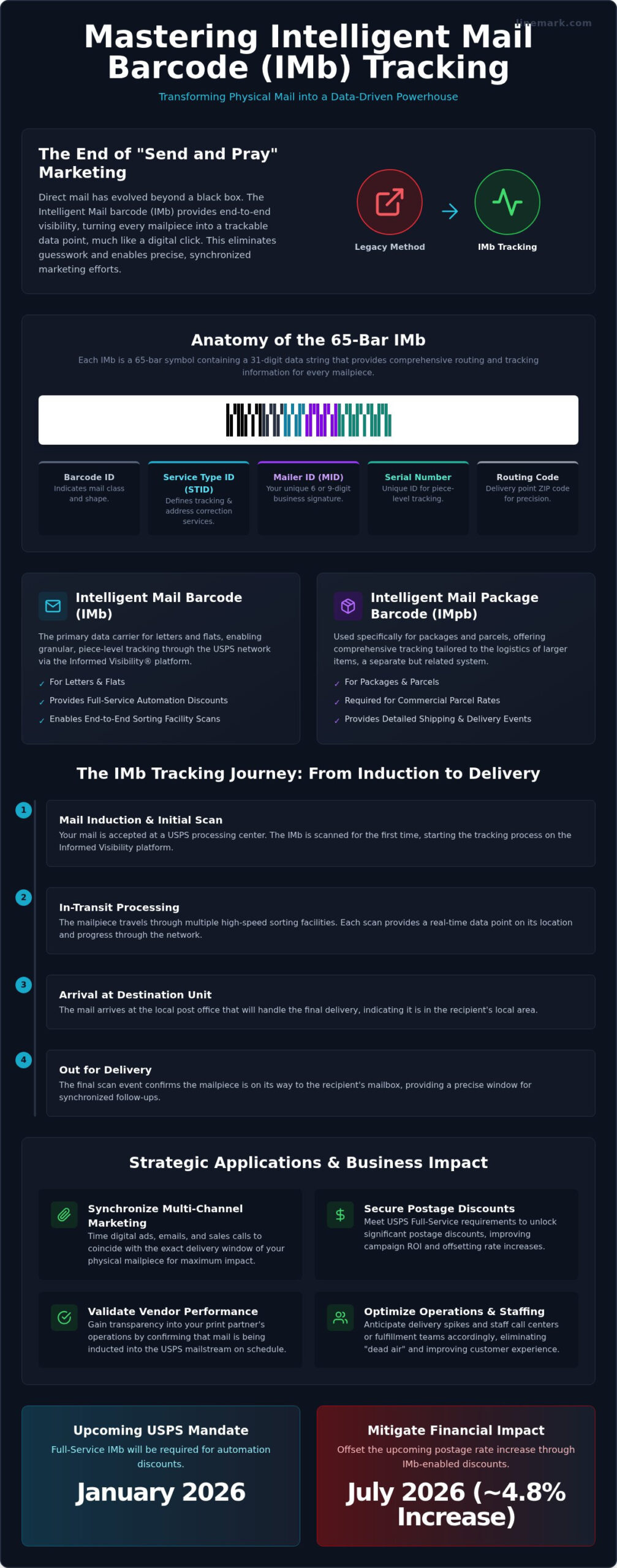
This technical string is divided into specific fields that tell the story of your mailpiece. The Barcode Identifier indicates the mail class and shape, while the Service Type Identifier (STID) defines the specific tracking and address correction services requested. Perhaps most importantly, the Mailer ID (MID) acts as your unique 6- or 9-digit business signature. These elements work in unison to ensure that every piece is accounted for as it moves through high-speed sorting equipment, providing a level of logistical certainty that was previously impossible to achieve at scale.
Why Tracking Matters for Your Bottom Line
Leveraging intelligent mail barcode tracking allows you to validate vendor performance and confirm that your production partner is hitting critical induction windows. This visibility eliminates “dead air” in customer service operations; your team can anticipate delivery spikes and staff call centers accordingly. You’re no longer guessing when a promotion lands. Instead, you’re reacting to hard data that confirms your audience has the offer in hand. The IMb functions as a critical bridge between physical mail assets and digital marketing analytics.
The Anatomy of an IMb: How Data Becomes Visibility
Every USPS Intelligent Mail barcode is a marvel of industrial engineering. It compresses complex routing instructions and tracking identifiers into a compact string of 65 bars. This symbology isn’t just a static label; it’s a dynamic data carrier that enables intelligent mail barcode tracking across the entire postal network. The USPS Informed Visibility (IV) platform acts as the central nervous system for this data, capturing scan events as mailpieces move through high-speed automated sorters. These events track the journey from the moment a piece is “Accepted” at a processing center to its final “Out for Delivery” status at the local destination facility.
The serial number within the barcode is the linchpin of piece-level visibility. While bulk mailings were once tracked only by the pallet or container, the IMb allows for the identification of every individual letter or flat. This unique identifier ensures that your 50,000-piece acquisition campaign isn’t just a single shipment, but a collection of 50,000 distinct data points. By monitoring these unique serials, you can identify exactly which segments of your list are receiving mail first, allowing for a level of logistical precision that was previously reserved for small-parcel shipping.
Decoding the 65-Bar String
The visual structure of the barcode relies on four distinct bar heights: the tracker, ascender, descender, and full bar. These heights represent specific bit values that, when decoded, reveal a 31-digit data string. This string includes the Routing Code, which typically uses a ZIP+4 to ensure hyper-local delivery precision. For internal reporting, the 20-digit tracking portion (comprising the MID, STID, and Serial Number) provides the necessary granularity to link physical delivery windows with your digital marketing dashboard.
Data Flow from Press to Post Office
Generating these barcodes at industrial speeds requires sophisticated variable data printing capabilities. As your print partner, we apply these unique codes directly onto the mailpiece during the production phase, ensuring that the data in the barcode perfectly matches the recipient’s address and your tracking requirements. Readability is paramount; if a barcode is blurred or incorrectly positioned, it can lead to sorting delays or “no-reads” that blind your tracking system. Our high-capacity facility utilizes advanced verification technology to ensure every barcode meets strict USPS quality standards before it ever enters the mail stream. This seamless handoff between print production and postal logistics is what transforms a simple mailpiece into a high-tech communication tool.
IMb vs. IMpb: Navigating the USPS Tracking Ecosystem
Distinguishing between the Intelligent Mail barcode (IMb) and the Intelligent Mail package barcode (IMpb) is a fundamental step in logistical planning. While both provide visibility, they operate on different tracking logic. The IMb is designed for letters and flats, using a 65-bar string to facilitate high-speed sorting. In contrast, the IMpb is reserved for parcels and requires a different symbology. Understanding these boundaries is essential for maintaining compliance with USPS standards, especially following the July 12, 2026, rate increases. For instance, Marketing Mail parcels that lack a valid IMpb now incur a $0.25 fee per piece, a penalty that can quickly erode a campaign’s ROI.
Choosing the right standard impacts your access to data and postage discounts. Intelligent mail barcode tracking for letters often utilizes Full-Service standards to unlock the lowest possible automation rates, which range from $0.395 to $0.467 for Marketing Mail depending on the presort level. This level of service provides piece-level visibility through the entire mail stream. Conversely, packages may require the new Intelligent Mail Matrix Barcode (IMmb) as of March 05, 2026. This 2D version of the package barcode is designed for better readability on non-standard packaging, ensuring that e-commerce kits and bulky marketing materials don’t suffer from “no-read” events at sorting facilities.
The Strategic Differences
The tracking logic for letters (IMb) focuses on automated sorting events at major distribution centers. For parcels (IMpb), the system offers more granular delivery confirmation. Selecting the correct Service Type Identifier (STID) is a critical decision; it determines whether you receive automated address correction or simple delivery tracking. Full-Service adoption remains the gold standard for enterprise mailers, as it provides the most comprehensive data set for multi-channel synchronization without any additional per-piece fees for the tracking itself.
Which One Does Your Campaign Need?
Most marketing collateral, including postcards, standard envelopes, and self-mailers, will fall under the IMb umbrella. These pieces benefit from high-speed sorting and the piece-level visibility that intelligent mail barcode tracking provides. However, if your campaign involves thick catalogs or kitted marketing materials that exceed the dimensions of a flat, you must transition to IMpb or IMmb standards. Professional direct mail fulfillment services manage these transitions automatically. This expertise ensures that every piece, regardless of shape, is encoded with the correct barcode dimensions and placement to avoid sorting delays and unnecessary surcharges.
Strategic Applications: Leveraging Real-Time Mail Visibility
Transforming raw scan data into actionable marketing intelligence is where intelligent mail barcode tracking provides its greatest return on investment. By moving beyond simple delivery confirmation, organizations can use real-time visibility to orchestrate complex, multi-channel customer journeys. This level of precision allows you to treat a physical mailpiece with the same responsiveness as a digital ad, ensuring your brand remains top-of-mind during the critical window when the recipient is most likely to engage with your offer. You’re no longer guessing when your message arrives; you’re reacting to it.
Operational efficiency also sees a significant boost through precise delivery forecasting. When you know exactly when a high-volume drop will land in a specific region, you can optimize call center staffing or local branch resources to handle the inevitable spike in inquiries. This proactive approach eliminates the friction that occurs when marketing and operations are siloed. Additionally, by correlating web traffic spikes with physical mail scans, you can build a more accurate attribution model. This data proves the value of your direct mail spend by showing a direct link between a mailbox arrival and a digital conversion.
The Multi-Channel Synchronization Framework
A synchronized approach ensures that your physical and digital touchpoints work in harmony rather than competing for attention. Implementing this framework involves three key stages:
- Step 1: Monitor the ‘Out for Delivery’ scan event. Use your tracking dashboard to identify when mailpieces have reached the final destination facility and are scheduled for local delivery.
- Step 2: Trigger digital ads or emails within 24 hours of arrival. Sending a follow-up email while the physical piece is still on the kitchen counter creates a powerful reinforcement effect that boosts recall.
- Step 3: Track the lift in conversion compared to unsynced mail. Use A/B testing to measure how this “surround sound” strategy impacts your bottom line compared to standalone campaigns.
Informed Delivery Integration
The IMb also serves as the engine for the USPS Informed Delivery service, a platform that provides millions of consumers with a digital preview of their incoming mail. By integrating your tracking data with this service, you can add color “Representative Images” and clickable links to the daily digest email. This effectively gives your physical mail a digital “pre-click” opportunity, capturing engagement before the mailbox is even opened. If you’re ready to modernize your outreach, our team can help you implement a data-driven direct mail strategy that maximizes every scan event through our high-capacity production facility.
Implementing IMb Tracking with a Strategic Print Partner
While basic online tools can generate a single barcode, enterprise-level intelligent mail barcode tracking requires an infrastructure capable of managing millions of unique data points with absolute precision. Attempting a DIY approach for high-volume campaigns introduces significant risks, ranging from barcode duplication to “no-read” errors that result in costly postal surcharges. A strategic print partner acts as your technical intermediary, ensuring that the digital tracking string generated during pre-press aligns perfectly with the physical piece. This centralized oversight is the only way to maintain the data integrity required for the sophisticated multi-channel campaigns modern marketers demand.
Security is equally paramount when handling Personally Identifiable Information (PII) within your mailing lists. Professional partners implement rigorous data protection protocols that far exceed basic encryption standards. By housing data management, print production, and direct mail fulfillment under one roof, we minimize the “hops” your sensitive data must take between various vendors. This unified workflow doesn’t just secure your customer information; it also streamlines the handoff to the USPS, ensuring that your tracking data is live and actionable the moment the mail is inducted into the system.
Technical Onboarding and Data Management
Accurate tracking begins with meticulous mailing list hygiene. Our automated workflows scrub your data to prevent barcode duplication and ensure every address meets current USPS standards for deliverability. By leveraging variable data printing, we assign a unique serial number to every individual piece in your run. This level of granularity allows you to track specific recipient responses and refine your attribution models with precision, turning your static mail files into a dynamic marketing asset that feeds directly into your CRM.
The Linemark Advantage: Precision at Scale
With over 30 years of industrial production experience, we understand the technical nuances of USPS compliance and the specific requirements of the 2026 postal landscape. Our 90,000-square-foot high-tech facility is designed to handle complex kitting and high-volume fulfillment projects while maintaining the meticulous attention to detail required for successful intelligent mail barcode tracking. We don’t merely provide a service; we act as a strategic communications ally to ensure your campaigns achieve maximum postage discounts and superior operational excellence. Contact Linemark to optimize your direct mail tracking today.
Elevating Your Direct Mail Strategy for 2026
Mastered correctly, intelligent mail barcode tracking serves as more than a compliance requirement; it’s a strategic sensor that bridges the gap between physical and digital marketing. You’ve seen how piece-level visibility allows for precise multi-channel timing and how understanding the nuances between IMb and IMpb standards protects your bottom line from unnecessary surcharges. By leveraging the Informed Visibility platform, your organization can move from reactive mailing to proactive, data-driven engagement that captures attention at the exact moment of delivery.
Achieving this level of precision at scale requires a partner with the industrial capacity to manage complex data files and advanced variable data printing with absolute accuracy. As a Full-Service USPS provider with a 90,000-square-foot high-tech facility, we specialize in the kitting and fulfillment logistics that turn technical barcodes into measurable ROI. Streamline your mail tracking with Linemark’s direct mail experts to ensure every campaign is a model of operational excellence. It’s time to stop guessing and start growing your impact through total mailstream transparency.
Frequently Asked Questions
What is the difference between IMb and POSTNET barcodes?
The primary difference is data capacity. Legacy POSTNET barcodes only contained routing information, whereas the 65-bar IMb integrates routing, tracking, and service identifiers into a single symbol. This unified approach allows the USPS to track individual pieces through automated equipment, a capability that POSTNET lacked. By combining the functions of POSTNET and PLANET barcodes, the IMb provides the end-to-end visibility required for modern logistics.
Is Intelligent Mail Barcode tracking free for all mailers?
There is no separate per-piece fee for intelligent mail barcode tracking. In fact, using the IMb is a prerequisite for receiving automation postage discounts, which can save you significant costs on high-volume mailings. While the tracking data itself is free via the Informed Visibility platform, you must meet Full-Service requirements to access the most granular piece-level insights without additional USPS charges.
How can I check the status of my mail using an IMb?
You can monitor your campaign status through the USPS Informed Visibility (IV) platform or a consolidated dashboard provided by your print partner. These systems aggregate scan data from sorting facilities across the country. By tracking the unique serial numbers assigned during production, you can see when pieces are accepted, processed, and eventually marked as out for delivery at the local destination facility.
What is a Mailer ID (MID) and how do I get one?
A Mailer ID (MID) is a unique 6- or 9-digit number used to identify the mail owner or the mail service provider. You can obtain a MID through the USPS Business Customer Gateway by registering your organization and requesting a specific ID for your mailing activities. This identifier is a permanent component of your intelligent mail barcode tracking string, ensuring all scan data is correctly attributed to your account.
Do I need special software to print Intelligent Mail Barcodes?
Yes, generating the 65-bar string requires specialized software that can encode your routing and tracking data into the correct visual format. While some DIY tools exist, enterprise mailers typically rely on a high-capacity production partner to handle this step. We integrate this software into our automated workflows to ensure every barcode is uniquely serialized and perfectly positioned for high-speed USPS scanning equipment.
What happens if my barcode is unreadable by USPS machines?
If a barcode is unreadable, the mailpiece loses all tracking visibility and becomes ineligible for automation discounts. This often happens due to poor print quality, incorrect placement, or physical damage to the piece. Beyond losing data, you may be hit with “no-read” surcharges or manual processing fees. We use advanced verification technology in our 90,000-square-foot facility to prevent these errors before the mail leaves our dock.
How does IMb tracking integrate with Informed Delivery?
The IMb acts as the trigger for the Informed Delivery consumer app. When the USPS scans your barcode at a sorting facility, it identifies the recipient and matches the piece to their digital profile. This allows the system to send a daily digest email containing a preview of the mail. Marketers can enhance this experience by adding clickable links and color images that drive engagement before the physical mailbox is even opened.
Can I use IMb tracking for international mailings?
No, the Intelligent Mail barcode is a domestic standard used exclusively within the USPS network. International mailings require different barcode formats and tracking protocols that comply with global postal standards. If your campaign targets both domestic and international audiences, your production partner must apply the appropriate encoding for each destination to ensure compliance and maintain visibility where available.