

 07/30/2026
  Steve Bearden
A 60lb paper stock can be a standard interior page or a sturdy booklet cover, and choosing the wrong one is a mistake your production budget won’t forget. With North American paper prices forecasted to rise by 3.4% in 2026, precision in your specifications is more critical than ever. Mastering the conversion of 60lb in gsm is the only reliable way to ensure your project meets international ISO 536:2019 standards and maintains a professional tactile quality.
We recognize that the gap between North American basis weights and the metric system often creates unnecessary friction in the design process. It’s frustrating to receive a high-volume run of catalogs only to find the stock feels lighter than your brand requires. This guide provides the technical clarity you need to handle complex specifications with precision. We’ll break down the exact GSM equivalents for 60lb Text and Cover stocks, giving you the logistical insight to specify paper for your next commercial run with absolute confidence.
Key Takeaways
- Understand why the US basis weight system differs from the international ISO 536:2019 standard to maintain consistency across global print specifications.
- Learn to distinguish 60lb Text from 60lb Cover to avoid costly production errors regarding paper thickness and project rigidity.
- Master the mathematical formula for converting 60lb in gsm for uncoated stocks, ensuring your custom book projects meet exact professional standards.
- Identify the ideal applications for 60lb stock, such as optimizing direct mail for postage savings while maintaining a high-quality tactile feel.
Understanding Paper Weight Systems: Why 60lb Isn’t Universal
The North American printing industry still relies heavily on the basis weight system, but this legacy method often leads to production errors in a global marketplace. When you specify 60lb paper, you aren’t describing the weight of a single sheet in isolation. Instead, you’re referencing the weight of 500 sheets, a full ream, at its original “parent” or basis size before it’s cut for the press. This is why converting 60lb in gsm is the first step toward technical accuracy for any professional print run.
Precision matters when your brand’s physical identity is on the line. Relying on a pound rating without understanding the underlying grade can lead to ordering paper that is either too flimsy for a high-end catalog or too heavy for cost-effective mailing. In an era where paper prices are forecasted to rise by 3.4% in 2026, these technical errors carry significant financial consequences for high-volume projects.
What is Basis Weight?
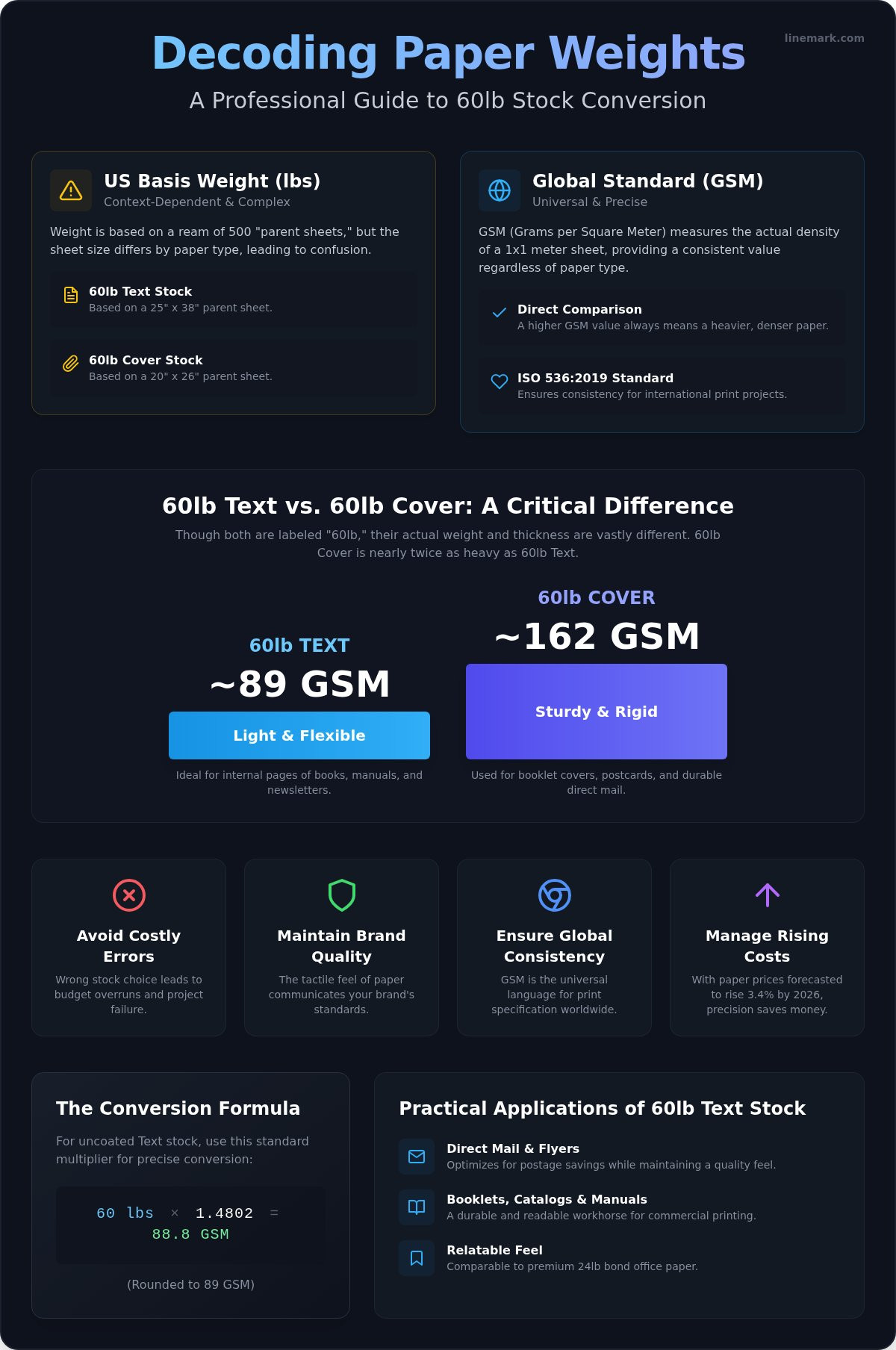
The US system categorizes paper into specific grades, such as Text, Cover, Bond, and Index. Each grade is assigned a unique basis size. For example, the basis size for Text paper is 25 x 38 inches, while Cover stock is measured at 20 x 26 inches. If 500 sheets of the 25 x 38 parent size weigh 60 pounds, it’s labeled 60lb Text. However, if 500 sheets of the much smaller 20 x 26 parent size weigh 60 pounds, you have 60lb Cover.
Modern digital designers often find this system confusing because a 60lb Cover stock is nearly twice as thick as 60lb Text, despite sharing the same numerical label. This lack of a single standard is exactly why a direct conversion of 60lb in gsm varies so wildly between paper grades. Without specifying the grade, the “60lb” designation is incomplete and potentially misleading for production teams.
The Rise of GSM in Modern Printing
In contrast, Understanding Paper Weight Systems through the lens of GSM provides a universal constant that transcends paper grades. GSM stands for Grams per Square Meter. It’s a metric unit of measurement that defines the mass of a paper product relative to a single square meter of surface area. This standard, governed by ISO 536:2019, eliminates the guesswork inherent in the US system.
GSM is the preferred measurement for precision digital printing and automated production environments. It allows for easier calculation of postage and shipping weights, which is vital for managing large-scale direct mail campaigns. Because GSM measures the paper itself rather than a ream of varying parent sizes, it serves as a reliable benchmark for quality control. It ensures that the paper you specify in the design phase is exactly what arrives at the loading dock, regardless of where the mill is located.
Converting 60lb to GSM: The Exact Math for Print Pros
Converting 60lb in gsm requires more than a simple calculator. It involves understanding the specific conversion factor assigned to the Text paper grade. For Text stock, the standard multiplier is approximately 1.4802. When you multiply 60 by this factor, you arrive at 88.8, which the industry typically rounds to 89 GSM. This figure represents the mass of the paper, but it doesn’t tell the whole story about how the sheet will behave under the pressure of a high-speed press.
Density and thickness, known as caliper, are distinct properties that dictate the final outcome of your project. An offset sheet and a coated sheet might both weigh 60lb, but their physical profiles are rarely identical. Offset paper is generally more porous and tactile. Coated paper uses additives like clay or polymers to create a smooth surface, which increases density. This means a 60lb coated sheet often feels thinner than an uncoated one. If you’re managing complex custom book printing projects, these subtle variations in caliper can significantly impact the final spine width of your publication.
60lb Text Stock Conversion Table
- Uncoated Offset: 89 to 90 GSM. This is the workhorse of the commercial industry, providing a reliable balance of durability and readability for manuals and newsletters.
- Coated Matte/Gloss: 88 to 92 GSM. The specialized coating adds weight and surface smoothness without necessarily increasing the physical thickness of the sheet.
- Practical Comparison: This weight is comparable to premium 24lb bond office paper. It offers a high-quality feel that exceeds standard copier paper while remaining light enough for high-volume distribution.
Variables That Affect the Final Feel
The architectural makeup of the paper fibers and the subsequent finishing processes dictate the tactile experience of a 60lb sheet. A gloss finish reflects light and feels slick, which often makes the paper seem thinner than a matte finish that diffuses light. Opacity is another critical factor. Higher-quality 60lb stocks are engineered with specific fillers to prevent “show-through,” allowing you to print high-coverage graphics on both sides without compromising legibility.
Some mills produce “high-bulk” versions of 60lb stock. These are engineered to feel like a heavier 70lb sheet while maintaining the lower mass. This is a strategic choice for brands looking to reduce costs in large-scale logistics without sacrificing the perceived value of their printed materials. Understanding these nuances ensures that your technical specifications align perfectly with your creative vision.
60lb Text vs. 60lb Cover: Avoiding a Costly Mistake
One of the most expensive errors in commercial production occurs when a project is specified by weight alone without identifying the paper grade. While both stocks carry the “60lb” label, the physical reality of 60lb Text and 60lb Cover is fundamentally different. This discrepancy exists because the basis weight is calculated using different parent sheet sizes. Because a ream of Text paper is measured at a much larger surface area than a ream of Cover stock, the 60lb rating applies to very different thicknesses. Understanding the specific conversion of 60lb in gsm for each category is the only way to avoid receiving a product that is either too flimsy for its purpose or impossible to bind.
Visualizing this difference is essential for design accuracy. Imagine the interior page of a high-quality hardcover book; that is your 60lb Text. Now, imagine a lightweight business card or a sturdy greeting card; that is the equivalent of 60lb Cover. We see this confusion frequently in high-volume production, where a simple miscommunication can lead to an entire run of postcards being printed on paper that doesn’t meet USPS thickness requirements. Precision in your specifications ensures your project maintains its intended professional feel and structural integrity.
The 60lb Cover Deep Dive
When you require a stock with rigidity and snap, 60lb Cover is the entry-level choice for cardstock applications. It typically converts to approximately 162 to 165 GSM. This weight provides enough durability for report covers, lightweight folders, and promotional inserts that need to stand upright. It’s a strategic choice for brands that want the tactile authority of a cover stock without the added postage costs of a heavy 100lb or 120lb board. It offers a professional “pop” that lighter papers simply cannot replicate.
The 60lb Text Deep Dive
In contrast, 60lb Text is engineered for flexibility and high-capacity page counts. It generally converts to 89 or 90 GSM, making it the industry standard for brochures, newsletters, and internal book blocks. While it’s significantly lighter than its Cover counterpart, it’s still a substantial upgrade from standard 20lb bond office paper, which typically sits at 75 GSM. Choosing 60lb in gsm for your interior pages provides better opacity and a smoother finish, ensuring that high-ink coverage doesn’t bleed through to the opposite side of the sheet.
Practical Applications: When to Choose 60lb Stock
Selecting the right stock involves balancing tactile quality with logistical costs. 60lb paper is often the default choice for high-volume projects because it bridges the gap between premium feel and economic efficiency. When you specify 60lb in gsm for your project, you’re choosing a weight that’s light enough to reduce bulk but substantial enough to carry high-density ink without the transparency issues of lighter 50lb stocks. This versatility makes it the primary candidate for everything from technical manuals to sophisticated marketing collateral.
60lb in Custom Book Manufacturing
In the world of custom book printing, 60lb uncoated text is the gold standard for educational textbooks and non-fiction titles. Its porous nature allows for excellent ink absorption, which is critical for high-resolution graphics and technical diagrams that require sharp detail. Beyond aesthetics, this stock choice has a direct impact on the physical dimensions of the final product. A 400-page book printed on 60lb text will have a manageable spine width that remains compatible with standard binding and finishing processes. This ensures the book is durable enough for repeated use in classrooms or libraries without becoming excessively heavy or difficult to handle.
Direct Mail Efficiency with 60lb Stock
For organizations managing large-scale direct mail, 60lb stock represents a “sweet spot” for maximizing return on investment. With paper prices forecasted to rise by 3.4% in 2026, every gram matters for your bottom line. Using a 60lb text stock for newsletters or multi-page catalogs allows you to include more content while staying within specific postage weight tiers. Despite its lighter profile, it’s engineered to withstand the rigors of automated postal sorting machines. The paper’s tensile strength prevents tearing during high-speed processing, ensuring your message arrives in pristine condition.
If your campaign requires a more rigid presence, 60lb cover stock is an ideal entry-level cardstock for direct mail marketing pieces like postcards or self-mailers. It provides the necessary snap to stand out in a mailbox while converting to roughly 163 GSM. This keeps your shipping costs predictable while maintaining a professional presentation. This strategic selection of 60lb in gsm allows for high-impact creative without the logistical penalties of heavier boards. It’s the perfect solution for high-volume commercial runs where consistency and cost-effectiveness are paramount.
Our MarCom On-Demand portal can help your team manage these complex specifications across multiple locations to ensure brand consistency on every run.
Partnering for Precision: Why Paper Selection Matters
Understanding the technical conversion of 60lb in gsm is a vital first step, but the final quality of a high-volume print run depends on the precision of the production partner. Small variances in humidity, fiber direction, or coating density can alter how a sheet behaves on a high-speed digital or offset press. When you scale a marketing campaign across thousands of units, these minor technical details become the difference between a successful launch and a costly production error.
Our role as a strategic communications ally is to manage these complexities so your team can focus on creative strategy. We bridge the gap between abstract specifications and physical reality. By leveraging a centralized MarCom On-Demand portal, corporations can ensure that every brochure, catalog, or direct mail piece maintains consistent stock across different geographical regions. This centralized approach eliminates the confusion of local basis weight variations and ensures your brand identity remains tactilely consistent.
Industrial Authority in Every Print Run
With a 90,000-square-foot high-tech production facility and over 30 years of industrial experience, we provide the infrastructure needed for scalable print solutions. We don’t just print files; we engineer results. Our facility utilizes data-driven strategies to personalize print at scale, ensuring that even complex variable data projects maintain the structural integrity of the chosen 60lb in gsm stock. This technological pride is reflected in our ability to handle diverse substrates with the meticulous attention to detail typically found in boutique shops.
Preventing “paper-weight regret” is a core part of our collaborative process. In an environment where paper costs are rising and supply chains are restructuring, professional consultation is a safeguard for your budget. Our experts help you navigate the nuances of fiber density and opacity, ensuring that your choice of 60lb stock delivers the professional feel your project demands without unnecessary waste.
Next Steps for Your Project
The best way to appreciate the difference between various stocks is through a physical tactile experience. We encourage you to request a paper sample kit to feel the distinct texture and rigidity of 60lb Text versus 60lb Cover in person. Once you’ve established your project’s goals, consult with one of our experts to refine your specifications for custom book manufacturing or high-volume direct mail. Contact Linemark today to develop a holistic production strategy that transforms your technical requirements into a powerful, professional reality.
Elevate Your Production Standards for 2026
Mastering the conversion of 60lb in gsm is more than a technical exercise; it’s a strategic necessity for maintaining brand integrity. You now understand the critical distinction between Text and Cover stocks and how identifying the correct GSM ensures your project meets international standards. Precision in these specifications prevents the logistical friction that often plagues high-volume commercial runs.
We provide the industrial authority required to navigate these complex variables with ease. Our 90,000-square-foot high-tech production facility is engineered for precision, backed by over 30 years of industrial printing experience. We manage every detail from custom book manufacturing to national fulfillment and distribution, ensuring your specifications translate perfectly into tangible results. Your vision deserves a production partner that values technical accuracy as much as you do.
Scale your next project with Linemark’s commercial printing expertise
Frequently Asked Questions
Is 60lb paper the same as 60 GSM?
No, 60lb paper is not equivalent to 60 GSM. In the commercial printing industry, 60lb Text stock converts to approximately 89 to 90 GSM. The two systems use different measurement foundations; the US system relies on the weight of a 500-sheet ream of a parent size, while GSM measures the mass of a single square meter. Confusing these units often results in ordering paper that is much thinner than your project requires.
What is the difference between 60lb Text and 60lb Offset?
These terms are frequently used interchangeably, but 60lb Offset specifically refers to an uncoated grade engineered for high-speed lithographic and digital presses. While both share the same weight and convert to the same 60lb in gsm value, Offset paper is optimized for superior ink absorption. It is the industrial standard for internal book blocks, newsletters, and high-volume manuals where readability and tactile consistency are paramount.
Can I use 60lb paper for double-sided printing without show-through?
Yes, 60lb stock typically provides enough opacity for standard double-sided text and light graphics. It is a substantial upgrade from standard 20lb bond paper, which often suffers from transparency issues. If your project involves heavy ink coverage or dark, full-page images, we recommend reviewing a physical sample. This ensures the density of the specific 89 GSM sheet meets your brand’s professional standards for legibility.
Is 60lb stock considered ‘cardstock’?
60lb Text is not cardstock, but 60lb Cover is. This distinction is a common source of confusion in print procurement. 60lb Text is a flexible paper used for the interior pages of books and brochures. In contrast, 60lb Cover is a lightweight cardstock that provides the rigidity needed for postcards and booklet covers. Always specify the grade to ensure your project has the intended structural integrity.
How does 60lb paper affect the cost of my direct mail campaign?
60lb Text is a strategic “sweet spot” for reducing weight-based postage costs while maintaining a high-quality feel. Because it’s lighter than 70lb or 80lb stocks, it often allows you to include more pages without jumping into a more expensive USPS weight tier. This efficiency is critical for managing budgets, especially with the forecasted 3.4% rise in paper prices across North America in 2026.
What is the GSM of 60lb Cover stock?
The GSM of 60lb Cover stock is approximately 162 to 163 GSM. This is nearly double the mass of 60lb Text, which sits at roughly 89 GSM. Understanding the specific conversion of 60lb in gsm for cover grades is essential for ensuring your direct mail pieces have the necessary snap and durability to survive automated postal sorting equipment without tearing or bending.
Which is heavier: 60lb Text or 24lb Bond?
These two stocks are essentially identical in weight and physical feel. 60lb Text is the commercial industry’s equivalent to the 24lb Bond paper typically found in premium office environments. Both convert to approximately 90 GSM. The primary difference lies in the manufacturing scale; 60lb Text is produced in larger parent sheets specifically designed for high-volume commercial presses and sophisticated finishing equipment.
Why do different brands of 60lb paper feel different?
Tactile differences between brands are caused by variations in fiber density, internal fillers, and surface calendering. Even when two sheets share the same 60lb in gsm rating, one may feel “bulkier” or stiffer because of its unique manufacturing process. We help you navigate these nuances by selecting specific mill brands that align with your project’s tactile requirements, ensuring a consistent professional finish across every run.