

 07/18/2026
  Steve Bearden
What if the most expensive part of your project isn’t the ink or the binding, but the strategy behind the press you choose? Mastering hardcover book printing costs in 2026 requires more than just comparing quotes; it demands a firm grasp of a volatile market where hardwood pulp has reached $600 per ton and mill operating rates are climbing toward 91%. You’ve likely felt the pressure of unpredictable logistics or the fear that a budget-friendly paper choice will ruin the tactile experience your readers expect. It’s a complex balancing act where technical decisions lead to massive shifts in your final unit price.
We believe your print budget should be a tool for growth, not a source of uncertainty. This guide provides a clear framework to help you master production variables and optimize your spend across digital and offset platforms. We’ll identify the critical tipping point between 500 and 1,000 units where volume dictates your ROI. You’ll gain the technical knowledge to navigate rising material costs while ensuring your book remains a premium reflection of your brand. We’ll examine how to build a production strategy that balances industrial precision with fiscal responsibility.
Key Takeaways
- Learn how specialized case binding labor and specific trim sizes dictate paper consumption and overall machine time.
- Discover the critical volume threshold where offset lithography becomes more cost-effective than digital inkjet for your hardcover book printing costs.
- Evaluate material variables like case wraps and endpapers to balance a premium tactile feel with industrial efficiency.
- Account for the total cost of ownership by integrating warehousing and distribution logistics into your initial manufacturing budget.
- Optimize your investment by preparing production-ready files that leverage advanced prepress technology to avoid expensive corrections.
The Primary Drivers of Hardcover Book Printing Costs
Manufacturing a hardcover book is an industrial feat that requires a multi-stage assembly process. Unlike the streamlined production of softcover books, case binding involves complex machinery and specialized labor. This structural complexity is why hardcover book printing costs carry a significant premium. You’re not just paying for ink and paper; you’re investing in the structural integrity of a custom-built case that protects your content for decades. Every choice, from the thickness of the board to the adhesive used, impacts the final quote.
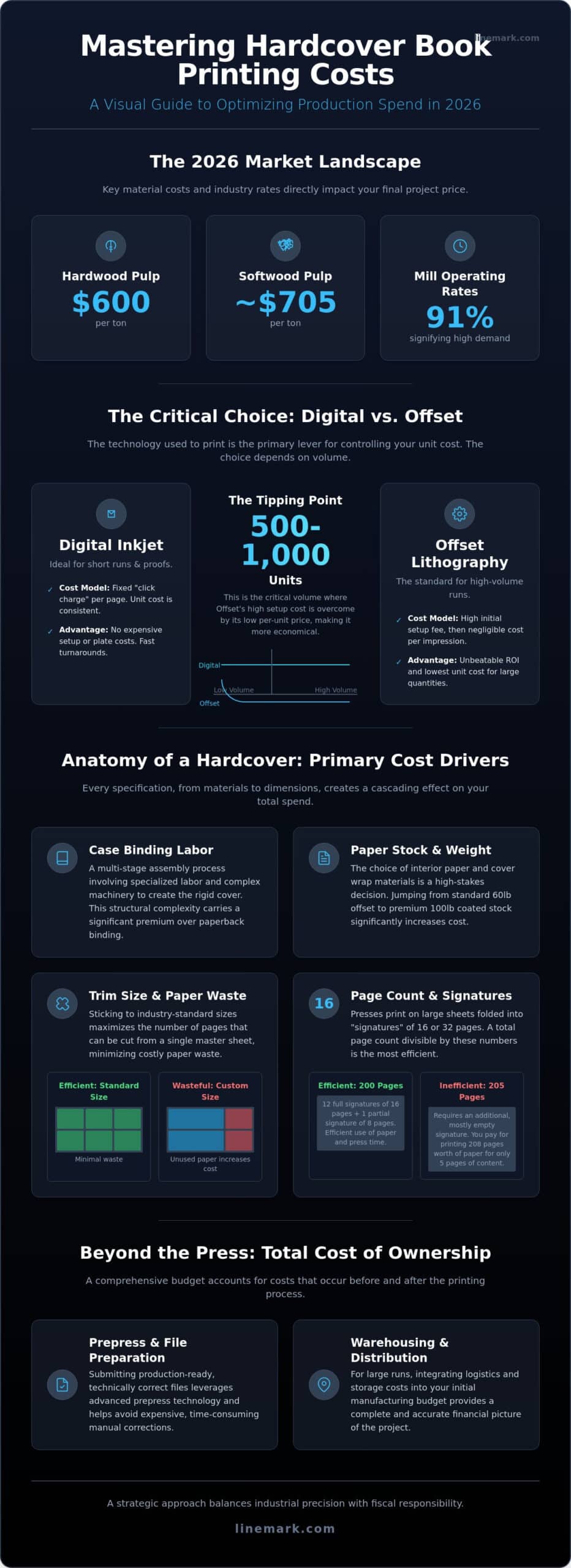
Raw material pricing in 2026 adds another layer of complexity to your budget. With hardwood pulp priced at approximately $600 per ton and softwood pulp near $705 per ton as of July 2026, your choice of paper stock is a high-stakes decision. High mill operating rates of 91% mean producers currently hold the pricing power. This makes it essential to understand how material weight, such as the jump from standard 60lb offset to premium 100lb coated stocks, creates a cascading effect on your total manufacturing spend.
To better understand the financial landscape of publishing, watch this helpful video:
Understanding Case Binding vs. Paperback
Case binding involves wrapping a printed sheet, cloth, or faux leather around thick greyboard to create a rigid exterior. This “case” is then attached to the interior pages using reinforced endpapers. The setup times for these presses are more intensive because the dimensions of the board and the wrap must align with mathematical precision. When you evaluate various hardcover binding methods, you’re choosing a production path that prioritizes long-term durability. While the initial investment is higher than a paperback, the ROI is found in the book’s perceived value and its ability to withstand repeated use.
Trim Size and Paper Waste Optimization
Every inch of paper matters in a high-volume run. Choosing a custom, “off-size” trim often increases waste because it leaves unused paper on the master sheets. We recommend sticking to industry-standard sizes to maximize your yield and keep hardcover book printing costs manageable. Another critical efficiency factor is the use of “signatures.” Industrial presses print in large blocks, typically in multiples of 16 or 32 pages. If your book is 200 pages, you’re hitting those signatures efficiently. If it’s 205 pages, you’re paying for a partial signature that requires extra labor and machine time. For more technical details on optimizing your project, explore our guide to Custom Book Printing: A Complete Guide to Professional Results.
Digital vs. Offset: How Quantity Impacts Your Unit Cost
The single most influential factor in your budget is the technology used to transfer ink to paper. Choosing between digital and offset technology is the primary lever for controlling hardcover book printing costs. It’s a decision driven by the “tipping point,” which is the specific volume where the high setup costs of offset lithography are finally eclipsed by its lower per-unit running costs. For most hardcover projects in 2026, this threshold sits between 500 and 1,000 units. Below this number, the financial mechanics of digital printing are almost always superior because you avoid the expense of creating physical plates.
Digital printing operates on a “click charge” model where every page has a fixed cost. Offset, however, requires a significant upfront investment in aluminum plates and press calibration. Once the press is running, the cost of each additional impression is negligible. This is why the economics of offset printing reward those who can commit to higher volumes. At our 90,000-square-foot facility, we maintain both high-speed inkjet and traditional offset presses. This dual-capability allows us to guide you toward the technology that maximizes your ROI rather than forcing your project into a one-size-fits-all solution.
Quality parity is no longer a debate in 2026. Modern digital presses now rival offset for almost all hardcover applications. While purists might still prefer the ink-to-paper feel of a traditional press, the technological gap has closed. The decision now rests almost entirely on your distribution strategy and inventory goals. If you’re looking for a strategic communications partner who understands these nuances, we can help you navigate the transition from short-run testing to high-volume success.
When to Choose Digital Printing
Digital technology is the ideal choice for short runs, typically between 25 and 500 copies. It’s the engine of on-demand publishing. It allows for rapid turnarounds without the burden of plate-making fees. If you’re testing a new market or need a limited run of 200 copies, digital keeps your upfront risk low. If your project requires personalization or variable data printing for limited editions, digital is your only viable path.
When to Transition to Offset Printing
Once your order exceeds 1,000 copies, offset printing becomes the clear winner for efficiency. The unit cost drops dramatically as the run length increases. Research indicates that for orders of 250 or more, the per-copy cost can drop significantly, but the real savings accelerate at the four-figure mark. Beyond the price advantage, offset offers access to specialized finishes and precise Pantone matching that digital sometimes struggles to replicate. If you’re planning a high-volume release, these industrial-scale efficiencies ensure your project remains profitable at retail.
Material Specifications: Paper, Binding, and Finish Variables
While the printing technology determines the efficiency of your run, the material specifications define the final tactile experience. These choices are the primary drivers of perceived value. A book’s weight, texture, and structural details signal quality to the reader before they even read the first page. Selecting the right combination of materials is a balancing act between aesthetic goals and the physical realities of your budget. Every specification, from the thickness of the board to the weight of the interior sheets, impacts your total hardcover book printing costs.
The “case” itself offers several paths for customization. A printed paper-over-board wrap is the most common choice for modern trade books. It allows for full-color graphics across the entire exterior. For corporate gifts or limited editions, cloth or faux leather covers provide a timeless appeal. These often utilize foil stamping or embossing for the title and logo. Small details like ribbon markers and headbands (the small decorative fabric bands at the top and bottom of the spine) add minimal cost per unit but significantly enhance the book’s status as a premium object.
Specialty Finishes that Drive Value
Finishing is often the most expensive variable in hardcover production because it requires additional passes through specialized machinery. Spot UV and Soft Touch lamination are popular choices for 2026 projects. They add a tactile contrast that encourages engagement. Foil stamping and embossing create a “collector’s edition” feel, which is essential for projects intended as high-value marketing assets. These finishes aren’t just decorative; they’re strategic investments in the longevity and shelf-presence of your work.
Dust Jackets vs. Case Wrap
Choosing between a dust jacket and a case wrap is a functional and financial decision. Adding a dust jacket typically increases hardcover book printing costs by $1 to $2 per copy. This separate component requires its own printing, laminating, and mechanical folding process. While a jacket offers extra protection and design real estate, many brands are now moving toward “naked” hardcovers. These designs use high-texture finishes and direct-to-board printing to create a minimalist, durable aesthetic that eliminates the need for a separate jacket entirely.
Beyond the Press: Hidden Costs and Logistics Savings
Focusing solely on the invoice from the bindery is a common pitfall for many publishers. To truly master hardcover book printing costs, you must look at the Total Cost of Ownership (TCO). This metric includes the expense of moving, storing, and delivering heavy, finished goods. Hardcover books are significantly heavier than their softcover counterparts, which means shipping and storage fees can quickly erode your margins if not managed strategically. As of July 2026, USPS Media Mail rates start at $4.13 for a 1-pound package; while this remains a cost-effective option for single copies, bulk business-to-business distribution requires a more sophisticated logistical footprint.
Storing 5,000 hardcovers safely requires more than just square footage. It demands a climate-controlled environment to prevent warping or adhesive degradation. Our 90,000-square-foot facility is designed to handle these complex requirements, offering an integrated solution that keeps your inventory secure and ready for immediate dispatch. By centralizing production and distribution, you eliminate the “double-freight” costs associated with shipping books from a printer to a separate third-party logistics provider. This streamlined approach ensures that your project moves efficiently from the press to the end user without unnecessary transit overhead.
The Role of Kitting and Fulfillment
Kitting and fulfillment bridge the gap between manufacturing and a unified brand experience. By combining your books with other marketing collateral, such as brochures or personalized letters, you create a high-impact package that resonates with the recipient. Automating this process within the same facility where the books are printed reduces manual labor costs and minimizes the risk of errors. This integrated approach is particularly effective when paired with Direct Mail Marketing in 2026: The Comprehensive Strategic Guide to drive measurable engagement.
Inventory Management for Associations and Corps
For associations and large corporations, managing decentralized ordering is a major operational challenge. We utilize proprietary MarCom On-Demand portals to streamline this process. These portals allow your team to order only what they need, moving toward a “just-in-time” production model that reduces dead stock and waste. This technology transforms your print budget from a static expense into a dynamic, scalable asset. For a deeper look at how to manage distributed marketing, see MarCom On-Demand: The Strategic Guide to Distributed Marketing in 2026.
Optimizing your logistics is just as important as choosing the right paper stock. If you are ready to simplify your supply chain and reduce your total spend, partner with our kitting and fulfillment experts to build a custom distribution strategy.
Optimizing Your Investment with a Strategic Print Partner
Successful hardcover production depends on a shift from a transactional vendor mindset to a collaborative partnership. When you view your manufacturer as a strategic communications ally, you gain access to decades of industrial expertise that can significantly lower your hardcover book printing costs. With over 30 years of experience and a 90,000-square-foot facility, we focus on identifying efficiencies that a standard print shop might overlook. This relationship ensures that your project isn’t just another job on the press, but a precisely engineered asset designed for market success.
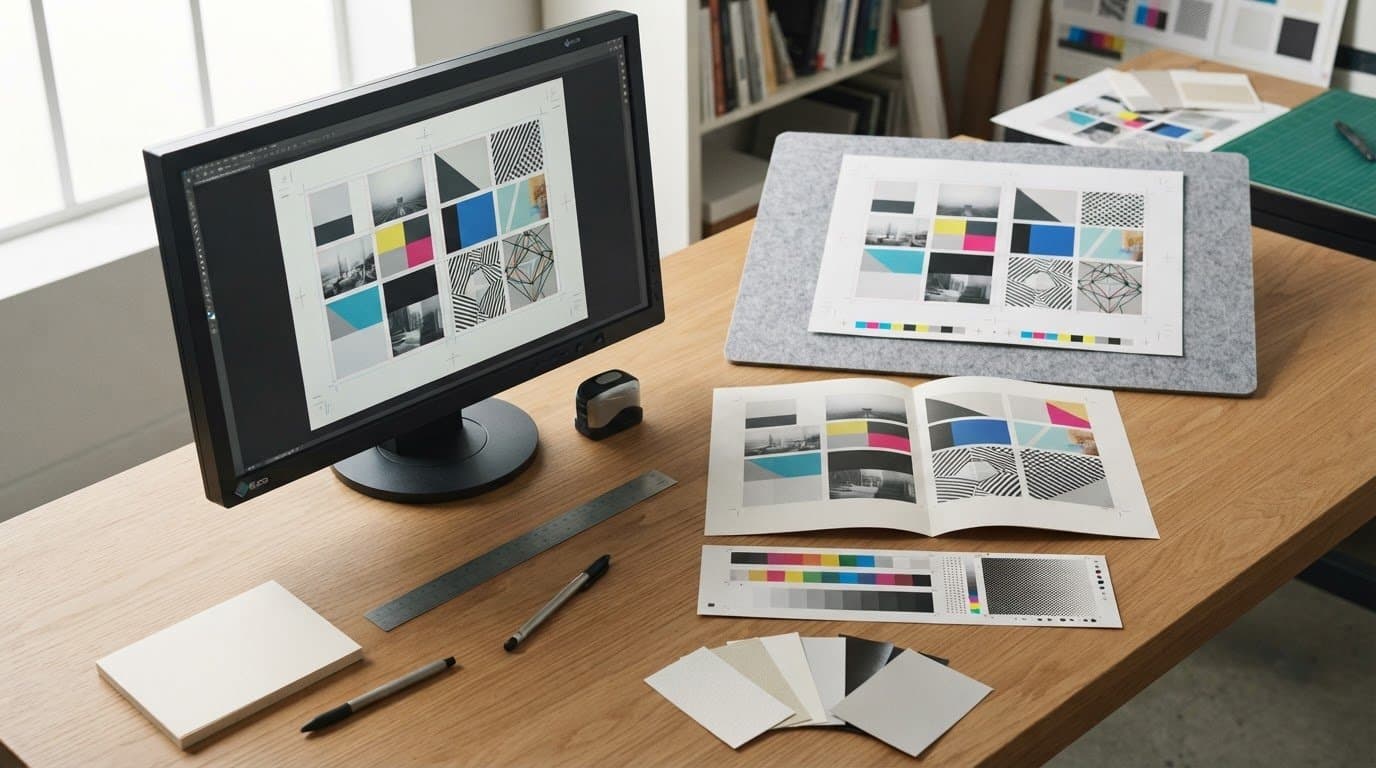
The transition from a digital file to a physical case-bound book is a high-stakes journey. Technical precision at the start prevents expensive delays at the finish. We emphasize the importance of physical proofs, especially for hardcover projects where the interaction between the cover wrap, the board, and the endpapers must be flawless. A physical proof allows you to verify color accuracy on your chosen stock and test the structural “feel” of the binding before committing to a full production run. This level of oversight is what separates a professional industrial project from a standard commercial order.
Prepress and File Preparation
Precision in the prepress phase is the most effective way to protect your budget. Hardcover books require specific bleed and margin settings that differ from paperbacks because the cover wrap must fold over the heavy greyboard. If these margins aren’t calculated correctly, your artwork may shift or be cut off during the binding process. Additionally, ensuring your files are converted from RGB to CMYK prevents unexpected color shifts that can lead to costly reprints. A prepress review serves as a critical cost-saving step that identifies structural file errors before they reach the production floor.
Final Checklist: 5 Questions for Your Print Partner
- Is the binding and finishing handled in-house to ensure total quality control?
- Does the quote account for specific signature counts to minimize paper waste?
- Are there integrated kitting and fulfillment services available to streamline distribution?
- Will I receive a physical case-bound proof before the full run commences?
- How does the unit cost change if we move from digital to the next offset volume threshold?
Getting an Accurate Custom Quote
Generic “ballpark” pricing rarely reflects the reality of industrial-scale manufacturing. To provide an accurate estimate for your hardcover book printing costs, we require exact specifications, including trim size, page count, and finishing details. Providing these details upfront allows us to leverage our advanced digital and offset technology to your advantage. If you’re ready to move from a business challenge to a scalable solution, Request a custom hardcover printing quote from Linemark today.
Executing Your 2026 Print Strategy
We bring 30+ years of commercial printing expertise to every project, operating from a 90,000-square-foot state-of-the-art production facility. Our integrated kitting and nationwide fulfillment services ensure your books move seamlessly from the bindery to your audience. We don’t just print books; we act as a strategic ally to build holistic journeys that empower your brand to grow with precision and confidence. It’s time to elevate your production standards with a partner who values every detail as much as you do. Partner with Linemark for your next high-volume hardcover project.
Frequently Asked Questions
How much does it typically cost to print a single hardcover book?
Single copy prices are highest because they lack the benefits of scale. Print-on-demand services like Amazon KDP or Lulu typically range from $9 to $15 for a 200-page book in 2026. For professional industrial runs, the price per unit is significantly lower, but these rates require a minimum volume to activate manufacturing efficiencies.
What is the minimum order quantity for cost-effective hardcover printing?
Cost-effectiveness usually begins at 250 copies for digital runs. However, the true tipping point for maximum ROI occurs between 500 and 1,000 units. This is the volume where you move away from high per-unit digital costs and toward the industrial efficiencies of offset production, which can reduce the per-book cost by over 50% compared to a run of 200.
Does the number of colors inside the book affect the printing cost?
Interior color significantly increases the price per page compared to black-and-white text. Digital presses charge higher click rates for color, while offset presses require four separate plates for every signature. If your budget is tight, consider a black-and-white interior with a full-color cover wrap to maintain a premium aesthetic while controlling hardcover book printing costs.
How much should I budget for a dust jacket versus a printed case wrap?
Adding a dust jacket typically adds between $1 and $2 to your per-unit cost. This reflects the extra material, printing, and mechanical folding required. A printed case wrap is more budget-friendly because the design is applied directly to the board. This eliminates the need for a separate component while providing a durable and modern finish.
Why is offset printing cheaper for large quantities of hardcover books?
Offset printing uses aluminum plates that require a high upfront setup cost. Once the press is calibrated, the cost of ink and paper is the only major variable. This allows the setup fee to be distributed across thousands of copies. This results in a unit price that digital technology simply cannot match once you exceed the 1,000-unit threshold.
What are the most common hidden costs in book printing and fulfillment?
Shipping, storage, and file corrections are the most frequent hidden expenses. Hardcover books are heavy, and shipping multiple pallets can be expensive without competitive freight rates. You should also account for warehousing fees and potential prepress fees if your files aren’t production-ready. Integrated kitting and fulfillment can often mitigate these logistical overheads.
How long does the hardcover printing and binding process usually take?
The standard lead time for hardcover production is typically four to six weeks. Digital runs may be faster, but the complexity of case binding requires specific drying times for adhesives and specialized finishing. Planning your release schedule with these industrial timelines in mind ensures a smooth launch without the need for expensive rush fees.
Can I use variable data printing on a hardcover book cover?
Digital technology allows for high-quality variable data printing on cover wraps. This is a powerful tool for creating personalized editions or limited corporate runs where each recipient’s name is integrated into the design. It’s a strategic way to add value to your hardcover book printing costs without the setup constraints of traditional offset methods.