

 07/10/2026
  Steve Bearden
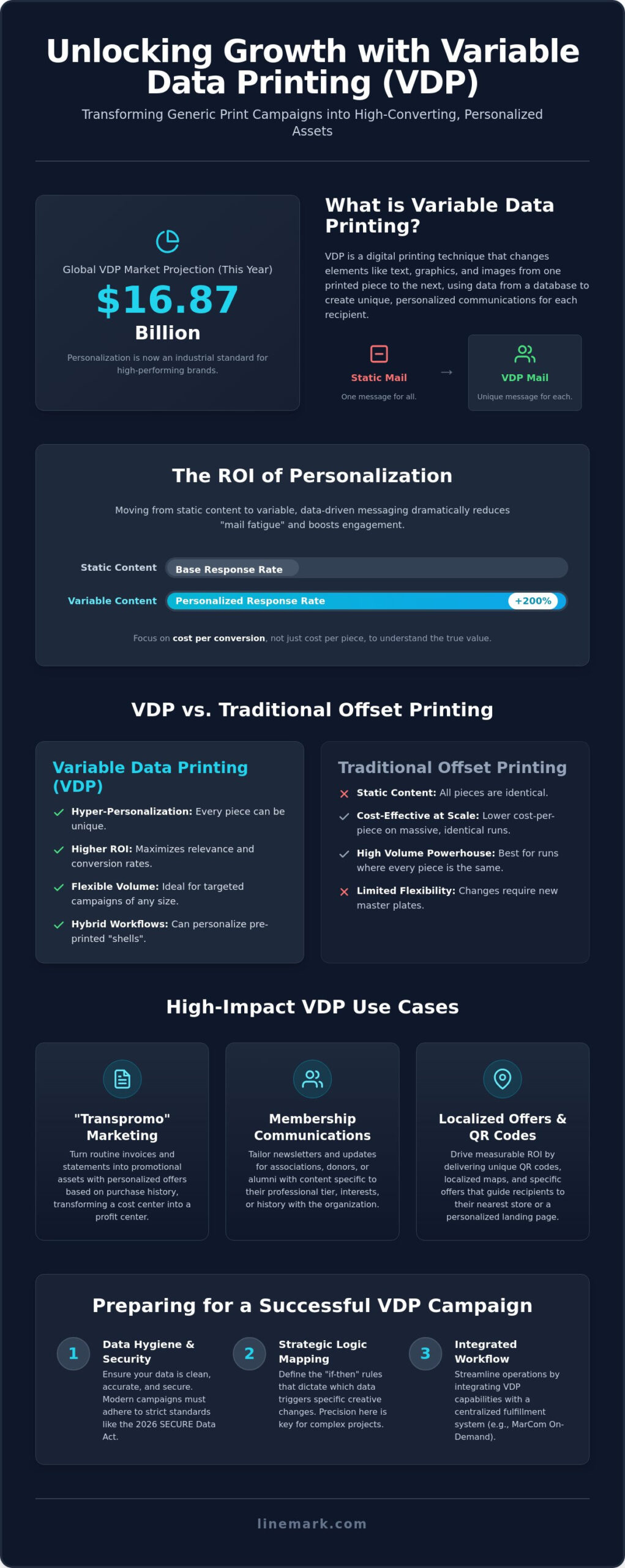
With the global variable data printing market projected to reach $16.87 billion this year, it’s clear that personalization is no longer a luxury; it’s an industrial standard for high-performing brands. You’ve likely felt the frustration of watching generic direct mail campaigns yield diminishing returns while the complexity of managing massive datasets feels like a logistical bottleneck. Identifying effective VDP use cases for marketing is the first step toward reclaiming your audience’s attention and driving measurable growth through physical touchpoints.
We believe that your print assets should be as agile and data-driven as your digital channels. In this guide, you’ll discover how to leverage Variable Data Printing to transform generic mailers into high-converting, strategic assets. We will preview actionable campaign ideas, outline the technical requirements for modern data security under the 2026 SECURE Data Act, and provide a roadmap for scaling these operations across distributed teams. It’s time to move beyond simple name changes and embrace a holistic, tech-forward approach to your marketing logistics.
Key Takeaways
- Learn how to transform generic print campaigns into high-converting assets by shifting from static messaging to hyper-personalized touchpoints.
- Discover actionable VDP use cases for marketing that leverage unique QR codes and localized offers to drive measurable ROI and engagement.
- Master the technical requirements of logic mapping and data hygiene to maintain precision across complex, high-volume projects.
- Streamline your operational workflow by integrating variable data capabilities with a centralized MarCom On-Demand fulfillment system.
What is Variable Data Printing and Why Does it Matter in 2026?
Variable data printing (VDP) is a sophisticated form of digital production where elements such as text, graphics, and images change from one printed piece to the next. Unlike traditional methods that require a static master plate, VDP pulls directly from a database. This allows every postcard, brochure, or catalog in a high-volume run to be unique. In 2026, this technology serves as the essential bridge between digital precision and physical impact. It transforms a standard mailer into a tailored communication that speaks directly to the recipient’s needs and history.
Modern marketing requires a physical “handshake” that mirrors the personalization found in digital channels. As consumers become more selective about the media they consume, the “batch and blast” era of direct mail has reached its end. Today, high-speed digital presses maintain industrial-scale production speeds while managing complex data overlays. This ensures that even the largest campaigns can be executed with meticulous attention to detail. It’s about moving from a transactional exchange to a strategic partnership with your audience.
To better understand the practical application of these trends, watch this helpful video:
The ROI of Personalization: Beyond the Name Field
VDP vs. Traditional Offset Printing
The choice between digital VDP and traditional offset printing often comes down to a balance of volume and intent. Offset printing remains a powerhouse for high-volume runs where every piece is identical. However, the perceived “digital premium” of VDP is often a misconception when you analyze the final results. Instead of focusing on the cost per piece, we encourage our partners to calculate the cost per conversion. A more expensive personalized piece that converts at a higher rate is always more cost-effective than a cheap, generic mailer that goes ignored. Identifying the right VDP use cases for marketing helps justify the investment by focusing on bottom-line growth.
Many organizations now utilize hybrid workflows to maximize their budget. This involves printing high-quality “shells” using offset printing and then running them through digital presses for the variable overlays. This strategy combines the industrial authority of offset with the agile personalization of digital. It’s a scalable solution for distributed marketing teams who need to maintain brand consistency while delivering localized, personalized content across the country.
High-Impact VDP Use Cases for Modern Marketing
Effective VDP use cases for marketing extend far beyond a personalized greeting on a postcard. In a high-capacity production environment, these tools become strategic levers for revenue and retention. One of the most impactful applications is “transpromo” marketing. This strategy turns standard invoices and statements into promotional assets. By using the high-attention real estate of a billing statement, you can insert personalized offers based on the customer’s specific purchase history. This approach transforms a necessary administrative cost into a profit center that feels like a tailored service rather than a generic ad.
Membership communications for associations also benefit from this level of precision. Instead of a generic newsletter, organizations can tailor content to specific professional tiers or donor interests. This ensures that every member receives information that’s directly relevant to their career or history with the organization. Citing the Importance of Variable Print reveals that targeted physical touchpoints significantly outperform generic broadcasts in building long-term loyalty. When you deliver value that’s this specific, you’re not just sending mail; you’re building a partnership.
Direct Mail and Fulfillment Integration
Modern marketing logistics allow for the seamless integration of offline and online tracking. We use personalized URLs (PURLs) and unique QR codes to create a trackable journey for every recipient. This gives marketing teams visibility into exactly who interacted with a mailer and when. You can even include dynamic maps that show the recipient the shortest route to your nearest physical location. For distributed teams, automated kitting ensures that variable inserts are perfectly matched with personalized outer envelopes. This precision is vital when managing nationwide direct mail campaigns that require local relevance at an industrial scale.
Personalized Catalogs and Custom Books
Versioned catalogs allow brands to display products based on a customer’s specific browsing or buying patterns. This level of customization ensures that the most relevant items are front and center, increasing the likelihood of a repeat purchase. Beyond retail, on-demand book printing is a powerful tool for stakeholder engagement. Organizations can produce individualized annual reports or training manuals for high-value clients and employees. By leveraging professional custom book printing techniques, you can ensure that these high-end marketing materials maintain a premium feel while delivering data-driven content. This blend of quality and personalization is exactly what high-volume marketing leaders need to stand out.
VDP Strategies for Industry-Specific Growth
Every industry faces unique communication hurdles, yet the need for precision remains a constant. Standardized marketing often fails to resonate in sectors where the relationship is the primary driver of value. By implementing VDP use cases for marketing that are tailored to specific vertical needs, organizations can move past generic outreach and toward a model of high-impact engagement. Whether you’re managing a nationwide franchise or a regional non-profit, the ability to automate personalized physical touchpoints is a catalyst for growth, especially when supported by the tailored marketing strategy services provided by MarkGo.
In the education sector, recruitment packets can be dynamically assembled based on a prospective student’s intended major or extracurricular interests. Instead of a one-size-fits-all brochure, the applicant receives a custom-bound book that highlights their specific path. This level of Variable Data Printing (VDP) ensures that the first physical interaction with the institution feels intentional and supportive. It sets the stage for a long-term partnership rather than a transactional enrollment.
Non-Profit and Association Outreach
For associations and non-profits, the connection to the mission is deeply personal. Utilizing VDP allows these organizations to reference a donor’s specific giving history or a member’s years of service directly within appeal letters and annual reports. This strategy transforms a standard document into a personalized impact statement. We act as a strategic communications ally to help you implement these high-touch strategies at scale. Consider these specific applications:
- Variable “Ask” Amounts: Use wealth screening data to suggest donation levels that align with a donor’s capacity and history.
- Personalized Impact Stories: Feature images and text that show exactly how a donor’s previous contributions supported specific projects.
- Automated Renewal Notices: Trigger membership expiration alerts that include the member’s specific professional tier and local chapter information.
Corporate and Franchise Marketing
Large corporations and franchise models often struggle to balance brand consistency with local relevance. A centralized marketing team might struggle to provide tailored assets for hundreds of local branches. Using MarCom On-Demand portals solves this by empowering local sales teams to customize corporate-approved templates. This distributed marketing model allows for hyper-local variable data without sacrificing the brand’s industrial authority.
This approach ensures that every local branch can launch VDP use cases for marketing that include regional offers, local contact details, and specific store maps. We provide the centralized fulfillment and logistics required to manage these decentralized needs. It’s a scalable solution that maintains meticulous attention to detail at every level of the organization. By providing a unified destination for diverse marketing needs, we help our partners maintain control while driving local conversion.
How to Prepare for a Variable Data Printing Campaign
While identifying high-impact VDP use cases for marketing is a creative milestone, the success of your campaign rests on the technical preparation of your data and assets. Moving from a digital database to a physical, personalized product requires a disciplined workflow that prioritizes precision and security. We view this process as a collaborative journey where our industrial capacity meets your strategic vision. To ensure your campaign delivers the expected ROI, you must follow a structured pre-production roadmap.
The first and most critical stage is data hygiene. Data hygiene is the systematic process of cleaning and segmenting your mailing lists to remove inaccuracies and redundancies before they reach the press. Once your data is pristine, you must define your logic mapping. This involves creating “if/then” rules that dictate which content appears for specific audience segments. For example, if a recipient lives within five miles of a specific branch, the logic map triggers a localized map and a unique offer code. This level of detail ensures that every piece of collateral serves as a personalized handshake with the customer.
The creative phase requires a dual-layer approach. Designers must build a static “master” layer for brand elements and a variable “placeholder” layer for dynamic content. Managing these assets involves organizing high-resolution images and graphics in a centralized repository to prevent production delays. Finally, we conduct a rigorous pre-flight and testing phase. By running sample data through the logic engine, we verify that every variable element aligns perfectly with the static design. If you’re ready to move from concept to production, our team can help you audit your workflow through our expert Variable Data Printing solutions.
Data Security and Compliance
In 2026, data security is not optional. With the implementation of the SECURE Data Act, marketers must ensure that all customer information is handled with extreme care. We utilize secure file transfer protocols (SFTP) to protect your sensitive datasets during the transition to our facility. It’s essential to partner with a printer that understands these evolving privacy standards and maintains a secure production environment. This commitment to security instills confidence that your high-volume projects are managed with both technical precision and legal integrity.
Designing for Variable Content
Designing for variable data requires a focus on flexibility. Copy length can vary significantly between recipients, so layouts must account for text overflow to prevent design breaks. Similarly, variable images should be standardized in their dimensions to maintain consistent quality across the entire run. One of the most complex challenges is color management. Our digital presses are calibrated to ensure that variable elements perfectly match the static offset shells, maintaining a unified brand appearance. This attention to detail reflects our modern, proactive spirit and ensures that your final product meets the highest standards of industrial production.
Scaling Your Impact with Linemark’s MarCom On-Demand
High-volume marketing requires more than just a digital press; it demands a unified logistics framework. Implementing diverse VDP use cases for marketing is only effective if your production partner can handle the weight of industrial-scale distribution. Our 90,000-square-foot facility serves as a centralized destination for complex kitting and nationwide fulfillment. This infrastructure allows us to integrate personalized printing into a comprehensive direct mail and communications strategy that moves as fast as your data. By combining high-capacity production with meticulous attention to detail, we ensure your message reaches the right mailbox with surgical precision.
Real-time inventory management is the backbone of this operation. When you utilize VDP-enabled marketing portals, you need to know that your static shells and variable assets are ready for immediate deployment. This visibility eliminates the guesswork from high-volume campaigns and positions variable data as a catalyst for long-term strategic growth. It’s about moving from a series of disconnected projects to a steady, confident stream of personalized communication that builds brand authority at every touchpoint.
The MarCom On-Demand Advantage
Large organizations often struggle with the “rogue marketing” problem, where local branches or sales teams create their own off-brand materials. Our centralized portals eliminate this issue by providing a single source of truth for all marketing assets. Local teams can access corporate-approved templates and inject their own variable data, ensuring that every piece of collateral remains brand-compliant. This automated workflow moves from data upload to the mailbox in record time, reducing the traditional bottlenecks associated with custom print runs.
This on-demand model also significantly reduces waste. Instead of over-printing generic brochures that eventually become obsolete, you produce only what’s needed based on precise targeting data. This efficiency mirrors the operational excellence we promise to our partners. It’s a sustainable, tech-forward approach that values both your budget and your brand’s reputation.
Nationwide Logistics and Fulfillment
The complexity of VDP use cases for marketing often extends to the packaging itself. Advanced kitting allows us to deliver multi-part personalized packages where every component is tailored to the recipient. Whether it’s a membership kit with a custom-bound book or a promotional package with localized inserts, our facility handles the synchronization of these elements with ease. We manage the entire journey, from the initial digital file to the final delivery, maintaining a steady pace that builds a sense of security for your team.
Our nationwide distribution strategies are designed to optimize postage costs and delivery speed. By leveraging our proximity to major logistics hubs, we help our partners navigate the complexities of the 2026 mailing landscape. Choosing a strategic communications ally over a simple print vendor means you gain a partner who understands the nuances of modern marketing and logistics. We don’t just print your data; we help you scale your impact across the country with precision and reliability.
Transforming Your Print Strategy into a Data-Driven Engine
The shift from generic broadcasting to hyper-personalized physical touchpoints is a significant evolution in modern marketing logistics. We’ve explored how identifying the right VDP use cases for marketing can turn standard communications into high-converting assets. Success in this field requires a combination of disciplined data hygiene and the industrial capacity to execute at scale. By leveraging advanced logic mapping and strategic creative templating, your organization can build a physical handshake that mirrors the precision of your digital channels.
Linemark brings 30+ years of industrial print expertise to every partnership. Our 90,000-square-foot production and fulfillment facility ensures that your most complex projects are handled with meticulous precision. Through our advanced MarCom On-Demand portal technology, we provide a scalable solution that maintains brand integrity while empowering local teams. It’s time to move beyond the transactional and embrace a holistic journey toward measurable growth.
Ready to personalize your next campaign? Contact Linemark for a VDP consultation.
Frequently Asked Questions
What is the difference between VDP and versioning?
Versioning involves changing content for specific groups or segments, such as different regional branches. Variable Data Printing (VDP) goes much deeper by allowing every single printed piece to be unique. While versioning might change a block of text for a thousand people, VDP can change the name, imagery, and specific offers for every individual recipient in a high-volume run based on your database records.
How much does variable data printing cost compared to static printing?
VDP typically carries a higher per-unit cost than static offset printing because of the specialized digital processing and data management involved. However, the focus should remain on the final ROI. Personalized campaigns often yield significantly higher response rates, which can drive down the cost per lead. It’s an investment in precision that prioritizes conversion over simple volume and generic outreach.
What kind of data file do I need to provide for a VDP project?
Most industrial print projects require a structured database file such as a CSV, Excel (XLSX), or a tab-delimited text file. These files must include clearly defined headers that correspond to the variable fields in your design template. Ensuring your data is clean and organized is a vital step in our collaborative journey to prevent production errors and ensure logic mapping accuracy.
Can I use variable images as well as variable text?
You can absolutely use variable images alongside text. This level of customization allows you to swap graphics, photos, and even background colors based on your dataset. This is one of the most effective VDP use cases for marketing because it creates a deeper visual connection with the recipient. Matching imagery to a customer’s past purchases or interests significantly increases brand recall and trust.
Is VDP only for direct mail, or can it be used for other products?
VDP is a versatile technology used for a wide range of products beyond direct mail. It is essential for custom book printing, personalized annual reports, membership newsletters, and transactional documents like statements. Any product that can be digitally printed can benefit from high-volume personalization to increase its relevance. This flexibility makes it a powerful catalyst for growth across various industry verticals.
How do I track the success of a variable data printing campaign?
Success is tracked through unique identifiers such as personalized URLs (PURLs), dynamic QR codes, or individualized offer codes. These elements allow you to bridge the gap between physical mail and digital analytics. By assigning a unique code to each recipient, you can see exactly who interacted with the piece and which VDP use cases for marketing are driving the highest conversion rates for your brand.
What is the typical turnaround time for a high-volume VDP run?
Turnaround times vary based on the complexity of the data and the volume of the run. While modern digital presses are incredibly fast, the pre-production phases of data hygiene and logic testing are vital for precision. Most industrial-scale projects are completed within a few business days once the data and creative assets are finalized. We maintain a steady, confident pace to ensure quality is never sacrificed for speed.
Does VDP work for large format graphics or signage?
While VDP is most common in small-format projects, it can be applied to large format graphics and signage. For instance, a national retail chain can use variable data to print window graphics or banners with localized store hours and addresses. This ensures that every location receives tailored signage while the parent company maintains industrial brand authority across its entire network. It is a scalable solution for decentralized teams.