


 07/09/2026
  Steve Bearden
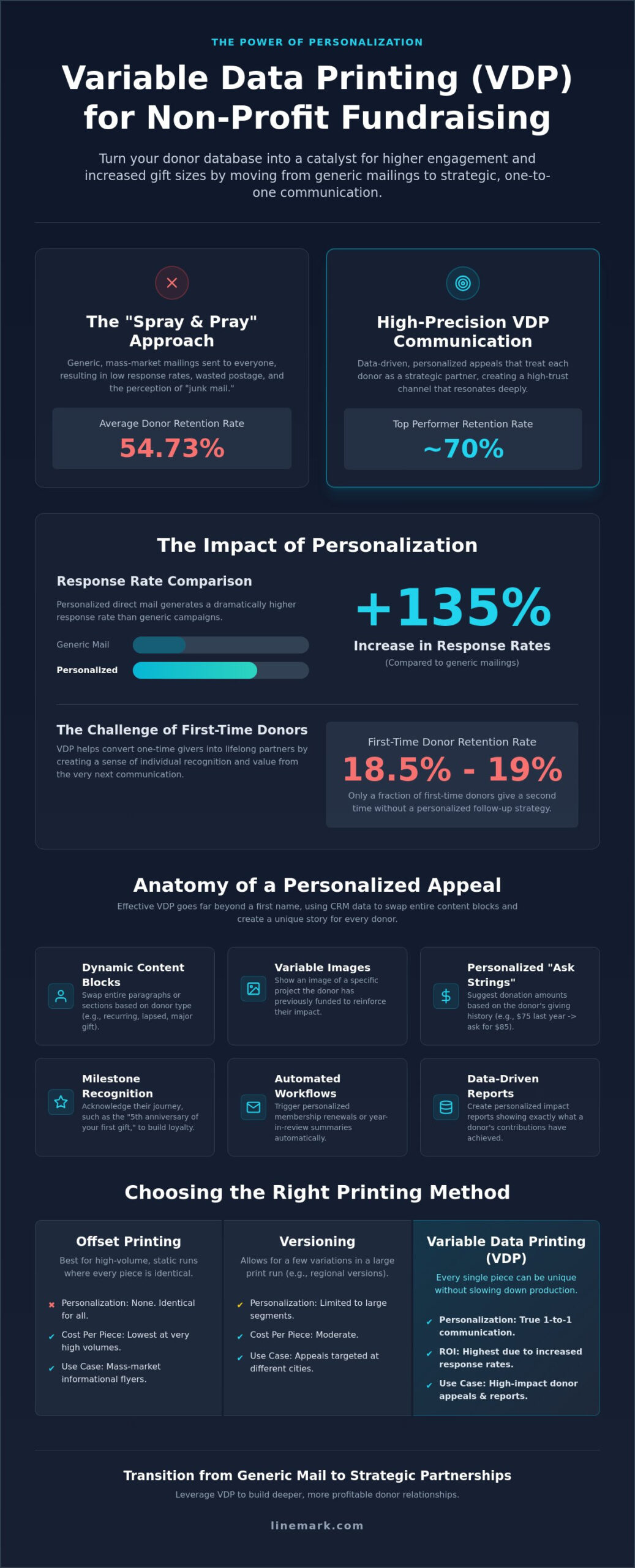
Did you know that personalized direct mail can generate a 135% increase in response rates compared to generic, mass-market mailings? With the average donor retention rate sitting at 54.73% and postage costs for nonprofit marketing mail rising by 5.1% as of July 12, 2026, your organization can’t afford to send mail that goes ignored. You’ve likely seen the diminishing returns of traditional campaigns and the high cost of donor acquisition. We believe that every piece of mail should be a strategic touchpoint. Implementing VDP for non-profit fundraising allows you to transition from bulk mailing to high-precision communication that resonates on an individual level.
We agree that the era of “spray and pray” fundraising is over. This guide will show you how Variable Data Printing turns your donor database into a catalyst for higher engagement and increased gift sizes. We will examine the automated workflows and segmentation strategies that make personalized mail both scalable and cost-effective. By the end of this article, you’ll understand how to leverage industrial-grade printing technology to build deeper, more profitable donor relationships.
Key Takeaways
- Transition from generic mass mailings to high-precision, data-driven appeals that treat every donor as a strategic partner.
- Leverage previous giving history to craft personalized ask strings and impact reports that drive higher retention and gift sizes.
- Master the critical data preparation steps required to execute high-impact VDP for non-profit fundraising campaigns with accuracy.
- Optimize your operational efficiency through automated workflows for membership renewals and personalized year-in-review communications.
- Partner with a seasoned expert to navigate the logistics of high-volume production and nationwide distribution for complex projects.
What is VDP for Non-Profit Fundraising?
Fundraising success depends on relevance. In a landscape where donors are inundated with generic requests, VDP for non-profit fundraising provides the technical infrastructure to stand out. At its core, VDP is a technology that changes text and graphics from one piece to the next without stopping the press. This capability allows organizations to move away from the outdated “spray and pray” model, where identical letters are sent to thousands of donors regardless of their history or interests. Instead, we use your existing data to create a high-precision dialogue that feels like a personal conversation with every recipient.
By leveraging Variable Data Printing (VDP), non-profits can bridge the gap between the high trust levels of physical mail and the granular targeting of digital marketing. While digital fatigue continues to lower email engagement, physical mail offers a tangible presence that captures focused attention. Modern digital presses enable this one-to-one communication at a scale previously reserved for generic bulk mailings. This transformation ensures that your organization is seen not just as a service provider, but as a strategic partner that understands the donor’s unique contribution to the mission.
To see the technical precision of this process in action, watch this short demonstration of variable data printing on envelopes:
The Anatomy of a Personalized Appeal
True personalization goes far beyond simply inserting a donor’s first name. Effective VDP for non-profit fundraising utilizes CRM data to swap entire content blocks based on donor behavior in real-time. For example, a recurring donor might see an image of a specific project they’ve funded in the past, while a lapsed donor receives a letter focused on the impact of returning to the fold. By pulling gift histories directly into the layout, the press can automatically generate unique “ask strings” that reflect the donor’s specific capacity. This level of detail transforms a standard appeal into a personalized impact story that resonates deeply.
VDP vs. Traditional Offset Printing
Choosing between digital VDP and traditional offset printing is a matter of strategic intent and operational scale. Offset printing remains a reliable choice for high-volume static runs where every piece is identical. However, digital VDP eliminates the perceived “personalization tax” by significantly increasing response rates and overall ROI. While the cost per piece may be higher than a static run, the efficiency of a targeted campaign often outweighs the initial spend. It’s also vital to distinguish VDP from “versioning.” Versioning allows for a few variations in a large run, but true variable data printing enables every single piece to be unique without slowing down the production cycle.
The Impact of Personalization on Donor Retention
Retention is the lifeblood of any organization. With first-time donor retention rates currently hovering between 18.5% and 19%, the pressure to convert one-time givers into lifelong partners is immense. VDP for non-profit fundraising addresses this by creating a sense of individual recognition. When a donor receives a mailer that acknowledges their specific history, the “Personalization Effect” triggers a psychological shift. They move from feeling like a transaction to feeling like a valued member of a community. This relevancy directly counters the perception of direct mail as “junk,” replacing it with a high-trust communication channel that respects the recipient’s time and previous contributions. Top-performing non-profits that prioritize these relationships see retention rates climb toward 70%.
One of the most powerful applications of this technology is the creation of dynamic “Ask Strings.” Instead of a generic list of donation amounts, VDP for non-profit fundraising allows you to present options that reflect the donor’s previous generosity. If a donor gave $75 last year, their personalized ask might start at $85 or $100. This subtle nudge, combined with acknowledging milestones like the “5th anniversary of your first gift,” significantly reduces churn. By celebrating the donor’s unique journey, you reinforce their impact and encourage continued commitment. It’s about moving the needle from a one-off donation to a recurring partnership.
Leveraging Donor Personas
Effective campaigns segment lists by specific interest areas. A donor focused on animal rescue should see different imagery and messaging than one dedicated to habitat preservation. VDP enables you to tailor graphics to match a donor’s demographic or geographic location, creating a localized feel even in national campaigns. This data-driven approach fosters an “insider” status. It makes the donor feel that your organization truly understands their philanthropic priorities. When your CRM data flows directly into your print production, you can automate these complex segments without sacrificing the meticulous attention to detail that high-value donors expect.
The ROI of Relevance
The financial case for VDP is clear. VDP campaigns often see double-digit increases in response rates compared to generic mailers. While static mail achieves a solid response rate for house lists, personalized pieces can generate a 135% increase in that engagement. This precision is particularly effective for “upgrading” mid-level donors to major gift status by providing them with sophisticated materials that mirror their level of investment. If you’re looking to scale your impact, exploring integrated variable data printing solutions can transform your outreach strategy. By treating every donor like a major gift prospect, you maximize the lifetime value of your entire database.
Strategic VDP Applications for Annual Appeals
The annual appeal is often the most critical revenue driver for an organization, yet many still rely on static templates that fail to capture individual attention. By integrating VDP for non-profit fundraising, you can transform these high-volume mailings into personalized reports that demonstrate specific impact. Instead of a generic summary, a donor receives a Year-in-Review that highlights the exact projects their contributions supported. This level of operational transparency builds trust and establishes a foundation for future growth.
Membership renewals also benefit from this high-tech approach. Sending notices with pre-filled donor information removes administrative friction for the supporter, making the renewal process feel like a seamless continuation of their partnership. You can also trigger matching gift reminders based on specific employer data found in your CRM, effectively doubling the impact of a single piece of mail. For lapsed donors, “Win-Back” campaigns use variable emotional triggers tailored to the donor’s original reason for giving. This reminds them of the unique bond they once shared with your mission and provides a compelling reason to return.
Personalized Ask Strings and Gift Arrays
The science of the “Next Logical Gift” is a cornerstone of VDP logic. Generic ask amounts often leave money on the table because they don’t account for an individual’s actual giving capacity. If a donor consistently gives $100, asking for $25 is a missed opportunity. Our high-capacity production environment allows you to calculate and print a gift array that starts at $110 or $125, nudging the donor toward a higher level of commitment. Additionally, VDP for non-profit fundraising enables you to suggest monthly recurring options that feel manageable and specifically tailored to their historical budget.
Integrated Multi-Channel Campaigns
VDP serves as the physical anchor for a broader digital strategy. Driving donors to Personalized URLs (PURLs) creates a seamless transition from the mailbox to a dedicated, high-converting landing page. QR codes on a postcard can pre-populate donation forms with the donor’s ID and contact info, significantly increasing conversion rates by reducing the effort required to give. This approach bridges the gap between traditional direct mail and digital landing pages. It ensures that your fundraising efforts aren’t just seen, but acted upon through a unified, tech-savvy donor experience.
How to Prepare Your Data for a VDP Campaign
Precision in VDP for non-profit fundraising is entirely dependent on the integrity of your dataset. You can’t deliver a personalized donor experience if the underlying information is incomplete or fragmented. The process begins with a rigorous audit of your CRM to identify gaps in donor history or contact details. Once you’ve verified the accuracy of your records, you must define the specific variable fields that will drive the campaign. These typically include the donor’s name, their last gift amount, and their specific program interests. This structured approach ensures that every data point serves a strategic purpose in the final printed piece.
The next phase involves technical list cleansing. Utilizing National Change of Address (NCOA) services is a non-negotiable step to maintain deliverability and control costs. After cleansing, you’ll create a “logic map” that dictates which content blocks appear for specific donor segments. If a donor is tagged with an interest in “scholarships,” your logic map ensures they receive imagery and copy related to education. Finally, collaborate closely with your print partner on file formatting and data security protocols. This unified effort guarantees that your sensitive donor information is handled with industrial-grade precision and care.
Data Hygiene and Deliverability
Bad data is the primary cause of failed VDP campaigns. When addresses are outdated or names are misspelled, the “Personalization Effect” mentioned earlier backfires, damaging donor trust. Standardizing your address formats is essential to maximize postal discounts and ensure your mail actually reaches the doorstep. We also emphasize the critical role of “Suppression Lists.” Removing deceased individuals, those who have opted out, or major donors who require a more bespoke approach protects your brand reputation. Clean data ensures your investment is focused on reachable, high-potential supporters.
Design for Variability
Designing for VDP requires a different mindset than static layouts. Your templates must be flexible enough to account for varying text lengths without breaking the visual hierarchy. A short name like “Lee” and a long name like “Alexandria” must both look intentional within the design. Similarly, selecting high-resolution variable imagery that aligns with specific donor segments is vital for maintaining a professional aesthetic. Whether you are producing annual reports or custom book printing for major donors, brand consistency must be absolute. Every element should feel like a cohesive part of your organization’s visual identity.
Ready to see how your data can drive better results? Contact our data specialists today to begin mapping out your next high-precision VDP campaign.
Linemark: Your Strategic Partner for Non-Profit Communications
Executing a high-precision campaign requires more than just software; it demands a partner with the industrial capacity to deliver at scale. Linemark brings over 30 years of expertise to the table, specifically tailored to the nuances of high-volume non-profit mailings. We don’t just provide a service; we act as a strategic communications ally that understands how to translate donor data into meaningful, physical touchpoints. Our 90,000-square-foot facility serves as a centralized hub for your entire mission, housing the advanced digital presses and logistics infrastructure needed for nationwide distribution. This scale ensures that your VDP for non-profit fundraising efforts are handled with both speed and meticulous accuracy.
Our integrated solutions are designed to support every facet of your outreach strategy. From high-impact annual reports and newsletters to sophisticated marcom on-demand portals, we provide the tools to maintain brand consistency across all channels. This holistic journey allows your team to focus on donor relationships while we manage the complexities of data processing, production, and mailing. By consolidating these needs under one roof, you gain the operational excellence required to maximize the ROI of every appeal.
Security and Compliance in Data Handling
Non-profit boards and executives require absolute certainty when it comes to donor privacy. Protecting sensitive donor data is a core component of our VDP for non-profit fundraising process. We maintain SOC 2 compliance and utilize secure data transfer protocols to ensure that every record remains confidential from the moment of ingestion to the final print. This commitment to security provides the peace of mind necessary to leverage deep personalization without compromising the trust you’ve built with your supporters. We treat your data with the same level of care as the physical products we produce.
Scaling Your Fundraising Impact
As your organization grows, your communications needs often move beyond simple postcards. We specialize in scaling impact through complex kitting and fulfillment services that can handle even the most diverse donor segments. Whether you’re launching a regional membership drive or a nationwide capital campaign, having a single-source provider for all your commercial printing needs streamlines your workflow and reduces overhead. This efficiency allows you to reinvest more of your budget back into your mission. We invite you to consult with one of our experts to explore how we can elevate your next national appeal with precision-engineered communications.
Scale Your Mission with Precision and Purpose
Scaling these efforts requires a partner with the industrial capacity to handle complex, high-volume projects without sacrificing detail. Linemark provides 30+ years of commercial printing experience and the security of SOC 2 compliant data processing. Our 90,000-square-foot production facility is equipped to handle your most ambitious national appeals with speed and accuracy. You’ve built the mission; let us help you build the communications strategy that funds it.
Request a Consultation for Your Next VDP Fundraising Campaign
We look forward to collaborating with you to turn your donor data into a transformative catalyst for organizational growth.
Frequently Asked Questions
What is the minimum list size for a VDP campaign to be cost-effective?
Variable data printing is cost-effective for lists as small as 500 to 1,000 pieces, though industrial-scale efficiency often begins at 2,500 units. Digital technology eliminates the high setup costs associated with traditional offset plates, making smaller, highly segmented runs viable. The primary goal is to balance the per-piece print cost against the significantly increased response rates that high-level personalization consistently provides to your organization.
Do I need a special database to use variable data printing?
No, a specialized database is not required, but you do need structured data in a common format like .CSV or .XLSX. Most modern CRMs used for VDP for non-profit fundraising can easily export the necessary fields for personalization. We work with your existing data exports to map variable fields directly to the print layout, ensuring a seamless flow from your digital records to the physical page.
Can VDP be used for images, or is it just for text?
Variable data technology is fully capable of swapping images, graphics, and even entire layout blocks based on donor data. This allows you to tailor imagery to match a donor’s specific program interest or geographic location. For example, a wildlife conservation group can show a donor who gave to “ocean projects” a sea turtle, while a “forest project” donor sees a woodland scene on the same press run.
How does VDP affect the turnaround time for a direct mail project?
Turnaround times for VDP projects generally range from 5 to 7 business days after final proof approval. Since digital presses don’t require plate making or ink drying time like offset printing, the production process is remarkably efficient. However, complex logic mapping and data auditing can add one or two days to the initial prep phase to ensure absolute accuracy before the high-capacity press run begins.
Is variable data printing compatible with non-profit postal rates?
Yes, variable data printing is fully compatible with Nonprofit Marketing Mail rates, provided the mailer meets USPS content and preparation requirements. Using VDP for non-profit fundraising actually helps you maintain these discounts by integrating NCOA cleansing and move-update requirements directly into the production workflow. This ensures your mail is deliverable and qualifies for the lowest possible automation rates as of the July 2026 increases.
What are the most common mistakes non-profits make with VDP?
The most common mistake is neglecting data hygiene, such as failing to remove deceased donors or using outdated addresses. Another frequent error is “over-personalization,” where the mailer feels invasive rather than helpful. We recommend focusing on relevant data points like gift history and specific interests rather than inserting too many personal details that don’t directly serve the fundraising narrative or the donor relationship.
How do I track the success of a personalized VDP campaign?
Success is best tracked through Personalized URLs (PURLs), unique QR codes, or specific source codes printed on each piece. These tools allow you to attribute every donation directly back to the individual mailer and the specific variable data used. By monitoring these metrics in your CRM, you can calculate the exact ROI and response rate for each segment, allowing for data-driven refinements in your next national appeal.
Can VDP help with donor acquisition or is it only for retention?
While VDP is a powerhouse for retention, it’s also highly effective for donor acquisition when using modeled prospect lists. By tailoring the message to a prospect’s demographic profile or neighborhood data, you can create a more compelling first impression. However, the highest ROI is typically seen in retention and “win-back” campaigns where you already possess rich, historical data to drive the sophisticated personalization logic.