

 06/06/2026
  Steve Bearden
With average order quantities for commercial print dropping by approximately 60% over the last five years, the era of massive warehouses filled with unsold inventory is officially over. You likely recognize that while traditional offset runs offer precision, they demand a level of capital and storage that doesn’t align with agile publishing models. Meanwhile, standard print-on-demand often lacks the tactile quality and specialized finishing required for a premium retail presence. This is where short run digital book printing becomes your strategic advantage, offering a bridge between industrial excellence and boutique flexibility.
We understand that your goal is to produce a professional product without the financial risk of overproduction. This guide will show you how to leverage high-end digital technology to achieve retail-quality results in small batches. We’ll examine the shift toward flexible production workflows, explore professional binding options that elevate your brand, and detail how to select a scalable partner that treats every small run with the meticulous attention of a high-volume project. By the end of this article, you’ll have a clear roadmap for navigating the technical and logistical nuances of modern small-batch production.
Key Takeaways
- Understand how the transition from physical plates to data-driven imaging enables high-speed production for batches between 50 and 500 copies.
- Identify the critical break-even point where short run digital book printing becomes more cost-effective than both print-on-demand and traditional offset methods.
- Discover why batch-at-a-time production offers superior unit-cost scaling and more sophisticated finishing options than standard unit-at-a-time models.
- Learn to select professional binding styles and paper weights that provide the tactile “heft” and durability required for a retail-ready product.
- Leverage industrial-scale manufacturing precision to ensure your small-batch projects receive the same technical rigor as high-volume commercial runs.
Understanding Short Run Digital Book Printing in 2026
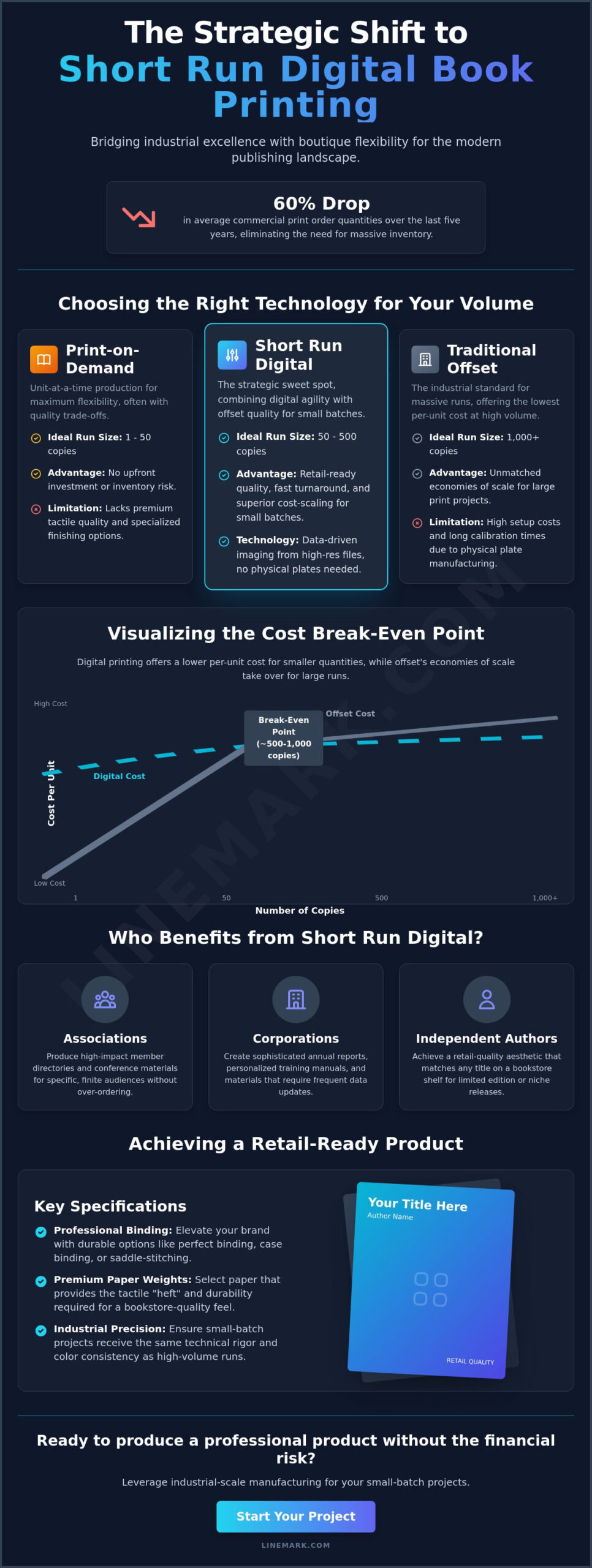
In the modern manufacturing environment, efficiency is defined by the capacity to produce exactly what the market requires without the burden of excess. Short run digital book printing represents this shift, utilizing high-speed inkjet or toner-based systems to produce professional volumes ranging from 50 to 500 copies. Unlike traditional methods that rely on the physical creation of aluminum plates, this technology draws directly from high-resolution data files to render images with surgical precision.
The evolution of digital printing technology has reached a critical milestone in 2026. The historical quality gap between digital and offset has virtually vanished; advanced imaging sensors and precision ink placement now replicate the crispness and color depth once reserved for long-run lithography. This allows organizations to maintain a high-end brand image while bypassing the prohibitive setup times and upfront investments typical of traditional production. It’s a transformative catalyst for speed-to-market.
To better understand how modern technology simplifies the manufacturing process, watch this helpful video:
The Strategic Advantage of Small-Batch Production
Adopting a small-batch approach effectively eliminates the risk of “warehouse rot,” a common issue where printed materials become obsolete before they ever leave the shelf. This is particularly vital for technical manuals, directories, or annual reports that require frequent data updates. By printing in shorter, more controlled cycles, you ensure your communications remain accurate and relevant to your audience. This model also serves as a low-risk testing ground. Publishers can gauge market viability for new titles or specialized content without committing to the thousands of units required by traditional offset runs.
Who Should Choose Short Run Digital?
Digital vs. Offset: Choosing the Technology for Your Volume
Deciding between technologies depends on your volume and the complexity of your requirements. Offset printing has long been the industrial standard for massive runs, but its reliance on physical plates creates significant setup overhead. This process can take hours to calibrate; plates must be manufactured, mounted, and the press must be “inked up” to achieve color balance. Conversely, digital printing transitions from file to production in minutes. This speed makes short run digital book printing the logical choice for projects where agility is a priority.
The financial “break-even point” is the metric that drives most production decisions. Industry data suggests that for runs under 500 to 1,000 copies, digital methods typically offer a lower per-unit cost. Beyond this threshold, the economies of scale offered by offset begin to take over. However, as noted in a recent Book Manufacturers’ Institute report, the industry is seeing a major shift as digital capabilities expand, allowing publishers to better manage inventory and reduce financial risk.
Digital technology also unlocks capabilities that offset simply cannot match, specifically variable data printing. This allows for total personalization, where each book in a run can feature a unique cover, personalized dedication, or region-specific content. Whether you’re producing technical documentation or bespoke custom book printing, the ability to tailor content at the individual level adds immense value to the end product without requiring a complete press stop.
When Digital is the Superior Choice
Speed is often the deciding factor. If your project requires a turnaround of under five business days, digital is the only viable path. It’s also the best solution for short-lived content. If you’re printing technical manuals or annual reports that require frequent revisions, the digital workflow allows you to update files and print new batches without the cost of new plates. This flexibility prevents your organization from being locked into outdated material and reduces waste.
The Quality Standards of Modern Digital Presses
Don’t let outdated perceptions of digital quality influence your decision. Modern industrial presses achieve exceptional color registration and text clarity that rivals lithography. High-resolution inkjet technology ensures consistency across the entire run. The first book off the press will look identical to the 500th. Additionally, the availability of digital-ready paper stocks ensures that the finished product has the same “heft” and tactile quality as any traditional offset book. This ensures that every project using short run digital book printing meets the highest professional standards.
Short Run vs. Print-on-Demand (POD): A Strategic Comparison
Understanding the distinction between Print-on-Demand (POD) and short run digital book printing is essential for any organization managing a publication budget. POD is a transactional service designed to produce a single unit only after a sale occurs. While this “unit-at-a-time” model eliminates inventory risk, it often sacrifices quality and profit margins. Short run production is a “batch-at-a-time” manufacturing strategy. By producing a set quantity, typically between 50 and 500 copies, you gain access to industrial-grade quality controls that automated POD queues simply cannot replicate.
The technical superiority of a dedicated press run is a significant differentiator. In a POD environment, your book is one of thousands in an automated line, often resulting in minor variations in color or trim from one copy to the next. Short run digital production involves a dedicated setup where the press is calibrated specifically for your project. This ensures total consistency across the entire batch. According to research from the RIT Printing Industry Center, the evolution of data-driven imaging has made these dedicated digital runs the benchmark for high-fidelity, personalized output.
Unit Cost Efficiency and Profit Margins
Financial logic dictates the choice between these two models. With POD, your per-unit cost remains static; you pay the same price for the 1st book as you do for the 100th. Short run digital book printing offers a descending cost curve. For example, a 200-page black-and-white paperback in a 250-copy run typically costs between $4 and $7 per unit, whereas the same book via POD might cost between $6 and $7.50. This “sweet spot” allows for significantly higher profit margins on retail sales. Furthermore, batch production enables streamlined Kitting & Fulfillment, reducing the logistical overhead of shipping individual units from disparate locations.
Customization and Finishing Flexibility
POD services generally limit you to a narrow selection of standard trim sizes and basic paper stocks to maintain their automated workflow. Choosing a short run strategy unlocks a much broader range of Binding & Finishing options. You aren’t restricted to “standard” templates. Instead, you can select premium features that define a professional brand, such as:
- Specialty foil stamping and custom laminates for covers.
- Non-standard trim sizes that help your title stand out on a retail shelf.
- Heavier paper weights that provide a tactile sense of quality.
- Sophisticated Inventory Management solutions that balance “Smart Inventory” with rapid replenishment.
This flexibility ensures your publication isn’t just another generic volume, but a carefully crafted tool for strategic communication.
Key Specifications for Professional Short Run Results
Achieving a retail-quality finish in short run digital book printing requires precise technical alignment between your design files and industrial finishing equipment. Unlike traditional long runs where mechanical adjustments can be made over thousands of units, digital production relies on data accuracy from the very first sheet. This precision ensures that your small-batch project possesses the structural integrity and visual depth required for a professional marketplace. Every detail, from the gutter margin to the paper grain, contributes to the final tactile experience.
Technical specifications for digital finishing differ slightly from offset requirements. Digital presses use heat and dry toner or specialized high-speed inkjet fluids, which can affect how paper folds and how adhesives bond. Understanding trim, bleed, and gutter requirements is critical. For instance, a standard 0.125-inch bleed is mandatory to ensure images extend to the very edge of the page after trimming. Similarly, the gutter, or the inner margin where the pages meet the spine, must be adjusted based on the thickness of your page count to prevent text from disappearing into the binding.
Binding Options for Small Batches
Selecting the appropriate binding style is a strategic decision that impacts both the utility and the perceived value of your book. We offer several industrial-grade solutions tailored for smaller quantities:
- Perfect Binding: This is the industry standard for professional paperbacks. It uses a durable adhesive to secure the cover to the spine of the gathered pages, creating a clean, square-back look suitable for retail distribution.
- Saddle Stitching: A cost-effective and efficient choice for booklets, catalogs, or newsletters under 64 pages. This method uses wire staples along the fold line, allowing the document to lay nearly flat.
- Spiral and Wire-O: These are the preferred options for high-utility items like training manuals, workbooks, or cookbooks. They allow for 360-degree page rotation, ensuring the book remains open during active use.
Preparing Your Files for the Press
High-resolution output starts with high-resolution input. All imagery must be set to 300 DPI at the final print size to maintain clarity and prevent pixelation on modern digital presses. While digital screens operate in RGB, our production environment utilizes CMYK color profiles to ensure the vibrant imagery you see on your monitor translates accurately to the printed page. We recommend using PDF/X-1a standards; this format flattens layers and embeds fonts, which eliminates the most common technical errors during the hand-off to production.
Your choice of paper stock also defines the “heft” of the project. Research indicates that many publishers are currently moving toward 200 to 250 gsm cover stocks. This weight provides a premium feel while optimizing shipping costs and handling durability. For projects requiring these precise technical standards, explore our comprehensive Binding & Finishing services to ensure your batch meets retail expectations.
Scaling Your Project with Linemark’s Industrial Capabilities
Operational excellence is the foundation of our 90,000-square-foot manufacturing facility. This high-capacity environment allows us to deliver industrial precision for every project, regardless of the batch size. We’ve structured our operations to offer a unique blend of large-scale power and boutique attention to detail. For corporate and association clients, short run digital book printing is rarely an isolated task; it’s a critical component of a broader strategic initiative. Our facility is designed to handle these complexities, ensuring that each unit meets the rigorous standards of a retail-ready product.
We act as a strategic communications ally by integrating diverse services into a unified workflow. You can seamlessly combine your short run digital book printing needs with sophisticated custom book printing strategies or targeted direct mail campaigns. This holistic approach ensures brand consistency across all touchpoints. Our infrastructure supports nationwide distribution and robust Inventory Management, allowing you to scale your production up or down based on real-time market demand without sacrificing quality or speed.
Beyond the Press: Kitting and Fulfillment
Our role extends far beyond the physical press. We provide comprehensive Kitting & Fulfillment solutions that address the logistical challenges many consumer-grade printers ignore. We can assemble your short run books with other marketing collateral, such as Brochures or Catalogs, into professional kits ready for immediate distribution. Our automated kitting processes ensure surgical accuracy even for large-scale corporate rollouts. Additionally, our warehousing solutions allow you to store your short run inventory in our secure facility, effectively freeing up your office space and reducing your internal logistical burden.
The Collaborative Path to Publication
We view every client relationship as a long-term partnership rather than a simple transaction. Our team works closely with you to navigate the nuances of modern production, from initial file preparation to final delivery. To streamline your workflow, we provide access to MarCom On-Demand portals. These proprietary interfaces allow your team to manage assets and execute easy re-ordering of your short run titles with just a few clicks. This technology-driven approach provides the agility needed to stay ahead in a fast-paced market. When you’re ready to elevate your production standards, Request a consultation with the Linemark team to begin your next project.
Mastering Your Publishing Agility
Success in this landscape requires a partner with both the scale to execute and the expertise to advise. With over 30 years of industrial printing experience and a 90,000-square-foot advanced production facility, we provide the infrastructure necessary to transform your manuscript into a powerful brand asset. Our integrated kitting and nationwide fulfillment capabilities ensure your project reaches its audience with surgical accuracy, regardless of the distribution complexity.
It’s time to move beyond the limitations of wasteful overproduction and the quality compromises of standard print-on-demand. Partner with Linemark for your next short run book project and experience a holistic journey from file to fulfillment. Your vision deserves the precision of a seasoned expert who values your growth as much as you do.
Frequently Asked Questions
What is considered a “short run” in book printing?
A short run typically refers to a production volume between 50 and 500 copies. This specific range allows organizations to leverage industrial-grade quality without the massive financial overhead or storage requirements of traditional offset runs. It’s the ideal strategic choice for niche publications, technical manuals, or testing the market viability of new titles.
How does digital printing quality compare to traditional offset printing?
Modern digital technology has virtually eliminated the historical quality gap between digital and offset methods. High-resolution imaging systems now achieve the same crisp text and vibrant color registration once reserved exclusively for lithography. This ensures your small-batch projects maintain a premium retail presence that is indistinguishable from high-volume commercial titles on a bookstore shelf.
Can I get a proof of my book before the full short run is printed?
You can absolutely receive a physical proof of your book before the final production begins. Digital workflows allow for the creation of a single, press-accurate copy with minimal setup time and cost. This step is a critical part of our collaborative process; it ensures all color management and binding specifications meet your precise expectations before the full batch is manufactured.
What is the most cost-effective binding option for a short run of 100 books?
Saddle stitching is generally the most cost-effective option for documents with lower page counts, such as newsletters or instructional booklets. For thicker volumes that require a professional retail look, perfect binding is the preferred industrial standard for batches of 100 copies. It provides a clean, square-back spine that significantly enhances the perceived value and durability of your publication.
How long does it typically take to complete a short run digital book project?
Standard turnaround times for short run digital book printing generally range from 3 to 10 business days. This timeline is significantly faster than offset printing because it bypasses the lengthy plate-making and calibration phases. The efficiency of a data-driven workflow allows your organization to move from final file approval to distribution with industrial speed.
Can I use variable data to personalize individual books in a short run?
Digital technology excels at variable data integration, allowing you to personalize every book in a single run without slowing down the press. You can customize covers, add unique dedication pages, or include region-specific technical data for different stakeholders. This capability transforms a standard batch into a highly targeted strategic communication tool tailored to individual readers.
What file format is best for submitting my book to a digital printer?
The industry standard for high-fidelity digital production is a print-ready PDF/X-1a file. This specific format ensures that fonts are embedded, layers are flattened, and color profiles are locked in CMYK to prevent shifts during production. To maintain industrial-grade clarity, all images should be set to a minimum of 300 DPI at their final print size.
Do you offer fulfillment and shipping services for short run orders?
We provide comprehensive kitting and fulfillment services as part of our integrated logistics model for short run digital book printing. Our 90,000-square-foot facility handles everything from automated kitting with other marketing collateral to nationwide distribution. This end-to-end approach allows you to manage your inventory from a centralized location while we handle the technical complexities of shipping and logistics.