

 05/16/2026
  Steve Bearden
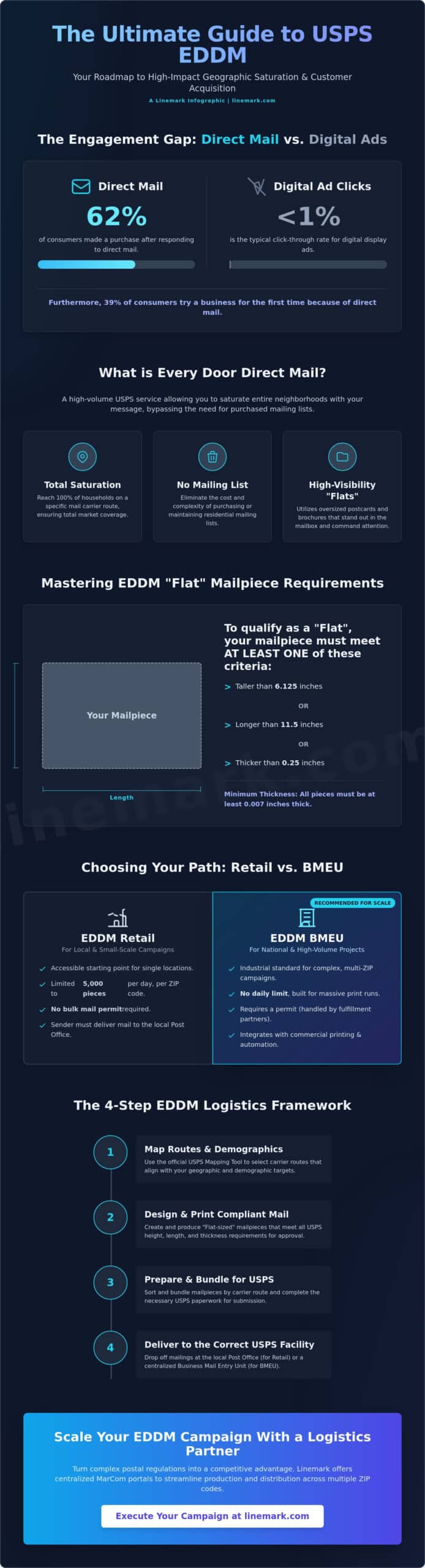
While digital click-through rates often struggle to reach 1%, 62% of consumers who responded to direct mail in the past three months actually completed a purchase. It’s a staggering disparity that highlights why physical saturation remains a cornerstone of high-capacity marketing. You’ve likely felt the frustration of trying to scale your message while grappling with restrictive mailing lists and skyrocketing digital acquisition costs. This USPS Every Door Direct Mail (EDDM) guide simplifies that complexity, offering a strategic roadmap to deliver your brand directly to every household in your target ZIP code without the overhead of purchased data.
We understand that navigating the 2026 postal landscape requires more than just a printer; it requires a logistics partner who masters the nuances of the April 2026 rate changes and strict USPS size requirements. You’ll learn how to leverage industrial-scale printing and precise distribution to turn complex regulations into a competitive advantage. We will cover everything from meeting the 0.007-inch thickness minimum to managing high-volume logistics across multiple regions. This article provides the technical clarity and operational strategy needed to execute a seamless, high-impact campaign that drives measurable growth.
Key Takeaways
- Saturate entire neighborhoods with precision by bypassing the need for expensive third-party residential mailing lists.
- Leverage the USPS Mapping Tool to select carrier routes that align with your geographic and demographic expansion goals for 2026.
- Ensure seamless postal approval by mastering the specific height, length, and thickness requirements for EDDM “Flat” mailpieces.
- Use this USPS Every Door Direct Mail (EDDM) guide to compare postage rates and determine the most cost-effective path for high-volume national reach.
- Scale complex marketing logistics through centralized MarCom On-Demand portals that streamline production and distribution across multiple ZIP codes.
What is USPS Every Door Direct Mail (EDDM)?
USPS Every Door Direct Mail is a high-volume saturation service that allows organizations to reach every household on a specific mail carrier route. Unlike traditional direct mail that requires a curated database, EDDM eliminates the need to purchase or maintain a residential mailing list. It’s an efficient logistical tool for organizations that prioritize geographic density over individual demographic filters. This USPS Every Door Direct Mail (EDDM) guide highlights how the service functions as a specialized category of Advertising mail, designed specifically for “flat-sized” pieces that command attention in the mailbox.
The format is strictly defined by USPS regulations to ensure maximum visibility. A mailpiece must exceed at least one of the standard letter dimensions to qualify as a flat. This means it must be taller than 6.125 inches, longer than 11.5 inches, or thicker than 0.25 inches. In 2026, EDDM has evolved into a vital component of multi-channel marketing. By integrating QR codes and leveraging the USPS Informed Delivery service, brands can bridge the gap between physical touchpoints and digital conversions. It’s no longer just a standalone flyer; it’s a gateway to a broader digital experience.
To better understand this concept, watch this helpful video:
The Strategic Advantage of Geographic Saturation
Geographic saturation provides a level of penetration that digital algorithms often miss. While online ads can be blocked or ignored, a physical mailer reaches 100% of the households in a targeted area. Statistics show that 39% of consumers try a business for the first time because of direct mail, proving its power as a customer acquisition tool. It’s the most cost-effective way to achieve total market coverage because it utilizes the lowest postage rates available through the postal service. This efficiency makes it an ideal solution for national associations and non-profit organizations that need to broadcast community-wide initiatives. By using postcards or oversized brochures, you ensure your message remains the primary focus of the recipient’s daily mail interaction.
EDDM Retail vs. EDDM BMEU: Which is Right for You?
Choosing the right entry point depends on the scale of your campaign and your long-term growth goals. EDDM Retail is built for local, small-scale deployments. It’s limited to 5,000 pieces per day per ZIP code and doesn’t require a bulk mail permit. It’s an accessible starting point for testing a specific neighborhood or supporting a single storefront. However, it requires the sender to transport the mail pieces directly to the local post office serving those specific routes.
For national saturation and high-volume projects, the Business Mail Entry Unit (BMEU) is the industrial standard. BMEU allows for much larger drops and provides the logistical infrastructure needed for complex, multi-ZIP code campaigns. Professional fulfillment partners almost exclusively use the BMEU route because it integrates seamlessly with commercial printing and automated sorting operations. It offers superior scalability and ensures that massive print runs move through the postal system with maximum precision. This route is essential for brands that view direct mail as a strategic communications ally rather than a one-off transaction.
How EDDM Works: The 2026 Logistics Framework
Executing a high-capacity saturation campaign requires a transition from creative vision to rigorous logistical planning. The process begins with the official USPS online interface, where you can identify specific carrier routes that align with your growth objectives. This USPS Every Door Direct Mail (EDDM) guide emphasizes that successful national scaling isn’t just about volume; it’s about the precision of your entry point. By utilizing the official Every Door Direct Mail (EDDM) mapping tool, you can visualize exactly where your message lands, ensuring your physical presence matches your market data.
Mapping Your Routes and Demographics
The USPS mapping tool provides more than just geographic boundaries. It offers sophisticated filters for age, average household size, and median income. These data points allow you to refine your targets, ensuring you don’t waste resources on routes that don’t fit your ideal customer profile. For instance, a luxury brand might prioritize routes with higher median incomes, while a local service provider might look for high-density residential clusters. Once you select your routes, the tool calculates total piece counts and provides instant postage estimates. With current 2026 Retail rates at $0.247 per piece and BMEU rates as low as $0.242, you can balance saturation with your specific budget constraints before the first sheet of paper hits the press.
The Production and Preparation Phase
Industrial scale requires industrial standards. Your postcards or flats must meet strict physical requirements to survive the high-speed sorting equipment. All pieces must be between 0.007 inches and 0.75 inches thick. We recommend a durable paper stock that maintains its integrity throughout the postal journey. Preparation involves more than just printing; it requires precise bundling. Pieces must be grouped in stacks of 50 to 100, secured with rubber bands, and topped with a “facing slip.” These slips are critical for postal acceptance as they identify the specific carrier route, piece count, and sender information.
Timing is the final piece of the logistics puzzle. For national distribution, your physical drops must be synchronized with your digital campaigns to create a unified brand experience. Managing these moving parts across multiple ZIP codes can be complex, which is why many organizations partner with a strategic communications ally to handle the heavy lifting of high-volume logistics. Whether you are dropping at a local Retail counter or a regional Business Mail Entry Unit (BMEU), precision in the preparation phase ensures your campaign reaches every doorstep without delay.
EDDM vs. Targeted Mailing Lists: A Strategic Comparison
Choosing between geographic saturation and individual data-point targeting is a fundamental strategic decision for modern marketers. Traditional mail relies on the precision of a curated list, but EDDM prioritizes the efficiency of total market coverage. The official EDDM User Guide clarifies that this service is built for volume, offering some of the most competitive postage rates in the industry. In 2026, the cost-per-impression for EDDM remains a powerful advantage for organizations that view their local community as a primary growth engine.
Targeted mail often involves higher postage costs and the recurring expense of list acquisition. EDDM eliminates these database costs entirely. From an operational standpoint, commercial printing for EDDM is streamlined because every piece is identical. This approach accelerates production timelines. It allows for rapid deployment when market conditions shift. While targeted mail offers granularity, EDDM provides the breadth needed to reach a 5-9% average response rate across a wide audience. This USPS Every Door Direct Mail (EDDM) guide helps you weigh these logistical trade-offs against your specific conversion goals.
When to Choose Every Door Direct Mail
When Targeted Mail (Variable Data) is Superior
Precision targeting becomes essential when the message requires a high degree of personalization to be effective. For high-value customer retention or renewal notices, variable data printing allows you to tailor every aspect of the mailpiece to the individual recipient. This 1-to-1 marketing approach is vital for complex financial appeals or non-profit campaigns that rely on specific donor history. While the cost per piece is higher, the increased relevance often leads to higher conversion rates for established audiences. Choosing between these models isn’t about finding the “better” service, but about selecting the right logistical tool for your specific business challenge.
Design Guidelines for EDDM Success
Design for saturation is a technical discipline that blends visual impact with industrial precision. This USPS Every Door Direct Mail (EDDM) guide ensures your creative vision meets postal reality. Every element, from the paper stock to the placement of the indicia, must be engineered to survive high-speed sorting while capturing the recipient’s attention. Because EDDM mailpieces are addressed simply to “Postal Customer,” the design itself must do the heavy lifting of building an immediate connection with the household.
Your choice of materials directly impacts the campaign’s success. We recommend using a paper thickness between 0.007 inches and 0.75 inches to maintain durability. If a piece is too flimsy, it risks damage during the automated sorting process. If it’s too thick, it may exceed the 3.3-ounce weight limit. Precision in the commercial printing phase prevents these logistical failures and ensures your message arrives in pristine condition. To streamline your production and ensure 100% postal compliance, consider partnering with a strategic communications ally that understands the nuances of high-volume mail design.
Essential Dimensions and Specifications
To qualify for the lowest postage rates, your mailpiece must meet the USPS definition of a “flat.” This means it must exceed at least one of the following minimums: 6.125 inches in height, 11.5 inches in length, or 0.25 inches in thickness. Most organizations choose oversized postcards to maximize visibility without incurring extra costs. Common, effective sizes include 6.25″ x 9″, 6″ x 11″, and 8.5″ x 11″. You must also respect the maximum limits; no piece can be larger than 12 inches high by 15 inches long. The EDDM Retail Indicia is another critical requirement. It must be placed in the upper right corner, measure at least 0.5″ x 0.5″, and use all-caps text with a minimum 4-point font size.
Creative Best Practices for Direct Mail
Successful mailers follow the “3-Second Rule.” Your headline and primary visual must communicate your value proposition instantly as the recipient sorts through their daily mail. Since EDDM pieces are often oversized, you have ample real estate for high-impact storytelling. Use bold visuals and clear calls to action. We suggest designing for the “Flip” by placing essential contact information and digital triggers on both sides of the piece. Integrating QR codes allows you to bridge the gap between print and web, providing a trackable digital touchpoint for an offline campaign. This integration is particularly effective when used with the USPS Informed Delivery service, which gives customers a digital preview of their mail before it even reaches their door.
Scaling Your EDDM Campaign with Linemark
Scaling a campaign across hundreds of ZIP codes requires more than just a USPS Every Door Direct Mail (EDDM) guide; it requires the industrial infrastructure to support massive throughput. When your marketing strategy shifts from local testing to national saturation, the complexity of logistics can quickly overwhelm internal teams. Linemark serves as a strategic communications ally, bridging the gap between high-volume production and precise postal delivery. By consolidating your commercial printing and distribution under one roof, you eliminate the friction of managing multiple vendors and disparate timelines.
Industrial Capacity for National Brands
Our 90,000-square-foot facility provides the scale necessary for even the most ambitious saturation projects. We utilize advanced offset printing for massive runs where cost-efficiency is paramount, and high-speed digital printing for shorter, more agile deployments. This dual-capacity approach ensures that whether you’re mailing 5,000 pieces or 5 million, your brand maintains absolute color consistency. Beyond the press, our kitting & fulfillment experts manage the intricate details of bundling and facing slips. We handle the physical drop-offs at regional USPS facilities, ensuring your campaign bypasses the delays often associated with local retail entry. This end-to-end oversight guarantees that your message reaches every doorstep exactly when it’s supposed to.
Simplified Management with On-Demand Portals
Centralized control shouldn’t come at the expense of regional agility. Our MarCom On-Demand portals empower your regional managers to trigger localized EDDM drops within their specific territories. You maintain brand integrity through pre-approved templates, while they gain the flexibility to respond to local market conditions in real-time. This distributed marketing model transforms how national brands approach geographic saturation. The portal provides a unified view of your entire campaign, offering real-time tracking and inventory management for recurring mail programs. You no longer have to guess where your materials are or when they’ll arrive. Instead, you gain a transparent, high-tech solution that turns complex postal logistics into a streamlined, repeatable process for growth.
Master Your Market Coverage in 2026
Physical mail remains a dominant force for high-impact customer acquisition. By mastering geographic saturation and precise postal regulations, you turn a complex logistical challenge into a scalable growth engine. This USPS Every Door Direct Mail (EDDM) guide has provided the roadmap for navigating 2026 requirements, from strict flat dimensions to the strategic selection of carrier routes. Success in national distribution requires more than just a service provider; it demands a strategic communications ally who understands the intersection of industrial production and modern marketing.
With over 30 years of industrial print and logistics experience, we provide the stability and precision your brand deserves. Our 90,000-square-foot high-tech production facility is engineered to handle massive volumes without sacrificing meticulous detail. You can streamline your entire workflow through our advanced MarCom On-Demand portal integration, allowing for centralized control and regional flexibility. Partner with Linemark for your next high-volume EDDM campaign to ensure your message reaches every doorstep with flawless execution. Your vision for nationwide saturation is ready to take flight.
Frequently Asked Questions
What is the minimum number of pieces required for an EDDM mailing?
You must mail a minimum of 200 pieces per ZIP code to qualify for EDDM rates. This threshold ensures that the campaign meets the USPS definition of a saturation mailing. While there’s no upper limit for the total project, each specific carrier route must be fully covered. This requirement makes the service ideal for testing localized geographic clusters before committing to a larger national expansion.
How much does USPS EDDM postage cost in 2026?
As of May 2026, the EDDM Retail postage rate is $0.247 per piece. For organizations utilizing a Business Mail Entry Unit (BMEU), the rate drops as low as $0.242 per piece. These rates provide a significant cost advantage over traditional targeted mail. This USPS Every Door Direct Mail (EDDM) guide emphasizes that these fixed costs allow for precise budget forecasting even when managing high-volume distribution across multiple regions.
Do I need a special permit to send Every Door Direct Mail?
You don’t need a special permit for EDDM Retail mailings between 200 and 5,000 pieces per day. However, high-volume campaigns entering through a BMEU require a bulk mailing permit. Professional fulfillment partners typically manage these permits on your behalf to streamline the entry process. This allows your team to focus on strategic communication while the logistical complexities of postal account management are handled by experts.
Can I send EDDM mailers to businesses only?
EDDM doesn’t allow you to target businesses exclusively while skipping residential addresses on a route. You can choose to deliver to “Residential Only” or “Business and Residential” addresses. Because the service is built for total saturation, it’s most effective for broad-market appeals where every household in a specific area is a viable prospect. For business-only targeting, traditional targeted mailing lists are a more appropriate logistical tool.
What is the difference between EDDM Retail and EDDM BMEU?
EDDM Retail is designed for smaller, local drops of up to 5,000 pieces per day at a local post office. BMEU is the industrial standard for national campaigns, requiring a bulk mail permit and entry at a regional processing facility. BMEU offers lower postage rates and removes the daily volume caps. Most large-scale organizations prefer the BMEU route to ensure their postcards move through the system with maximum efficiency.
How long does it take for EDDM mail to be delivered?
Most EDDM mailpieces reach their destination within 7 to 14 business days once they’re accepted by the USPS. Delivery times can vary based on the distance to the regional processing facility and the current volume at specific local post offices. We recommend planning your production schedule at least three weeks in advance to ensure your physical touchpoints align perfectly with your digital marketing launches and seasonal promotions.
Can I include a QR code on my EDDM postcard?
Including a QR code on your EDDM mailer is a highly effective way to bridge the gap between print and digital channels. This 2026 USPS Every Door Direct Mail (EDDM) guide recommends using unique codes to track engagement and conversion rates at the route level. By providing a digital gateway on a physical postcard, you create a multi-channel experience that allows recipients to move seamlessly from their mailbox to your online storefront.
What happens if my mailer does not meet the USPS size requirements?
If your mailer doesn’t meet the strict flat dimensions, the USPS will likely reject the shipment or reclassify it at a much higher postage rate. A piece must exceed the standard letter size to qualify for saturation discounts. Pieces that fail these checks are often processed as standard letters or first-class mail, which can double your projected costs. Precise trimming and finishing during the commercial printing stage are essential to maintain compliance.