

 05/03/2026
  Steve Bearden
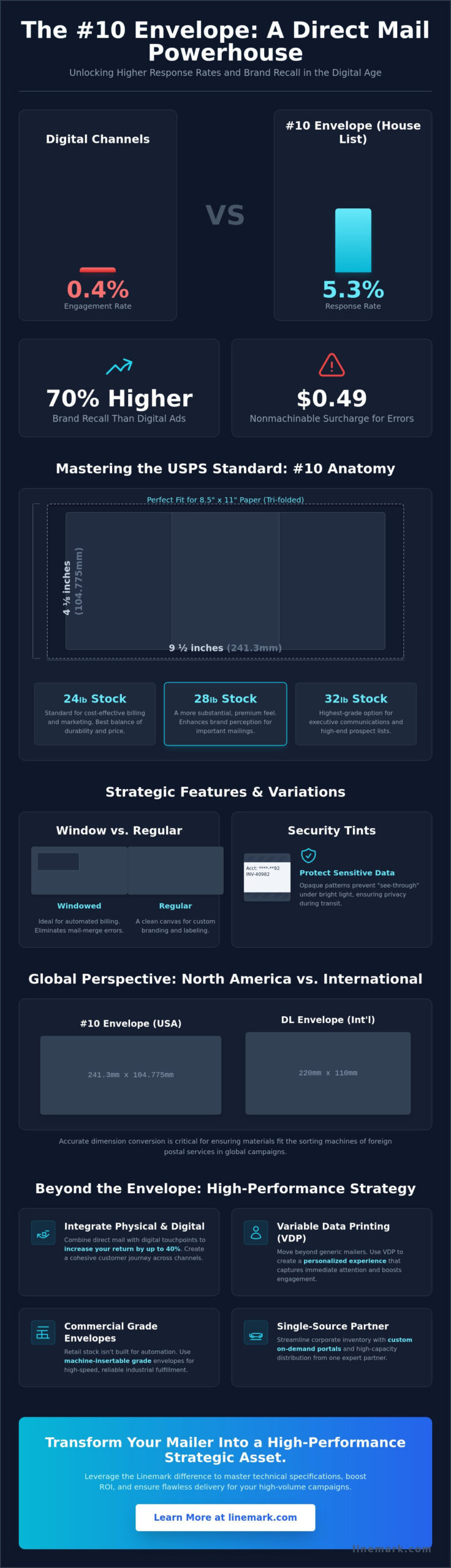
While digital channels struggle with engagement rates as low as 0.4%, the standard #10 envelope continues to drive a 5.3% response rate for house lists and achieves 70% higher brand recall than digital ads. It’s the undisputed workhorse of American business. However, even a minor oversight in paper weight or aspect ratio can trigger a $0.49 nonmachinable surcharge or lead to costly delivery failures. You likely know that a professional appearance is non-negotiable, but managing the technical specifications of a high-volume 10 envelope campaign often feels like a moving target.
We’ve designed this guide to eliminate that uncertainty and help you leverage the Linemark difference in your communications. You’ll learn how to master technical USPS specifications, choose the right security tints, and implement strategic design choices that boost your direct mail ROI. We’ll walk through the exact 4⅛ by 9½ inch dimensions required for automation compatibility and show you how to integrate physical mail with digital touchpoints to increase your return by up to 40%. This is your roadmap to transforming a simple mailer into a high-performance strategic asset.
Key Takeaways
- Understand why the 10 envelope remains the precise industry standard for 8.5 x 11 documents and how its dimensions ensure seamless USPS automation.
- Select the ideal combination of window placements and security tints to protect sensitive data while streamlining your addressing process.
- Leverage Variable Data Printing (VDP) to move beyond generic mailers and create a personalized experience that captures recipient attention immediately.
- Recognize the critical technical differences between retail stock and machine-insertable grade envelopes for high-speed industrial fulfillment.
- Streamline your corporate inventory through custom on-demand portals and high-capacity distribution from a single-source partner.
Understanding the #10 Envelope: Standard Dimensions and Specifications
The 10 envelope is the cornerstone of professional correspondence. Measuring exactly 4 1/8 inches by 9 1/2 inches (104.775mm x 241.3mm), this format isn’t arbitrary. It’s a precision-engineered standard designed to balance physical durability with postal efficiency. For high-volume mailers, understanding these specifications is the first step in avoiding the $0.49 nonmachinable surcharge that applies to non-standard shapes. At Linemark, we treat these dimensions as the baseline for every scalable solution we build for our partners.
To better understand how this specific size interacts with other common business mailers, watch this helpful video:
As a Standard Business Envelope, the #10 is primarily defined by its aspect ratio. The USPS requires letters to be rectangular and within specific height-to-length ratios to ensure they flow through automated sorting equipment at high speeds. If your mailpiece is too square or too rigid, it requires manual handling. This increases costs and slows down delivery. Choosing the right paper weight is equally vital for performance. Standard 24lb stock offers the best balance of cost and durability for most billing and marketing needs. Upgrading to 28lb or 32lb stock provides a more substantial, premium feel that enhances brand perception for high-end prospect lists. This attention to detail is part of the Linemark difference.
Why the #10 Size Dominates Business Communication
The dominance of this format stems from its perfect compatibility with standard 8.5 x 11 inch letterhead. When folded into thirds, a standard sheet slides into the envelope with just enough clearance to prevent jamming during the insertion process. This makes it the ideal choice for high-speed commercial insert machines used in our 90,000-square-foot facility. Beyond mechanics, there’s a psychological component. Recipients immediately recognize the 10 envelope as professional business mail, which helps establish trust before the envelope is even opened.
Metric vs. Imperial: A Global Perspective for International Mailing
While the #10 is the king of North American mail, international partners often work with the DL envelope. Measuring 110mm x 220mm, the DL is slightly shorter and wider than its American counterpart. If you’re coordinating global campaigns, converting dimensions accurately is essential to ensure your materials fit the sorting machines of foreign postal services. Using the 104.775mm x 241.3mm metric equivalent for the #10 ensures your international logistics partners can calibrate their equipment for seamless integration. Miscalculating these specs by even a few millimeters can lead to delivery failures in automated systems abroad. As your single-source partner, we ensure your specs are accurate for every destination.
Anatomy of a Professional Envelope: Features and Variations
The 10 envelope is far more than a simple carrier for your documents. It’s a precision tool that must satisfy both your brand’s aesthetic requirements and the rigid mechanical demands of modern postal systems. Every feature, from the adhesive on the flap to the pattern of the interior tint, serves a specific functional purpose in a high-volume fulfillment environment. At Linemark, we understand that these technical nuances are what separate a successful delivery from a costly failure.
Choosing between a regular and a windowed envelope often comes down to your integration strategy. Regular envelopes offer a clean, professional canvas for custom printing or labels. Windowed versions, however, are the preferred choice for automated billing and statements because they eliminate the risk of mis-matching a letter with the wrong carrier. For companies managing these business-critical communications, utilizing a specialist like Integrity Statements for printing and fulfillment ensures that every invoice and statement is handled with precision. To protect sensitive information like account numbers or personal data, we recommend an opaque security tint.
Seal types also dictate the efficiency of your project. For high-speed industrial inserting machines, moisture-activated gummed seals are the gold standard. They’re designed to withstand the rapid friction of commercial equipment without jamming. Conversely, peel & seal or flip & seal options are excellent for low-volume, manual fulfillment where speed is less critical than convenience. The flap style matters too. While square or pointed Baronial flaps offer a high-end look for invitations, the commercial flap is the undisputed leader for business mail due to its compatibility with automated sorters.
Window Placements and USPS Compliance
Precision is paramount when designing windowed mailers. A standard window usually measures 1 1/8 inches by 4 1/2 inches and sits 7/8 of an inch from the bottom edge. Maintaining these exact coordinates is essential for meeting USPS Physical Standards. You must also account for the “Clear Zone,” an area reserved for barcode printing that must remain free of any distracting text or graphics. If your address doesn’t align perfectly within the window, the mailpiece may be rejected by automated sorters. For complex documents like invoices that include a return address, double-window envelopes provide a streamlined solution that removes the need for secondary printing.
Paper Finishes and Brand Impression
The tactile experience of your mailpiece often dictates whether it gets opened or discarded. Wove finish is the industry standard for the 10 envelope because its smooth, non-textured surface allows for crisp, high-speed printing. For brands looking to make a more sophisticated impression, linen or laid finishes provide a textured, premium feel that conveys authority. We’re also seeing a significant shift toward sustainability, with 66% of U.S. consumers considering environmental factors in their purchases. Utilizing FSC-certified or recycled stocks allows you to align your direct mail strategy with these consumer values. If you’re ready to elevate your brand’s physical presence, our team can help you select the customized solutions that best fit your long-term goals.
Strategic Use of #10 Envelopes in Direct Mail Marketing
The 10 envelope serves as the initial handshake between your brand and your prospect. It isn’t just a commodity; it’s a strategic asset that determines whether your message is read or recycled. While we previously explored the technical anatomy of these mailers, the real value lies in how you deploy them within a modern marketing funnel. Successful campaigns leverage the physical space of the envelope to create a sense of urgency, curiosity, or professional necessity. This isn’t about guesswork. It’s about using data-driven design to command attention in the few seconds a recipient spends sorting their daily mail.
Integration is the key to scalability. By treating the outer envelope as dynamic real estate, you can synchronize your physical mail with digital touchpoints. For instance, adding a unique QR code transforms a static letter into a gateway for your online ecosystem. When a recipient scans that code, it can trigger an immediate follow-up email or a targeted social media ad. This creates a cohesive narrative that follows the customer across platforms. As your single-source partner, we provide the technology to track these interactions in real time, giving you a clear picture of your campaign’s performance and ensuring your mailer isn’t an isolated expense, but a high-performance engine for conversion.
Maximizing Open Rates with Outer Envelope Design
Design choices should always reflect the campaign’s intent. An “Official Document” aesthetic, often used for notices or compliance mail, relies on minimalism and high-quality paper to signal importance. Conversely, a “Creative Marketing” approach might use bold color blocks and provocative teaser copy to disrupt the recipient’s routine. Integrating the Direct Mailpiece Guide principles ensures your creative choices don’t compromise machinability or increase your postage costs. Implementing Variable Data Printing (VDP) to customize headlines and recipient names directly on the outer wrap can increase response rates by as much as 30%.
Case Study: The #10 Envelope in High-Volume Financial Direct Mail
Financial institutions remain the heaviest users of the 10 envelope because the format communicates stability and trust. These organizations balance high-security features, like heavy opaque tints, with subtle marketing CTAs that drive customers to digital banking portals. They rely on the LineMark difference to maintain consistency across millions of pieces, ensuring that every mailer reflects the bank’s authority. To see how these elements fit into a broader direct mail strategy, marketing leaders must look at the entire lifecycle of the mailpiece from the mailbox to the final database entry. Precision in the early stages of design prevents friction during the high-speed fulfillment process.
Commercial Production vs. Retail: Why Your Source Matters
The distinction between a retail-grade carrier and a machine-insertable 10 envelope is the difference between a seamless campaign and a logistical nightmare. For small office needs, a box of 500 envelopes from a local supplier suffices. However, when your volume scales into the thousands, the physical integrity of the envelope becomes a critical variable in your production timeline. Retail products often lack the consistent paper grain and high-tack adhesive required for industrial speeds. At LineMark, we provide commercial-grade solutions designed specifically to withstand the friction and pressure of high-speed sorting equipment.
Cheap retail envelopes carry hidden costs that don’t appear on a purchase order. Inconsistent glue application can lead to “envelope curling” or flaps that seal prematurely in humid conditions. These defects cause significant machine downtime. If an inserter jams every 1,000 pieces due to poor envelope construction, a project that should take four hours can easily stretch into a full day. We eliminate these bottlenecks by sourcing materials with a specific moisture content and grain direction that ensures every piece flows through our 90,000-square-foot facility without interruption.
Scaling from 500 to 500,000 Envelopes
Brand consistency becomes exponentially harder to maintain as your volume grows. While digital printing is efficient for short runs, offset printing remains the superior choice for large-scale branding on a 10 envelope. Offset technology allows for precise Pantone matching, ensuring your corporate “blue” looks identical across 500,000 impressions. This level of precision builds trust with your recipients. It signals that your organization is stable, professional, and attentive to detail. Our integrated inventory management systems also allow you to warehouse these high-volume runs, so your branded materials are ready for immediate deployment whenever a new campaign triggers.
The Role of Kitting and Fulfillment
The right envelope selection is the foundation of a successful kitting process. When you’re managing complex kits that include personalized letters, brochures, and response cards, the envelope must provide enough “throat” clearance for the mechanical arms of an inserter. Working with commercial printing experts ensures that your outer wrap is perfectly sized for its contents. This synergy reduces waste and prevents the damaged edges that often occur with ill-fitting retail stock. If you’re ready to move beyond transactional printing and streamline your fulfillment logistics, our team is prepared to engineer a scalable solution for your next high-volume project.
Linemark: Your Single-Source Partner for #10 Envelope Solutions
Mastering the technical specifications and strategic applications of the 10 envelope is only half the battle. The final, most critical component is execution. At LineMark, we don’t just print envelopes; we engineer comprehensive communication workflows that bridge the gap between marketing intent and logistical reality. Operating from our state-of-the-art 90,000-square-foot facility, we provide the industrial capacity and technological precision required to manage high-volume projects with the meticulous care of a boutique shop. This is the LineMark difference, where every campaign is treated as a strategic partnership rather than a simple transaction.
Our approach centers on integration and scalability. We understand that a modern direct mail strategy requires more than just a well-designed carrier. It demands a sophisticated infrastructure that can handle complex data sets for personalization while maintaining absolute brand consistency across millions of impressions. As your single-source partner, we streamline your entire supply chain, from initial design consultation to nationwide distribution. Our facility is equipped with the latest digital and offset technologies, ensuring that your 10 envelope campaigns are delivered on time, within budget, and with the high-impact results your business requires to grow.
Custom Portals for Distributed Marketing
Managing brand standards across multiple regional offices often leads to fragmented messaging and inventory waste. We solve this challenge through our custom MarCom On-Demand portals. These private, web-to-print platforms empower your local teams to order brand-compliant envelopes and marketing materials while giving corporate leadership total control over design and spend. By automating reorder points and centralizing production, you ensure your offices never run out of critical stock. You can explore how this technology transforms business operations in our marcom on-demand solutions guide.
High-Impact Solutions for 2026 and Beyond
As we look toward the shifting postal landscape of 2026, agility is your greatest asset. Our team is constantly investing in the next generation of print and fulfillment technology to help you stay ahead of rising postage rates and evolving consumer preferences. We also provide holistic branding support that extends beyond the mailbox. For example, many of our partners leverage large format graphics to create a consistent brand experience at live events that mirrors their direct mail outreach. If you’re ready to experience a more streamlined, tech-forward approach to your communications, contact us today to request a custom quote for your next high-volume production run.
Future-Proof Your Direct Mail Strategy
Mastering the technical specifications of the 10 envelope is the first step toward achieving a standardized, professional appearance that commands respect in the mailbox. You’ve learned how commercial-grade materials and precise window alignments eliminate the friction of high-speed fulfillment. By integrating these physical assets with data-driven personalization and digital touchpoints, you create a resilient marketing funnel that stands out in a crowded digital landscape. The right infrastructure doesn’t just deliver mail; it delivers measurable results and brand security.
LineMark provides the industrial authority and innovative technology needed to scale your communications with confidence. Our 90,000-square-foot state-of-the-art production facility and over 30 years of commercial printing expertise ensure your projects are handled with absolute precision. Through our proprietary MarCom On-Demand technology, we simplify the complexities of distributed marketing for your entire organization. Partner with LineMark for your high-volume #10 envelope and direct mail needs to experience the operational excellence your brand deserves. We’re eager to help you turn your next challenge into a concrete, scalable success.
Frequently Asked Questions
What is the exact size of a #10 envelope?
A standard #10 envelope measures exactly 4 1/8 inches by 9 1/2 inches. In the metric system used by many international logistics partners, this translates to 104.775mm by 241.3mm. This specific size is engineered to house 8.5 x 11 inch documents folded into thirds. Maintaining these exact dimensions is critical for high-speed sorting; any deviation can lead to manual handling fees or delivery delays.
Can a #10 envelope be used for USPS Certified Mail?
You can use a 10 envelope for USPS Certified Mail to send legal notices or sensitive documents that require proof of mailing. This service provides a mailing receipt and electronic verification that an article was delivered or that a delivery attempt was made. Just as WorkReferences provides professional verification for employment and job references, choosing the right mailing methods ensures your most important documents are tracked and confirmed. Since the #10 falls within the standard letter category, it’s a cost-effective choice for high-volume compliance mailings without the higher costs associated with larger flat envelopes.
What is the difference between a #10 envelope and a DL envelope?
The primary difference lies in the dimensions and geographic usage of the two formats. While the #10 is the North American business standard at 4 1/8 by 9 1/2 inches, the DL envelope is the European counterpart measuring 110mm by 220mm. The DL is slightly shorter and wider. If you’re coordinating international campaigns, it’s essential to verify that your fulfillment equipment can handle both sizes to prevent mechanical jams during high-volume runs.
How much postage does a standard #10 envelope require?
As of July 13, 2025, a standard 1-ounce letter sent in a #10 envelope requires $0.78 in postage if using a stamp or $0.74 if using a postage meter. Each additional ounce costs $0.29. For commercial bulk mailers, presorted Marketing Mail rates range from $0.372 to $0.433 per letter. We recommend accounting for a projected 2 to 5 percent rate increase anticipated in July 2026 when planning long-term budgets.
What is security tint and do I need it for my business mail?
Security tint is a patterned, opaque ink printed on the inside of an envelope to prevent sensitive information from being visible through the paper. You should use it whenever you’re mailing checks, invoices, or documents containing personal identifiable information. This feature builds trust with your recipients by demonstrating a commitment to data privacy. At LineMark, we integrate security tints as a standard best practice for financial and healthcare communications.
Can I print on both sides of a #10 envelope for marketing?
You can print on both sides of the envelope provided you leave specific areas clear for USPS requirements. The front must maintain a clear zone for the delivery address, return address, and postage. The back of the envelope is prime real estate for teasers, logos, or call-to-action graphics. Utilizing this space effectively can increase your open rates, though it requires precise calibration to ensure ink doesn’t interfere with the sealing adhesive.
What is a window envelope and what are the standard window dimensions?
A window envelope features a transparent film that allows the recipient’s address on the enclosure to show through. The standard window size is 1 1/8 inches by 4 1/2 inches, typically positioned 7/8 of an inch from the bottom edge. This design eliminates the need for printing addresses directly on the envelope. This streamlines the kitting process and reduces the risk of matching errors in high-volume fulfillment projects.
How many sheets of paper can fit in a #10 envelope without extra postage?
You can typically fit up to five sheets of standard 20lb bond paper in a 10 envelope before exceeding the 1-ounce limit for First-Class Mail. If you use heavier 24lb or 28lb stock, this capacity may drop to three or four sheets. Exceeding the 1-ounce threshold triggers the $0.29 additional ounce rate. We always suggest weighing a complete sample kit to ensure your postage calculations remain accurate.