

 04/22/2026
  Steve Bearden
The most valuable real estate in your 2026 retail environment isn’t at eye level; it’s under your customers’ feet. You already know that capturing attention in a crowded market requires every square inch of your footprint to work harder. Yet, for many brand managers, the struggle to maintain high-quality floor graphics for retail stores often leads to unsightly peeling or safety concerns that increase liability risks. When signage fails at one of your 50 or 500 locations, it doesn’t just look poor; it compromises your brand’s professional standard.
This guide shows you how to leverage advanced material science and centralized fulfillment to transform your floors into high-conversion marketing assets. We understand that you need a single-source partner who can ensure durability and precision at scale. You’ll learn how to implement UL-410 certified slip-resistant materials that withstand heavy foot traffic while boosting point-of-purchase sales by up to 20% according to industry marketing reports. We will also preview the logistics of maintaining 100% brand consistency across all retail branches through a streamlined, tech-driven approach.
Key Takeaways
- Leverage the “downward gaze” phenomenon to reach mobile-engaged shoppers and transform underutilized floor space into high-conversion touchpoints.
- Understand the material science behind durable substrates, including the critical importance of UL 410 slip-resistance certification for retail safety.
- Design for maximum impact using high-contrast color palettes and bold typography optimized for legibility from a standing height.
- Master the technical nuances of installation and surface preparation to ensure your floor graphics for retail stores maintain long-term adhesion.
- Discover how a single-source partner provides the scalability and precision needed to maintain brand consistency across national retail footprints.
The Strategic Value of Retail Floor Graphics in 2026
The retail environment in 2026 demands a more integrated approach to physical space. Floor graphics for retail stores have evolved into high-performance, adhesive-backed large format signage solutions engineered for durability and high-traffic impact. These aren’t simple decals; they represent a sophisticated layer of communication that bridges the gap between digital engagement and physical browsing. As a single-source partner for retail branding, LineMark recognizes that every square inch of a facility must contribute to the bottom line.
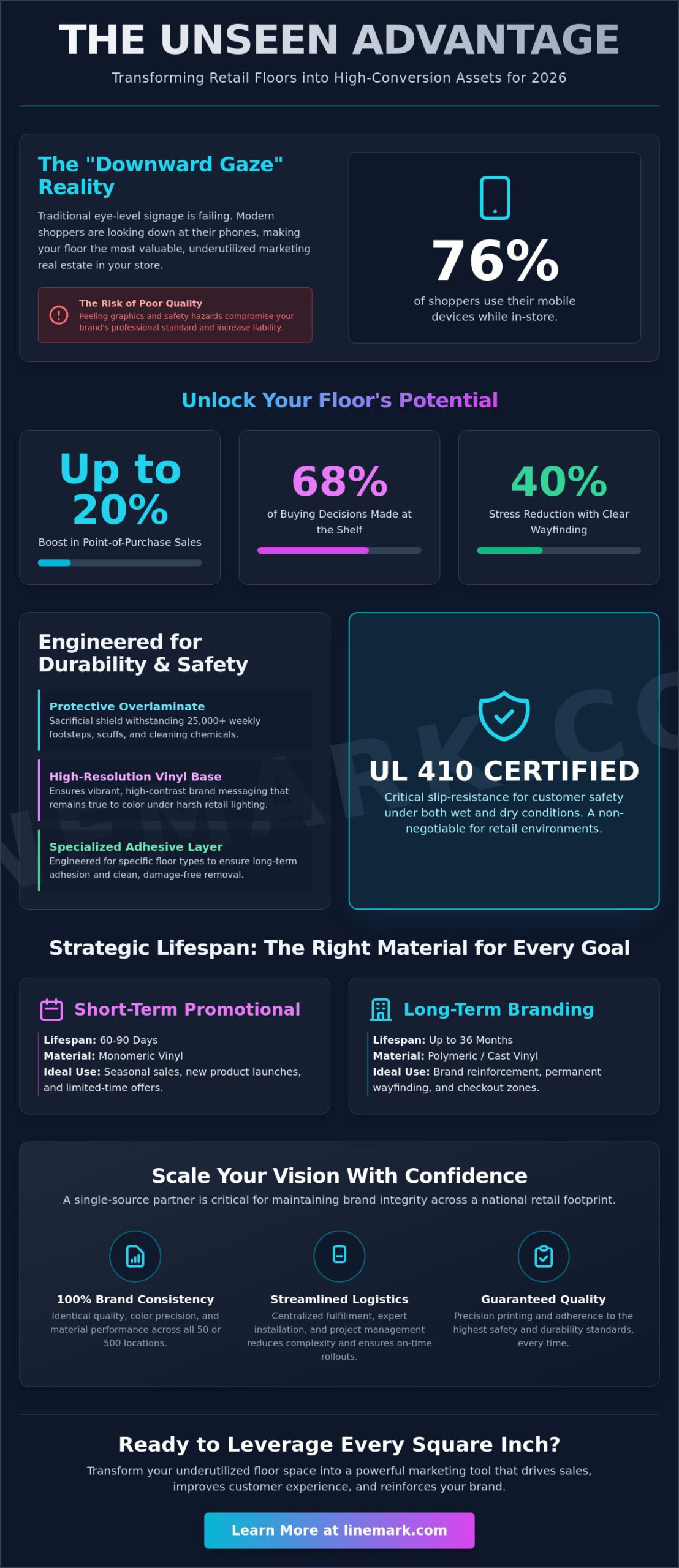
Retailers face a unique challenge: the “downward gaze.” Research indicates that 76% of shoppers interact with their mobile devices while navigating store aisles. This shift in posture means traditional eye-level signage often goes unseen. By utilizing floor space, brands reclaim underutilized marketing real estate and place messaging directly in the consumer’s line of sight. This strategy aligns perfectly with modern visual merchandising principles by creating a seamless path from digital discovery to physical purchase.
To better understand this concept, watch this helpful video:
Driving Point-of-Purchase Conversions
Floor graphics for retail stores act as the final nudge in the decision-making process. Industry data shows that 68% of buying decisions are made at the shelf. Strategically placed decals highlight seasonal promotions or limited-time offers right at the point of purchase. Color psychology plays a vital role here; using high-contrast warm tones like red or orange can trigger impulsive buying behavior by signaling urgency. Our precision printing ensures these colors remain vibrant under harsh retail lighting, maintaining brand integrity throughout the campaign life cycle.
Enhancing the Customer Journey through Wayfinding
Shopper frustration is a primary driver of cart abandonment. A 2024 retail study found that 40% of customers feel stressed when they can’t locate high-demand departments quickly. Functional directional signage integrated into the floor design reduces this friction. By marking clear paths to trending categories or checkout zones, retailers prevent congestion in high-volume environments. This isn’t just about utility; it’s about the LineMark experience of blending branding with logistics. We help partners turn functional wayfinding into an aesthetic extension of their brand identity, ensuring the customer journey is both efficient and memorable.
Material Science: Selecting Substrates for Durability and Safety
High-impact floor graphics for retail stores rely on a sophisticated three-tier material architecture. This system includes the base vinyl, the adhesive layer, and the protective overlaminate. Every component must function in unison to survive the 25,000 weekly footsteps common in high-traffic big-box environments. Safety remains the primary engineering constraint for any deployment. We prioritize materials with UL 410 certification, which ensures the surface maintains consistent slip resistance under both dry and wet conditions. For facilities managing complex safety protocols, adhering to floor marking color requirements helps maintain compliance while directing customer flow through the retail environment.
Choosing between short-term promotional films and long-term branding substrates depends entirely on the retail cycle. Short-term materials typically utilize monomeric vinyls designed for 60 to 90-day campaigns. These are ideal for seasonal sales or product launches. Long-term solutions use polymeric or cast vinyls that resist shrinkage for up to 36 months. Selecting the wrong adhesive leads to “ghosting,” where chemical residues permanently mar luxury vinyl tile or polished concrete. A strategic approach involves matching the adhesive’s peel strength to the specific floor finish to ensure a clean exit at the end of the campaign.
The Role of High-Performance Overlaminates
The overlaminate acts as a sacrificial shield for your brand assets. It must withstand the grinding friction of shopping cart wheels and heavy industrial floor scrubbers. Data from 2024 installations indicates that 82% of floor graphic failures resulted from laminate delamination rather than print fading. For graphics placed near entryways or large windows, UV-stable laminates prevent the 15% color degradation often caused by direct sunlight exposure over a 6-month period. Texture choice is equally vital for risk mitigation. While matte finishes offer a sophisticated, non-glare look, pebble-textured laminates provide superior traction in areas prone to tracked-in moisture.
Substrate Compatibility for Different Surfaces
Substrate selection varies based on the chemical composition of the flooring. Polished concrete requires high-tack adhesives to bite into the microscopic pores of the surface. Conversely, luxury vinyl tile (LVT) and finished hardwoods require low-tack, removable adhesives to protect expensive factory coatings. Low-pile carpets demand a specialized fabric-based substrate that grips the fibers without causing “fuzzing” upon removal. Outdoor applications on asphalt or sidewalks utilize foil-backed materials that conform to the heavy texture of the ground. In the context of seasonal retail cycles, removability is defined as the capacity of a substrate to be extracted in one piece without the need for heat or chemicals after its intended 12-week use cycle.
Achieving this level of technical precision requires a single-source partner
Designing for Impact: Visual Best Practices for Retail Floors
Effective floor graphics for retail stores require more than a simple logo placement. They must compete with ambient noise, overhead lighting, and varied floor textures like polished concrete or dark wood. High-contrast color palettes are essential for visibility. If your retail environment features light-colored tiling, use deep blues, rich greens, or charcoal to create a distinct visual break. This contrast ensures the graphic doesn’t blend into the background, making it a functional part of the customer journey.
Typography must be bold and legible from a standing height of 5 to 6 feet. Avoid decorative scripts or thin serifs that disappear when viewed from an angle. Use sans-serif fonts with heavy weights to maintain clarity. Beyond text, the physical shape of the decal matters. Standard circles and squares often mimic architectural elements and can be ignored by the subconscious mind. Use “break-out” shapes or custom die-cuts that follow the contour of a product or an arrow. These irregular shapes disrupt the floor’s visual pattern and grab attention more effectively than traditional geometric borders.
Consistency is the final pillar of high-impact design. Your floor elements should act as an extension of your large format graphics and window displays. When the color hex codes and font families match across all surfaces, it reinforces brand authority. As a single-source partner, we ensure that every printed element, from the ceiling to the floor, maintains perfect color fidelity to protect your brand identity.
Visual Hierarchy at the Shopper’s Feet
Shoppers move quickly, so your message must pass the 3-second rule. This means the core value proposition should be understood instantly. Minimalist design is your best tool here; don’t clutter the space with unnecessary details. It’s better to have one clear command than three competing messages. To add a layer of digital integration, incorporate high-contrast QR codes. Recent 2024 consumer data shows that 45% of shoppers are willing to scan floor-based codes for instant coupons or stock checks, creating a seamless bridge between the physical aisle and your digital storefront.
Scale and Placement Strategies
Size dictates the graphic’s strategic purpose. Grand entrance graphics should span 4 to 8 feet to establish a theme or welcome customers. In contrast, aisle-end graphics should be smaller and more tactical. Strategic placement is vital for ROI. Position graphics near high-margin items or “power aisles” where foot traffic is highest. Industry benchmarks indicate that well-placed floor signage can increase dwell time in specific zones by 15% or more. Always maintain a balance between branding and white space to prevent the floor from looking crowded, which can cause “visual fatigue” and lead shoppers to ignore the signage entirely.
Implementation: Professional Installation and Maintenance
Precision in execution separates a high-performing marketing asset from a potential liability. Adhesion failure is rarely a product defect; instead, 90% of failures originate from improper surface preparation. Your floor must be surgically clean before any vinyl touches the substrate. Even microscopic dust or residual wax buildup prevents the adhesive from achieving its specified bond strength. We recommend a two-stage cleaning process using a heavy-duty degreaser followed by a 70% isopropyl alcohol wipe to ensure a neutral, oil-free surface for your floor graphics for retail stores.
Choosing between dry and wet application depends on the specific material chemistry. Most modern floor graphics for retail stores utilize air-release technology, making dry application the preferred method for speed and immediate foot traffic. Wet application remains a viable solution for massive, non-vented decals where repositioning is critical, though it requires a 24-hour cure time before heavy use. Once installed, maintenance teams shouldn’t use high-pH chemicals or abrasive scrubbing machines. These can delaminate the slip-resistant top layer or cause edge-lift, which creates a tripping hazard for 100% of your visitors. Regular inspections ensure the LineMark experience remains safe and visually striking.
Step-by-Step Installation for Retail Staff
Success begins with the center-hinge technique. After cleaning, secure the graphic with masking tape across the middle. Peel back one half of the liner and use a felt-edge squeegee at a 45-degree angle to sweep air toward the edges. Repeat for the second half. For textured surfaces like concrete or low-pile carpet, use a heat gun to warm the edges to 180 degrees Fahrenheit. This process softens the vinyl, allowing it to conform to the floor’s micro-texture for a permanent seal that resists heavy foot traffic and pallet jacks.
Clean Removal Without Residue
The LineMark difference prioritizes the full lifecycle of your signage, including the exit strategy. High-performance adhesives are typically rated for clean removal within a 6 to 12-month window. If left longer, adhesive “ghosting” can occur, requiring chemical solvents to clear. During overnight store resets, use a steady, low-angle pull to lift the vinyl. If the adhesive resists, a quick pass with a heat gun will release the bond without leaving residue. This efficiency ensures your floor is ready for the next campaign immediately. Experience a seamless transition for your brand by choosing a single-source partner for your retail signage needs.
Scaling Your Retail Vision with a Single-Source Partner
Maintaining brand integrity across 500 or 1,000 locations isn’t just a logistics challenge; it’s a critical component of market dominance. When you deploy floor graphics for retail stores, the difference between a successful campaign and a fragmented brand image lies in centralized production. Linemark acts as your single-source partner, eliminating the variables that occur when multiple vendors handle different regions. This approach ensures that the vibrant color matching and substrate durability you expect are identical from a flagship store in New York to a boutique in California.
Strategic retail growth in 2026 requires more than isolated signage. You need a cohesive ecosystem where direct mail campaigns drive foot traffic that is then greeted by synchronized in-store visuals. Our production floor bridges these channels, allowing you to manage high-impact graphics alongside personalized mailers under one roof. This integration reduces administrative friction and ensures your messaging remains consistent across every physical touchpoint.
To empower local teams without sacrificing corporate control, our MarCom On-Demand portals provide a streamlined ordering interface. Store managers can access pre-approved templates for floor graphics for retail stores, ensuring every local promotion adheres to global brand standards while meeting specific regional needs. It’s a scalable solution that grows with your footprint.
Streamlining National Rollouts
Precision Large Format Capabilities
With 90,000 square feet of production power, Linemark handles oversized displays that demand industrial-grade precision. Our custom die-cutting technology allows for unique brand shapes and silhouettes that go beyond standard rectangles. We’ve optimized the design-to-distribution pipeline to reduce lead times, ensuring your retail environment evolves as fast as the market. This scalability means we can pivot from a single prototype to a massive rollout without losing the meticulous attention to detail your brand deserves.
Transforming Your Floor Space Into a High-Performance Marketing Asset
Success in the 2026 retail landscape requires moving beyond traditional signage to embrace data-driven, durable solutions. Effective floor graphics for retail stores rely on a sophisticated balance of visual impact and rigorous safety standards. By utilizing UL 410 Slip Resistance Certified materials, you ensure your brand messaging remains safe and vibrant under heavy foot traffic. Scaling these initiatives across multiple locations demands a partner with the infrastructure to deliver precision at pace. LineMark offers this through our 90,000 Sq. Ft. high-volume production facility and over 30 years of strategic printing experience.
We don’t just print graphics; we provide a comprehensive fulfillment ecosystem designed for modern marketing logistics. As your single-source partner, we streamline the journey from design to professional installation, ensuring every square foot reflects your brand’s excellence. It’s time to leverage the untapped potential of your retail environment with a team that values technical precision and collaborative growth. Request a custom quote for your retail floor graphics project today. Your vision deserves the reliability of a seasoned industry leader.
Frequently Asked Questions
Are floor graphics safe for all types of retail flooring?
Modern adhesives are designed for compatibility with most industrial surfaces including sealed concrete, luxury vinyl tile, and ceramic tile. However, unsealed stone or highly porous surfaces require specific high-tack adhesives to ensure stability. According to ASTM D2047 standards, these materials are tested to ensure they don’t damage the substrate upon removal. Our team evaluates your specific floor type to ensure the material choice prevents adhesive transfer or ghosting.
How long do retail floor graphics typically last in high-traffic areas?
High-performance floor graphics for retail stores typically maintain their integrity for 3 to 6 months in zones with over 1,000 daily footfalls. Durability depends on the thickness of the UL 410 certified slip-resistant laminate used. For short-term seasonal promotions lasting 30 days, we utilize thinner 5-mil laminates. For 180-day permanent wayfinding, we deploy 10-mil polycarbonate finishes that withstand heavy pallet jack traffic and industrial scrubbing.
What is the best way to clean floors with graphics installed?
You should clean floor graphics using standard pH-neutral cleaners and microfiber mops. It’s best to avoid automated floor scrubbers with aggressive abrasive brushes; these can lift the edges if the downward pressure exceeds 50 pounds. Most retail maintenance cycles involve daily damp mopping. Waiting 24 hours after installation before the first cleaning ensures the pressure-sensitive adhesive reaches its maximum bond strength of approximately 4 pounds per inch.
Can floor graphics be used on outdoor sidewalks or parking lots?
Specialized aluminum-backed foils are designed specifically for asphalt and broom-finished concrete. These materials conform to the texture of the ground and can last up to 12 months in outdoor environments. They’re engineered to withstand UV exposure and temperature fluctuations from -40 to 150 degrees Fahrenheit. This allows you to extend your brand messaging from the parking lot directly to the storefront entrance using durable, weather-resistant materials.
Do I need a professional to install large format floor graphics?
Are these graphics slip-resistant when they get wet?
All high-quality floor graphics for retail stores must meet or exceed the ANSI A326.3 dynamic coefficient of friction rating of 0.42 for wet surfaces. This standard ensures the graphics remain safe even during rainy days or cleaning cycles. We utilize laminates with a textured finish that provides 15% more traction than standard polished flooring. This technical precision minimizes liability while maintaining the visual impact of your marketing campaign.
How can I ensure the colors match my other branded marketing materials?
We utilize G7 Master Qualification standards to ensure color consistency across all substrates, achieving a 95% match to your specific Pantone colors. Our digital printing presses use spectrophotometers to measure color accuracy during every production run. This rigorous process eliminates the 10% color shift often seen between different material types. By centralizing production, you guarantee that your floor signage aligns perfectly with your hanging banners and window displays.