


 04/19/2026
  Steve Bearden
What if your direct mail campaigns functioned with the same real-time precision as a digital ad buy? According to 2024 industry benchmarks, 42 percent of marketing executives still struggle to align physical mail arrival with their digital follow-up sequences. You likely recognize the frustration of launching a high-volume campaign only to be met with cryptic status updates that offer zero actionable intelligence. Relying on basic us post office tracking shouldn’t feel like a guessing game. You deserve a clear view of your mail stream to ensure your sales team isn’t calling leads three days too early or a week too late.
At LineMark, we believe visibility is the foundation of operational excellence. This guide will show you how to master the nuances of USPS tracking to transform simple delivery into a data-driven marketing and logistics powerhouse. We’ll explore advanced integration techniques that can reduce customer service inquiries by 25 percent and provide the concrete data you need to reconcile delivery dates with your marketing ROI. From understanding Intelligent Mail barcodes to synchronizing multi-channel touchpoints, you’re about to gain full control over your commercial mail strategy for 2026.
Key Takeaways
- Transition from basic package scanning to the Intelligent Mail® ecosystem to transform delivery data into a strategic marketing and logistics asset.
- Move beyond the limitations of consumer-facing tools by utilizing advanced us post office tracking protocols engineered for high-volume commercial scalability.
- Learn to coordinate regional drop-ship dates and barcode technology during the design phase to ensure precise campaign timing and operational efficiency.
- Decode complex USPS status updates and commercial terminology to accurately project delivery windows and better manage stakeholder expectations.
- Discover the advantage of a single-source partner that integrates high-speed production with sophisticated logistics for comprehensive, end-to-end project visibility.
Understanding US Post Office Tracking for High-Volume Mailers
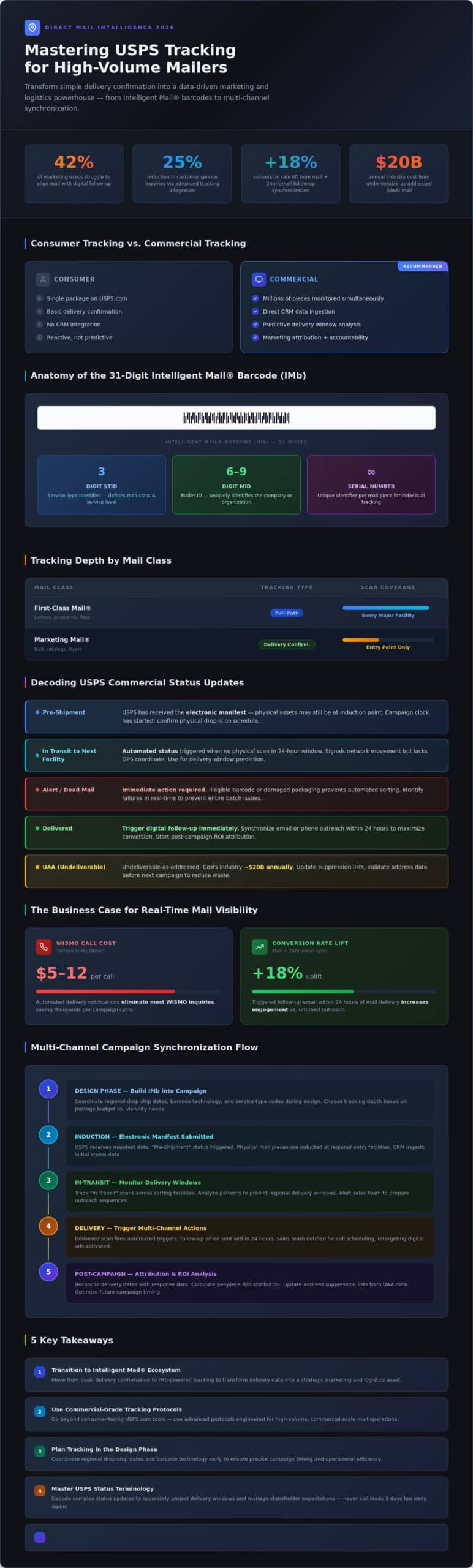
The landscape of us post office tracking has transformed from a basic delivery confirmation service into a sophisticated data stream. In 2026, commercial mailers rely on the Intelligent Mail® ecosystem to drive operational decisions. This evolution reflects a broader shift in the history and technology of mail tracking, moving from manual scans to automated, high-speed visibility. While a standard consumer might check a single package on USPS.com, high-volume mailers utilize the 31-digit Intelligent Mail® barcode (IMb) to monitor millions of pieces simultaneously. This level of granularity allows for precise marketing attribution and corporate accountability that was previously impossible.
To better understand the basic mechanics of how these systems function for end-users, watch this helpful video:
The distinction between consumer tools and commercial tracking systems is significant. For a business, tracking isn’t just about knowing a package arrived; it’s about data integration. By leveraging the LineMark experience, mailers can ingest raw USPS data into their own CRM systems. This integration ensures that every mail piece contributes to a larger picture of customer engagement and logistical efficiency. High-volume mailers don’t just track; they analyze patterns to predict future delivery performance across different regions.
The Anatomy of a Modern Tracking Number
The 31-digit IMb is the backbone of modern logistics. It isn’t just a serial number; it’s a data-rich identifier. It contains a 3-digit Service Type Identifier (STID), a 6-digit or 9-digit Mailer ID (MID), and a unique serial number. First-Class Mail® often provides “full-path tracking,” offering scans at every major sorting facility. In contrast, Marketing Mail® may only offer “delivery confirmation” or entry-point scans. Understanding these nuances is vital for any single-source partner looking to optimize postage spend while maintaining visibility. Choosing the right service type code ensures you don’t pay for tracking depth you don’t actually need.
The Business Case for Real-Time Visibility
Real-time visibility creates a bridge between physical and digital channels. When a mailer knows exactly when a catalog hits a doorstep, they can trigger a follow-up email within 24 hours. This synchronization has been shown to increase conversion rates by up to 18% in recent retail studies. Additionally, predicting delivery windows allows warehouses to manage inventory levels more effectively. Automating these notifications significantly reduces “where is my order” (WISMO) inquiries, which typically cost customer service departments $5 to $12 per call. Effective us post office tracking at scale isn’t just a convenience; it’s a catalyst for measurable growth.
Decoding USPS Tracking Statuses and Commercial Terminology
Mastering us post office tracking requires more than just monitoring a delivery date; it involves interpreting the logistical data points that dictate your campaign’s ROI. For commercial mailers, the “Pre-Shipment” status indicates that the USPS has received the electronic manifest, though the physical assets may still be at the induction point. Once the mail enters the stream, the “In-Transit to Next Facility” update often appears. This is an automated status triggered when a mailpiece hasn’t been scanned by a physical sensor within a 24-hour window. It signals movement through the network but lacks a specific GPS coordinate, making it a critical metric for predicting delivery windows in high-volume distributions.
When a tracking log shows an “Alert” or “Dead Mail” status, immediate action is necessary. These designations often stem from illegible barcodes or damaged packaging that prevents automated sorting. In 2024, the USPS reported that undeliverable-as-addressed (UAA) mail costs the industry roughly $20 billion annually. Identifying these failures in real-time allows mailers to troubleshoot production issues before the entire batch is affected. The “Out for Delivery” scan is the most valuable data point for local marketing. It provides the precise moment to synchronize digital touchpoints. By leveraging Informed Delivery for Business Mailers, brands can place a digital ad in a recipient’s inbox the same morning the physical piece arrives, increasing response rates by up to 40%.
Understanding Processing Milestones
Network Distribution Centers (NDCs) serve as the backbone of the us post office tracking system, handling the consolidation of bulk mail into regional streams. From there, mail moves to Sectional Center Facilities (SCFs), where scans indicate the piece is nearing its final destination. This regional sorting is where delivery timelines are solidified. Arrival at Unit is the final local sorting step where the mailpiece is processed at the specific post office responsible for the recipient’s route.
Handling Delivery Exceptions
Delivery exceptions like “Notice Left” or “Undeliverable as Addressed” provide essential feedback for list hygiene. Census Bureau data shows that approximately 14% of Americans move each year, which means mailing lists decay rapidly. High-quality tracking data helps you identify these movers, allowing you to purge or update addresses to minimize postage waste. Managing these returns effectively prevents the accumulation of “Dead Mail” and protects your sender reputation. Working with a single-source partner allows you to automate this data feedback loop, ensuring your next campaign is leaner and more targeted.
The Gap Between Consumer Tracking and Commercial Logistics
Most individuals are familiar with the standard USPS Tracking Basics, where a single number provides a delivery status. This interface serves the public well for isolated packages, but it fails the commercial mailer overseeing 10,000 or 100,000 pieces. Scalability requires more than a simple notification; it demands granular visibility into the mailstream. Relying on manual lookups creates a data silo that prevents real-time decision-making and stunts campaign growth.
Manual vs. Automated Tracking Systems
Individual lookups are a drain on human capital. If a staff member spends just 60 seconds tracking one piece, a 10,000-piece campaign would require 166 hours of manual labor. Our integrated API solutions eliminate this waste by pulling raw scan data directly into centralized dashboards. MarCom On-Demand portals allow distributed teams to view campaign progress from any location, ensuring every department stays aligned. By integrating this us post office tracking data into a CRM, sales teams can time their follow-up calls to coincide exactly with mail arrival, which has been shown to increase conversion rates by as much as 20% in specific industries. This automation transforms a clerical task into a strategic advantage.
Intelligent Mail® Barcode (IMb) Advantages
The Intelligent Mail® barcode (IMb) is the link between physical mail and digital analytics. This technology provides full-path visibility, allowing us to monitor a mailpiece from the moment it leaves the press until it reaches the recipient’s porch. Unlike basic us post office tracking, the IMb allows for sophisticated sorting and routing. High-volume mailers leverage these barcodes to access significant postal discounts, often reducing postage costs by several cents per piece. This precision ensures that your budget goes further while providing the data necessary to justify every dollar spent.
Professional fulfillment partners look beyond simple timestamps. We analyze raw data to identify regional bottlenecks or delivery trends that could impact a multi-state rollout. This level of insight transforms a simple mailing into a strategic asset. Choosing a single-source partner ensures that your logistics and marketing data live in the same ecosystem, providing a level of precision that manual consumer tools simply cannot match. The LineMark experience is built on this foundation of technological pride and operational excellence, ensuring your message arrives exactly when it is intended to make an impact.
Integrating Tracking into Your Direct Mail Strategy
Precision in high-volume mailing begins long before the first piece hits the sorter. To maximize the utility of us post office tracking, commercial mailers must treat data as a primary design element. This strategic integration ensures that logistics and marketing work in a synchronized rhythm, providing the transparency needed for complex, multi-channel campaigns.
- Step 1: Barcode Integration. During the design phase, we implement the Intelligent Mail barcode (IMb) to provide unique identification for every mail piece. This technical foundation allows for granular tracking at the individual recipient level.
- Step 2: Logistics Coordination. Our team coordinates drop-ship dates with specific regional processing centers. By bypassing unnecessary handling, we often reduce transit times by 48 to 72 hours, ensuring predictable arrival windows.
- Step 3: Seed Monitoring. We utilize “seed” mail pieces, which are identical mailings sent to controlled addresses. This allows our partners to verify exactly when delivery starts in specific zip codes.
- Step 4: Curve Analysis. By analyzing delivery curves, we identify when 85% of a campaign has reached its destination. This data allows brands to time follow-up digital touches with surgical precision.
As your single-source partner, LineMark manages these technical layers to provide a seamless experience. We move beyond simple logistics to offer a collaborative approach that treats mailing as a sophisticated communications engine.
Leveraging Informed Delivery® for Marketers
The 2024 USPS Household Diary Study indicates that over 62 million Americans are enrolled in Informed Delivery. When us post office tracking triggers a digital preview in a consumer’s inbox, it creates an immediate touchpoint before the physical mail arrives. We help clients boost click-through rates by 12% to 18% by attaching interactive ride-along images to these previews. This dual-channel approach ensures your brand stays top-of-mind from the smartphone to the mailbox.
Data-Driven Campaign Optimization
Tracking data offers more than just arrival times; it provides a roadmap for future efficiency. For instance, our analysis shows that standard postcards often process 15% faster than complex flat mailers in high-volume environments. By calculating the exact lag time between delivery and conversion, we help marketers adjust regional schedules to account for localized postal delays. This level of detail ensures that your budget is allocated to the formats and regions that offer the fastest path to ROI.
Ready to enhance your mailing precision? Contact us today to experience the LineMark difference in logistics and tracking technology.
Scalable Fulfillment: The Linemark Difference
Linemark bridges the gap between high-volume production and logistical precision. We don’t just print; we orchestrate the entire lifecycle of your mail piece. By integrating high-speed printing with sophisticated tracking logistics, we eliminate the blind spots that often plague large-scale campaigns. Our role as a single-source partner means your project stays under one roof from the initial data processing to the final-mile reporting provided by us post office tracking systems. This vertical integration ensures that data integrity is maintained from the moment a file is uploaded to the second it reaches the recipient’s door.
Our approach centers on providing customized fulfillment solutions that offer transparency for even the most complex projects. We leverage advanced data processing to ensure 100% mail-stream visibility, allowing marketers to coordinate multi-channel touches with surgical timing. This level of control transforms direct mail from a static medium into a dynamic, trackable asset that fits seamlessly into a modern digital ecosystem.
Precision Production and Mailing
Every mailer we produce utilizes variable data printing (VDP) to ensure 100% trackability. This technology allows us to assign unique Intelligent Mail barcodes to every individual piece, providing granular data at every USPS scan point. Our 90,000-square-foot facility is strategically designed to streamline the USPS induction process, moving projects from the press to the mail stream with zero friction. This infrastructure is critical for executing successful Direct Mail Marketing in 2026, where speed and visibility are the primary drivers of campaign ROI.
Technology-Driven Communication Solutions
Managing distributed marketing collateral requires more than just storage; it demands real-time intelligence. Our MarCom On-Demand portals allow your team to order, customize, and track materials from a centralized interface. When these portals combine with our kitting and fulfillment services, you gain a clear view of your inventory integrity and delivery status. We use us post office tracking data to provide actionable insights, ensuring your kits reach their destination as planned.
- Inventory Integrity: Real-time tracking of components within complex kits.
- Strategic Timing: Aligning sales follow-ups with confirmed delivery dates.
- Scalable Capacity: Handling millions of pieces without sacrificing individual piece visibility.
Scalability shouldn’t come at the cost of clarity. Linemark provides the industrial capacity to handle massive volumes while maintaining the meticulous attention to detail of a boutique firm. Contact Linemark today to discuss how we can bring precision and 100% visibility to your next high-volume, tracked mailing campaign.
Future-Proof Your 2026 Mailing Strategy
Navigating the complexities of us post office tracking in 2026 requires more than just a basic understanding of delivery statuses; it demands a sophisticated integration of data and physical logistics. Success for high-volume mailers hinges on bridging the gap between consumer-level updates and commercial-grade intelligence. By leveraging advanced Intelligent Mail® barcode technology, your organization transforms simple mail pieces into trackable assets that drive measurable ROI. Scalability isn’t a luxury when your campaigns reach thousands of recipients simultaneously across the country.
Linemark stands as your single-source partner, offering over 30 years of industrial printing and mailing expertise to streamline your operations. Our 90,000-square-foot high-capacity production facility is engineered to handle complex fulfillment needs with the precision your brand deserves. We don’t just print; we provide a technological edge through seamless Intelligent Mail® barcode integration for every commercial campaign we execute. It’s time to move beyond transactional mailing and embrace a holistic approach to your logistics. Partner with Linemark for high-visibility direct mail and fulfillment solutions to ensure your message reaches its destination with absolute transparency. Your next large-scale campaign is ready for the precision it requires.
Frequently Asked Questions
What is the difference between USPS tracking and the Intelligent Mail barcode?
USPS tracking is designed for individual packages, while the Intelligent Mail barcode (IMb) provides visibility for letter and flat-sized commercial mail. The IMb allows high-volume mailers to track thousands of pieces simultaneously through the mail stream. Standard tracking usually requires a manual scan at the point of delivery. In contrast, the IMb generates automated data points as mail passes through sorting equipment at 285 processing centers nationwide.
How long does it take for US Post Office tracking to update after a mailing is dropped?
US post office tracking typically updates within 24 hours of the initial scan at a Regional Distribution Center. This first induction scan confirms the mail is officially in the system. For commercial mailers, visibility begins once the mail enters the USPS processing stream. Real-time updates depend on the 31-digit IMb being scanned by automated sorting machines during the transit process.
Can I track a bulk direct mail campaign with a single tracking number?
You can’t track a bulk campaign with one single number; instead, you use a unique Mailer Identifier (MID) within the IMb. This MID links every piece in the campaign to your specific account. While you don’t have one tracking number, you access a unified dashboard to see the progress of the entire 50,000 or 100,000 piece drop. This provides a holistic view of delivery percentages across different ZIP codes.
What should I do if my tracking status has not changed in several days?
If a status hasn’t changed for 72 hours, it usually means the mail is moving through a long-haul transport leg between hubs. High-volume mailers should monitor the expected delivery window provided by their logistics partner. If 5 percent of a mailing remains unscanned after 10 days, it’s time to initiate a Mail Search Request through the Business Customer Gateway to identify potential bottlenecks.
Does every piece of mail in a commercial campaign have its own tracking code?
Yes, every piece in a modern commercial campaign receives a unique sequence number within its Intelligent Mail barcode. This 6-digit or 9-digit sequence allows for granular tracking of every single recipient. It’s the foundation of personalized direct mail. By assigning unique codes, you can trigger follow-up emails or sales calls the moment a specific piece reaches a household, creating a seamless customer experience.
How can I use USPS tracking data to improve my marketing ROI?
Integrating us post office tracking data with your CRM allows you to synchronize digital ads with physical mail arrival. Studies from the Data and Marketing Association show that multi-channel campaigns see a 28 percent increase in conversion rates. By knowing exactly when a mailer lands, you can deploy a day-of email to reinforce the message. This precision reduces wasted spend and maximizes your total engagement.
What is the most accurate way for a business to track 100,000+ mail pieces?
The most accurate method for tracking 100,000+ pieces is utilizing Informed Visibility (IV) mail tracking. This USPS service provides near real-time data feeds directly into your analytics platform. It eliminates manual lookups by providing automated reports on every piece. Professional mailers rely on this system to manage large-scale distribution and ensure 99 percent deliverability across complex geographic regions without the need for manual intervention.
Can Linemark provide tracking reports for my direct mail and fulfillment projects?
Linemark provides comprehensive tracking reports that transform raw USPS data into actionable business intelligence. As your single-source partner, we deliver customized dashboards that show exactly where your mailing stands at any moment. We handle the technical integration of the IMb so you can focus on high-level strategy. Our systems provide the transparency needed to manage fulfillment projects with total confidence and precision.