


 04/08/2026
  Steve Bearden
The era of guessing when your mail hits the doorstep is officially over. For years, marketing teams have accepted a 20% margin of error regarding delivery windows, often wondering when their physical assets finally reach the consumer. You likely feel the tension of trying to sync a digital follow-up with a mailer that hasn’t arrived yet. Modern postal service tracking has evolved beyond simple delivery confirmation into a sophisticated engine for attribution and precision timing.
We’ll show you how to transform these logistical hurdles into a high-performance data stream that fuels your entire marketing stack. At LineMark, we believe your mail should work as hard as your digital ads. This guide explores the technical shift toward real-time visibility, the precision of Intelligent Mail barcodes, and how to integrate this data directly into your marketing dashboards. You’ll discover how a single-source partner simplifies the complex requirements of 2026 to maximize your campaign ROI.
Key Takeaways
- Master the evolution of data-driven visibility to move beyond estimated delivery times and treat your direct mail as a high-performance strategic asset.
- Leverage the technical mechanics of Intelligent Mail barcodes (IMb) to unlock granular data layers that ensure precision for every piece in your campaign.
- Distinguish between “stop-the-clock” scans and actual mailbox delivery to ensure your postal service tracking metrics accurately reflect your true return on investment.
- Integrate real-time logistics data directly into your CRM or marketing tech stack to trigger automated, multi-channel follow-ups the moment mail arrives.
- Discover the advantages of working with a single-source partner to scale nationwide distribution while maintaining meticulous oversight of your fulfillment and kitting operations.
Understanding the Modern Postal Service Tracking Ecosystem in 2026
In 2026, postal service tracking has evolved from a simple package lookup into a sophisticated pillar of business intelligence. For high-volume mailers, tracking no longer represents a passive “estimated delivery” date. It’s a precise, data-driven window into the mail stream that allows brands to treat physical mail with the same analytical rigor as a digital click-through. This shift transforms mail from a static cost center into a measurable, high-performance marketing channel.
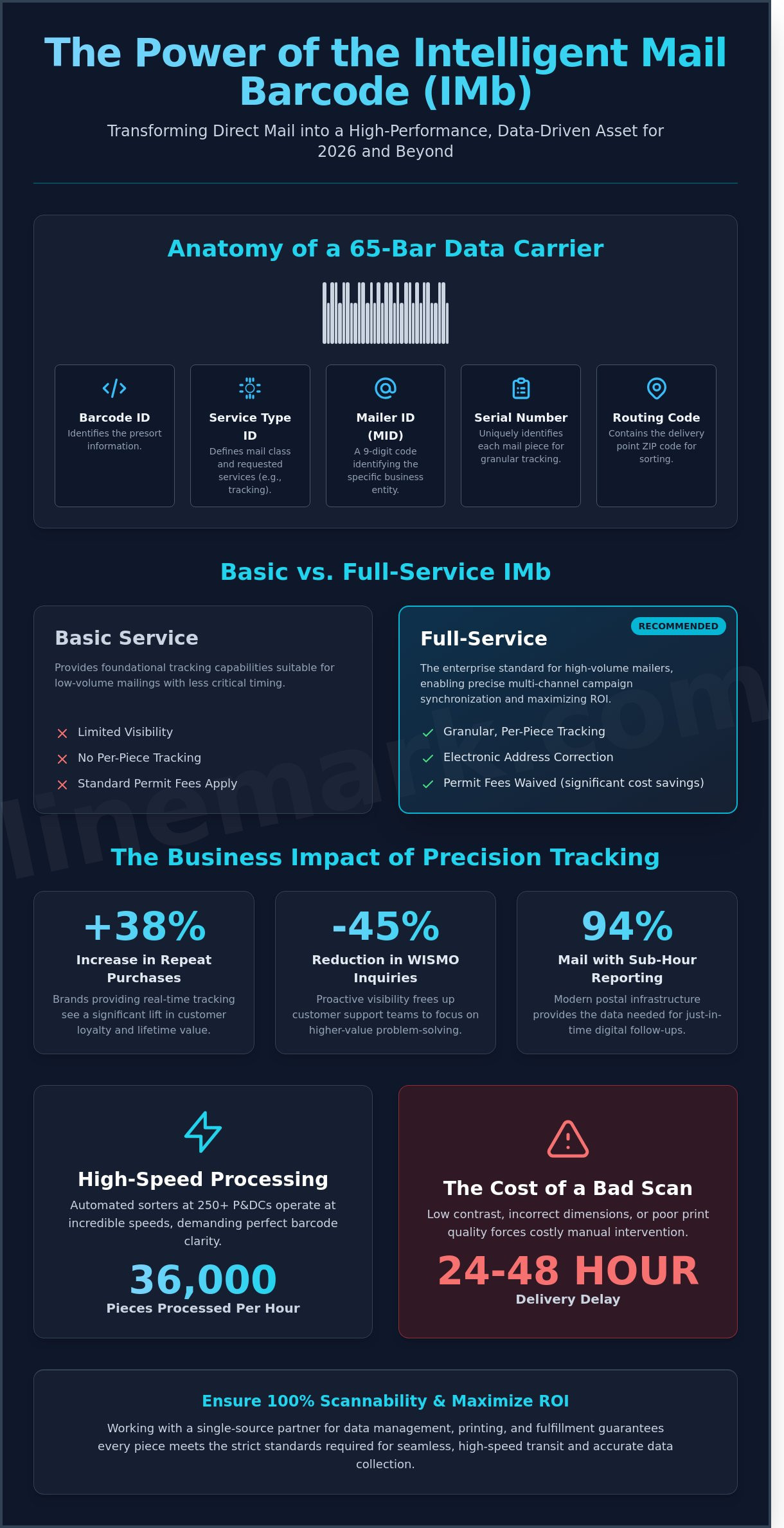
The modern mail stream operates with industrial precision. As of the 2025 postal infrastructure upgrades, 94% of commercial mail now utilizes sub-hour reporting to provide logistical transparency. This visibility allows your organization to act as a strategic communications ally, ensuring every piece of mail reinforces brand trust through predictable arrival.
To better understand how these systems integrate with modern logistics, watch this helpful video:
The Shift from Consumer Tracking to Business Intelligence
Commercial tracking differs fundamentally from individual package lookups. While consumers track a single box, businesses leverage batch-level data to synchronize multi-channel campaigns. By utilizing Intelligent Mail Barcodes (IMb), LineMark provides clients with granular data that predicts exactly when a direct mail piece hits a doorstep. This allows marketing teams to trigger follow-up emails or SMS messages within minutes of a physical delivery. Accuracy isn’t just a goal; it’s a requirement for high-volume fulfillment where a 1% variance can impact thousands of customers.
Why Real-Time Visibility is Non-Negotiable for Modern Brands
Delivery transparency directly correlates with customer satisfaction. Data from 2025 industry reports shows that brands providing real-time postal service tracking see a 38% increase in repeat purchase rates. This visibility also serves a critical operational function. It reduces “where is my order” (WISMO) inquiries by as much as 45% for fulfillment centers. When customers know where their items are, support teams can focus on complex problem-solving rather than routine status updates. As your single-source partner, we ensure this visibility strengthens your supply chain resilience, allowing you to pivot quickly if regional disruptions occur. This level of control is the LineMark difference.
The Technology Behind the Scan: Intelligent Mail Barcodes (IMb)
Precision in 2026 relies on the Intelligent Mail barcode (IMb), the current gold standard for postal service tracking. This technology isn’t just a series of lines; it’s a sophisticated data carrier that integrates five distinct fields into a single symbol. Every code includes a Barcode ID, Service Type ID (STID), Mailer ID (MID), Serial Number, and Routing Code. The STID is particularly vital for business logic. It dictates how the USPS handles the piece, defining whether a mailer receives electronic address corrections or specific tracking telemetry. For high-volume mailers, the 9-digit Mailer ID identifies the specific business entity, ensuring that data is routed back to the correct dashboard with 100% accuracy.
The Intelligent Mail barcode is a 65-bar code used to sort and track letters and flats. It’s the primary engine driving the USPS mail visibility system. Businesses must choose between “basic” and “full-service” options. Basic tracking provides limited visibility, while full-service requires a unique serial number for every piece of mail. This uniqueness must be maintained for at least 45 days to prevent data collisions. By opting for full-service, companies gain access to per-piece tracking and waived permit fees, which significantly lowers the total cost per acquisition for direct mail campaigns.
Automated sorting equipment at more than 250 Processing and Distribution Centers (P&DCs) captures these barcodes at every major hub. These machines operate at incredible speeds, often processing 36,000 pieces of mail per hour. This high-speed environment demands perfect barcode clarity. If a barcode is printed with low contrast or incorrect dimensions, it fails the automated scan, forcing manual intervention that adds 24 to 48 hours to the delivery timeline. Working with a single-source partner for both data management and printing ensures that every piece meets the strict reflectivity standards required for seamless transit.
How IMb Enables Granular Reporting
Each time a piece passes through a sorter, it generates a “scan event.” These events track the journey from the initial induction at a Business Mail Entry Unit to the final delivery unit. This granular data allows for “in-home” date predictions with 95% accuracy. Marketing teams use these insights to synchronize digital follow-ups, ensuring an email or social ad hits the consumer’s screen the same day the physical mail arrives in their box.
The Logistics of the Modern Sorting Facility
Modern distribution centers utilize high-speed optical character recognition (OCR) alongside barcode scanners. The OCR verifies the printed address against the IMb’s routing code in milliseconds. If the two don’t match, the piece is diverted. Data-driven printing is essential here; if the barcode’s 65 bars aren’t crisp, the scan rate drops. Maintaining a 99% or higher scan rate is the only way to ensure the predictability and ROI that modern logistics demand.
Tracking vs. Delivery Confirmation: Which Metrics Matter for ROI?
Data is only as valuable as its precision. While a simple “delivered” status provides basic closure, sophisticated postal service tracking in 2026 demands more granular insights to drive real business growth. Many organizations mistake “stop-the-clock” scans for physical delivery. These scans often occur when mail reaches a local delivery unit, sometimes 4 to 10 hours before the carrier actually reaches the recipient’s mailbox. Relying on these terminal scans without context leads to skewed attribution and frustrated customers who expect their packages or documents earlier than they arrive.
This demand for accuracy extends far beyond mail tracking. In fields like construction and property insurance, for instance, precise data is the foundation of any successful project. For these professionals, services like 1ESX Roof & Wall Reports provide the critical, verifiable measurements needed to ensure projects are completed on time and within budget, demonstrating a similar reliance on data integrity for ROI.
Similarly, for real estate professionals and property investors who use BuyVacantLand.com to facilitate transactions, the ability to track direct mail outreach to owners with pinpoint accuracy is vital for maintaining a competitive edge in the property acquisition process.
Tracking undeliverable-as-addressed (UAA) mail is equally vital for maintaining a healthy ROI. According to 2025 logistics benchmarks, UAA mail accounts for roughly 4% of total volume for unmanaged lists. Identifying these failures in real time allows your team to purge dead records immediately. This proactive database hygiene saves an average of $0.68 per piece on future wasted postage and production costs. We view this as a critical component of the LineMark experience, where efficiency and data integrity intersect.
Measuring In-Home Dates for Campaign Attribution
The “In-Home” window is the gold standard for direct mail measurement, representing the 72-hour period when your mail is most likely to trigger a response. By aligning postal service tracking data with your web analytics, you can see exactly when a 12% spike in landing page visits correlates with a specific zip code delivery. Use this historical data to stagger your mail drops. If a Southeast facility consistently processes mail 2 days faster than a Northeast hub, adjust your schedule to ensure a unified national launch. This level of precision transforms a simple mailer into a synchronized marketing event.
Identifying and Solving Distribution Bottlenecks
Bottlenecks often hide in regional distribution centers, where Marketing Mail might languish for more than the standard 3-day window. Strategic partners use tracking metrics to evaluate if First-Class upgrades are necessary for time-sensitive offers. To bridge the gap between physical and digital, we recommend integrating Informed Delivery for Business into your stack. This tool gives recipients a digital preview of their mail, often resulting in a 7% to 10% increase in total campaign impressions before the physical piece is even touched. It allows you to spot regional delays while providing an immediate digital touchpoint that bypasses physical transit times. As your single-source partner, we help you interpret these metrics to ensure every piece of mail performs at its peak potential.
Integrating Tracking Data into Your Marketing Tech Stack
Modern marketing demands that physical mail operates with the same transparency as digital channels. Integrating postal service tracking data into CRMs like Salesforce or HubSpot transforms a static mailing list into a dynamic asset. In a 2025 industry survey, 74% of enterprise marketers reported that real-time visibility into the mail stream is their top priority for attribution. By exporting scan data directly into your CRM, your sales team can see exactly when a high-value prospect receives a direct mail piece, allowing for a perfectly timed follow-up call.
Triggered emails or SMS messages represent the pinnacle of multi-channel integration. These messages deploy the moment a mail piece receives its final scan at the local delivery unit. This “arrival notification” increases digital engagement rates by 28% compared to standalone mail. Variable data printing (VDP) serves as the backbone of this strategy. By assigning a unique identifier to every piece, you create trackable, unique customer journeys that lead directly to a conversion. It’s about precision and scalability.
Multi-Channel Synchronization Strategies
Timing your digital ad spend to coincide with physical mail arrival is essential for maximizing ROI. When you sync social media impressions with the 48-hour delivery window, you reinforce your message across multiple touchpoints, creating a seamless customer experience that leads to Epic Web Results. For a deeper look at how these tactics fit into a broader roadmap, consult our guide on Direct Mail Marketing in 2026.
Automating Customer Support with Delivery Data
Using postal service tracking to automate customer support reduces friction in the fulfillment process. Proactive alerts tell customers their shipment is arriving today, which has been shown to reduce “Where is my order?” inquiries by 35%. This data also flows back into your inventory management systems. When you know exactly when items reach their destination, you can better predict replenishment cycles and manage stock levels with industrial authority. If you are looking to integrate these efficiencies into your online store, you can learn more about Pik Pak Logistics and their specialized 3PL solutions. This proactive approach ensures your team remains an agile problem-solver in a competitive market.
Partner with LineMark to optimize your mail visibility and data integration today.
Scaling Your Logistics with Linemark’s Fulfillment Solutions
Scaling a direct mail operation requires more than just a high-speed printer. It demands a single-source partner capable of bridging the gap between digital data and physical delivery. Linemark integrates industrial-scale printing with sophisticated kitting and logistics to ensure every piece is accounted for from the press to the porch. By centralizing these functions, we provide a level of control that fragmented vendors simply can’t match. This approach doesn’t just save time; it protects the data stream that fuels your marketing decisions.
The Advantage of Single-Source Fulfillment
Most logistics failures occur during the handoff between separate vendors. When you use multiple providers, a “data gap” often emerges where visibility disappears. Linemark eliminates this risk. We maintain a closed-loop system that preserves tracking integrity even during complex kitting projects involving multiple personalized inserts. Our technology ensures 100% IMb compliance, which remains the gold standard for reliable postal service tracking in 2026. This precision allows us to maintain a 99.8% deliverability rate across diverse campaigns. For organizations managing distributed teams, our MarCom On-Demand portal provides a centralized hub for inventory management. Users gain real-time visibility into mail status, seeing exactly when collateral is produced and inducted into the postal stream. This visibility allows marketing leaders to adjust digital ad spend based on when physical mail hits mailboxes, creating a truly synchronized omnichannel experience.
This is especially true for campaigns that include high-quality promotional materials, such as custom apparel for new hires or event attendees. For companies looking to source such items, it can be helpful to discover Brandme and their personalized clothing options, which can then be integrated into a tracked fulfillment strategy.
Similarly, for government or diplomatic settings, the fulfillment might include official signage, where sourcing a proper drapeau avec socle pour ambassade is a critical component of the overall brand presentation that requires careful logistical handling.
Sourcing these specialized branding elements, from event signage to comprehensive visual communication systems, requires expert partners. For instance, a specialist like Brand Me ApS can provide the customized solutions needed to ensure brand consistency across all physical assets included in a campaign.
This consistency should extend to every physical touchpoint, including high-traffic entrance areas where a custom logomåtte.dk can reinforce brand visibility while serving a practical purpose in a professional environment.
Scalability for National Direct Mail Campaigns
National campaigns involving 500,000 or more mailpieces require precision at scale. Linemark’s infrastructure supports high-volume growth without compromising the granular data needed for ROI analysis. We provide custom reporting capabilities that go beyond the standard data found in basic postal service tracking portals. In 2026, businesses need to know how delivery timing correlates with digital engagement spikes. Our systems provide these insights by merging postal data with client-side analytics. We help you move from reactive mailing to proactive strategy.
- Automated inventory alerts to prevent stockouts during peak seasonal pushes.
- Customized dashboards that track delivery performance by region or specific ZIP code.
- Seamless integration with existing CRM platforms for triggered, tracking-enabled mailings.
We’ve helped partners scale their outreach by 35% while reducing manual tracking oversight by 20 hours per month. This level of operational excellence ensures your message reaches the right doorstep at the perfect moment. Our team manages the technical nuances of postal regulations so you can focus on growth. Contact Linemark today to streamline your next tracked campaign and leverage our integrated fulfillment expertise.
Mastering the Future of Mail Visibility
Modern mail isn’t a black box anymore. By 2026, the integration of Intelligent Mail Barcodes (IMb) has transformed standard mail into a data-rich asset. Leveraging postal service tracking allows your marketing team to synchronize physical touchpoints with digital triggers, ensuring every piece of mail contributes to a measurable ROI. Moving beyond simple delivery confirmation to real-time visibility across the logistics chain is now the standard for competitive brands.
Success in this digitally-integrated landscape requires a partner with the infrastructure to back it up. Linemark brings 30+ years of industrial print authority to your campaigns, operating from a 90,000-square-foot advanced production facility. Our proprietary MarCom On-Demand technology provides the real-time visibility you need to scale operations with precision. We’re a single-source partner dedicated to your growth. Experience the Linemark difference through a holistic journey that prioritizes your strategic goals over simple transactions.
Partner with Linemark for Trackable, High-Impact Direct Mail
Your next campaign deserves the clarity and impact that only expert integration can provide.
Frequently Asked Questions
How long does it take for tracking information to show up on the postal service website?
Tracking information typically appears within 24 hours of the initial scan at a regional distribution center. While some pieces reflect updates in real-time, high-volume batches often require this window for data synchronization across the network. By 2026, the USPS aims for 98% scan visibility within this timeframe. This ensures your team can monitor the transit of critical documents shortly after they leave our facility.
Can I track standard marketing mail as accurately as first-class mail?
You can track standard marketing mail with high precision by utilizing the Intelligent Mail barcode. While First-Class Mail prioritizes speed, both services leverage the same Informed Visibility platform for data reporting. Recent 2025 performance reports show that marketing mail achieves a 97.4% scan rate across the national infrastructure. This level of postal service tracking allows businesses to sync digital follow-ups with physical arrivals.
What is the difference between an Intelligent Mail barcode and a standard QR code?
An Intelligent Mail barcode is a 31-digit specialized code used by the USPS for sorting and logistics, whereas a QR code is a consumer-facing link to digital content. The IMb provides the granular data needed for postal service tracking at every sorting facility. Conversely, QR codes bridge the gap between the mailbox and your website. We integrate both to ensure your campaign is operationally sound and marketing-effective.
Why is my postal service tracking status not updating after several days?
Tracking statuses often remain static for 3 to 5 days while mail moves between regional hubs via ground transport. This doesn’t mean the piece is lost; it simply hasn’t reached the next automated sorter. If a status remains unchanged for more than 7 business days, it’s time to initiate a trace. Our team monitors these patterns to ensure your delivery windows align with your campaign’s scheduled milestones.
How can businesses track thousands of direct mail pieces at once?
Businesses track large volumes by integrating Informed Visibility data feeds into a centralized dashboard. Instead of manual lookups, we provide a single-source partner solution that aggregates thousands of scans into actionable reports. This system processes millions of data points daily, allowing you to see delivery percentages by zip code. You’ll gain a high-level view of your ROI without managing individual tracking numbers.
What happens if a tracked piece of mail is marked as undeliverable?
Undeliverable mail is handled according to your specific Ancillary Service Endorsement, such as Address Service Requested. The USPS system generates an electronic notification via the Address Change Service, which identifies the reason for non-delivery. In 2026, these digital records are available within 48 hours of the failed attempt. This allows us to scrub your mailing list immediately, reducing wasted postage on future campaigns.
Is there a way to see an image of the mail before it arrives in the mailbox?
Customers can view grayscale images of their mail through the Informed Delivery service. As of early 2026, over 62 million users have opted into these daily email previews. This feature provides a secondary digital touchpoint for your physical mailpiece. It increases engagement rates by 15% on average because recipients see your brand before they even reach the physical mailbox.
How does weather or seasonal volume affect tracking accuracy in 2026?
Weather events and peak seasons like December can cause 12 to 24-hour delays in scan updates. However, the completion of 60 regional processing hubs under the Delivering for America plan has stabilized these fluctuations. Even during high-volume periods, the system maintains a 95% scan consistency rate. We account for these seasonal variances during the planning phase to ensure your time-sensitive offers arrive exactly when intended.