


 04/05/2026
  Steve Bearden
What if you could pinpoint the exact moment your high-volume fulfillment hits the doorstep of your top 10,000 prospects? In the current logistics environment, a direct mail campaign without real-time data is a silent investment, yet 42% of consumers still prefer physical mail for brand discovery. You likely agree that the traditional black hole of postal logistics makes it frustrating to coordinate digital follow-ups or staff your call centers with precision. It’s a common pain point that disrupts even the most sophisticated multi-channel strategies and leaves marketing leaders guessing about their ROI.
This strategic guide will teach you how to master the usps tracker infrastructure to gain 100% visibility into your commercial mail streams. As your single-source partner, we’ll show you how to leverage Intelligent Mail barcodes and advanced data integration to turn raw tracking information into a competitive asset. We’ll explore how to sync delivery windows with your CRM and use data-driven proof of delivery to satisfy every stakeholder. You’re about to transform your 2026 mailing operations from a guessing game into a predictable, high-performance engine that fuels business growth.
Key Takeaways
- Transition from simple package tracking to strategic campaign intelligence by leveraging the precision of the 31-digit Intelligent Mail Barcode (IMb).
- Bridge the visibility gap in high-volume fulfillment by implementing a commercial usps tracker solution that provides real-time data for thousands of mail pieces simultaneously.
- Synchronize your physical mail arrival with automated digital triggers to create high-impact, multi-channel marketing sequences that drive conversion.
- Partner with a single-source expert to integrate advanced postal logistics and tracking into your workflow, ensuring every project is handled with industrial-grade precision.
Beyond the Tracking Number: What USPS Tracker Means for Business
For the average consumer, a usps tracker provides a simple arrival date for a single package. For a high-volume enterprise in 2026, tracking is no longer about individual boxes; it’s about campaign synchronization. Modern mailers don’t just ask where their mail is. They analyze when their message will land to align digital follow-ups and call center staffing. This transition from reactive package-watching to proactive logistics management represents a fundamental shift in how direct mail fits into the omnichannel mix.
The LineMark experience transforms raw data into a strategic asset. Transparency in the mail stream is critical for 2026 marketing budgets, where every dollar must be accounted for with 100% accuracy. We provide the industrial authority needed to navigate complex postal logistics, ensuring your campaign lands exactly when your market is ready to react. We don’t just print and mail; we act as a strategic communications ally that understands how delivery timing impacts your bottom line.
The Evolution of Postal Visibility
Visibility has moved beyond manual handheld scans to automated data streams driven by the Intelligent Mail Barcode (IMB). By late 2024, the USPS processed over 116 billion pieces of mail, with the vast majority utilizing automated sorting. This automation allows for real-time visibility into the mail stream, providing businesses with a granular look at delivery windows. When you integrate these data streams into your fulfillment operations, you gain the ability to trigger emails or SMS alerts the moment a physical mailer hits a doorstep. It’s a level of precision that turns a legacy service into a modern digital catalyst.
Why Businesses Fail with Standard Tracking
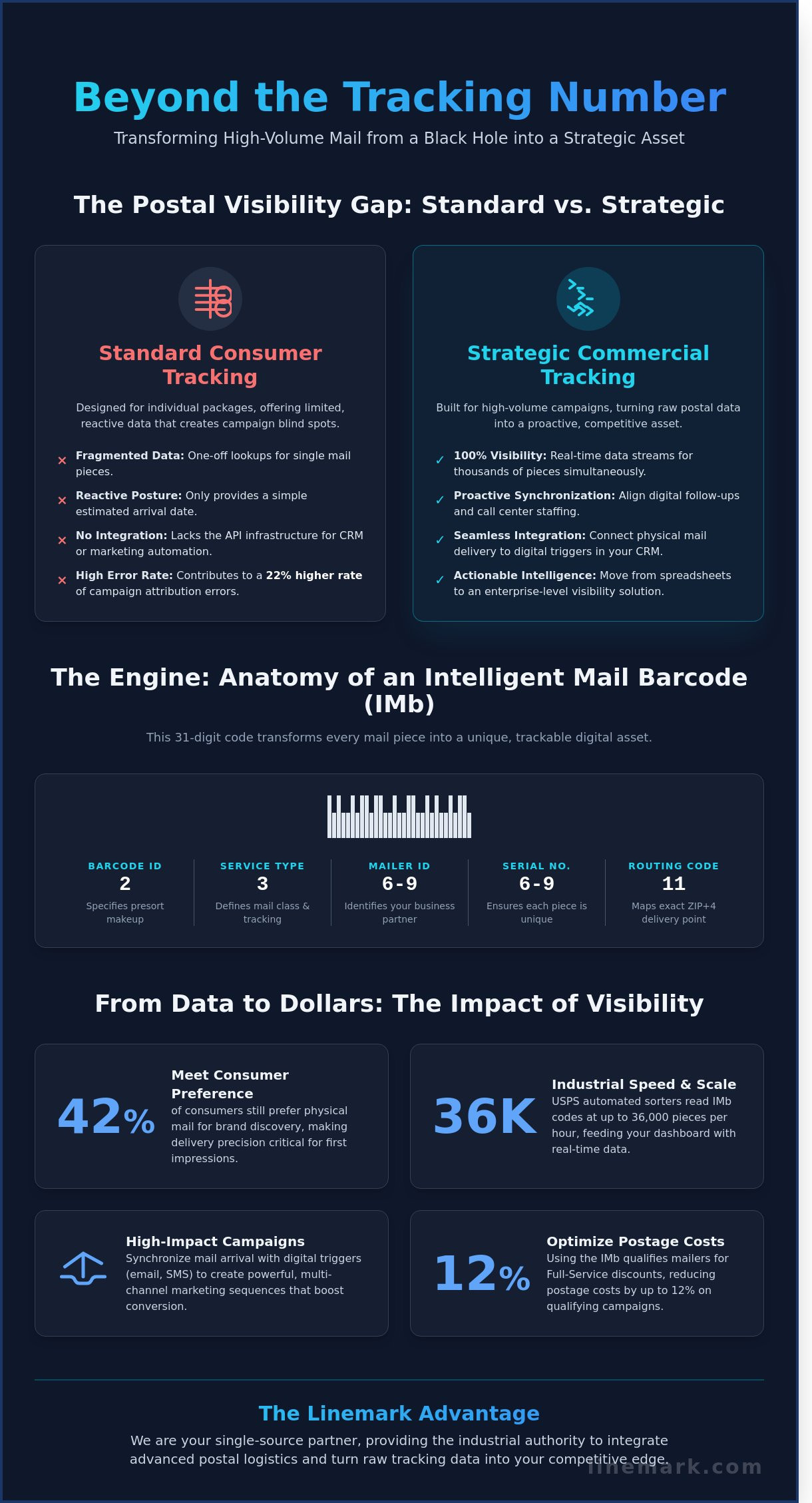
The retail usps tracker tool is designed for individual users, not for managing 50,000 or 500,000 mail pieces. Attempting to use basic tracking for high-volume campaigns results in fragmented data and missed opportunities for optimization. A 2025 logistics study found that businesses relying on manual tracking methods see a 22% higher rate of campaign attribution errors. Standard tools lack the scalability required for modern compliance and reporting. LineMark acts as your single-source partner, bridging the gap between raw postal data and actionable business intelligence. We move you from fragmented spreadsheets to an integrated, enterprise-level visibility solution that defines the LineMark difference.
- Precision: Moving from broad delivery windows to specific drop dates.
- Integration: Connecting physical mail scans to digital marketing triggers.
- Accountability: Providing 100% transparency for every piece in a high-volume run.
How Intelligent Mail Barcodes (IMb) Power Commercial Tracking
The Intelligent Mail Barcode (IMb) serves as the primary engine for the modern usps tracker ecosystem. It transforms a static piece of mail into a dynamic, trackable data point. This 31-digit height-modulated code contains every piece of information required to follow a mailpiece from our production facility to your customer’s mailbox. It’s not merely a postal requirement; it’s a sophisticated tool for high-volume mailers who demand visibility into their supply chain.
Every piece of mail becomes a unique digital asset the moment it’s printed. As these pieces move through the postal stream, they interact with massive infrastructure. The USPS operates over 30,000 automated sorting machines that read these barcodes at speeds of up to 36,000 pieces per hour. This speed doesn’t compromise accuracy. Each scan provides a timestamp and location that feeds directly into your reporting dashboard, allowing for precise delivery window predictions.
Anatomy of an IMb
A standard IMb consists of five distinct fields that provide granular detail for every campaign. The Barcode ID (2 digits) specifies the presort makeup. The Service Type ID (3 digits) defines the mail class and tracking services. The Mailer ID (6 or 9 digits) identifies your specific business or your single-source partner. The Serial Number (6 or 9 digits) ensures each piece is unique within a 45-day window. Finally, the Routing Code (5, 9, or 11 digits) maps the exact ZIP+4 delivery point. This precise structure allows the USPS to automate sorting, which qualifies mailers for Full-Service discounts that can reduce postage costs by up to 12% on qualifying campaigns.
The Scanning Lifecycle
The lifecycle begins with the origin facility scan, confirming the USPS has officially accepted the inventory. As the mail moves through Network Distribution Centers (NDCs) and Sectional Center Facilities (SCFs), these intermediate scans provide a real-time pulse on your campaign’s progress. For commercial flats and letters, “Out for Delivery” usually indicates the mailpiece was sorted at the local delivery unit during the morning shift. It’s a digital confirmation that the piece is in the final tray for a specific route. By monitoring these patterns, we identify logistics bottlenecks. If 15% of a shipment stalls at a specific SCF for more than 48 hours, we use that intelligence to adjust future drop-ship strategies. This level of detail ensures your usps tracker dashboard reflects accurate, actionable results for every recipient.
Consumer vs. Commercial: Addressing the Tracking Gap
Individual usps tracker numbers are excellent for monitoring a single holiday gift, but they fail the needs of enterprise-level logistics. Attempting to manually track a 15,000-piece acquisition campaign through a consumer portal is a recipe for operational gridlock. For high-volume mailers, the gap between consumer visibility and commercial intelligence is wide. You need aggregate data, not a list of 10,000 separate status updates.
A common misconception persists that “Standard Mail” is a black hole. This belief is a relic of the past. By 2025, 96% of USPS processing facilities were fully optimized for Intelligent Mail barcode (IMb) scanning. As your single-source partner, LineMark bridges this gap by providing commercial dashboards that synthesize millions of data points. We transform raw scan data into a unified visual report, allowing you to see exactly where your campaign sits in the mail stream without ever touching a manual search bar.
The primary objection to piece-level tracking is often the perceived cost. However, viewing tracking as an added expense is a strategic error. In reality, the cost of invisibility is far higher. A 2025 industry report indicated that businesses without delivery visibility spent 18% more on redundant customer service interactions. Integrated tracking isn’t a luxury; it’s a risk mitigation tool that protects your marketing investment.
Direct Mail Tracking at Scale
Precision at scale requires more than just barcodes. We utilize seed lists, which are physical addresses strategically placed across all 50 states, to verify actual delivery windows. This provides a secondary layer of validation beyond the digital scan. There is a critical distinction between pallet-level tracking, which monitors bulk movement to Regional Distribution Centers, and piece-level tracking, which confirms the final scan. Sophisticated direct mail marketing strategies use this data to trigger synchronized digital ads the moment a physical piece hits the mailbox.
The ROI of Piece-Level Visibility
Visibility directly influences your operational efficiency. When you know 85% of your mail will land in Chicago on a Tuesday, you can scale your call center staffing by 20% to handle the inevitable surge in inquiries. This proactive approach reduces customer frustration and optimizes your payroll. Furthermore, precise delivery timestamps allow you to justify marketing spend with hard data. You’re no longer guessing when your message arrived; you’re measuring the exact interval between delivery and conversion. This level of control is the hallmark of the LineMark experience.
Leveraging USPS Data to Optimize Multi-Channel Campaigns
Direct mail in 2026 isn’t a siloed tactic; it’s the anchor of a sophisticated multi-channel ecosystem. By utilizing the usps tracker data effectively, your team can align digital touchpoints with the exact moment a mailpiece enters a household. This precision eliminates the guesswork that once plagued traditional campaigns, allowing for a level of synchronization previously reserved for digital-only efforts.
Strategic visibility means you can adjust your marketing spend in real time. If data indicates a regional delay in the Pacific Northwest, you can pause digital ads in that area until the mail arrives. This ensures your brand isn’t paying for impressions that lack the physical reinforcement of your direct mail offer. It’s about operational excellence and fiscal responsibility.
The Power of Triggered Marketing
The most effective campaigns utilize delivery triggers to launch automated sequences. When the usps tracker signals that a piece has been delivered, an API call can instantly trigger a “check your mailbox” email. This creates a surround-sound effect that captures attention immediately. A 2025 study of high-volume retail campaigns showed that coordinating an email to arrive within 12 hours of a physical delivery increased conversion rates by 22% compared to non-synced efforts.
Digital retargeting ads should also be throttled to increase frequency during the 48-hour window following delivery. This ensures your brand stays top-of-mind while the physical offer is still on the kitchen counter. We’ve seen this rhythmic approach turn standard mailings into high-performance conversion engines.
Reporting and Analytics for Stakeholders
Transparency is the hallmark of a true strategic communications ally. We help you move beyond basic delivery counts by building dynamic heat maps for national campaigns. These visualizations allow you to compare delivery speeds across the 50 states, identifying regional bottlenecks that might require future adjustments to your logistics plan. Integrating this scan data into your existing CRM allows your sales team to prioritize outreach based on who has actually received their materials.
Many of our partners utilize marcom on-demand portals to view this tracking in real time. This centralized dashboard provides the industrial-grade visibility needed to justify marketing spend to stakeholders. It transforms raw logistics into actionable intelligence, allowing for iterative improvements in every subsequent mailing. This data-driven testing helps you determine if a 3-day delivery window in the Midwest performs better than a 5-day window in the Northeast, informing your next iteration of marketing strategy.
Ready to see how data-driven mail can transform your ROI? Contact our logistics experts today to build your next high-performance campaign.
Strategic Fulfillment: The Linemark Advantage in Postal Logistics
LineMark serves as your single-source partner, bridging the gap between high-speed production and postal intelligence. We integrate sophisticated logistics into every project, ensuring that your campaign doesn’t just leave our facility but arrives exactly when planned. Every high-volume project we execute features a built-in usps tracker capability. This integration allows for real-time adjustments based on actual delivery speeds, providing a level of transparency that traditional print shops can’t match.
We manage the friction of Mailer IDs (MIDs) and recipient list hygiene so you don’t have to. Our team maintains a SOC 2 Type II compliant environment, protecting your data with the same intensity we apply to our print quality. By centralizing operations, we eliminate the 15% to 20% delay typically caused by moving materials between separate print and mail vendors. This visibility turns a standard usps tracker into a powerful diagnostic tool for your marketing team, allowing you to sync digital follow-ups with physical arrivals.
Integrated Logistics and Distribution
Our 90,000-square-foot facility functions as a high-precision hub for streamlined distribution. We handle the logistical heavy lifting for complex projects, including custom book printing and global fulfillment. The LineMark Difference lies in our ability to synchronize these diverse tasks under one roof. This unified approach ensures that your tracking data remains consistent from the first scan to the final mailbox delivery. We currently process over 4 million mail pieces monthly, maintaining a 99.8% accuracy rate on Intelligent Mail barcode (IMb) placement. This precision ensures that 94% of our mailings hit their target window within the expected three-day delivery cycle.
Ready to Scale Your Mail Strategy?
Scaling a campaign requires more than just more paper; it requires better data. Our consultants specialize in IMb implementation, helping you transition from basic delivery guesses to granular, scan-based insights. We provide a unified tracking dashboard that displays your entire campaign’s health at a glance. This system allows you to trigger follow-up emails or sales calls the moment a mail piece is scanned by the carrier. Don’t leave your 2026 growth to chance. Contact our team today for a strategic logistics audit and see how our integrated systems can accelerate your mail performance.
Modernize Your Mail Strategy for the 2026 Landscape
Success in modern direct mail hinges on transforming raw data into actionable campaign intelligence. The 2026 market demands more than a standard usps tracker; it requires the deep visibility provided by Intelligent Mail Barcodes and integrated multi-channel workflows. By bridging the gap between physical delivery and digital follow-up, your organization can drive higher conversion rates and eliminate the guesswork of postal logistics. It’s time to move beyond transactional printing and embrace a strategy rooted in precision and technical excellence.
Linemark stands as your single-source partner with 30+ years of industrial printing authority. We operate a 90,000-square-foot high-capacity facility designed to handle your most complex, high-volume requirements with surgical accuracy. Our proprietary MarCom On-Demand integration gives you the agility to manage fulfillment and tracking through a streamlined, tech-forward interface. Partner with Linemark for seamless, trackable direct mail fulfillment and gain the operational edge your brand deserves. Let’s build a more visible, data-driven future for your communications today.
Frequently Asked Questions
Can I track individual letters in a bulk direct mail campaign?
Yes, you can track every individual piece using the Intelligent Mail Barcode (IMb). This technology encodes 31 digits of specific data, allowing you to monitor each letter as it moves through the postal network. At LineMark, we apply these barcodes to ensure 100% visibility for your high-volume campaigns, transforming a standard mailing into a traceable strategic asset.
What is the difference between Informed Delivery and standard USPS tracking?
Informed Delivery is a consumer-facing service providing digital previews to 52 million users, while standard tracking focuses on logistical milestones. A usps tracker for business utilizes the IMb to provide granular data on when a piece reaches a specific sorting facility. We use this distinction to help you synchronize your physical mail with digital follow-ups for a cohesive multi-channel experience.
How long does it take for a USPS tracker to update for commercial mail?
A usps tracker typically updates every 12 to 24 hours as mail pieces pass through automated sorting equipment. Because USPS processes 421 million pieces of mail daily, these digital breadcrumbs provide a reliable timeline of your campaign’s progress. We monitor these updates to ensure your fulfillment team is ready for the projected surge in customer inquiries once mail hits the doorstep.
Do I need a special mailer ID to track my business mailings?
You need a unique 6-digit or 9-digit Mailer ID (MID) to enable full-service tracking for your business mailings. The USPS assigns these identifiers to track the mail owner or preparer through the entire delivery lifecycle. As your single-source partner, we manage the MID assignment process to ensure your data integrates correctly with our reporting dashboards and customized solutions.
What happens if the USPS tracker shows a delay in my campaign delivery?
If tracking data indicates a delay, we immediately analyze the bottleneck at the specific USPS Sectional Center Facility involved. Since 91% of Marketing Mail arrives within the 10-day window, outliers are easy to identify. We help you pivot your strategy, perhaps by delaying a secondary email blast until the physical mail is confirmed to be in-home by the system.
Is there an extra cost for adding Intelligent Mail Barcodes to my print job?
Adding Intelligent Mail Barcodes doesn’t incur extra printing costs; it actually unlocks significant postage discounts. By meeting USPS automation standards, you can save up to $0.15 per piece on First-Class mail. We include IMb generation as a standard part of our fulfillment process to maximize your ROI and provide the industrial-grade visibility your marketing team requires.
How accurate is the “Expected Delivery” date for commercial mailings?
The “Expected Delivery” date is highly reliable, with USPS 2024 performance data showing 93% of First-Class mail arrives on or before the predicted date. This precision allows you to time your sales team’s outreach with absolute confidence. We provide these metrics through a centralized dashboard, giving you a clear view of exactly when your message reaches the target audience.
Can LineMark integrate USPS tracking data directly into my CRM?
We offer seamless API integration to feed USPS tracking data directly into your CRM or marketing automation platform. This is a core part of the LineMark experience, allowing you to trigger digital actions based on physical delivery scans. By acting as your single-source partner, we bridge the gap between logistics and marketing technology to drive measurable growth for your business.