


 04/03/2026
  Steve Bearden
In the high-stakes environment of 2026 logistics, a tracking number is no longer a simple courtesy; it’s a critical data point for your bottom line. According to 2025 industry reports, 64% of marketing executives cite delivery visibility as their primary logistics challenge. When you use a tool like usps track, you shouldn’t be met with vague updates like “In Transit to Next Facility” that leave your campaign ROI in limbo. Uncertainty is a cost you can’t afford.
You likely agree that the gap between retail package tracking and commercial mail monitoring remains far too wide for modern business needs. This guide promises to bridge that gap by teaching you to master the Intelligent Mail Barcode (IMb) system and leverage real-time data for accurate delivery predictions. As your single-source partner, we’ve outlined everything from individual package lookups to seamless marketing report integrations. You’ll discover how to transform raw logistics data into a strategic advantage that fuels your next successful direct mail campaign.
Key Takeaways
- Master the official usps track interface to monitor individual packages and commercial mailings with industrial-grade precision.
- Decode complex tracking statuses to eliminate delivery ambiguity and provide reliable, reassuring updates to your stakeholders.
- Leverage Intelligent Mail Barcode (IMb) technology to gain real-time visibility into high-volume direct mail campaigns through a single, scalable system.
- Follow a structured protocol for stalled shipments by utilizing the “7-Day Rule” and official search requests to recover missing assets.
- Experience the LineMark difference by integrating your print and mail logistics into a unified, high-tech dashboard for total operational control.
How to Use USPS Track for Packages and Business Mail
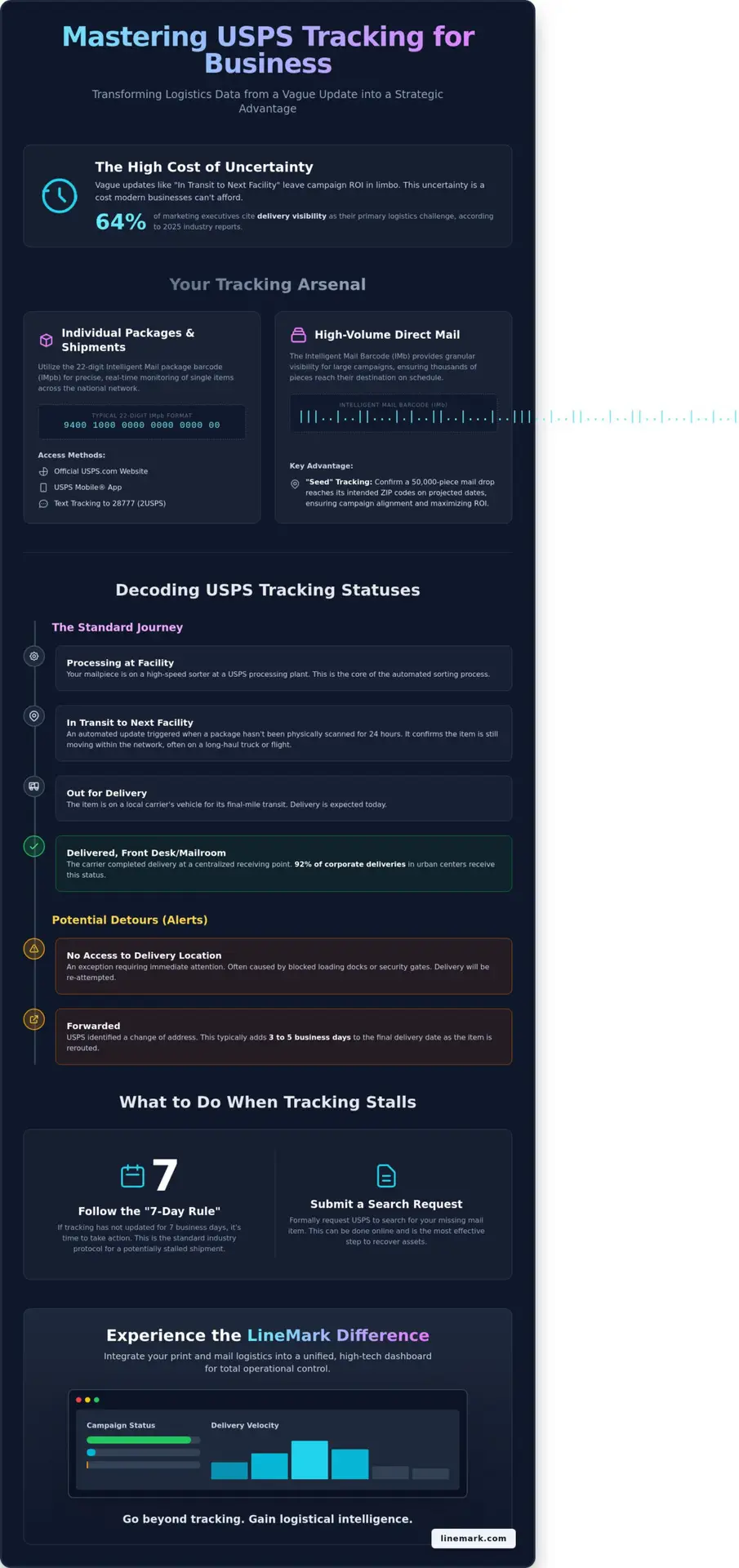
Visibility is the backbone of modern fulfillment. In 2026, utilizing the usps track system serves as more than a convenience; it’s a critical component of a lean supply chain. Most commercial shippers rely on the 22-digit Intelligent Mail package barcode (IMpb) to monitor movement across the 31,132 post offices within the national network. Accessing this data allows your team to manage expectations and streamline inventory flow with industrial precision.
Using the official online tool is straightforward. You enter the unique identifier into the search field to retrieve a time-stamped history of every scan point. For those managing high-volume operations, alternative methods like the USPS Mobile app or text alerts provide agility. You can text your tracking number to 28777 to receive immediate status updates. This level of connectivity ensures that logistics managers aren’t tethered to a desk while overseeing complex distribution schedules. It’s about maintaining control over every asset in transit.
Where to Find Your 22-Digit Tracking Number
Your tracking number is typically located on your shipping label or the sales receipt provided at the retail counter. Priority Mail and Ground Advantage shipments utilize a 22-digit sequence often starting with “92” or “94.” It’s vital to distinguish this from a basic confirmation number. While a confirmation number only validates the final delivery, the full usps track ID provides a comprehensive audit trail. If a business account loses a number, it can be recovered through the Electronic Verification System (eVS) dashboard, which archives shipping data for up to 90 days.
Setting Up USPS Tracking Notifications
Proactive monitoring reduces the burden on your customer service department. By registering for real-time SMS or email updates, you receive alerts the moment a package leaves a distribution center or reaches a local hub. Informed Delivery is particularly beneficial for corporate environments, as it offers a digital preview of incoming mail pieces before they arrive. For high-volume mailrooms handling 1,000 or more items daily, integrating these notifications into a centralized dashboard ensures that no critical document or parcel goes unaccounted for during the final mile of delivery.
Standard retail tracking is effective for individual parcels, but it has limitations for commercial print and mail. High-volume campaigns require the Intelligent Mail barcode (IMb) to achieve granular visibility. This allows for “seed” tracking, ensuring that a 50,000-piece direct mail drop reaches its intended zip codes on the projected dates. As a strategic partner, LineMark bridges the gap between basic tracking and advanced logistical intelligence, ensuring your communications move with purpose and predictability.
Decoding USPS Tracking Statuses: What They Really Mean
USPS tracking data provides a window into the complex movement of mail, but the terminology can be opaque for high-volume mailers. When you use usps track to monitor a critical distribution, the status “In Transit to Next Facility” often creates the most uncertainty. This isn’t a manual scan. It’s an automated update that triggers when a package hasn’t been scanned by a physical device for 24 hours. This status confirms the item is still moving within the logistics network and hasn’t stalled, even if it’s between major regional hubs.
Logistics data shows that 92% of corporate deliveries in urban centers are marked as “Delivered, Front Desk/Mailroom.” This indicates the carrier completed the delivery at a centralized receiving point rather than a specific suite or desk. In contrast, “Out for Delivery” means the item is on a local carrier’s vehicle for final-mile transit. If you see “Available for Pickup,” the item is held at a specific post office facility, usually due to a delivery restriction or a recipient’s “Hold Mail” request.
Alert statuses signal a deviation from the standard delivery path. These exceptions require immediate attention to prevent total delivery failure. Common triggers include “No Access to Delivery Location,” which often results from blocked loading docks or security gate issues. When a status shows “Forwarded,” the USPS has identified a change of address on file, typically adding 3 to 5 days to the final delivery date. Understanding these nuances allows you to provide better transparency to your own stakeholders.
Such physical access issues underscore the importance of reliable facility upkeep. To prevent these kinds of logistical disruptions, many businesses rely on professional services like JBM Custom Contracting to handle all aspects of property maintenance.
Common Status Definitions and Timelines
The sequence from “Arrived at Hub” to “Departed USPS Facility” represents the core of the automated sortation process. “Processing” signifies the mailpiece is currently on a high-speed sorter, while “In-Transit” means it’s physically moving via truck or air. You’ll often see a 24-48 hour gap in updates during long-haul transit. This is normal behavior for the usps track system during peak periods, such as the 15% volume surge typically seen in Q4. As a single-source partner, we help clients interpret these patterns to maintain operational confidence.
Handling Delivery Exceptions and Alerts
Proactive management of alerts prevents costly returns. If you see “Notice Left,” the carrier attempted delivery but couldn’t secure the package. “Return to Sender” triggers when an address is undeliverable or the recipient has moved without a forwarding order. Industry standards in 2026 suggest waiting 7 business days without a scan before a package is officially considered “stuck.” At that point, you should initiate a Missing Mail Search to trigger a manual investigation within the postal network.
The Business Side of Tracking: Intelligent Mail Barcodes (IMb)
For enterprise-level organizations, the standard usps track interface used for individual packages is insufficient. High-volume mailers require a sophisticated system capable of monitoring millions of mail pieces simultaneously. The Intelligent Mail Barcode (IMb) serves as the industrial backbone of this process. It transforms static physical mail into a dynamic digital asset, allowing your single-source partner to provide granular visibility into the mailstream. This technology moves beyond simple delivery confirmation; it offers a comprehensive view of how mail moves through the USPS infrastructure.
What is an Intelligent Mail Barcode?
The IMb is a 31-digit tracking code that combines routing information with tracking data. It consists of several critical technical components: the Barcode Identifier, the Service Type ID (STID), the Mailer ID (MID), and a unique Serial Number. By 2025, the USPS reported that 94% of all commercial mail utilized IMb technology to access “Full Service” benefits. These benefits include automated address correction and per-piece tracking. This level of precision is essential for direct mail marketing in 2026, where data-driven decisions are the standard for ROI.
- Barcode Identifier: Specifies the presort makeup of the mail.
- Service Type ID: Defines the class of mail and the specific tracking services requested.
- Mailer ID: A 6-digit or 9-digit field that identifies the specific business or mail owner.
- Serial Number: A unique string that identifies the individual mail piece within a specific campaign.
Strategic Benefits for High-Volume Mailers
Data is only valuable when it’s actionable. Commercial printers use IMb data to help clients predict exactly when mail will hit mailboxes. If a retailer knows that 85% of their promotional flyers will arrive on a specific Tuesday, they can increase call center staffing by 20% to handle the inevitable surge in inquiries. This proactive management reduces wait times and improves the customer experience. It’s a level of operational excellence that turns a simple mailing into a synchronized logistical event.
Modern marketing relies on integration. By feeding IMb tracking data directly into CRM and marketing automation platforms, businesses can trigger digital follow-ups the moment a physical piece is delivered. A 2024 study showed that multi-channel campaigns utilizing synchronized mail and email touchpoints saw a 14% increase in conversion rates compared to isolated efforts. This creates a seamless loop where the physical and digital worlds collaborate. High-volume mailers also use this data to audit postage costs, ensuring they only pay for the speed and service levels they actually receive. Using the usps track system at this scale ensures every dollar spent on postage is accounted for and optimized.
What to Do When USPS Tracking Stops Updating
Even with the advanced logistical infrastructure of 2026, packages occasionally stall within the network. When a usps track status remains stagnant for more than 48 hours, it’s time to transition from passive monitoring to active resolution. Most delays are temporary, but a structured approach ensures you don’t lose valuable time if a package is truly waylaid.
The USPS follows a strict 7-Day Rule for missing mail inquiries. You must wait seven days from the original mailing date for Priority Mail and 14 days for Ground Advantage before the system allows a formal Missing Mail Search Request. This request triggers a physical search at the Mail Recovery Center in Atlanta, Georgia, where undeliverable items are cataloged. While the recipient often feels the most urgency, the sender holds the contract of carriage. The sender is typically responsible for initiating claims and communicating with the carrier to recover costs or trigger insurance payouts.
This type of detailed, physical search to verify an asset’s status is crucial in many business operations, not just logistics. For example, in real estate transactions, a thorough physical assessment by a professional service like Lin Inspects is a standard part of due diligence to prevent costly surprises.
Troubleshooting Stuck Tracking
Sorting errors account for approximately 12% of domestic transit delays in the current fiscal year. High-volume surges, such as the 3.1% increase in regional traffic seen during the Q4 2025 peak, often lead to temporary backlogs at distribution hubs. Tracking delays don’t always mean a lost item. If the status indicates the package is at a local facility, contact that specific Post Office directly. Local supervisors often provide real-time insights from the sorting floor that aren’t yet visible on the national hotline or digital dashboard.
Navigating the Claims Process
Precision is vital when filing for indemnity. You’ll need a digital copy of the original mailing receipt and concrete proof of value, such as a sales invoice or a verified credit card statement. For most insured services, claims must be filed within a specific window; for Priority Mail, this is no earlier than 15 days and no later than 60 days from the mailing date. Missing these deadlines can result in an automatic denial of the claim.
LineMark mitigates these logistical hurdles by acting as a dedicated single-source partner for high-volume clients. We manage the complexities of fulfillment by integrating advanced data tracking with proactive resolution strategies. Our team handles the granular details of claim filing and carrier communication, ensuring that your operations remain scalable and your customers remain satisfied. If you’re looking for a logistics ally that prioritizes precision, explore how LineMark streamlines complex fulfillment for modern enterprises.
Maximizing ROI with Linemark’s Integrated Tracking Solutions
Visibility isn’t a luxury in 2026; it’s a requirement for any brand looking to maintain its edge. The Linemark difference lies in our ability to provide granular, real-time visibility into your entire print and mail logistics chain. While standard tools might help you usps track a single package, our systems monitor the health of your entire campaign. We recently helped a national retail partner reduce their inbound customer service volume by 28% simply by integrating proactive delivery data into their customer portal. This level of transparency builds trust and reduces the operational burden on your support staff.
Our MarCom On-Demand portals are designed to simplify these complex workflows. These portals allow distributed teams to order materials that are pre-approved for brand standards while logistics are handled centrally. You get the speed of a local printer with the tracking power of a national leader. It’s about scaling your campaigns without losing control of the details. Our single-source partner model ensures that every piece of mail is accounted for from the moment it leaves our facility until it reaches its final destination.
Custom Dashboards for Direct Mail Monitoring
Successful national campaigns require more than just delivery confirmation. Our custom dashboards utilize visual heatmaps to show exactly where your mail is landing across the country. We automate reports for your stakeholders, ensuring marketing teams have the data they need to sync digital follow-ups with physical arrivals. This precision ensures your brand remains consistent from the initial print production to the final delivery. By using our interface to usps track high-volume mailings, you can identify regional delivery trends and adjust your strategy in real-time. This data-driven approach eliminates the guesswork often associated with traditional mail.
Partnering for Operational Excellence
Efficiency is built into our 90,000-square-foot facility. We handle everything from kitting to complex distribution under one roof, which allows us to maintain strict quality control. This scale allows us to optimize postage and tracking for specialized projects like custom book printing. By acting as your single-source partner, we remove the friction of managing multiple vendors. Your logistics become a competitive advantage rather than a hurdle. We focus on the technical details so you can focus on growth. Ready to streamline your logistics? Contact our expert team today to see how we can transform your 2026 mailing strategy.
Mastering Your Logistics Strategy for 2026
Navigating the complexities of the usps track system requires more than just a basic tracking number; it demands a deep understanding of Intelligent Mail Barcodes (IMb) and the technical precision to decode every status update. By leveraging these digital tools, your business transforms simple mail into a data-driven asset that fuels marketing ROI. LineMark brings 30 years of industrial printing authority to your logistics strategy, ensuring every campaign is executed with surgical accuracy. We’ve spent decades refining the intersection of physical mail and digital transparency.
We operate out of a 90,000-square-foot high-capacity facility designed to manage your most complex distributions with ease. Our advanced IMb tracking integration ensures you’re never in the dark about your campaign’s progress. We don’t just print; we serve as your single-source partner for scalable communication solutions. It’s time to turn your direct mail into a precision-engineered growth engine. Streamline Your Direct Mail Logistics with Linemark today. Your next high-volume project is in capable hands and we’re ready to help you scale.
Frequently Asked Questions
How long does USPS tracking take to update after a package is dropped off?
USPS tracking typically updates within 24 hours of the initial scan at a regional sorting facility. While a package receives a scan at the retail counter, the digital system often requires a secondary scan at a high-volume distribution hub to refresh the online status. We recommend checking your dashboard after 8:00 PM for the most recent activity. This 24-hour window ensures that complex logistics data has been fully processed through the postal network.
What should I do if my USPS tracking says ‘Delivered’ but I don’t have the package?
You should wait 24 hours before filing a formal claim because carriers occasionally scan items as delivered while they’re still on the delivery vehicle. Check your porch, side doors, and with neighbors, as 15 percent of missing packages are simply misplaced nearby. If the item doesn’t appear after one full business day, contact your local post office to request a GPS verification of the delivery coordinates. This data provides the exact location where the carrier scanned the barcode.
Can I track a letter without a tracking number?
You can’t track a standard letter without a tracking number unless you use Informed Delivery or Certified Mail services. Standard First-Class envelopes lack the unique identifiers required for a manual usps track search. For business mailers, we provide the LineMark difference by integrating Intelligent Mail Barcodes on every piece. This technology allows you to monitor the progress of 10,000 or 1,000,000 letters through the postal stream with total transparency and precision.
Is there a difference between USPS tracking and the Intelligent Mail Barcode?
USPS tracking provides delivery confirmation for individual parcels, while the Intelligent Mail Barcode (IMb) tracks high-volume mail through the entire postal network. The IMb is a 65-bar code that identifies the mailer, the specific mail class, and the destination ZIP+4 code. As your strategic communications ally, we use this data to trigger follow-up digital marketing. This integration ensures your multi-channel efforts are perfectly timed with the physical mail’s arrival at the household.
How do I track a bulk direct mail campaign for my business?
Tracking a bulk direct mail campaign requires the implementation of Intelligent Mail Barcodes and a specialized tracking dashboard. Our single-source partner approach provides you with a centralized portal to view real-time delivery percentages across all 50 states. We transform raw postal data into actionable insights, showing you exactly when 95 percent of your campaign has reached its destination. This visibility allows your sales team to coordinate their outreach with maximum efficiency.
What does ‘In Transit to Next Facility’ mean for my delivery date?
This status indicates your package is moving between distribution hubs and hasn’t received a new scan for 24 hours. The system generates this automated message to confirm the item is still moving within the network. Most packages reach their next destination within 48 to 72 hours of this update. If the status remains unchanged for more than 5 days, we advise filing a help request through the official postal website to locate the item.
Can I change the delivery address while a package is in transit?
You can change a delivery address using the USPS Package Intercept service for a fee of $17.50 plus the cost of additional postage. This service is available for most domestic mail with a tracking barcode, provided the item hasn’t been delivered or released for delivery. It’s a scalable solution for businesses that need to redirect shipments due to customer errors. You must submit the request online to ensure a 90 percent success rate for the redirection.
How do I contact a real person at USPS regarding a tracking issue?
Call 1-800-275-8777 and say “Agent” repeatedly to bypass the automated system and speak with a human representative. You can also visit your local post office for immediate assistance with a usps track inquiry. Getting a real person on the line usually takes 15 to 30 minutes depending on the current call volume. For our clients, we handle these logistical hurdles directly, providing a seamless experience that removes the burden of postal troubleshooting from your team.