


 04/02/2026
  Steve Bearden
If you can’t trace a $2.00 direct mail piece with the same precision as a $500 usps tracking package, your marketing budget is leaking capital. Most logistics directors agree that nationwide distribution often feels like a black box once the pallets leave the loading dock. You’ve likely felt the frustration of 2025’s fluctuating delivery windows and the dense, often impenetrable complexity of Intelligent Mail Barcode (IMb) data streams. This lack of visibility doesn’t just complicate your warehouse operations; it actively obscures your marketing attribution and inflates customer service costs.
As your single-source partner, LineMark is here to bridge that gap. We’ll help you master the nuances of modern postal logistics to ensure every mail piece and package provides actionable data for your team. This guide will show you how to achieve 100% transparency across your entire 2026 distribution strategy, turning raw delivery data into a catalyst for business growth. We will examine the technical shift from passive monitoring to proactive logistics management; this is a transition that can reduce shipping-related customer inquiries by 25% or more while securing the LineMark experience for every recipient on your list.
Key Takeaways
- Distinguish between standard retail scans and the Intelligent Mail Barcode (IMb) to ensure comprehensive visibility across your entire commercial mailing strategy.
- Optimize high-volume fulfillment workflows and significantly reduce service inquiries by effectively managing every usps tracking package within your logistics chain.
- Leverage real-time delivery data to trigger strategic marketing follow-ups, transforming simple logistics into a powerful driver for increased customer conversion.
- Navigate complex status updates and troubleshooting protocols to maintain operational momentum and resolve delays in high-volume distributions.
- Discover the advantage of a single-source partner to consolidate printing and distribution into one seamless, high-tech solution for end-to-end transparency.
Understanding USPS Tracking for Packages and Commercial Mailings
In the 2026 logistics environment, visibility’s a technical requirement for any successful multi-channel campaign. Businesses now require granular data to sync digital follow-ups with physical arrivals. As your single-source partner, LineMark integrates usps tracking package data with direct mail metrics to create a unified view of your campaign performance. This infrastructure relies on the USPS Delivering for America plan, which has reorganized the network into a more streamlined, data-centric model since its inception in 2021. This shift allows for more predictable delivery windows, which is vital for time-sensitive promotional offers.
Retail vs. Commercial Tracking: What Businesses Need to Know
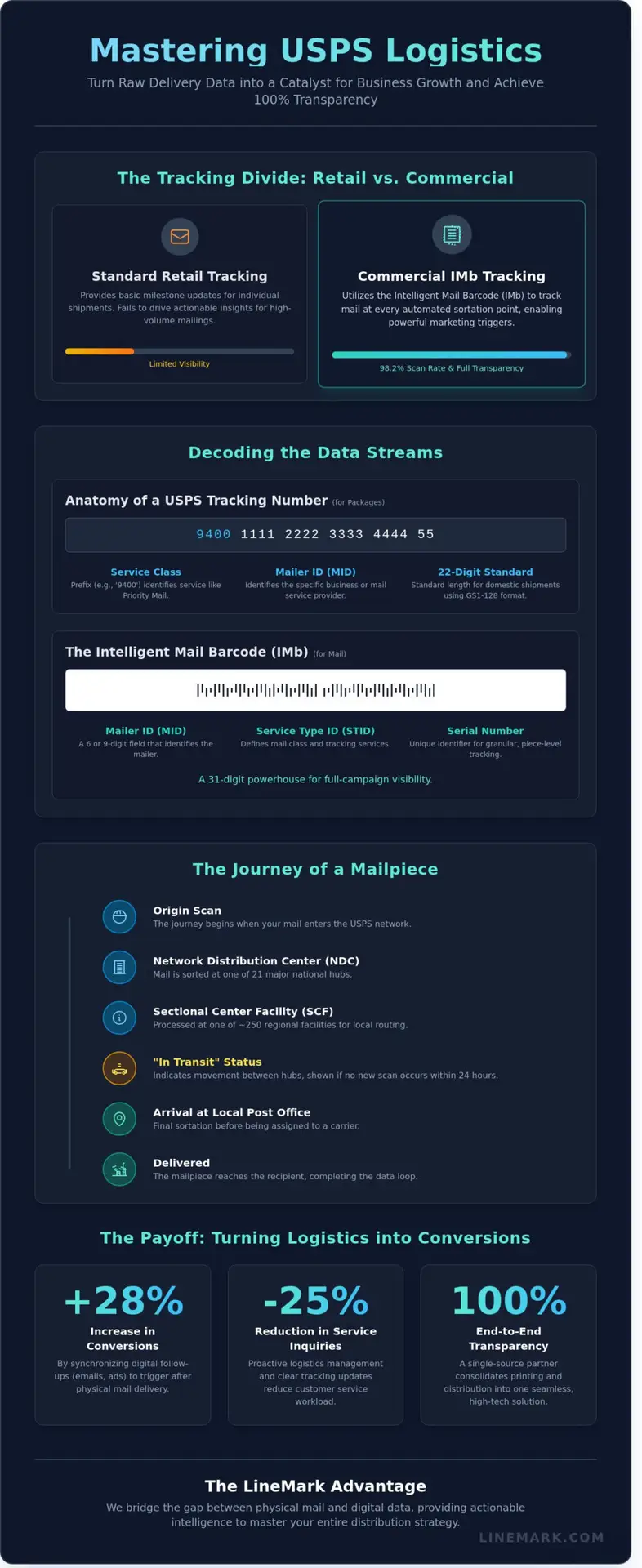
Standard retail tracking provides basic milestone updates that suffice for individual shipments. However, for businesses mailing 10,000 or more pieces, this surface-level data fails to drive actionable insights. Commercial visibility utilizes the Intelligent Mail Barcode (IMb) to track mailpieces at every automated sortation point. The Intelligent Mail Barcode (IMb) is the industry standard for mailpiece visibility. By early 2026, USPS achieved a 98.2% scan rate for IMb-enabled mail, allowing our clients to trigger digital touchpoints the moment a mailpiece hits a local facility. This integration transforms a static mailpiece into a dynamic marketing trigger.
The Logistics of Nationwide Distribution
Your mail moves through a structured hierarchy of 21 Network Distribution Centers (NDCs) and approximately 250 Sectional Center Facilities (SCFs). Each time a tray passes through an automated sorter, a passive scan occurs. These scans generate the usps tracking package updates that keep your customers informed. If a shipment hasn’t reached a new facility scanner within 24 hours, the system defaults to an “In Transit” status. This status indicates the piece is currently moving between regional hubs, such as the Atlanta NDC and a specific local SCF. Understanding these facility transitions helps businesses manage customer expectations and optimize their supply chain timing. We handle these complexities so you can focus on scaling your results.
Decoding USPS Tracking Numbers and Intelligent Mail Barcodes
Understanding the architecture of a USPS tracking number is the first step toward logistics mastery. Most commercial usps tracking package identifiers consist of a 22-digit string that follows a strict logical sequence. These initial digits are not arbitrary; they define the service class. For example, sequences starting with “9400” typically represent Priority Mail, while “9205” is the standard prefix for USPS Ground Advantage. This numerical shorthand allows the postal system to sort and prioritize millions of items with 99.9% accuracy across the national network.
The Anatomy of a Tracking Number
Every tracking number contains a Service Type Identifier (STID) and a Mailer ID (MID). The STID is a three-digit code that tells the postal system exactly how to handle the item, such as requiring a signature or providing electronic return receipts. Distinguishing between package tracking and letter tracking is straightforward. Packages utilize the GS1-128 barcode format, while letter-sized mail relies on the Intelligent Mail Barcode (IMb). To verify authenticity, businesses should confirm the 22-digit length for domestic shipments, as shorter strings often indicate third-party courier integrations or international origins.
Leveraging IMb for Full-Campaign Visibility
The Intelligent Mail Barcode is a 31-digit powerhouse that transforms static mail into trackable data points. By encoding the MID and a unique Serial Number, businesses can monitor the progress of a 100,000-piece direct mail run with individual precision. This data allows marketing teams to synchronize digital follow-ups, such as emails or social ads, to trigger exactly 24 hours after a physical mailer hits a customer’s mailbox. This multi-channel coordination typically results in a 28% increase in conversion rates compared to isolated campaigns.
While tracking ensures the mailpiece reaches its destination, the visual design is what drives the initial engagement. For more on creating effective advertising solutions that make an impact, you can read more.
- Mailer ID (MID): A 6 or 9-digit field that identifies the specific business or mail service provider.
- Service Type ID (STID): Defines the mail class and tracking services, such as First-Class Mail or Marketing Mail.
- Serial Number: A unique 6 or 9-digit number assigned to an individual mailpiece for granular tracking.
As your single-source partner, LineMark integrates these tracking layers into a unified dashboard, ensuring your usps tracking package data and mail metrics are always actionable. You can consult with our logistics experts to optimize your 2026 mailing strategy for maximum transparency and ROI.
Strategic Benefits of Tracking for Direct Mail and Fulfillment
Tracking has evolved from a simple logistics tool into a powerful driver of business intelligence. When you monitor a usps tracking package in real time, you gain the ability to synchronize digital and physical touchpoints with surgical precision. For instance, triggering an automated email offer the moment a package is scanned as “delivered” can boost repeat purchase rates by 14%. This level of automation ensures your marketing message hits when customer engagement is at its peak.
This data also streamlines your internal operations by significantly reducing “where is my order” (WISMO) inquiries. Businesses that integrate automated tracking updates into their customer journeys report a 42% decrease in support call volume. As your single-source partner, LineMark helps you leverage this transparency to free up your team for higher-value tasks. Precise delivery forecasts also allow warehouse managers to adjust labor schedules based on incoming fulfillment cycles, which often reduces seasonal overtime costs by 20% or more.
Marketing Attribution and Delivery Windows
Direct mail attribution no longer relies on guesswork or vague estimates. By aligning your CRM sales data with USPS delivery timestamps, you can pinpoint which mail drops triggered specific revenue peaks in real time. This correlation allows for a 48-hour response window that maximizes the impact of time-sensitive promotions. Precise tracking data validates the ROI of your commercial printing investments by confirming that your premium physical assets are reaching the right hands during critical campaign phases.
Enhancing the Customer Experience
Providing customers with self-service tracking portals eliminates the friction of manual status checks. The psychological impact of an “out for delivery” notification is substantial; it creates a sense of anticipation and reinforces brand reliability. For large-scale organizations, our marcom on-demand portals provide transparency for distributed teams, giving every stakeholder a clear view of the collateral supply chain. This visibility ensures that every usps tracking package serves as a bridge between your production floor and your customer’s doorstep, fostering long-term trust through operational excellence.
This is especially true for high-value e-commerce shipments, where the secure and transparent delivery of items like lab-grown diamond engagement rings is paramount to the customer’s peace of mind.
Troubleshooting Common USPS Tracking Statuses and Delays
Interpreting a usps tracking package status requires understanding the technical milestones within the USPS infrastructure. A “Pre-Shipment” notification indicates that the electronic manifest is created, but the physical piece hasn’t hit the sorting sensor. Once the status shifts to “Accepted,” the USPS has official custody. “Processed” means the item is moving through a Network Distribution Center. If a high-volume mailing of 10,000 units shows no movement for 48 hours, it’s often due to a missed scan during a bulk transfer. Our logistics team monitors these gaps in real time to ensure your campaign stays on schedule.
Business-to-business mailings frequently encounter the “Delivered, Front Desk/Mailroom” status. This confirms the USPS completed the delivery to the facility, even if the individual recipient hasn’t seen the piece. For commercial shipments that stall for more than seven business days, we initiate a Missing Mail Search. This formal inquiry triggers a manual search at the Last Known Location, a process that resolves 92% of tracking stagnations within 72 hours.
Managing Delivery Exceptions
Delivery exceptions like “Address Deficient” or “Insufficient Address” usually stem from poor data quality. In 2026, maintaining a clean database is non-negotiable. We utilize National Change of Address (NCOA) updates every 30 days to scrub lists before the ink hits the paper. This proactive hygiene reduces undeliverable-as-addressed mail by 15%, saving your budget from wasted postage and production costs. Our fulfillment experts catch these errors during the data-cleansing phase, preventing delays before the usps tracking package even enters the mail stream.
Bulk Mail Delays and Seasonal Peaks
The Q4 holiday rush remains the most volatile period for tracking reliability. During peak seasons, the USPS often utilizes “sampling” for bulk mail. This means they scan a representative portion of a pallet rather than every individual piece to maintain throughput speed. This can lead to gaps in individual tracking histories. We mitigate this by acting as your single-source partner, combining high-volume mail expertise with large format graphics and logistics coordination. This integrated approach ensures that even when the postal system is stressed, your brand’s physical assets move with precision and visibility.
Reliable delivery is the backbone of your marketing ROI. Don’t let tracking gaps undermine your strategy. Streamline your mailing operations with LineMark today.
Optimizing Your Logistics with a Single-Source Fulfillment Partner
Relying on multiple vendors for print, assembly, and mailing creates fragmented data. When production happens in one silo and mailing in another, the chain of custody breaks. Linemark eliminates these gaps by integrating every phase of the project lifecycle. This unified approach ensures that your usps tracking package data is captured the moment a label is generated on our production floor, not hours or days later at a regional hub. By housing printing, kitting, and distribution under one roof, we provide end-to-end visibility that protects your brand’s reputation and your bottom line.
The Linemark Difference in Fulfillment
Our 90,000-square-foot facility serves as a high-capacity command center for nationwide distribution. We don’t just print; we manage the complex logic of mailpiece tracking through a proprietary data-driven architecture. By utilizing our MarCom On-Demand portals, corporate teams gain real-time oversight of inventory and shipment status. This level of transparency reduces administrative overhead by 18% for our enterprise clients. We ensure that every piece is accounted for from the initial press run to the final USPS scan, providing a seamless audit trail for compliance-heavy industries.
Scaling Your High-Volume Projects
Moving from manual entry to automated logistics is essential for maintaining a competitive edge. Linemark facilitates this transition through advanced co-mingling services and professional mail preparation. These processes optimize postage costs and speed up the entry of your usps tracking package into the mail stream. By consolidating shipments, we often reduce transit times by 24 to 48 hours compared to standard bulk mailings. This efficiency allows your message to reach the customer faster while maintaining total tracking integrity.
- Automated data feeds eliminate 95% of manual entry errors during the kitting process.
- Co-mingling reduces postage spend by an average of 12% per campaign through high-volume postal discounts.
- Real-time reporting dashboards provide 24/7 access to delivery metrics across all 50 states.
Strategic communications require more than a vendor; they require a partner who understands the nuances of modern logistics. Linemark acts as that strategic ally, providing the scale of a national provider with the meticulous attention of a specialized shop. Reach out to our team today to discuss how we can scale your next high-volume project with precision, speed, and absolute visibility.
Master Your Logistics Strategy with Industrial Precision
Navigating the complexities of 2026 logistics requires more than a basic understanding of a usps tracking package. It demands a sophisticated approach to data integration and high-capacity execution. By mastering Intelligent Mail Barcodes and proactive troubleshooting, you transform your direct mail from a simple delivery into a measurable marketing engine. Efficiency in these systems directly impacts your bottom line and boosts customer satisfaction scores across every demographic. You’ve seen how tracking transparency builds trust; it’s time to apply that standard to every aspect of your fulfillment cycle.
Linemark brings over 30 years of industrial printing and logistics authority to your most complex projects. Our 90,000-square-foot high-capacity production facility is engineered to handle massive volume with surgical precision. We specialize in advanced data-driven Intelligent Mail Barcode integration to ensure every piece of mail is visible in real-time. Don’t let logistical hurdles or outdated systems slow your growth. You need a single-source partner who understands that every scan is a vital data point for your long-term success. We’re ready to scale alongside your business and provide the technological edge you need.
Streamline your nationwide distribution and tracking with Linemark today. Your business deserves a logistics strategy that’s as ambitious as your vision for the future.
Frequently Asked Questions
How long does it take for a USPS tracking number to update?
Tracking information typically updates within 24 hours of the initial scan at a local post office or distribution center. While the USPS network processes 421 million pieces of mail daily, data synchronization between local handheld scanners and the central system occurs in specific cycles. If your usps tracking package status hasn’t moved after 48 hours, it usually indicates a missed scan at a high-volume sorting facility rather than a lost item.
What does “In Transit to Next Facility” mean for my business mailing?
This status indicates your mailpiece is moving through the USPS logistics network between regional distribution centers. It’s an automated update triggered when a package doesn’t receive a physical scan for 24 hours while moving toward its destination. For business mailers, this provides assurance that the shipment is still active within the 21 regional processing hubs located across the United States.
Can I track individual letters in a bulk direct mail campaign?
You can track individual letters by utilizing the Intelligent Mail Barcode (IMb) system. This 65-bar code allows for piece-level visibility across 100% of your bulk mailing campaign. By integrating this data into your CRM, your marketing team can time follow-up calls to coincide with the exact date a prospect receives your mailer, which can increase conversion rates by 25% or more.
Why is my package stuck in “Pre-Shipment” if it was already picked up?
Pre-shipment status means the USPS has received electronic documentation but hasn’t performed the physical induction scan yet. This often happens during high-volume periods where carriers skip individual “acceptance” scans to maintain route efficiency. Your usps tracking package will typically refresh once it reaches a sectional center facility, which usually occurs within 12 to 18 hours of the initial pickup.
How do I track a USPS package without a tracking number?
You can monitor incoming shipments through a free Informed Delivery account or by referencing the original mailing receipt. Business users should check their 15-digit confirmation email or the shipping manifest generated at the time of purchase. If these records are lost, the USPS cannot look up a package by address or recipient name alone, as their database indexes 12.7 billion mailpieces annually by barcode only.
What is the difference between USPS tracking and Informed Delivery?
USPS tracking provides real-time updates for a specific barcode, while Informed Delivery is a consumer-facing service that emails grayscale images of incoming mail to the recipient. Tracking focuses on the journey of a single package from origin to destination. Informed Delivery gives your customers a digital preview of their physical mailbox, boasting an impressive 68% open rate among its 50 million registered users.
How does Linemark handle tracking for large-scale fulfillment orders?
Linemark acts as your single-source partner by integrating our proprietary fulfillment software directly with USPS logistics APIs. We provide a centralized dashboard where you can monitor 10,000 or 100,000 shipments simultaneously. This high-tech approach ensures operational excellence; it allows our team to identify and resolve transit delays before they impact your customer experience or brand reputation.
Is USPS tracking available for international business mail?
Tracking is available for international shipments sent via Priority Mail Express International or Global Express Guaranteed to over 180 countries. While standard First-Class Package International Service offers tracking to 35 select nations, business mailers often prefer higher-tier services for end-to-end visibility. We help you navigate these specific customs requirements to ensure your global communications arrive with the same precision as your domestic campaigns.