

 03/16/2026
  Steve Bearden
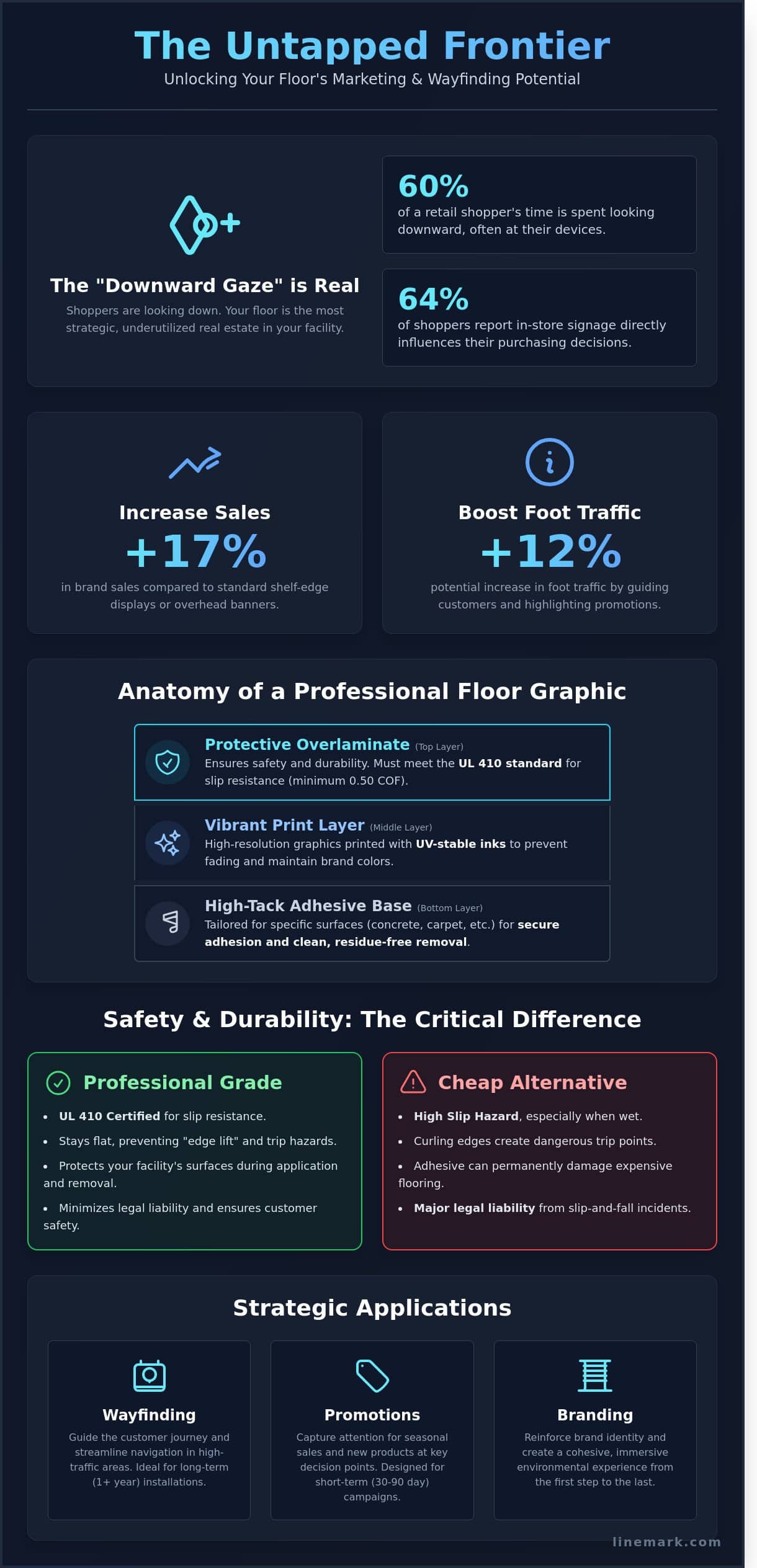
The most valuable real estate in your facility isn’t at eye level; it’s the 10,000 square feet of floor space you’re likely walking over right now. While 64% of shoppers report that in-store signage directly influences their purchasing decisions, the floor remains an underutilized frontier for many national brands. You’ve likely hesitated to deploy floor graphics because the fear of a slip-and-fall lawsuit or permanent adhesive damage outweighs the potential for a 12% boost in foot traffic. It’s a valid concern for any operations manager focused on safety and facility integrity.
We agree that a marketing solution shouldn’t create a maintenance nightmare or a legal liability. As your single-source partner, Linemark understands that scalability requires more than just high-quality printing; it demands a technical strategy for durability and safety compliance. This guide provides the roadmap to transform your surfaces into powerful tools for wayfinding and branding. You’ll learn how to select materials that meet the 0.50 COF safety standard while ensuring a clean removal after a 90-day campaign. We’re covering everything from material science to the logistics of a 500-location rollout to ensure your brand stays looking new from the first step to the last.
Key Takeaways
- Leverage the psychology of the “downward gaze” to transform underutilized floor space into high-impact marketing real estate.
- Navigate the critical safety standards of UL 410 slip resistance to ensure your installations are as secure as they are visually striking.
- Optimize the customer journey by implementing strategic floor graphics that influence the path to purchase and streamline wayfinding in high-traffic environments.
- Protect your facility’s assets with professional installation and removal techniques designed for long-term durability and surface preservation.
- Scale your brand vision across national locations using a single-source partner to guarantee consistency and operational efficiency.
What are Floor Graphics and Why is This Space Often Forgotten?
Floor graphics represent a specialized category of custom-printed adhesive vinyl designed to endure the rigors of heavy foot traffic and industrial cleaning. These tools are far more than decorative elements; they’re a functional subset of Supergraphics that convert dormant floor space into high-impact communication zones. In 2023, eye-tracking studies revealed that retail shoppers spend approximately 60% of their time looking downward, either at their mobile devices or the path directly in front of them. This behavioral shift makes the floor the most strategic piece of real estate in any Maryland retail environment. LineMark approaches these projects as a strategic communications ally, ensuring every installation serves a clear purpose.
Traditional wall signage often fails to break through the digital noise. Research conducted by the Center for Advanced Retail & Technology (CART) indicates that floor graphics can generate a 17% increase in brand sales compared to standard shelf-edge displays or overhead banners. By utilizing this space, you’re maximizing ROI on your existing square footage without adding physical clutter that can impede traffic flow or obscure product visibility. It’s a scalable solution that integrates seamlessly into a broader marketing strategy. Our integrated services help clients move from a business challenge to a concrete, high-tech solution that drives measurable growth. We don’t just print; we provide a customized roadmap for engagement.
The psychology of the “downward gaze” provides a unique opportunity for retailers. While customers are distracted by smartphones, their peripheral vision remains anchored to the ground for navigation. Capturing attention at this level feels less intrusive than eye-level advertisements, leading to higher dwell times and better brand recall. By positioning floor graphics at key decision points, such as the entrance or the start of a specific aisle, you guide the customer journey with precision. This is the LineMark difference: transforming a transactional exchange into a holistic brand experience.
The Anatomy of a High-Performance Floor Decal
A durable floor decal consists of three primary layers. The base vinyl features a high-tack adhesive tailored for specific surfaces like polished concrete or low-pile carpet. We apply the print layer using UV-stable inks for vibrant color. The final component is the overlaminate. This slip-resistant layer must meet a minimum static coefficient of friction of 0.5 to ensure customer safety and long-term durability.
Short-Term Promotions vs. Long-Term Environmental Branding
Choosing materials depends on the campaign lifecycle. A 30-day seasonal sale requires a removable adhesive that leaves zero residue. Conversely, a 1-year wayfinding project demands high-performance cast vinyl capable of resisting edge lift. Environmental variables also dictate choice. In Maryland’s humid summers, moisture-resistant adhesives are essential to prevent bubbling. As your single-source partner, we analyze these technical nuances to provide a solution that aligns with your operational goals.
The Science of Safety: Slip Resistance and Durability Standards
Retail liability in Maryland hinges on the physical condition of the shopping environment. According to the National Floor Safety Institute (NFSI), slip and fall accidents result in over 8 million emergency room visits annually. When you install floor graphics, you aren’t just adding a visual element; you’re altering the walking surface. This change requires a technical understanding of the static coefficient of friction (SCOF). If a graphic is too smooth, it becomes a hazard when wet. If it’s too abrasive, it traps dirt and becomes an eyesore. Professional installations prioritize the UL 410 standard, which ensures the material maintains a minimum SCOF of 0.5. This numerical benchmark is the dividing line between a safe walkway and a legal liability.
Cheap, monomeric vinyl stickers often sold by online discount printers represent a massive risk for high-traffic retail spaces. These materials lack the structural integrity to withstand the lateral forces of foot traffic and heavy shopping carts. Over time, the edges of inferior stickers begin to curl, a phenomenon known as edge lift. This creates a catch point for shoes, which can lead to trips. By choosing a single-source partner who understands these mechanical stresses, retailers can ensure their branding stays flat and secure. You can explore the technical nuances of floor graphics certifications to see how specific ratings protect your business from avoidable accidents.
Slip Resistance Certifications Every Manager Should Know
Managers must distinguish between “dry” and “wet” slip resistance ratings. A material that performs well in a dry hallway might become a skating rink near a grocery produce section or a rainy storefront entrance. Look for the ANSI A137.1/A326.3 dynamic coefficient of friction (DCOF) test results on spec sheets. While UL 410 focuses on static friction, these modern standards provide a more accurate picture of how a surface behaves under a moving foot. Professional-grade materials utilize specialized textured overlaminates. These clear layers are engineered with microscopic peaks and valleys that provide grip even when moisture is present. Relying on certified materials ensures your store remains compliant with local safety codes and insurance requirements.
Durability Factors in High-Traffic Zones
Durability in a retail setting is measured by more than just time; it’s measured by cycles of friction. High-traffic zones experience thousands of footfalls and hundreds of cart passes daily. To maintain visual clarity, floor graphics must possess high scuff resistance. This is achieved through cross-linked polymer coatings that resist the abrasive action of rubber soles. Without this protection, the printed image will blur within 30 days of installation. Consider these critical durability factors:
- Adhesive Shear Strength: High-tack adhesives prevent the graphic from shifting under the weight of 150-pound point loads from heavy carts.
- Chemical Resistance: Graphics must survive daily exposure to industrial floor scrubbers and pH-neutral cleaning agents without fading or peeling.
- Dimensional Stability: Premium cast vinyls resist shrinking, which prevents the “sticky ring” of adhesive that typically attracts black soot around the edges of cheaper decals.
The LineMark approach focuses on matching the specific material chemistry to your store’s flooring type, whether it’s polished concrete or luxury vinyl tile. If you’re ready to upgrade your space, our team can help you develop an integrated floor branding strategy that balances aesthetic impact with uncompromising safety standards.
Strategic Applications: Wayfinding, Retail, and Corporate Branding
Floor graphics serve as silent navigators that direct the flow of commerce and human movement with industrial precision. At LineMark, we act as a single-source partner to transform underutilized floor space into high-impact communication zones. These assets don’t just sit on the ground; they actively influence the path to purchase and streamline complex logistics in high-traffic environments. Our approach combines technical printing expertise with a deep understanding of spatial psychology to ensure every decal achieves its intended business objective.
Crowds create significant visual noise at eye level, which often renders traditional signage less effective. Research from a 2018 retail design study indicates that humans process floor-based cues faster than overhead signs in high-density areas. This speed is critical in environments like Baltimore-Washington International (BWI) or sprawling medical campuses where every second of confusion leads to congestion. Safety remains our priority. Every installation must adhere to ADA floor surface requirements to ensure slip resistance and stability for all visitors, regardless of their mobility needs. We prioritize these specifications to protect both the user and the facility owner.
The Psychology of Floor Wayfinding
Efficient navigation reduces visitor friction and builds trust in a facility’s operational excellence. A 2018 retail pilot program demonstrated that using directional arrows on the floor increased foot traffic to secondary departments by 20%. This isn’t a coincidence; it’s a calculated response to how people naturally scan their environment while walking. By implementing color-coded paths, hospitals and airports guide travelers intuitively through complex corridors. We use high-durability materials that withstand heavy foot traffic while maintaining color vibrance, ensuring the navigation system remains clear for the long term.
Point-of-Purchase (POP) Floor Graphics
Point-of-purchase floor graphics drive immediate ROI by capturing attention at the exact moment of a buying decision. Placing a 24-inch circular graphic directly in front of a promotional endcap triggers impulse buying behavior effectively. For regional retail chains, LineMark manages high-volume seasonal rollouts that we can deploy across 50+ locations in a single weekend. This scalability allows marketing teams to synchronize their physical and digital campaigns without delay.
Modern floor designs often feature scannable QR codes to bridge the gap between the physical aisle and digital loyalty platforms. It’s a seamless transition that captures valuable customer data while the shopper is still in the store. This integration reflects our commitment to being a tech-forward partner that understands the nuances of modern marketing logistics. Whether it’s a short-term promotion or a permanent fixture, we provide the durability and precision required for high-stakes retail environments.
Beyond loyalty platforms, this digital bridge can also unlock unique brand assets like exclusive digital art or collectibles. For an example of how premium digital art is curated and presented online, you can visit LightBender NFT.
Corporate offices and trade shows also benefit from this strategic application. Large-scale logos in lobbies or mission statements in hallways turn a standard workspace into a powerful brand experience. At trade shows, temporary decals define a brand’s footprint without the need for expensive structural builds. They provide a high-capacity solution for short-term visibility, allowing exhibitors to maximize their presence on the convention floor while maintaining a professional, polished image.
Professional Installation and Removal: Protecting Your Surfaces
Precision installation begins long before the adhesive touches the substrate. For Maryland retailers, the longevity of floor graphics depends on a rigorous 3-step preparation protocol. Our teams start by scrubbing the target area with a pH-neutral cleaner to remove surface grease and contaminants. This is followed by a 99% isopropyl alcohol wipe to ensure no chemical film remains. We perform a moisture test on concrete floors; levels must remain below 4% to prevent the adhesive from failing prematurely. This technical attention to detail ensures the bond is secure from day one.
Large-format murals and complex wayfinding systems require advanced application techniques. Installers utilize a center-out squeegee method to eliminate air pockets that could lead to punctures. We also prioritize outgassing periods for specific materials. If you’ve recently sealed your floors, we mandate a 21-day curing window before application. Applying vinyl too early traps vapors, leading to unsightly bubbling and potential damage to the floor’s finish. It’s a strategic delay that protects your long-term capital investment.
Safe removal is the final stage of the lifecycle. We use industrial heat guns calibrated to 120 degrees Fahrenheit to soften the bond. By pulling the vinyl at a consistent 90-degree angle, we prevent the adhesive from delaminating and leaving a sticky residue. This professional approach eliminates “ghosting,” which is a common issue where the floor’s original luster is unevenly preserved, leaving a permanent shadow of the old graphic behind.
Surface Compatibility: From Polished Concrete to Carpet
Matching the adhesive to the substrate is a core part of the LineMark experience. Low-pile commercial carpets require a high-tack, fabric-reinforced backing to prevent shifting under foot traffic. Conversely, polished concrete needs a removable acrylic adhesive that won’t bite too deeply into the sealer. For outdoor asphalt or rough sidewalks, we utilize conformable aluminum-based substrates. These materials are designed to melt into the texture of the stone, providing a slip-resistant surface that survives heavy Maryland winters and salt treatments.
The Maintenance Lifecycle
Integration with your janitorial routine is essential for maximizing the value of your environmental graphics. We provide a specific checklist for your cleaning crews. They should avoid high-speed buffers and aggressive chemical strippers on the graphic edges. If an edge lifts by more than 0.25 inches, it’s no longer just an aesthetic issue; it’s a safety hazard. We recommend a monthly inspection to identify minor wear. Repairing a small lift with a seam sealer takes five minutes, whereas replacing a damaged floor graphics installation requires a full production cycle.
Ready to transform your retail environment with precision-engineered visuals? Partner with LineMark for a seamless installation experience that prioritizes the integrity of your facility.
Scaling Your Vision: The Linemark Advantage for National Signage
Managing a retail footprint across 50 or 100 locations requires more than a local print shop; it demands a single-source partner capable of maintaining brand integrity across every zip code. Linemark provides this stability through our 90,000-square-foot production facility in Upper Marlboro. We’ve optimized this space to handle high-volume output without sacrificing the precision required for complex retail environments. This massive footprint allows us to scale production rapidly, turning around national campaigns in a fraction of the time smaller shops require.
Centralizing your marketing assets is the only way to ensure 100% brand compliance. Our MarCom On-Demand platform allows regional managers or franchise owners to order pre-approved floor graphics and signage directly through a secure portal. This system eliminates the 25% waste often seen in decentralized ordering by controlling versioning and inventory in real-time. It’s a strategic solution that empowers local teams while giving corporate marketing total oversight of the brand’s visual identity.
Logistics shouldn’t be an afterthought in a national rollout. Our fulfillment center specializes in complex kitting, where we gather diverse signage elements into a single, organized package for each specific store layout. Whether you’re shipping to 12 locations in Maryland or 500 across the United States, our distribution network ensures every kit arrives on schedule. We track every shipment to provide peace of mind, acting as a catalyst for your growth by removing the burden of manual distribution and inventory management.
Customization at Scale
We utilize variable data printing to localize every square foot of your campaign. A store in Baltimore might require different promotional messaging or language options than a location in Bethesda, and we handle these data-driven shifts seamlessly. Our high-resolution large format capabilities extend beyond the floor. We often integrate floor graphics with wall murals, window displays, and custom vinyl wall decals to create a 360-degree brand experience. This holistic approach ensures your environmental graphics work in harmony to transform any retail space into a compelling brand story.
The Linemark Experience: From Design to Distribution
The Linemark difference is built on a 30-year legacy of technical excellence and collaborative partnership. Our team doesn’t just print; we consult on material selection and slip-resistance specifications to meet rigorous safety codes. We’ve spent three decades refining a process that moves from initial design to final fulfillment with surgical precision. This seasoned expertise ensures your project is in capable hands, regardless of its complexity or scale. We operate as a strategic communications ally, ensuring your vision is executed flawlessly across every location.
Master Your Environment with Precision Signage
Transforming your physical space requires more than just a creative eye; it demands a rigorous commitment to safety standards and technical precision. High-impact floor graphics bridge the gap between aesthetic appeal and functional utility, ensuring your brand message remains slip-resistant and durable under heavy foot traffic. Success in large-format signage depends on choosing a partner who manages every detail from initial concept to final removal. Your surfaces are valuable assets that deserve professional protection and strategic engagement.
LineMark provides this stability through our 90,000 sq. ft. high-tech production facility. We’ve spent 30+ years refining our industrial printing processes to become your reliable single-source partner for print, mail, and signage. We don’t just print your designs; we scale your vision across national footprints with operational excellence. Our team handles the complexities of logistics and fulfillment so you can focus on high-level strategy.
Partner with Linemark for Your Next Large-Format Project and see how our integrated solutions turn every square foot into a meaningful communication opportunity. Let’s start building your brand’s next big move today.
Frequently Asked Questions
How long do custom floor graphics typically last?
Custom floor graphics typically last between 6 and 12 months in high-traffic retail environments. LineMark utilizes UL 410 certified laminates to ensure durability against 1,200 daily footfalls. For short-term seasonal promotions, we provide 30-day removable options that leave zero adhesive residue. This performance ensures your brand remains vibrant throughout the entire campaign cycle.
Are floor graphics safe to use on hardwood or laminate flooring?
Yes, floor graphics are safe for finished hardwood and laminate when paired with specific low-tack adhesives. Our technical team selects vinyl with a 3-mil thickness that shields the floor from physical scuffs. We suggest testing a small section if the wood finish is older than 5 years. This precision prevents any lifting of the original sealant during removal.
Can floor graphics be used outdoors on sidewalks or parking lots?
Specialized outdoor materials are engineered for asphalt and concrete surfaces with a functional lifespan of 90 to 180 days. These products feature a conformable aluminum base that molds to textured ground. LineMark’s outdoor solutions meet ASTM D-2047 standards, maintaining traction even when surface moisture increases. This durability makes them ideal for high-visibility sidewalk messaging.
What is the best way to clean floors that have graphics installed?
You should clean your graphics using a damp mop and a neutral pH cleaner to preserve the laminate’s integrity. Avoid using industrial power washers or scrubbers with abrasive bristles. It’s vital to wait 24 hours after the initial installation before applying any moisture. This delay allows the adhesive to reach its full 100% bonding strength.
Do I need a professional to install my floor decals?
Professional installation is recommended for any graphic exceeding 5 square feet to guarantee a seamless, bubble-free application. While small 10-inch decals are simple for staff to apply, larger scale branding requires expert alignment. As your single-source partner, we coordinate nationwide installation teams to ensure your 50 or 500 locations look identical.
Are floor graphics slip-resistant when they get wet?
Our graphics feature a grit-textured laminate that carries a slip-resistance rating of R10 or higher. This keeps your floors safe in entryways where moisture levels are elevated during 85% of storm events. Every material we print meets OSHA safety standards. This focus on technical precision protects your customers and minimizes your facility’s liability.
Can I use floor graphics on commercial-grade carpet?
You can apply specialized high-tack films to low-pile commercial carpets that have a pile height under 0.25 inches. These materials use a unique adhesive that grips fibers without leaving a sticky residue behind. We’ve successfully deployed these solutions in 150+ corporate environments. They provide a high-impact branding tool for spaces where traditional signage isn’t feasible.
How much do custom floor graphics cost for a national rollout?
Unit costs for a national rollout generally range from $18 to $55 depending on the square footage and material specifications. Volume pricing becomes highly effective for orders over 250 units, offering the scalability your marketing team requires. The LineMark difference includes integrated fulfillment and logistics, ensuring your 50-state distribution arrives on time and within 3% of the projected budget.