

 02/28/2026
  Steve Bearden
You’ve poured your expertise and passion into every word of your manuscript. Now, the path from a digital file to a finished book can feel lined with unfamiliar terms and complex choices, from selecting the right paper weight to understanding how to prepare your files for a professional printer. This is where the process of custom book printing transforms from a source of anxiety into an opportunity for impact. This guide is engineered to demystify that journey, providing the clarity you need to navigate every critical decision with confidence.
We will explore the nuances of paper stocks, binding types, and finishing options, translating technical requirements into actionable insights. Our goal is to equip you with a clear roadmap to transform your manuscript into a high-quality, professional book that aligns perfectly with your vision and budget. By the end, you will understand how to collaborate effectively with a printing partner to create a tangible product that not only looks impressive but also delivers your message with the excellence it deserves.
Key Takeaways
- Master the foundational decisions-binding, cover style, and printing method-to strategically control your project’s budget, quality, and long-term durability.
- Discover how interior paper choices enhance readability while specialized cover finishes transform your book into a powerful marketing asset.
- The success of your custom book printing project depends on choosing the right partner; understand the key differences between POD and commercial printers to align with your goals.
- Gain a clear understanding of the production timeline, from file submission to final delivery, to confidently manage your project and ensure professional results.
The Core Decisions: Printing Method, Cover Style, and Binding
Embarking on a custom book printing project begins with three foundational decisions that dictate the final product’s quality, cost, and durability. Your choice of printing method, cover style, and binding type forms the strategic framework for your book. Making the right decision from the outset ensures a seamless production process and a final product that meets your exact specifications and connects with your audience.
Printing Method: Digital vs. Offset
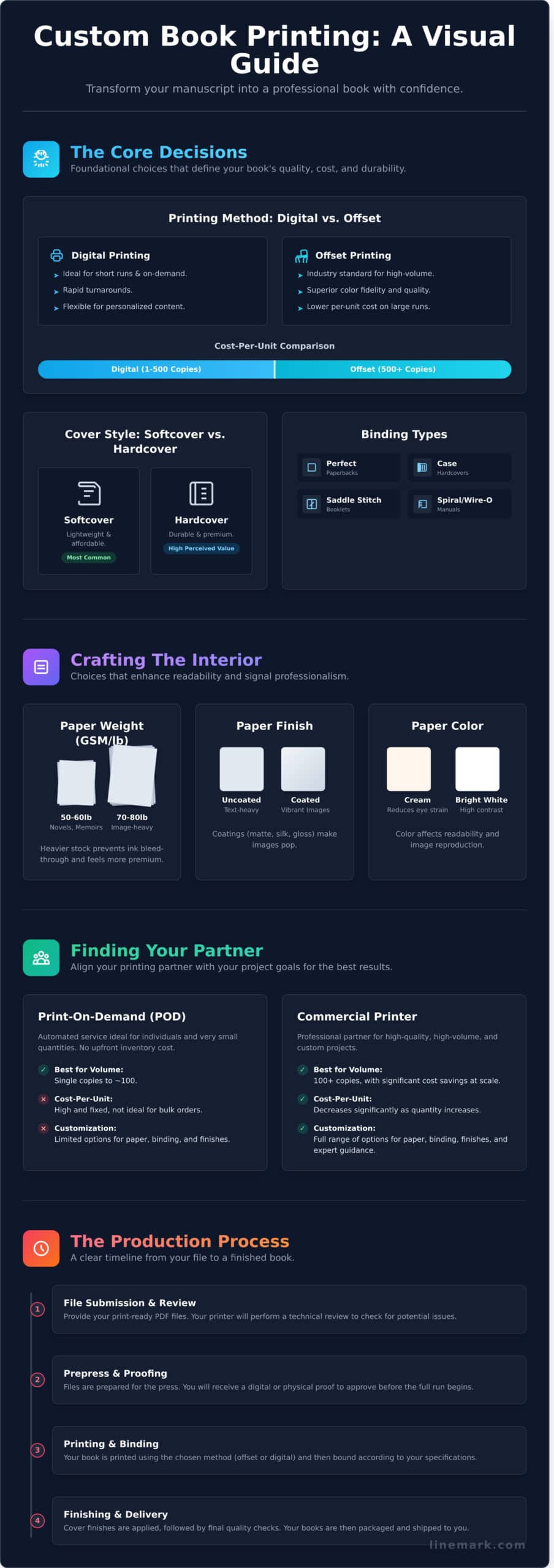
The two dominant printing methods in modern commercial production are digital and offset, each engineered for different project scales and goals. Digital printing is ideal for short runs (typically under 500 copies), offering rapid turnarounds and the flexibility for on-demand printing. Offset printing is the industry standard for high-volume projects, where its superior color fidelity and lower per-unit cost provide significant advantages.
Cost-Per-Unit Comparison: Digital vs. Offset
- 1-500 Copies: Digital printing is more cost-effective.
- 500+ Copies: Offset printing becomes the more economical solution, with costs decreasing as volume increases.
Cover Style: Hardcover vs. Softcover (Paperback)
The cover is your book’s first impression. Softcover (or paperback) is the most common and affordable choice, offering a lightweight and versatile format suitable for fiction, memoirs, and trade publications. Hardcover (or casebound) books provide superior durability and a premium feel, commanding a higher price point and perceived value. This makes them an excellent choice for special editions, textbooks, and art books. For functional documents like workbooks or manuals, spiral-bound covers allow the pages to lie completely flat.
Choosing the Right Binding Type
Binding is the structural backbone of your book, directly impacting its longevity and user experience. Each style serves a distinct purpose, and aligning your choice with your book’s function is critical for a professional result. Understanding the full spectrum of book binding options — from durability considerations to shipping cost implications — is essential for making a strategic production decision.
- Perfect Binding: The standard for most paperbacks. Pages are glued together at the spine with a strong adhesive, creating a clean, flat edge.
- Case Binding: The method used for hardcover books. Pages are sewn together in signatures and then attached to a rigid cover, offering maximum durability.
- Saddle Stitching: Ideal for shorter publications like booklets or magazines. Pages are nested and stapled through the centerfold.
- Spiral & Wire-O Binding: Best for manuals, notebooks, and cookbooks that must lay flat for easy use.
Crafting the Interior: Paper, Ink, and Layout
Beyond the cover, the interior of your book is where the reader’s journey truly begins. The tactile feel of the paper and the clarity of the text are not minor details; they are foundational elements that signal professionalism and enhance readability. The interior decisions you make are central to a successful custom book printing project, transforming your manuscript into an immersive, high-quality experience.
Selecting the Perfect Paper Stock
The paper you choose directly influences the reader’s perception of quality. Key factors include:
- Paper Weight (GSM/lb): This determines the page’s thickness and opacity. A heavier stock (e.g., 70-80lb / 105-120 GSM) prevents ink from showing through, which is ideal for image-heavy books. A lighter stock (50-60lb / 75-90 GSM) is the cost-effective standard for novels and memoirs.
- Paper Finish: Uncoated paper offers a classic, non-reflective surface perfect for text-heavy work. Matte, silk, or gloss coatings provide a smooth, premium base that makes images and graphics appear more vibrant.
- Paper Color: Cream-colored paper reduces eye strain, making it an excellent choice for long-form reading. Bright white paper, in contrast, provides high contrast for crisp text and vivid color reproduction in art books or manuals.
For authors focused on sustainability, we also offer a range of recycled and FSC-certified paper stocks.
The Nuances of Ink and Color
Your choice between black and white or full-color printing is driven by both your content and budget. While black and white is the efficient standard for most text-based works, full-color printing is essential for cookbooks, children’s books, or photography collections. Full-color utilizes the CMYK process-a method where Cyan, Magenta, Yellow, and Key (black) ink are combined to create a vast spectrum of hues. For projects requiring perfect brand color replication, Spot Colors (like Pantone) offer unparalleled precision. Ensuring color consistency from your screen to the printed page requires professional file preparation and calibration, a core part of our quality assurance process.
Interior Layout and Formatting
A flawless reading experience depends on meticulous technical preparation. Professional typesetting establishes consistent typography, margins, and gutters (the space inside the spine) to ensure no text is lost in the binding. All images must be submitted at a high resolution-the industry standard is 300 DPI (Dots Per Inch)-to guarantee crisp, clear reproduction. Mastering these technical specifications is a critical part of the production process of self-publishing, ensuring your digital file translates perfectly to a physical book. Elements like page numbering and headers provide the final polish, guiding your reader seamlessly through your work.
Designing a Standout Cover: Finishes and Special Effects
In a crowded marketplace, your book cover is your most critical marketing tool. It’s the first interaction a potential reader has with your work, and its perceived quality directly influences their purchasing decision. While a great design is foundational, advanced finishing options elevate a cover from simply functional to truly premium. These tangible details not only create a memorable reader experience but also justify a higher price point, communicating value before the first page is even turned. This level of detail is a key differentiator when you engage a commercial partner for your custom book printing project.
Investing in professional finishes transforms your book into a durable, high-impact product that commands attention on any shelf.
Protective Coatings and Laminations
Lamination is a thin, transparent plastic film applied to your cover, providing robust protection against moisture, scuffs, and general wear. Beyond durability, it significantly enhances the visual and tactile appeal of your book. We offer several core options to match your project’s aesthetic goals:
- Gloss Lamination: Delivers a high-shine, reflective finish that makes colors appear deeper and more vibrant. It’s an excellent choice for dynamic, eye-catching covers that need to pop.
- Matte Lamination: Provides a sophisticated, non-reflective finish that diffuses light. This elegant option offers a smooth, professional feel ideal for literary works and academic texts.
- Soft-Touch Lamination: Offers a unique sensory experience with a velvety, rose-petal texture. This luxurious finish invites touch and immediately signals a high-quality product.
Special Finishes that Add Value
To create a book that stands out, consider incorporating special effects that add texture and visual contrast. These techniques are precision-applied to specific design elements, guiding the reader’s eye and creating a powerful tactile impression. The Linemark difference is our ability to integrate these complex processes seamlessly into your custom book printing workflow.
- Foil Stamping: The process of applying metallic or pigmented foil to the cover using heat and pressure. It creates a brilliant, luxurious effect perfect for titles and key design accents.
- Embossing & Debossing: Embossing creates a raised, three-dimensional impression on the paper, while debossing creates a recessed one. Both add physical depth and a sophisticated, classic feel.
- Spot UV: A high-gloss ultraviolet coating applied to specific areas of the cover. When used over a matte lamination, it creates a striking contrast in texture and sheen, highlighting logos, titles, or images.
The Production Process: From Your File to a Finished Book
Once your design is finalized, the journey from digital file to physical book begins. This production phase is where precision and technology converge to bring your vision to life. As your strategic partner, we manage every step to ensure a seamless, predictable experience, transforming your manuscript into a professionally finished product. Understanding this process empowers you to collaborate effectively and ensures your custom book printing project meets every expectation.
Preparing Your Files for a Commercial Printer
A successful print run starts with a technically sound file. The universal standard for submission is a high-resolution, print-ready PDF. This format locks in all your design elements, from fonts to images, preventing unexpected shifts during production. Key preparations include setting a “bleed”-extending your artwork beyond the trim line-to ensure a flawless edge-to-edge look. Before submitting, conduct a final review.
- Resolution Check: Are all images at least 300 DPI for crisp, clear results?
- Color Mode: Is the file set to CMYK, the standard for professional printing?
- Fonts and Images: Are all fonts outlined or embedded, and are all images linked correctly?
- Bleed and Margins: Is a .125″ bleed included, and is critical text within the safe margins?
The Critical Role of Proofing
Proofing is the most critical checkpoint in the custom book printing process. It is your final opportunity to approve every detail before the full production run begins. We provide two types of proofs: a digital (or soft) proof to review layout and text for errors, and a physical (or hard) proof to verify color accuracy and the feel of your chosen paper stock. Meticulously check for typos, pagination, and color fidelity. Our experts guide you through the proofing process to ensure your complete confidence. Learn more about our commitment to quality assurance.
Understanding Timelines and Turnaround
Setting realistic expectations for your project timeline is essential. Production speed is influenced by several factors, including order quantity, the complexity of binding, and any special finishing like foil stamping or embossing. Generally, digital printing offers a faster turnaround suitable for shorter runs, while offset printing is more efficient for large quantities but requires a longer setup time. Remember to factor in shipping and fulfillment, which add to the overall schedule. Planning ahead is the key to meeting your deadlines without compromising quality. At LineMark, we provide clear timelines from the start, ensuring your project stays on track.
Finding Your Partner: POD Services vs. a Commercial Printer
The final, critical decision in your publishing journey is selecting a printing partner. This choice between a Print-on-Demand (POD) service and a dedicated commercial printer is not merely about cost; it is a strategic decision that will define the quality, scalability, and ultimate success of your book.
When to Use Print-on-Demand (POD)
POD services offer a low-risk entry point, ideal for authors testing a concept or needing single copies for personal use. They eliminate upfront inventory costs, which is their primary appeal. However, this convenience comes with significant trade-offs: standardized options, a higher cost per book, and a hands-off process with no direct quality oversight. For projects where control and premium quality are secondary to accessibility, POD can be a practical starting point.
The ‘LineMark Difference’: Advantages of a Commercial Partner
When your book is a representation of your brand or a serious commercial endeavor, partnering with a commercial printer like LineMark unlocks a superior level of execution. The LineMark difference is built on a foundation of control, quality, and strategic guidance.
- Unmatched Quality Control: Your project is overseen by a dedicated team of experts who ensure color consistency, precise registration, and flawless binding from the first copy to the last.
- Greater Customization: Gain access to a vast portfolio of premium paper stocks, sophisticated binding types, and specialty finishes like foil stamping or embossing that make your book truly unique.
- Scalability and Cost-Effectiveness: As your order volume increases, your per-unit cost significantly decreases-a crucial advantage for authors planning for commercial distribution and sales.
- Expert Guidance: Our team acts as your strategic ally, advising on the most effective materials and methods to achieve your vision within your budget.
What to Look for in a Printing Partner
Selecting the right partner for your custom book printing project is critical. Look for a provider who demonstrates a commitment to your success through:
- A consultative, collaborative approach focused on understanding your specific project goals.
- Advanced digital and offset technology with a wide range of in-house capabilities.
- A proven track record with high-quality publications and satisfied authors.
- Comprehensive, integrated services that can extend from printing to fulfillment and distribution.
Your book deserves more than a transactional service; it requires a strategic partnership. A true single-source partner doesn’t just print pages-they help bring your vision to life with precision and scale. When you’re ready to produce a book that reflects your commitment to excellence, explore the possibilities at linemark.com.
Your Partner in Professional Book Production
The journey from a digital file to a tangible, professionally bound book is a sequence of critical decisions. As we’ve explored, the selection of binding, paper stock, and cover finishes directly impacts the reader’s experience, while the strategic choice between a POD service and a dedicated commercial printer defines the scale, quality, and potential of your project. These elements are the foundation of successful custom book printing.
Navigating these complexities requires a partner with proven expertise and industrial-scale capability. For over 30 years, LineMark has delivered printing excellence. From our advanced 90,000-square-foot production facility, we operate as your dedicated single-source partner, managing every technical detail from initial file review to final fulfillment and distribution. We transform your vision into a tangible asset with precision and reliability.
Your project deserves a partner committed to quality at every stage. Start your custom book project with a LineMark expert today. Let’s build something exceptional together.
Frequently Asked Questions About Custom Book Printing
What is the minimum number of books I can order?
Our advanced digital printing technology allows for ultimate flexibility, with order minimums as low as a single book. This is ideal for proof copies or small, targeted distributions. For larger runs where cost-per-unit is a key factor, we utilize offset printing, which is most efficient for quantities of 500 or more. We partner with you to determine the most scalable and cost-effective solution for your project, ensuring precision at any volume.
How much does it cost to print a custom book?
The cost of custom book printing is determined by several key specifications: order quantity, page count, paper stock, binding style (e.g., hardcover, paperback), and color requirements. Each project is unique, which is why we provide a detailed, transparent quote tailored to your exact needs. Our team will guide you through these options to align the final product with your budget and vision, ensuring a high-value investment for your work.
How do I get an ISBN for my book, and do I need one?
An ISBN (International Standard Book Number) is essential if you plan to sell your book through retailers like bookstores or Amazon. Authors are required to purchase their own ISBNs directly from Bowker, the official U.S. agency. While we do not provide the number itself, our pre-press team will expertly guide you on its proper placement and generate the corresponding barcode for your back cover, ensuring your book meets all industry standards for distribution.
Can you help with the design and layout of my book?
Yes, we operate as a single-source partner for authors. Beyond printing, LineMark offers comprehensive design and layout services to bring your manuscript to life. Our experienced design team can manage everything from compelling cover creation to professional interior typesetting, whether you’re publishing a novel or creating training materials for a specialized field like the Auto Finance Course. We ensure your book is not only beautifully designed but also technically optimized for a flawless print run, reflecting the quality of your writing from cover to cover.
What’s the difference between CMYK and RGB color modes?
RGB (Red, Green, Blue) is an additive color model used for digital displays like computer monitors and screens. In contrast, CMYK (Cyan, Magenta, Yellow, Key/Black) is a subtractive color model required for physical printing. For accurate and vibrant color reproduction in your book, all design files must be converted to the CMYK color space. Our pre-press experts manage this conversion meticulously to guarantee that the printed colors match your creative intent.
How long does the entire custom book printing process take?
The complete timeline typically ranges from 4 to 6 weeks, depending on project complexity and book binding style. This process includes initial consultation and quoting, file preparation and proofing, the physical printing and binding phase, and final delivery. We provide a detailed production schedule at the outset to ensure full transparency and keep your project on track from start to finish, delivering a professional product efficiently and reliably.