

 03/19/2026
  Steve Bearden
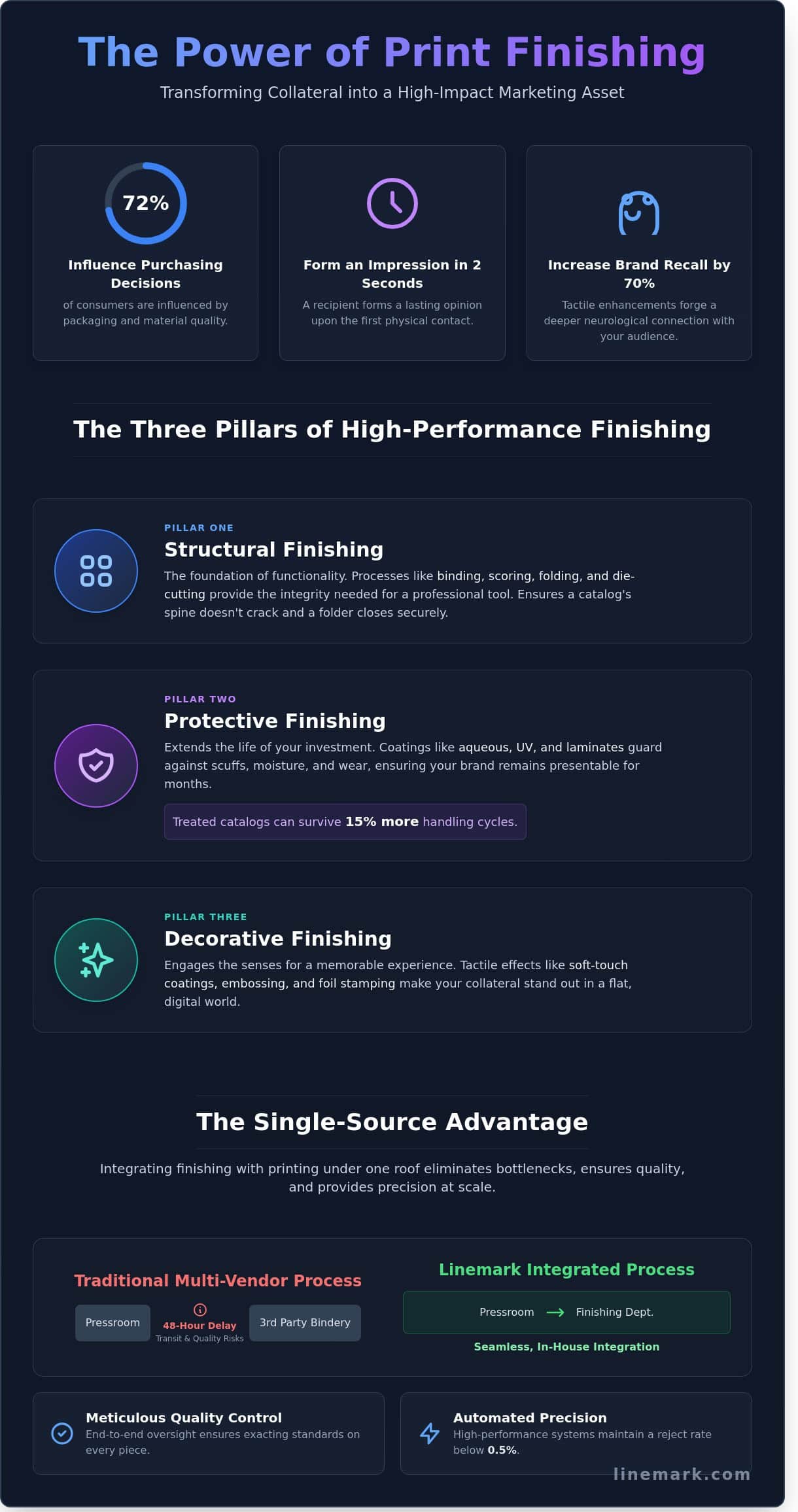
A 2024 study by the Paper and Packaging Board revealed that 72% of consumers let packaging and material quality influence their final purchasing decisions. In a marketplace where physical touchpoints are increasingly rare, a flimsy brochure or a generic mailer doesn’t just fail to impress; it actively erodes your brand equity. You likely recognize that your marketing collateral should feel as premium as the services you provide, which is why strategic print finishing is no longer an afterthought. It’s a critical component of a high-performance communication strategy that demands precision and industrial authority.
As your single-source partner, Linemark is here to ensure your vision translates into a tangible, high-impact reality. This guide provides a clear roadmap to the coatings, bindings, and tactile effects that will define custom printing in 2026. You’ll learn how to select finishes that maximize durability for mailed pieces and identify which specific enhancements offer the highest return on investment. We’ll break down the technical innovations that eliminate production delays; ensuring your brand maintains its competitive edge through precise, scalable execution that transforms standard collateral into a powerful marketing asset.
Key Takeaways
- Learn how to transform standard collateral into premium brand experiences by leveraging high-impact tactile and visual enhancements.
- Master the three pillars of print finishing-structural, protective, and decorative-to drive higher engagement and ROI for your marketing assets.
- Identify the strategic criteria for matching specific finishes to your project’s environment, ensuring every embellishment serves a measurable purpose.
- Discover why integrating technical finishing requirements into the initial design phase is essential for avoiding common production pitfalls and costly errors.
- Understand the advantage of working with a single-source partner to scale your projects from boutique runs to million-piece distributions with precision.
Understanding Print Finishing: More Than Just the Final Step
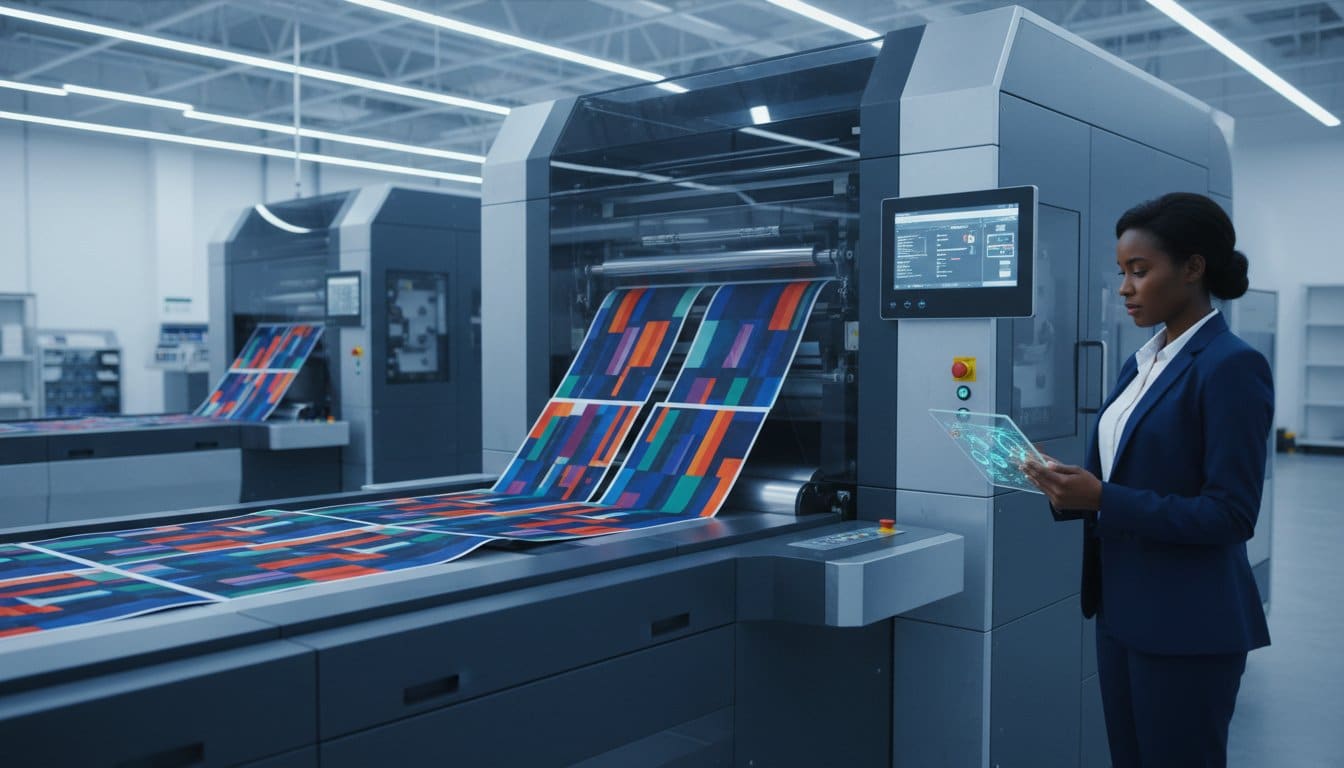
Print finishing encompasses every industrial process performed on your materials once they leave the press. It’s the transition from a flat, ink-covered sheet to a tangible product your audience can hold, open, and use. While many view it as a concluding step, it’s the phase where your brand’s physical identity takes shape. Understanding how these techniques integrate with broader printing processes ensures your project achieves both its aesthetic and functional goals. At our Upper Marlboro facility, we treat finishing as an engineering discipline rather than an afterthought.
Print finishing is the essential final stage that converts raw sheets into functional marketing assets.
To better understand how these techniques add value to your project, watch this helpful video:
Why Finishing Dictates Your Project’s Success
First impressions are physical. Research from the Eagleman Laboratory for Perception and Action shows that a recipient forms a lasting opinion of a brand within the first 2 seconds of physical contact. If a brochure feels flimsy or a catalog’s spine cracks upon opening, the perceived value of your message drops instantly. Finishing provides the structural integrity needed to withstand the rigors of the mail stream and repeated use.
Functional excellence is non-negotiable for high-end collateral. We utilize automated scoring and folding to ensure paper fibers don’t break, preserving the integrity of high-GSM stocks. Whether it’s ensuring a perfect-bound book lays flat or a complex die-cut folder closes securely, the precision of the bindery determines if a project is a professional tool or a logistical failure. High-performance equipment in our facility allows us to maintain these standards across runs of 50,000 units or more.
The ROI of Premium Finishes in 2026
Sensory marketing, or haptics, is a powerful driver of consumer behavior as we look toward 2026. A 2024 industry benchmark report indicates that tactile enhancements, such as soft-touch coatings or embossed textures, can increase brand recall by up to 70% compared to standard visual-only materials. These finishes don’t just look better; they forge a deeper neurological connection with your target audience. By engaging multiple senses, your marketing collateral stands out in an increasingly digital and flat landscape.
Protecting your investment is another critical component of the print finishing ROI. Coatings like aqueous or UV treatments extend the life of high-use materials such as catalogs and reference manuals. A catalog treated with high-scuff matte laminate can survive 15% more handling cycles than an untreated counterpart. This durability reduces replacement costs and ensures your brand remains presentable for months. Precision finishing also minimizes waste. Our automated systems ensure that high-volume runs maintain a reject rate below 0.5%, saving you money on materials and postage.
The LineMark difference is rooted in our role as a single-source partner. We’ve integrated our finishing department directly with our pressroom to eliminate the production bottlenecks that plague traditional shops. By keeping every stage of the process under one roof in Upper Marlboro, we remove the 48-hour transit delays and quality risks associated with third-party bindery services. This holistic approach allows us to maintain meticulous attention to detail while scaling to meet the most demanding deadlines. You receive a streamlined experience that transforms commodity print into a premium, high-impact asset.
Essential Print Finishing Techniques: From Binding to Embellishments
Effective print finishing transforms a standard press sheet into a high-performance marketing asset. We categorize these processes into three distinct pillars: structural, protective, and decorative. This framework ensures every project meets both functional requirements and aesthetic goals. Recent data from the 2023 State of the Industry report indicates that 62% of high-growth print providers are investing heavily in digital finishing technologies. This shift allows brands to achieve premium looks without the $300 to $500 setup costs associated with traditional metal dies. Understanding the nuances of post-press finishing is critical for maintaining brand integrity across diverse media.
The evolution of digital technology has bridged the gap between short-run flexibility and high-end quality. While offset print finishing often relies on mechanical speed for large volumes, digital finishing utilizes laser cutting and inkjet-applied textures to offer customization at scale. This agility means a local business can order 100 high-end invitations with the same level of detail as a national 50,000-piece direct mail campaign. Choosing a single-source partner to manage these complex workflows is the only way to guarantee consistency from the first sheet to the last.
Structural Finishing: Binding and Folding
Choosing the right binding depends on page count and intended shelf life. Saddle stitching works best for booklets up to 64 pages; it’s cost-effective and fast. For thicker catalogs or premium annual reports exceeding 0.125 inches in spine width, perfect binding provides a professional, flat-back appearance. When durability is the priority for 200-page training manuals, spiral or Wire-O binding allows the document to lay completely flat. Specialty folds like 8-panel gatefolds or accordion folds turn a static piece into an interactive experience, increasing recipient engagement time by an average of 12 seconds per piece.
Protective Finishing: Coatings and Laminates
Protective layers ensure your message survives the rigors of the USPS or high-traffic environments. Aqueous coating is a water-based solution that dries instantly, making it a standard choice for high-speed offset runs. UV coating offers a higher gloss level and superior scratch resistance for high-impact covers. For luxury brands, soft-touch lamination creates a velvet-like texture that appeals to the sense of touch. If your materials are destined for national shipping, anti-scuff laminates prevent the unsightly marking that often occurs during transit, preserving the LineMark experience for every end-user.
Decorative Embellishments: Adding the ‘Wow’ Factor
Embellishments provide the tactile interest that distinguishes premium collateral from standard mail. Digital die-cutting now enables complex, custom shapes without the lead times of physical tooling. Foil stamping and embossing add physical depth and light-catching properties to stationery and packaging. Tactile Spot UV utilizes variable data technology to apply 3D textures to specific design elements. This means a single print run can feature 500 unique pieces, each with different raised patterns, driving a 20% higher response rate than flat alternatives. These details signal quality and authority before a single word is read.
Managing these complex workflows requires a single-source partner capable of integrating offset and digital production. Offset runs typically utilize inline finishing for speed, while digital runs benefit from near-line precision that handles variable data. This integration eliminates the risk of color shifts or alignment errors that occur when moving jobs between multiple vendors. We maintain this control under one roof to ensure every specification is met with industrial precision and collaborative insight.
Strategic Selection: Matching Finishes to Your Project Goals
High-volume production success requires more than aesthetic flair. It demands a purpose-driven strategy where every coating or fold serves a specific business objective. You shouldn’t apply a high-gloss UV coating simply because the press allows it. If your piece is intended for a bright, fluorescent-lit retail environment, that gloss might create a 40% glare increase, making the text unreadable. LineMark acts as your single-source partner to navigate these technical nuances. We analyze the “Triangle of Production,” balancing speed, quality, and budget to ensure your 10,000-unit run remains cost-effective without sacrificing tactile impact. For a deeper dive into these technical choices, The Print University’s Guide to Finishing offers a detailed look at how specific techniques affect the final product’s durability.
Environmental analysis is the next step in this strategic selection. A piece that sits on a shelf for three years requires different scuff-resistant laminates than a brochure handed out at a 3-day conference. If your project will be exposed to high humidity or frequent handling, a synthetic paper or a heavy-duty polyester lamination is necessary to prevent edge curling. We’ve seen projects where selecting a 1.5 mil lamination instead of a standard aqueous coating extended the life of a training manual by 200%. This level of foresight prevents the need for costly reprints and maintains your brand’s professional image long after the initial distribution.
Finishing for Direct Mail and Marketing
Direct mail ROI depends on your ability to bypass the “trash can filter.” Textured finishes or soft-touch laminations can increase recipient engagement by 35% compared to standard bond paper. However, these choices must align with USPS regulations. Heavy coatings can sometimes interfere with high-speed optical character readers, leading to delivery delays or surcharges. We specialize in creating “lumpy mail” using dimensional coatings that trigger curiosity while staying within the 0.25-inch thickness limit for standard letters.
Working with experienced direct mail fulfillment companies ensures your print finishing choices don’t inadvertently spike your postage costs. A simple change from a 10pt to a 12pt stock with heavy aqueous coating can push a mailer into a higher weight tier. In a 50,000-piece campaign, a weight increase of just 0.1 ounces can result in thousands of dollars in additional postage. We calculate these variables during the design phase to protect your budget while maximizing the physical impact of your mailer.
Finishing for Custom Book Manufacturing
The physical structure of a book dictates its perceived market value. A case-bound book suggests a premium price point and a 50-year shelf life, while a softcover with a matte aqueous coating is better suited for high-turnover educational manuals. Adding French flaps to a softcover can increase its structural integrity by 15% and provide additional real estate for author bios. Dust jackets offer a canvas for spot gloss and foil stamping, which a 2022 consumer survey showed can boost “giftability” perceptions by 28%.
You can explore our specific binding options in our guide on custom book printing to see which print finishing method fits your genre’s standards. Choosing the right binding isn’t just about looks; it’s about the “lay-flat” capability required for cookbooks or the ruggedness needed for field guides used in outdoor environments. Our use of PUR (Polyurethane Reactive) adhesive for softcover projects offers 40% more page-pull strength than traditional EVA glue, ensuring books survive heavy use without losing pages.
Design for Finishing: Technical Requirements and Common Pitfalls
Successful print finishing isn’t an afterthought; it’s a structural requirement that begins during the initial design phase. When a project moves from the screen to the bindery, the physical properties of paper and ink take over. If these variables aren’t accounted for in your Adobe InDesign or Illustrator files, the final product risks failure regardless of the print quality. A 32-page booklet printed on 80lb gloss text, for instance, will experience “the creep,” where the inner pages extend up to 0.125 inches further than the outer wrap. Without progressive margin adjustments, your page numbers or side-bar graphics will be sliced off during the final three-knife trim.
Paper selection also dictates how your finishes interact with the surface. Porosity is a primary concern for coatings. A 10pt uncoated cover stock can absorb up to 25% more UV coating than a silk-coated alternative, which often results in a mottled, uneven finish rather than a crisp, high-gloss shine. You’ve got to match the chemistry of your coatings to the absorption rate of your substrate to achieve the desired visual impact. LineMark’s production team often sees projects where a high-build spot UV is requested on a highly fibrous paper, which leads to the coating sinking into the sheet rather than sitting on top as a tactile element.
- Bleed Requirements: Standard 0.125-inch bleeds are sufficient for basic cuts, but complex die-cuts often require 0.25-inch bleeds to account for mechanical tolerances.
- Ink Coverage: Heavy ink density at the fold line increases the risk of cracking and set-off, especially on matte stocks.
- Safety Zones: Keep critical text at least 0.1875 inches away from any fold or trim line to maintain visual balance.
Avoiding the ‘Spine Crack’ and Other Structural Failures
Structural integrity depends on how you treat the paper’s fibers. For any cover stock exceeding 100lb, scoring is a mandatory step before folding. This process creates a controlled indentation that allows the fibers to bend without snapping. Digital prints present a unique challenge because toner contains fuser oils that can repel standard adhesives. To combat this, you must use digital-friendly thermal laminates that utilize aggressive bonding agents to prevent peeling at the edges. Grain direction is the most overlooked factor in clean, professional folding.
File Setup for Advanced Embellishments
Precision in your digital files is the only way to ensure precision on the press. When setting up spot UV or foil stamps, you must create a dedicated layer using a 100% K vector mask set to “Overprint.” This tells the finishing equipment exactly where to drop the embellishment. For mechanical binding like wire-o or spiral, designers need to leave a 0.5-inch safety margin on the binding edge to accommodate the punch holes. We’ve found that creating a physical mockup, or a “dummy,” reduces production errors by 18% on multi-stage projects involving nested folds or integrated mailers. It’s the most reliable way to verify that your panels fold in the correct sequence and that the grain direction supports the final shape.
The Linemark Advantage: Integrating Finishing with Fulfillment
Linemark operates within a 90,000-square-foot facility in Upper Marlboro designed for maximum throughput. This massive footprint isn’t just about storage; it’s about a continuous, logical flow from the initial press run to the final print finishing stage. We’ve eliminated the logistical gaps that typically plague large-scale projects. By housing every stage of production under one roof, we move your collateral from the binder to the mail stream without the assets ever leaving our secure environment. This closed-loop system removes the risks of transit damage and data breaches that occur when moving jobs between separate vendors.
Scalability is a core component of our operational philosophy. We don’t distinguish between a boutique run of 500 custom-die-cut invitations and a 1.2 million-piece national direct mail drop. Every project receives the same level of industrial precision. Our facility handles high-volume output while maintaining the tactile quality expected of a high-end shop. We’ve invested in advanced technology that allows for variable data finishing, meaning we can personalize physical touchpoints based on your specific marketing data. Whether it’s unique barcodes or personalized messaging on a complex fold, our machines adapt in real-time to your data sets.
Choosing a single-source partner is the only reliable way to ensure brand consistency across diverse collateral. When the same team oversees the ink application, the coating, and the final fold, the visual integrity remains intact. We ensure that the color profile on a heavy-weight pocket folder matches the lightweight inserts exactly. This level of integration is impossible to achieve when fragmented across multiple suppliers. We act as a strategic communications ally, protecting your brand’s visual identity through every mechanical process.
Streamlining the Supply Chain
Shipping costs between a printer and a separate finisher can inflate project budgets by 12% to 15%. We eliminate these “middleman” expenses entirely. Our integrated inventory management system allows for on-demand finishing and kitting. We store your base materials in our climate-controlled warehouse and finish them only when an order is triggered. This automated workflow integration has historically reduced lead times by 72 hours or more. It’s a leaner, faster way to manage your physical assets without sacrificing quality or oversight.
From Finishing to National Distribution
Our finishing team works in lockstep with our fulfillment experts to prepare complex kits for nationwide rollout. We don’t just complete a print finishing task; we prepare that asset for its final destination. This might involve kitting several finished pieces into a custom-branded box for a 50-state product launch. This seamless transition is what we call the LineMark Experience. It’s the reassurance that your project is handled by professionals who understand both the art of the finish and the science of the delivery.
We provide the industrial authority needed to handle your most complex, high-volume requirements. Our team manages the friction of logistics so you can focus on your broader marketing strategy. We’ve built our reputation on being a reliable, tech-savvy partner for businesses that demand excellence at scale. Partner with Linemark for your next high-impact print project and experience the difference that true integration makes.
Transform Your Vision Into a Tangible Competitive Edge
Success in 2026 requires more than just ink on paper. It demands a strategic approach where technical design requirements and high-end embellishments work in perfect harmony. By prioritizing print finishing early in your creative process, you eliminate common production pitfalls and ensure your brand stands out in a crowded physical landscape. High-impact results come from precise execution, not luck. It’s about making a lasting impression that drives measurable engagement.
LineMark acts as your single-source partner, bridging the gap between complex design and flawless delivery. We’ve spent 30 years refining our industrial expertise to help brands scale their messaging with confidence. Our 90,000-square-foot high-capacity production facility is equipped to handle everything from intricate binding to global fulfillment under one roof. You won’t have to manage multiple vendors or worry about logistics gaps. We’ve built our reputation on being the agile problem-solvers who get the job done right the first time.
Ready to see the LineMark difference in action? Request a custom quote for your next print finishing project today. Let’s build something remarkable together.
Frequently Asked Questions
What is the difference between aqueous and UV coating?
Aqueous coating is a water-based finish applied during the printing process to provide a fast-drying, smudge-resistant surface. It’s the standard for 90% of commercial brochures because it protects against fingerprints. UV coating uses ultraviolet light to cure a thicker liquid layer instantly. This creates a high-gloss sheen that’s 20% more durable than aqueous; it’s ideal for high-traffic items like business cards or book covers.
When should I choose perfect binding over saddle stitching?
Perfect binding is the superior choice for documents with a spine thickness of 0.125 inches or more, typically exceeding 60 pages. It uses a strong thermal adhesive to create a flat, professional spine similar to a paperback book. Saddle stitching uses wire staples along the fold and is most cost-effective for booklets between 8 and 64 pages. This method allows the document to lay flatter, which is essential for 11-inch by 17-inch spreads.
How does print finishing affect my direct mail postage costs?
Your choice of print finishing directly impacts postage costs by altering the weight and thickness of the mail piece. Adding a heavy laminate can push a postcard over the 3.5-ounce limit for standard letter rates, leading to a 40% increase in per-piece costs. We recommend aqueous coatings for high-volume mailings because they provide protection without adding the bulk that triggers USPS non-machinable surcharges for pieces exceeding 0.25 inches in thickness.
Can I use spot UV on a digital print run?
You can absolutely apply spot UV to digital print runs using our specialized MGI Jetvarnish 3D technology. Unlike traditional offset methods that require expensive plates, this digital process applies the coating directly from a file. This allows for variable data finishing on runs as small as 50 units. It’s a high-impact solution that provides a 3D tactile feel, elevating your brand’s physical presence without the 48-hour setup time of traditional methods.
What is soft-touch lamination and why is it popular for 2026?
Soft-touch lamination is a premium film that creates a velvety, matte texture that’s resistant to fingerprints and glare. It’s projected to dominate 2026 marketing trends as brands focus on sensory experiences to combat digital fatigue. Studies show that tactile finishes increase consumer engagement by 15% compared to standard gloss. This finish provides a sophisticated, non-reflective surface that makes colors appear deeper and more saturated on high-end packaging.
How do I prepare my design files for die-cutting?
Prepare your die-cutting files by creating a separate layer in your vector software labeled “Die Line” using a distinct spot color. Ensure your design includes a 0.125-inch bleed beyond the cut line to prevent white edges during the finishing process. We require a 1-point stroke weight for all paths to ensure the steel rule die aligns perfectly with your artwork. This precision prevents production delays and ensures a clean edge on complex 3D shapes.
Does Linemark handle large-format finishing for banners and signage?
Linemark manages comprehensive large-format finishing for banners and signage using our 126-inch wide-format equipment. We provide specialized services like heat welding for reinforced hems, grommet installation every 24 inches, and UV-resistant laminations that extend outdoor life to 5 years. Our facility handles rigid substrates up to 2 inches thick. This allows us to be your single-source partner for both small-scale collateral and massive stadium graphics.
Why is scoring necessary for heavy paper stocks?
Scoring is vital for any paper stock exceeding 100lb cover or 10pt thickness to prevent the paper fibers from cracking when folded. This mechanical process creates a precise indentation that guides the fold, maintaining the integrity of your print finishing and ink coverage. Without a proper score, heavy toner or ink will flake off at the fold line. This ruins the professional appearance of 4-color marketing materials and high-end invitations.