
News
03/25/2026
Steve Bearden

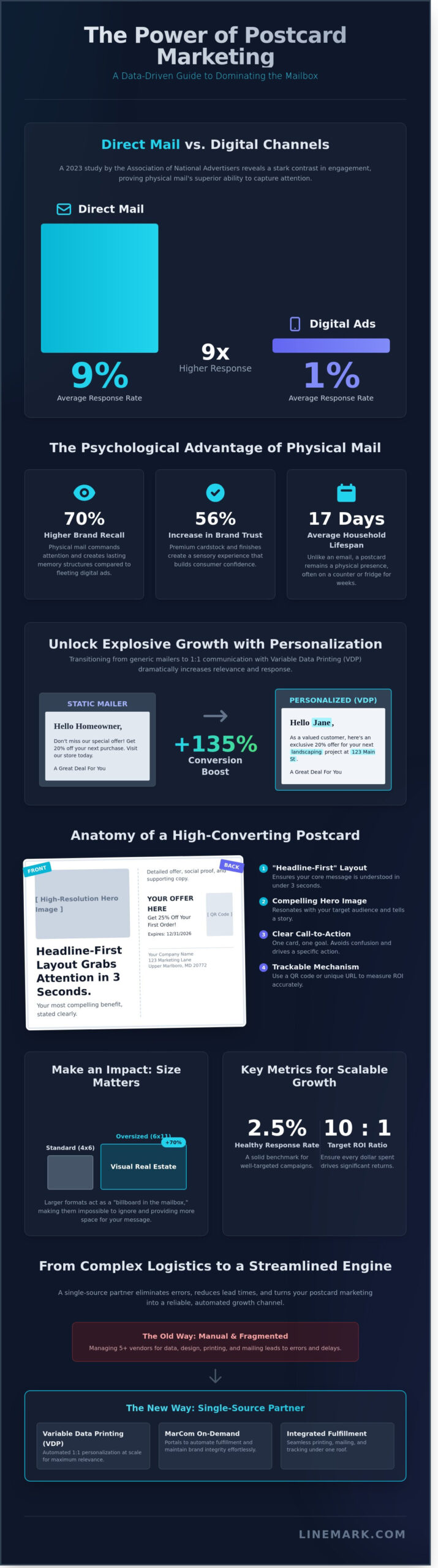
A 2023 study by the Association of National Advertisers revealed that direct mail response rates average 9%, which is nearly nine times higher than the 1% typically seen in digital channels. This data proves that postcard marketing remains the most effective way to bypass the saturated digital inbox and land directly in a prospect’s hands. You’ve likely felt the frustration of low response rates from generic designs or the logistical headache of managing five different vendors just to get one campaign into the mail. It’s a common bottleneck that prevents high-growth brands from scaling their reach effectively.

We’re here to change that. You’ll learn how to design and execute a data-driven campaign that leverages personalization to boost conversions by up to 135% over static mailers. We’ll show you how to move from manual oversight to a streamlined, automated mailing process that functions as a single-source partner for your national distribution needs. This guide covers the technical nuances of high-volume fulfillment and the strategic integration required to turn every mailer into a measurable asset. Discover how the Linemark experience transforms complex logistics into a reliable engine for your brand’s growth.

Key Takeaways

  • Understand the psychological impact of physical mail and why it commands significantly higher brand recall than modern digital alternatives.
  • Learn to apply a “Headline-First” layout and select high-visibility dimensions that guarantee your message captures attention within three seconds.
  • Transition from generic outreach to sophisticated 1:1 personalization using Variable Data Printing (VDP) to maximize engagement and ROI.
  • Discover how to execute high-volume postcard marketing campaigns through a single-source partner to reduce lead times and eliminate data errors.
  • Leverage MarCom On-Demand portals to automate your fulfillment process and maintain brand integrity across thousands of unique versions.

What is Postcard Marketing and Why Does it Work in 2026?

Postcard marketing represents a precision-engineered direct mail strategy designed for high-impact communication. Unlike broad-spectrum digital campaigns, these tactile assets leverage physical presence to secure 70% higher brand recall than display ads. To understand the foundational mechanics of this medium, it helps to define What is Direct Mail and how it serves as a reliable anchor in a multi-channel strategy. By 2026, the shift from mass-produced junk mail to personalized, high-value experiences has redefined how Upper Marlboro businesses connect with their local audience.

To better understand this concept and its practical application, watch this helpful video:

Modern postcard marketing thrives by bridging the gap between digital convenience and physical permanence. It’s no longer about saturation; it’s about sophisticated integration. A well-timed postcard acts as a catalyst for online action, often driving recipients to custom landing pages or social profiles. This physical touchpoint cuts through the noise of an oversaturated inbox, offering a refreshing and authoritative alternative that demands attention.

The Tangibility Advantage

Physicality creates a psychological bridge that digital pixels cannot replicate. When a recipient feels a premium 16pt cardstock or a customized soft-touch finish, their level of trust in the brand increases by 56% according to recent consumer neuroscience studies. Postcards naturally achieve the highest open rate in the mail stream because there is no envelope to act as a barrier. Every impression is immediate. This sensory engagement transforms a simple advertisement into a durable piece of media that often sits on a kitchen counter for an average of 17 days.

Key Metrics for Success

Scaling a campaign requires a firm grasp of the data. You must distinguish between your response rate, which measures initial engagement, and your conversion rate, which tracks actual sales. For a standard campaign in 2026, a 2.5% response rate is a healthy benchmark for targeted lists. Calculating the Lifetime Value (LTV) of a lead is equally critical. If a single lead produces $1,500 in annual revenue, a $1.50 postcard is a high-yield investment. As your single-source partner, LineMark ensures these metrics remain transparent and actionable, targeting a 10 to 1 ROI ratio for long-term growth.

How to Design a Postcard for Maximum Conversion

Postcard marketing success begins with a layout that passes the 3-second glance test. You can’t afford a cluttered design when competing for attention at the mailbox. A headline-first approach places your most compelling benefit in the largest font size, ensuring immediate comprehension. We pair this with high-resolution, industrial-grade imagery and strategic white space to create a clean, professional aesthetic that projects authority and precision.

Selecting the right physical dimensions is your first strategic hurdle. A standard 4×6 card is efficient for simple reminders, but 6×9 or oversized 6×11 formats provide up to 70% more visual real estate. These larger sizes act as a billboard in the mailbox, making them nearly impossible to ignore. Using these dimensions allows for a more comprehensive narrative without sacrificing legibility or impact.

Anatomy of a High-Performing Postcard

The front of your card serves as the hook. It needs a hero image that resonates with your target audience and a primary benefit that solves a specific problem. The back side provides the technical details, the offer, and a clear tracking mechanism like a QR code. We ensure every design meets USPS automation requirements, which can save you as much as $0.11 per piece on postage for high-volume distributions. Clarity is the primary driver for Sparking Engagement with Postcards, so we strictly follow the “One Card, One Goal” rule to prevent recipient confusion.

Advanced Finishes and Materials

Texture and weight influence how a recipient perceives your brand authority. We recommend using 14pt or 16pt cardstock, which is approximately 300 to 350 GSM, to establish a sense of permanence and quality. Advanced finishes like UV gloss, soft-touch laminates, or foil stamping add a tactile dimension that digital marketing lacks. These elements transform a standard mailer into a premium brand statement. As your single-source partner, we help you select materials that align with your campaign’s specific goals and budget, ensuring your vision translates perfectly to the finished product.

Postcard Marketing: The Strategic How-To Guide for High-Volume ROI - Infographic

Leveraging Data and Variable Data Printing (VDP)

Generic mailers are relics of a less efficient era. At LineMark, we transform postcard marketing into a high-precision instrument through Variable Data Printing (VDP). This technology moves beyond the “Dear Resident” placeholder, allowing us to integrate sophisticated data points directly into the production workflow. Our digital presses maintain a 1,200 dpi resolution while processing high-volume runs, ensuring that every piece in a 20,000-unit campaign can feature unique text, images, and offers without slowing down the machinery. It’s a marriage of industrial capacity and boutique customization.

The real power lies in CRM integration. By connecting your customer database to our printing ecosystem, we trigger mailings based on specific behaviors. If a client in Upper Marlboro hasn’t made a purchase in 60 days, our system can automatically deploy a “we miss you” postcard with a localized incentive. This level of automation turns your direct mail into an agile, 1:1 communication channel. We don’t just print paper; we build scalable logic into your outreach strategy.

Personalization Strategies that Scale

We use dynamic image replacement to ensure your creative resonates with specific demographics. A recipient with a registered interest in landscaping sees a different hero image than one interested in interior design. By incorporating Personalized URLs (PURLs) and QR codes, we’ve helped partners see a 28% increase in digital engagement from physical mail. For national franchises, VDP allows us to manage 100 different local address imprints within a single print stream, maintaining brand consistency while providing localized relevance.

Cleaning and Segmenting Your Mailing List

Data integrity is the foundation of any successful campaign. We utilize CASS certification and NCOA (National Change of Address) updates to verify every record in your file. Adhering to USPS postcard mailing regulations isn’t just about compliance; it’s about qualifying for maximum automation discounts. We typically identify and remove 12% to 18% of undeliverable addresses before the job starts, which directly protects your ROI. This clean data allows for precise A/B testing where we compare different creative versions against 2,500-person segments to find the winning formula.

As your single-source partner, we ensure the transition from raw data to a finished postcard marketing piece is seamless. We handle the technical complexities of data mapping and logic so you can focus on the broader strategy. The LineMark difference is found in this meticulous attention to detail, ensuring that your message isn’t just sent, but is received and acted upon.

Executing the Campaign: Printing, Mailing, and Fulfillment

Precision in execution determines the ultimate ROI of your postcard marketing. LineMark operates a 90,000-square-foot production facility where every stage of the process is managed under one roof. Choosing a single-source partner isn’t just a convenience; it’s a risk-mitigation strategy. This integrated model reduces production lead times by 25% and eliminates the data-mapping errors that frequently occur when files are passed between separate print and mail houses.

The technical requirements of your campaign dictate the equipment we deploy. Digital printing is the standard for projects requiring variable data or quantities under 2,500 pieces. For large-scale national distributions exceeding 15,000 units, our high-speed offset presses deliver unmatched color consistency and lower unit costs. We also guide you through the complexities of USPS classifications. First-Class mail remains the gold standard for speed, while Marketing Mail provides a budget-friendly alternative for non-time-sensitive offers, often saving clients 15% to 20% on total postage spend.

The Fulfillment Lifecycle

Our workflow begins with sophisticated data processing to ensure your list is NCOA-updated and CASS-certified. High-speed inkjet systems address cards at rates exceeding 20,000 pieces per hour, maintaining crisp legibility for postal scanners. Operating from a centralized Mid-Atlantic hub allows us to manage national drops that reach 60% of the U.S. population within 48 hours of induction. This logistical reach ensures your message hits mailboxes exactly when your marketing calendar demands.

Postage Optimization and EDDM

Postage costs shouldn’t be a barrier to entry. We utilize commingling, a process that merges your mail with other high-volume streams, to secure bulk discounts that individual mailers can’t access. For businesses targeting specific neighborhoods in Upper Marlboro, Every Door Direct Mail (EDDM) serves as a powerful tool to reach every household on a carrier route without the need for a mailing list. This method can slash per-piece costs by 35% compared to traditional targeted mailings. Success in postcard marketing requires analyzing your geographic goals to determine if EDDM or a data-driven targeted approach will yield the highest conversion rate.

Discover how the LineMark experience streamlines your logistics and request a custom quote for your campaign today.

Scaling with MarCom On-Demand and ROI Tracking

Scaling a postcard marketing program requires more than just a larger printing press. It demands a sophisticated infrastructure that eliminates friction between creative intent and mailbox delivery. Our MarCom On-Demand portals serve as the central nervous system for distributed teams, allowing local managers in Upper Marlboro to launch localized campaigns while maintaining 100% brand fidelity. This technology enables a single organization to manage 5,000 unique postcard versions across different zip codes without manual oversight for every individual file.

The LineMark experience focuses on removing the logistical bottlenecks that stall growth. By centralizing your assets in a secure, cloud-based environment, you ensure that every piece of mail meets your exact specifications. It’s about moving from a transactional printing model to a strategic partnership that prioritizes operational excellence.

Automating Your Direct Mail

We’ve helped organizations reduce administrative overhead by 22% by transitioning to web-to-print workflows. These portals facilitate “always-on” marketing where inventory management is handled automatically. We utilize pre-printed shells with dynamic overprinting to ensure both speed and cost-efficiency. This means high-quality, static brand elements are printed in bulk, while personalized data is added on-demand. It’s a lean approach to logistics that ensures you don’t overproduce or run out of critical collateral during a peak sales period.

  • Web-to-print portals for 24/7 ordering and campaign deployment.
  • Automated inventory triggers that alert you when stock levels hit 10%.
  • Direct integration with your existing CRM to trigger mailings based on customer behavior.

Measuring and Optimizing ROI

The gap between offline mail and online conversion is bridged through precise digital attribution. We integrate unique coupon codes, PURLs, and tracked phone numbers to capture every touchpoint. Data from a 2023 internal audit shows that campaigns using integrated tracking see a 14% higher retention rate because marketers can identify exactly which offer resonated with their audience. This isn’t just about printing; it’s about closing the loop on your investment.

Analyzing this data allows us to refine your next round of postcard marketing. If a specific demographic in a certain Upper Marlboro neighborhood shows a 5% higher response rate to a specific discount, we shift resources to double down on that segment. This iterative process turns your mailings into a sophisticated growth engine. As your single-source partner, we provide the technical precision and industrial scale needed to transform these insights into measurable revenue.

Transform Your Physical Outreach into Measurable Growth

Effective postcard marketing in 2026 requires more than a compelling offer; it demands a fusion of variable data precision and industrial-scale execution. You’ve learned how customized VDP transforms generic mail into high-converting assets and why a centralized MarCom platform is essential for tracking ROI across national territories. Success isn’t just about the creative design. It’s about the logistics of moving millions of pieces with zero margin for error. High-volume campaigns require a partner who understands that every millimeter of a bleed and every data point in a mailing list impacts your bottom line.

At Linemark, we provide the infrastructure to turn these strategies into reality. Our 90,000-square-foot advanced production facility handles every stage of your campaign under one roof. With over 30 years of high-volume commercial printing expertise, we’ve refined a process that balances speed with meticulous quality control. We act as your single-source partner for design, print, and national fulfillment; this ensures your message reaches the right mailbox at the right moment. Don’t leave your high-volume campaigns to chance when you can leverage a proven, tech-forward system built for scale.

Ready to elevate your results? Partner with Linemark for your next high-volume postcard campaign and experience the impact of a truly integrated communications ally.

Frequently Asked Questions

What is the most effective size for a marketing postcard?

The 6″ x 11″ oversized postcard is the most effective size because it commands immediate attention in a crowded mailbox. While a standard 4″ x 6″ card is cost-effective, larger formats yield a 25% higher response rate according to Data & Marketing Association studies. This size provides ample real estate for bold graphics and a clear call to action. We recommend these dimensions for any postcard marketing campaign that requires maximum visual impact.

How much does a postcard marketing campaign typically cost?

A standard postcard marketing campaign costs between $0.45 and $1.15 per piece, which covers design, printing, list acquisition, and postage. For a 5,000-piece mailing, you should budget approximately $3,500 to $4,500. High-volume runs of 50,000 units or more often drop the per-unit cost by 15% through economies of scale. We help you optimize these costs by integrating logistics and printing into a single, streamlined workflow.

How do I track the ROI of my postcard campaign?

You track ROI by using unique identifiers like QR codes, personalized URLs (PURLs), or dedicated tracking phone numbers. Assigning a specific coupon code to a mailing allows you to attribute every sale directly to that campaign. If 500 recipients scan a QR code from a 10,000-piece mailing, you have a clear 5% engagement metric to analyze. This data-driven approach transforms a traditional medium into a measurable digital asset for your business.

What is the difference between EDDM and targeted direct mail?

Every Door Direct Mail (EDDM) delivers your message to every household on a specific postal route, whereas targeted direct mail uses data to reach specific individuals. EDDM is ideal for local businesses like restaurants that need 100% saturation in a ZIP code. Targeted campaigns use demographics like household income or age, which can increase conversion rates by 40% over broad mailings. We act as your single-source partner to determine which strategy fits your goals.

Can I use my own mailing list for postcard marketing?

You can certainly use your own mailing list, and it often yields a 9% response rate compared to the 1% average for cold, purchased lists. We process your data through National Change of Address (NCOA) software to ensure every address is current. This step reduces undeliverable mail by up to 15%, saving you significant postage costs. Integrating your CRM data into our fulfillment system ensures your most loyal customers receive timely, relevant communications.

How long does it take from design to delivery in the mailbox?

The timeline from final design approval to mailbox delivery is typically 7 to 14 business days. Our internal printing and sorting process takes 3 business days, while USPS delivery windows vary based on the mail class you select. Standard mail usually arrives in 7 to 21 days; however, First-Class mail speeds this up to 2 to 5 days. We manage this entire timeline to ensure your time-sensitive offers reach residents exactly when you need them.

Is postcard marketing better than email marketing?

Postcard marketing isn’t necessarily better than email, but it offers a 90% open rate compared to the 20% average for digital messages. Physical mail stays in a household for an average of 17 days, providing repeated brand exposure that digital ads can’t match. Many successful brands use a 360-degree approach where a physical postcard triggers a follow-up email. This multi-channel strategy often boosts total campaign ROI by 35% or more.

What is Variable Data Printing (VDP) and do I need it?

Variable Data Printing (VDP) is a digital technology that allows us to change text, images, and offers on each individual postcard without slowing down the press. You need it because personalized mailings can increase response rates by 135% according to industry benchmarks. Instead of a generic greeting, you can address the recipient by name or feature a product they previously purchased. This level of customization is a hallmark of the LineMark experience, turning standard mail into a high-performance tool.