


 03/04/2026
  Steve Bearden
In an increasingly digital landscape, demonstrating the precise value of a physical mail campaign presents a distinct challenge. Rising fulfillment costs and the complexities of offline attribution can obscure the true impact of your investment, making it difficult to justify spend to key stakeholders. The barrier isn’t the effectiveness of the channel-it’s the clarity of the measurement. Mastering how to calculate direct mail ROI is the strategic imperative that transforms your direct mail from a perceived expense into a proven, scalable revenue driver.
This definitive marketer’s guide for 2026 moves beyond simplistic response rates. We provide the exact formulas and integrated tracking methodologies required to prove the high-impact value of your campaigns. You will gain a streamlined process for delivering a defensible ROI report, improving conversion rates through data-driven targeting, and optimizing your marketing spend with total confidence. It’s time to equip your team with the data to make smarter decisions and validate the power of your direct mail strategy.
Key Takeaways
- Understand why traditional metrics like “cost per piece” are insufficient for proving the value of direct mail in a digitally saturated market.
- Master the definitive formula for how to calculate direct mail roi by accurately defining net profit and accounting for all campaign variables.
- Uncover the “hidden costs” that can skew your data and learn proven digital methods to close the attribution loop on physical mailers.
- Discover how strategic technologies like Variable Data Printing (VDP) can be leveraged to significantly elevate response rates and maximize your marketing spend.
Beyond the Mailbox: Why Calculating Direct Mail ROI is Critical in 2026
In a marketing landscape saturated with digital noise, the tactile experience of direct mail has re-emerged as a powerful differentiator. Yet, many organizations still rely on outdated metrics like “cost per piece”-a vanity figure that obscures true performance and hinders strategic growth. To unlock the full potential of this channel, businesses must master how to calculate direct mail roi. This calculation transforms a mailer from a simple expense into a quantifiable revenue driver, providing the hard data needed for effective omnichannel attribution and confident budget allocation for the next fiscal year.
The Tangibility Advantage in 2026
A physical mailer creates a multi-sensory connection that digital ads cannot replicate, leading to significantly higher brand recall. Unlike a fleeting banner ad or an email that is deleted in seconds, a well-designed postcard or catalog has a “shelf-life,” often remaining in a household for days or weeks. This sustained presence offers multiple touchpoints for a single investment. At its core, Direct Mail ROI is the measurable financial gain relative to the total cost of production and distribution, providing a clear benchmark for success.
Direct Mail vs. Digital: The ROI Gap
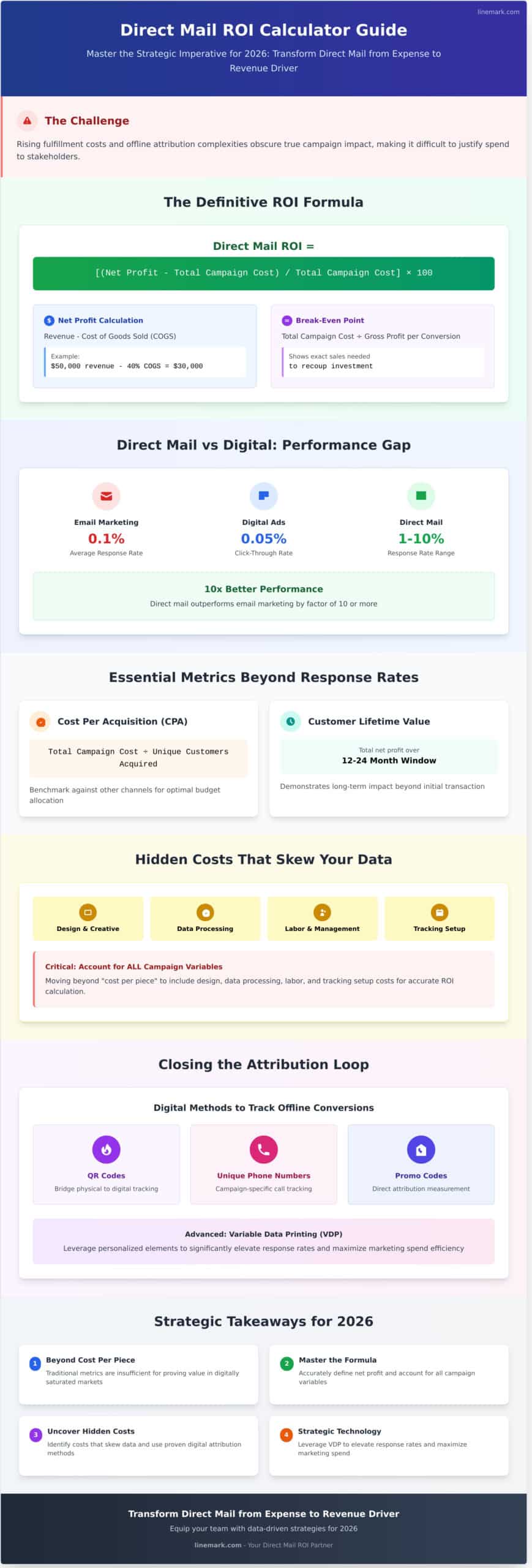
The performance metrics speak for themselves. With average response rates that can outperform email by a factor of 10 or more, direct mail consistently proves its value. The psychological impact of receiving personalized, physical communication builds a stronger customer connection, moving beyond the transactional nature of digital interactions. Modern campaigns overcome the “junk mail” stigma by leveraging sophisticated data integration, ensuring every piece is relevant, timely, and valuable to the recipient-transforming a simple mailer into a customized solution.
Ultimately, understanding your direct mail performance is a critical component of a holistic marketing strategy. The process is a specific application of the broader discipline of measuring Return on Marketing Investment, where every dollar spent is tied to a measurable outcome. Accurately calculating this figure is no longer an option; it is a strategic imperative that validates the channel’s contribution and secures its role in an integrated, high-performance marketing mix.
To ensure every component of that mix is optimized, it’s wise to partner with specialists. While this guide focuses on direct mail, for the digital advertising side of your strategy, you can check out HOT IRON Digital, an agency focused on data-driven paid campaigns.
And for the organic search component, which is crucial for capturing the brand interest your mailers generate, you can explore Consultoría SEO to maximize your digital visibility.
The Direct Mail ROI Formula: A Step-by-Step Mathematical Breakdown
To accurately measure the performance of your direct mail initiatives, you must move beyond response rates and focus on tangible financial returns. Understanding how to calculate direct mail ROI begins with a standard, yet powerful, formula that provides a clear picture of campaign profitability.
The foundational formula is:
- Direct Mail ROI = [(Net Profit from Campaign – Total Campaign Cost) / Total Campaign Cost] x 100
Here, “Net Profit” is the critical variable. It is not simply total revenue. To calculate it correctly, you must subtract the Cost of Goods Sold (COGS) from the revenue generated by the campaign. For example, if your mailer drove $50,000 in sales for a product with a 40% COGS, your Gross Profit is $30,000. This is the figure you use for your calculation.
This same logic allows you to determine your break-even point: simply divide your Total Campaign Cost by your Gross Profit per conversion. This reveals the exact number of sales needed to recoup your investment, a vital metric for planning and risk assessment.
Calculating Your Cost Per Acquisition (CPA)
Your CPA provides a clear, actionable metric for campaign efficiency. Calculate it by dividing the total campaign spend by the number of unique customers acquired. A low CPA relative to your product’s profit margin indicates a healthy, scalable campaign. Benchmarking this CPA against your other digital and traditional marketing channels is essential for optimizing your marketing mix and allocating budget effectively.
Integrating Customer Lifetime Value (LTV)
A sophisticated analysis of ROI looks beyond the initial transaction. The true value of a newly acquired customer often unfolds over months or years. Factoring in Customer Lifetime Value (LTV) – the total net profit a customer is projected to generate over their entire relationship with your brand – unlocks a more strategic view of campaign success. This approach, which often considers a 12 to 24-month window, demonstrates the long-term impact to executive leadership and justifies sustained investment in high-quality direct mail production.
Accounting for Every Cent: Identifying Total Campaign Costs
A common objection to direct mail is its perceived expense. However, the more precise question is not “Is it expensive?” but “What is its return?” Answering this requires a meticulous accounting of every cost component. Overlooking so-called “hidden costs”-from list cleansing to rush fees-is the fastest way to generate skewed data. A precise understanding of your total investment is the foundation of how to calculate direct mail ROI accurately.
To manage your budget effectively, categorize every expense in your tracking spreadsheet as either fixed or variable. This structure simplifies forecasting and post-campaign analysis.
- Fixed Costs: One-time expenses that do not change with campaign volume, such as design fees, copywriting, and initial data acquisition.
- Variable Costs: Expenses that scale directly with the number of pieces you mail, including printing, fulfillment labor, and postage.
Creative and Production Expenses
The tangible quality of your mailer begins here. This category includes design and copywriting fees, which are critical investments in a high-conversion layout. Printing costs will fluctuate based on your choice between digital printing for personalization and offset for high-volume efficiency. Finally, consider the strategic use of premium paper stocks and finishes. While more expensive, a soft-touch varnish or unique die-cut can significantly lift response rates, often justifying the added investment with a stronger ROI.
Data and Fulfillment Logistics
The success of your campaign hinges on reaching the right people efficiently. Your costs here include acquiring and cleaning targeted mailing lists-a crucial step for maximizing deliverability. From there, your single-source partner will manage all Kitting & Fulfillment services, including assembly and packing. The largest variable cost is typically postage, but it should be treated as an area for optimization, not a fixed price. Strategically choosing between options like EDDM vs. targeted mail can dramatically reduce your cost-per-piece and elevate overall campaign performance.
Closing the Attribution Loop: How to Track Offline Conversions Digitally
The greatest challenge in physical marketing has always been the “dark funnel”-the gap where a customer receives a mailpiece and later converts online, leaving no clear trail. Accurately answering how to calculate direct mail roi requires bridging this offline-to-online gap. Modern technology, however, provides a suite of tools that illuminate this path, transforming your direct mail from a standalone tactic into a fully integrated, trackable component of your omnichannel strategy.
At Linemark, we engineer campaigns with data visibility at their core. The key is to create a clear, measurable digital action prompted by a physical touchpoint. This requires a strategic approach that leverages:
- Personalized URLs (PURLs): By printing a unique URL (e.g., YourSite.com/Jane-Doe) on each mailpiece, you can track individual recipient engagement, see exactly who responded, and guide them to a customized landing page experience.
- Dynamic QR Codes: Looking ahead to 2026 and beyond, QR codes are essential for seamless mobile integration. Unlike static codes, dynamic QR codes can be updated post-print and provide deep analytics on scans, locations, and device types, offering granular performance data.
- Match-Back Analysis: The most direct method involves comparing your final sales or conversion data against your original mailing list. By matching names, addresses, or emails, you can definitively identify which recipients made a purchase after receiving the mailer.
Call Tracking and Coupon Codes
For campaigns driving phone calls or e-commerce sales, dedicated tracking mechanisms are critical. Using unique, campaign-specific phone numbers allows you to attribute every inbound call directly to your mail drop. Similarly, distinct coupon or promotional codes (e.g., “SAVE20MAIL”) used at checkout provide irrefutable proof of conversion. Remember, attribution is the process of identifying which marketing touchpoint led to a specific conversion, and these tools make that process precise.
CRM and AI-Driven Attribution Modeling
True scalability is achieved when your direct mail data integrates directly into your CRM. Platforms like Salesforce or HubSpot can ingest mailing list data, allowing you to view direct mail as a touchpoint in the customer journey. Advanced AI tools now leverage this data to predict which customer segments will yield the highest ROI from future mailings. This integration also helps measure the “Halo Effect”-the notable lift in branded organic search traffic and direct site visits that often coincides with a mail campaign’s in-home window.
Optimizing for Scale: How Linemark Maximizes Your Marketing Return
Mastering how to calculate direct mail roi is the critical first step. The next is to systematically improve every variable in that equation. At Linemark, we transform your direct mail from a simple tactic into a high-performance engine for growth by optimizing for cost-efficiency and response at scale.
As a true single-source partner, we eliminate the friction, communication gaps, and hidden overhead that erodes your return. Managing separate vendors for strategy, data processing, printing, and distribution introduces complexity and inflates costs that are difficult to track. Linemark integrates these critical functions under one roof. This unified approach not only simplifies your project management but also provides complete transparency. Furthermore, our 30+ years of logistics expertise allow us to identify significant postage savings through commingling and mail-piece design optimization, directly lowering the ‘investment’ side of your ROI calculation.
The Power of Personalization
True personalization goes far beyond a “Dear [First Name]” salutation. With Variable Data Printing (VDP), we customize imagery, offers, and messaging for each recipient, creating a truly one-to-one connection. Campaigns leveraging VDP consistently outperform generic mailings because relevance drives action. Our advanced digital printing technology makes this level of customization not just possible, but affordable at scale.
Fulfillment Excellence as an ROI Driver
Speed and efficiency are direct ROI drivers. Our in-house production, fulfillment, and distribution capabilities drastically reduce time-to-market, getting your campaigns in-hand faster. Through our MarCom On-Demand portal, you can streamline repeat campaigns and manage inventory intelligently, preventing the wasted spend of obsolete materials. This operational excellence ensures your marketing dollars are always working for you, not sitting on a warehouse shelf.
Ultimately, knowing how to calculate direct mail roi is about creating a predictable, scalable channel for customer acquisition. The Linemark difference lies in our ability to engineer every step of the process-from data to delivery-for maximum impact and efficiency. We provide the technology, expertise, and integrated infrastructure to turn your direct mail vision into measurable results.
Partner with Linemark to build your high-ROI direct mail strategy today.
From Calculation to Campaign Success: Mastering Your Direct Mail ROI
In 2026, mastering your direct mail return on investment is no longer an option-it’s a strategic imperative. As we’ve detailed, this requires more than a simple formula; it demands a meticulous accounting of total campaign costs and a robust strategy for tracking offline conversions with digital precision. Ultimately, understanding how to calculate direct mail roi is the critical first step toward optimizing your budget and proving the channel’s immense value.
But calculation is only half the equation. True optimization requires a partner equipped for flawless execution at scale. With over 30 years of industrial printing authority, Linemark operates from a 90,000-square-foot high-tech facility, serving as your single-source partner for strategy, design, print, and fulfillment. Maximize your campaign impact with Linemark’s direct mail expertise.
Take these insights, apply them with confidence, and watch your marketing return reach new heights.
Frequently Asked Questions About Direct Mail ROI
What is a good ROI for a direct mail campaign?
While campaign goals and industries vary, a direct mail ROI between 300% and 500% (a 3:1 to 5:1 return) is widely considered a strong performance. For industries with a high Customer Lifetime Value (CLV), even a lower initial ROI can be highly profitable over time. The key is to establish a clear benchmark based on your specific margins, offer, and strategic objectives before launching the campaign to accurately measure success against your goals.
How do you calculate response rate vs. ROI in direct mail?
Response rate measures engagement, while ROI measures profitability. The response rate is the percentage of recipients who took a desired action (e.g., visited a URL, made a call), calculated as (Responses ÷ Total Pieces Mailed) x 100. In contrast, ROI calculates financial return, using the formula [(Revenue Generated – Campaign Cost) ÷ Campaign Cost] x 100. A high response rate is a positive indicator, but true success is ultimately determined by profitable ROI.
Can I track direct mail conversions in Google Analytics?
Absolutely. Integrating physical mail with digital analytics is a core component of modern campaigns. By using unique tracking mechanisms like campaign-specific URLs (PURLs), QR codes leading to a tagged landing page, or custom discount codes, you can directly attribute website traffic and conversions back to your mail piece. This creates a closed-loop reporting system, allowing you to measure digital actions originating from a physical touchpoint with high precision and confidence.
What are the biggest factors that lower direct mail ROI?
Three primary factors typically diminish direct mail ROI: an inaccurate or poorly targeted mailing list, a weak offer or unclear call-to-action, and inefficient production or postage costs. A flawed list wastes budget on uninterested recipients, while a weak creative fails to motivate action. As your single-source partner, LineMark helps mitigate these risks through advanced list hygiene, strategic guidance, and optimized, scalable production to protect your investment and maximize returns.
Is direct mail still effective for B2B marketing in 2026?
Yes, direct mail remains a highly effective and strategic channel for B2B marketing. As digital channels become more saturated, a tangible, personalized mail piece commands attention and cuts through the noise. It is exceptionally effective for reaching high-value decision-makers, promoting complex services, and driving engagement for account-based marketing (ABM) initiatives. When integrated into a multi-channel strategy, its impact is amplified, delivering a premium and memorable brand experience.
This same logic applies to specialized B2C industries like real estate investing, where direct mail is a key strategy for finding properties. Investors seeking to build a strong foundation in this area can discover Multifamily Intelligence, an all-in-one educational platform.
How does postage affect my total ROI calculation?
Postage is one of the most significant line items in your campaign investment and directly impacts your final ROI calculation. It is a critical variable in the cost portion of the ROI formula. Optimizing postage through intelligent mail piece design, weight considerations, and leveraging presort and commingling services is essential. Reducing this fixed cost without sacrificing quality or deliverability provides more budget for list acquisition or creative, directly improving your potential for a higher return.
How many times should I mail a lead to see a return?
A single touchpoint is rarely enough to drive significant returns. Effective direct mail strategy often involves a multi-touch cadence, with 3 to 5 mailings to the same list over a planned period. Repetition builds brand recognition, establishes credibility, and engages prospects at different stages of their buying journey. A well-timed sequence of communications consistently outperforms a one-time mail drop, leading to higher overall response rates and a more substantial return on investment.
What is the difference between gross ROI and net ROI in printing?
Understanding this distinction is fundamental to how to calculate direct mail ROI accurately. Gross ROI measures the total revenue generated against the total campaign cost. Net ROI provides a more precise picture of profitability by subtracting the Cost of Goods Sold (COGS) from the revenue before calculating the return. For example, if a $10,000 campaign sells $50,000 of a product that cost $20,000 to produce, the net profit is $20,000, not $40,000.