

 02/24/2026
  Steve Bearden
Transforming a digital concept into a tangible, high-quality hardcover book is a significant investment. Yet, the path from vision to final product is often complicated by a landscape of technical specifications and variable costs that can feel overwhelming. The final number on your hardcover book printing quote is more than just a price; it’s the culmination of dozens of strategic decisions, from paper weight and binding style to custom finishes and order quantity. This uncertainty can lead to budget overruns or compromises in quality that dilute your project’s impact, turning an exciting venture into a source of anxiety.
This comprehensive 2026 guide is designed to remove that uncertainty. We will deconstruct every critical component that influences your printing costs, translating industry jargon into actionable insights. You will gain the confidence to prepare a precise project brief and make strategic decisions that balance premium quality with fiscal responsibility. Consider this your roadmap to mastering the printing process and achieving a final product that meets your highest standards, perfectly aligning your creative vision with your budgetary goals.
Key Takeaways
- Master the 7 key cost drivers-from quantity and paper stock to special finishes-to strategically control your project budget.
- Understand the critical difference between offset and digital printing to select the most cost-effective technology for your specific run size.
- Utilize our project specification checklist to gather all the necessary details, ensuring you receive a fast and accurate hardcover book printing quote.
- Discover how partnering with an experienced printer provides strategic solutions and value that extend far beyond a simple price estimate.
Anatomy of a Hardcover Book: What Printers Need to Know
A hardcover book is a custom-manufactured product, which is why generic price lists are impractical for professional projects. Instead, a strategic printing partner provides a hardcover book printing quote-a detailed cost estimate built with precision from your project’s unique specifications. To build that quote accurately, we must deconstruct the product into its core components. Understanding the basic Anatomy of a Hardcover Book, primarily the case, the book block, and the binding method, is the foundational step toward clarifying your vision and managing your budget effectively.
The Case: Your Book’s First Impression
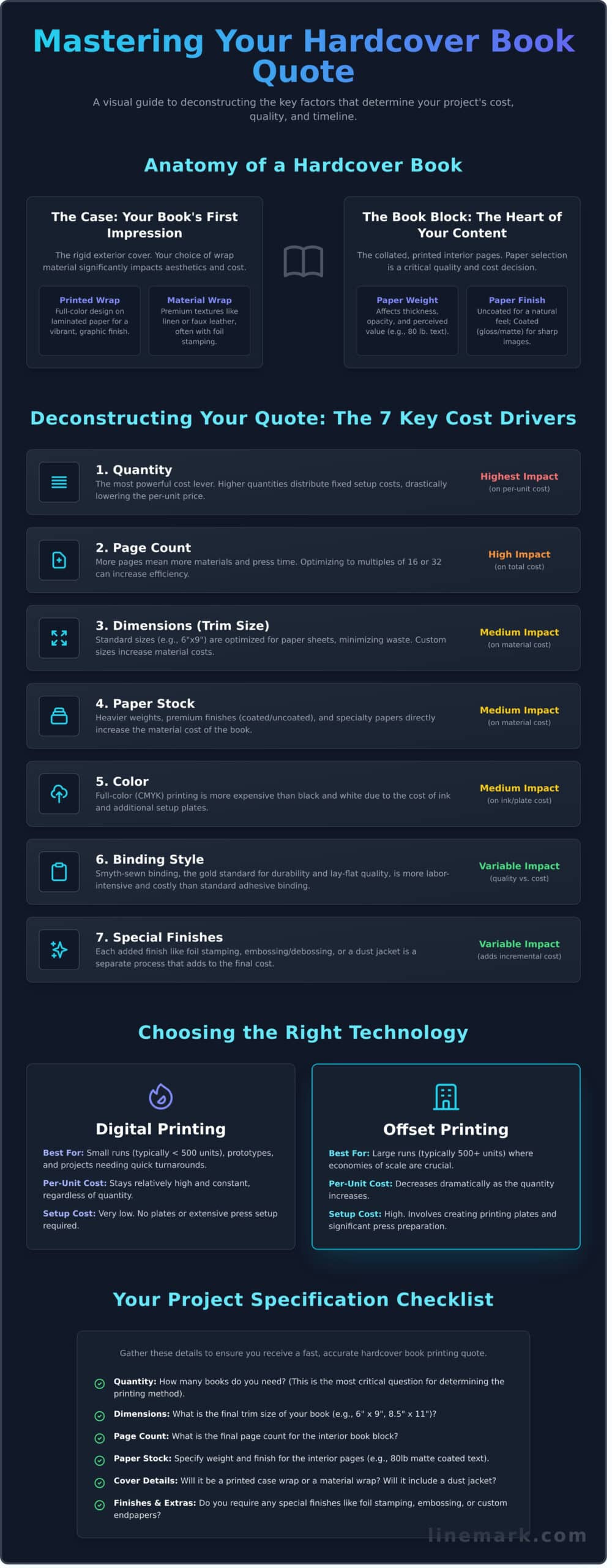
The case is the rigid exterior that gives a hardcover its signature durability and distinguished feel. It consists of heavy-duty binder’s board wrapped in a specific cover material, a choice that significantly impacts aesthetics and cost. A printed wrap (or “case wrap”) involves printing your full-color design on paper that is then laminated and wrapped around the board for a vibrant, graphic-rich finish. Alternatively, a material wrap uses premium substrates like linen, buckram, or faux leather to create a more tactile, classic experience, typically decorated with foil stamping or debossing. A dust jacket, while common, is a separate printed component with its own finishing requirements and is quoted as a distinct line item.
The Book Block: The Heart of Your Content
The book block is the engine of your project: the collated, printed interior pages that carry your message. The primary cost driver here is your paper selection, a critical decision that communicates quality before a single word is read. Key specifications include:
- Weight: Measured in pounds (e.g., 80 lb. text), affecting the book’s thickness, opacity, and perceived value.
- Finish: Uncoated stock offers a natural, tactile feel ideal for literary works, while coated stock (gloss or matte) provides a smooth, sealed surface for superior image reproduction in photo books or corporate publications.
In high-volume offset printing, pages are imposed and printed on large sheets called signatures, which are then folded into groups (typically 16 or 32 pages). Optimizing your page count to align with these signatures is a key strategy for maximizing material efficiency and securing a competitive hardcover book printing quote.
Deconstructing Your Quote: The 7 Key Cost Drivers
To get the most accurate hardcover book printing quote, it’s essential to understand the core components that determine your final investment. These seven variables are the primary levers you can adjust to align the project’s specifications with your budget. Mastering them is the key to achieving a final product that meets both your quality standards and financial targets. Think of this not as a list of costs, but as a dashboard for optimizing your project.
| Cost Driver | Impact on Per-Unit Price |
|---|---|
| Quantity | Higher quantity significantly lowers the per-unit cost. |
| Page Count | Higher page count increases cost. |
| Dimensions | Custom or oversized dimensions increase cost due to paper waste. |
| Paper Stock | Heavier, coated, or specialty papers increase cost. |
| Binding Style | Smyth-sewn is more expensive than standard adhesive case binding. |
| Color | Full-color (CMYK) is more expensive than black and white. |
| Special Finishes | Each added finish (e.g., foil, embossing) increases cost. |
Quantity, Dimensions, and Page Count
These three factors form the structural foundation of your quote. Quantity is the most powerful cost driver due to the economies of scale in offset printing; higher volumes distribute the initial setup costs across more units, drastically reducing the per-book price. Dimensions matter because standard sizes (like 6″x9″ or 8.5″x11″) are engineered to minimize paper waste. Custom sizes often require more raw material and custom tooling, increasing expense. Finally, your page count must be divisible by four, but for optimal efficiency and cost-effectiveness in offset printing, counts divisible by 16 or 32 are ideal. This aligns with how large press sheets are folded into signatures, a core tenet of official printing standards that ensures production efficiency.
Paper Stock and Binding Method
The tactile experience of your book is largely defined here, making this a critical decision for quality and cost. Paper stock choices range from uncoated paper, which has a natural, matte feel, to coated stocks (gloss, silk, or matte) that make images pop. The paper’s weight, measured in GSM or Lb., also impacts the perceived quality and price. For binding, Smyth-sewn is the gold standard for durability and a true lay-flat finish, while adhesive case binding offers a robust and more cost-effective alternative for many projects.
Color and Special Finishes
Visual appeal is driven by your color and finishing choices. The difference between printing in black and white versus full-color (CMYK) is one of the most significant cost variables in any hardcover book printing quote. Beyond base color, special finishes are powerful tools for elevating your cover’s perceived value. Options like foil stamping, embossing (a raised effect), debossing (an indented effect), and spot UV coatings add a layer of sophistication and sensory engagement, but each adds a distinct process and associated cost to production.
Offset vs. Digital Printing: Choosing the Right Technology for Your Budget
When developing a hardcover book printing quote, no decision has a greater impact on your final cost than the choice between offset and digital printing technology. This strategic selection is driven almost entirely by your project’s volume. Understanding the fundamental difference between these two methods is the first step toward optimizing your investment for both quality and efficiency.
The core distinction lies in the setup. Offset printing utilizes custom-etched metal plates to transfer ink to paper, a process that involves significant initial preparation but delivers exceptional per-unit savings at high volumes. In contrast, digital printing operates more like a high-end office printer, applying toner or inkjet technology directly to the page without the need for plates. This difference in mechanics creates a clear break-even point; for most hardcover projects, this crossover occurs between 500 and 1,000 copies. Below this threshold, digital is more economical. Above it, offset provides superior value.
When to Choose Offset Printing
Offset printing is the definitive solution for large-scale projects where achieving the lowest possible cost per book is paramount. Its high initial setup costs are quickly absorbed across runs of 1,000 copies or more, yielding unmatched economies of scale. This method is the industry standard for projects demanding absolute precision.
- High-Volume Efficiency: Ideal for print runs exceeding 1,000 units, where the per-piece cost drops significantly with volume.
- Superior Quality and Consistency: Delivers unparalleled color accuracy, including Pantone® matching, ensuring every copy is identical. The precision of offset ensures every element-from the endpapers to the spine, key components in the Anatomy of a Hardcover Book-is rendered with absolute fidelity.
- Material Versatility: Offers the widest possible selection of paper stocks, weights, and specialty finishes like varnishes, foils, and embossing.
When Digital Printing Makes Sense
For short runs, rapid prototyping, or personalized content, digital printing provides a powerful and cost-effective alternative. By eliminating the plate-making process, it offers remarkable flexibility and speed, making it the go-to technology for projects that require agility. A timely and accurate hardcover book printing quote for a small batch relies on this technology.
- Short-Run Profitability: The perfect choice for quantities under 500 copies, proofs of concept, or limited-edition releases without a large upfront investment.
- Customization and Variable Data: Enables unique content on each book, such as personalized names or sequential numbering, without slowing production.
- Speed to Market: Drastically reduces turnaround times by removing the extensive setup phase required for offset printing.
Preparing for Your Quote: A Project Specification Checklist
To receive a fast and precise hardcover book printing quote, it is essential to have your project specifications clearly defined. Approaching a printing partner with well-organized details not only streamlines the entire process but also positions you as a prepared, professional client. This simple checklist is designed to empower you with the exact information our team needs to build an accurate, actionable proposal for your project.
Having these answers ready transforms a complex request into a straightforward conversation, ensuring we can deliver a quote that aligns perfectly with your budget and vision.
Essential Project Details
The core variables of your book dictate the foundational costs of production. Having these numbers finalized, or at least narrowed down, is the critical first step toward a reliable estimate. Be prepared to provide:
- Final Quantity: Do you need 500 copies or 5,000? If you are exploring options, we recommend requesting pricing for a few quantities (e.g., 1,000, 2,500, and 5,000) to see how the per-unit cost changes with scale.
- Finished Trim Size: Specify the final dimensions of your book, written as width by height (e.g., 6″ x 9″ or 8.5″ x 11″). This directly impacts paper usage and press configuration.
- Final Page Count: Provide the total number of pages in your final manuscript, including all front matter, back matter, and any intentional blank pages. This ensures complete accuracy.
Material and Finish Specifications
The materials you choose define the tactile experience and visual impact of your hardcover book. These details have a significant influence on the final cost and production timeline. Consider the following:
- Interior Paper Stock: Specify the weight and finish you prefer for the inside pages. Common choices include 80# gloss text for photo-heavy books or 60# uncoated offset for novels.
- Cover Material & Finish: Describe your vision for the cover. Will it be a printed casewrap with a matte laminate? Do you want to add a premium finish like a foil stamp on the title or a spot UV gloss effect?
- Binding Style: For maximum durability and a lay-flat reading experience, Smyth-sewn binding is the gold standard for hardcover books. If you have another preference, be sure to note it.
For a more exhaustive list of options and technical considerations, download our full specification sheet to prepare for your quote.
Beyond the Numbers: Partnering with an Expert for the Best Value
Understanding the components of a hardcover book printing quote is the first step. The next, more critical step, is choosing the right partner to bring your project to life. A price on its own is just a number; true value comes from a partnership with a printing expert who invests in your project’s success, offering strategic guidance that protects both your budget and your brand’s reputation.
An experienced printer operates as a solutions provider. They can analyze your specifications and identify opportunities for optimization that you might have missed. For instance, a minor adjustment to your book’s trim size could allow it to fit more efficiently on a press sheet, significantly reducing paper waste and cost. Similarly, an alternative paper stock could offer a nearly identical look and feel while delivering substantial savings. This consultative approach transforms the quoting process from a simple transaction into a strategic collaboration.
The Linemark Difference: Consultation, Not Calculation
At Linemark, we don’t just process your specifications-we analyze them to ensure perfect alignment with your goals. We see ourselves as your single-source partner, dedicated to delivering a superior final product with maximum efficiency. The Linemark experience is built on a foundation of expert guidance and integrated execution.
- Strategic Analysis: Our team reviews your project to identify potential production efficiencies and cost-saving alternatives without compromising quality.
- Integrated Solutions: We manage the entire production lifecycle under one roof, from expert pre-press and printing to sophisticated binding, finishing, and global fulfillment.
- Dedicated Partnership: Your project is supported by a team of professionals committed to proactive communication and flawless execution from start to finish.
Ready to Start Your Project?
You now have the knowledge to confidently request a detailed hardcover book printing quote. Consider this the start of a conversation. The numbers you receive are a baseline, but the discussion that follows is where real value is created. Let our team show you how a strategic partnership can elevate your project beyond your expectations.
Connect with a Linemark expert today to discuss your vision and receive a comprehensive quote. Let’s build something remarkable together.
From Quote to Creation: Partnering for Printing Excellence
Understanding the key cost drivers of a hardcover-from paper stock to binding style-is the first step toward mastering your budget. By choosing the right printing technology for your volume and preparing detailed specifications, you transform the quoting process from a simple price check into a strategic planning tool. This empowers you to secure a hardcover book printing quote that accurately reflects your project’s scope and quality.
A quote, however, is only as valuable as the partner behind it. With over 30 years of commercial printing experience, Linemark operates as your single-source strategic ally. Our full-service capabilities, from precision printing to integrated fulfillment, are guided by dedicated project management to ensure a seamless experience and exceptional value.
Let us help you move beyond the numbers to achieve a superior final product. Request a consultative quote for your hardcover book project and discover the Linemark difference. We are ready to build something remarkable together.
Frequently Asked Questions About Hardcover Book Printing
What is the minimum number of hardcover books I can order?
LineMark is structured for both high-volume offset and specialized digital printing. While our systems are optimized for scalability, we typically accommodate short runs starting at 250 units for most hardcover specifications. This flexibility allows us to serve as a strategic partner for large-scale publishers and businesses executing targeted campaigns. Our project specialists can always advise on the most cost-effective solutions to meet your precise project objectives and ensure maximum ROI on your investment.
How much does it cost to print a hardcover book?
The cost of a hardcover book is a direct result of its specifications. Key variables include quantity, page count, paper stock, cover materials, and binding style. For example, a 500-unit run of a 200-page book with a standard case-wrapped cover will be priced differently than a 5,000-unit run with a cloth cover and Smyth-sewn binding. The most effective way to determine your investment is to submit your project details for a precise hardcover book printing quote.
How long does it take to get a quote for hardcover book printing?
We understand that efficiency is critical to your project’s success. Our streamlined quoting process is designed for a rapid response. Once you submit your project specifications through our online portal or directly to a project specialist, you can typically expect a detailed and accurate quote within 24 to 48 business hours. For highly customized projects, we maintain clear communication on timelines, ensuring you have the data you need to make timely decisions.
Can I get a physical proof of my book before the full print run?
Absolutely. We consider proofing a critical step in our quality assurance protocol. We provide a physical, one-off proof of your hardcover book, produced with the same materials and on the same equipment planned for the final production. This allows your team to verify color accuracy, trim size, binding, and overall finish before committing to the full run. This meticulous attention to detail ensures the final product aligns perfectly with your brand standards and project vision.
What’s the difference between case binding and Smyth-sewn binding?
Both are premium hardcover binding methods, but they differ in construction and durability. Standard case binding, or adhesive binding, involves gluing the book block directly to the spine of the cover, offering a durable and cost-effective solution for most projects. Smyth-sewn binding involves stitching individual signatures (groups of pages) together with thread before adhering them to the case. This superior method allows the book to lay completely flat and offers maximum longevity, ideal for archival-quality projects.
How should I format my files for a hardcover book printing quote?
For optimal processing and accuracy, we require high-resolution, print-ready PDF files. Your interior pages should be submitted as a single, multi-page PDF with all fonts embedded. The cover, including the front, back, and spine, should be provided as a separate, single-page PDF laid out to our specific template dimensions. Our pre-press team provides detailed specifications and templates to ensure your files are prepared correctly, streamlining the path from submission to production.
What is a dust jacket and do I need one for my hardcover book?
A dust jacket is a removable protective paper cover that wraps around the hardcover book. It provides a premium canvas for full-color graphics, marketing copy, and author information while protecting the underlying case wrap. While not required, a dust jacket significantly enhances the perceived value and retail appeal of a book. The decision to include one depends on your project’s goals, budget, and intended audience. We can model the cost impact for you.
Does the type of cover material (e.g., cloth vs. paper) significantly change the price?
Yes, the choice of cover material is a significant driver of the final unit cost. A standard printed paper case wrap with lamination is the most common and cost-effective option. Premium materials like linen, buckram cloth, or faux leather introduce a tactile, high-end feel but also carry a higher material cost and may require specialized finishing processes like foil stamping or debossing. Our team can provide comparative pricing to help you select a material that aligns with your budget and brand aesthetic.