

 03/06/2026
  Steve Bearden
A striking metallic finish can elevate a project from standard to unforgettable. Yet, the path to achieving it is often fraught with technical hurdles-the fear of poor adhesion on a high-volume mail run, the complexities of file preparation, and the budget implications of traditional die-based methods. Perfecting the art of foil stamping requires a level of precision that goes beyond the design file, ensuring the final product is as durable as it is brilliant.
This comprehensive guide is engineered to eliminate that uncertainty. We will demystify the entire process, from the critical nuances of file setup to the strategic choice between digital and traditional foiling for maximum impact and scalability. By the end, you will have the confidence to specify and execute premium finishes that captivate your audience and withstand the rigors of fulfillment. Consider this your roadmap to transforming ambitious concepts into tangible, high-performance assets, all managed through a streamlined, single-source partnership.
Key Takeaways
- Understand how premium tactile finishes can elevate perceived brand value and build consumer trust.
- Compare the cost structures and ideal applications of hot, cold, and digital foiling to select the most effective technique for your project.
- Determine the best paper stocks for your design by learning how surface texture directly impacts foil adhesion and final quality.
- Prepare your design files for foil stamping correctly by using dedicated layers and a 100% K spot color for die creation.
What is Foil Stamping? Elevating Brand Perception Through Metallic Finishes
In high-stakes communication, the first impression is the only impression. Foil stamping is a premium finishing process that transforms standard print materials into tactile, high-value assets. At its core, What is Foil Stamping? is a specialty printing method that uses a heated die, pressure, and a thin metallic film to apply a design to a surface. The result is a vibrant, opaque finish that immediately signals quality and permanence. This tangible quality has a direct psychological impact, increasing consumer trust and the perceived value of the product or brand it represents. While widely used for decorative elegance on invitations and packaging, this same technology provides functional security through anti-counterfeiting foils on currency and official documents, demonstrating its journey from an artisanal craft to a scalable, industrial-grade solution.
The Anatomy of a Foil Stamped Piece
Executing a flawless foil stamp requires precision engineering and a deep understanding of how its core components interact. The success of the final product is dictated by three critical elements working in concert:
- The Substrate: This is the base material-typically paper, cardstock, plastic, or even leather. The substrate’s texture, absorbency, and durability determine how well it accepts the foil and pressure, directly influencing the final look and feel.
- The Die: A custom-engraved metal plate, or die, holds the design. When heated, this die presses the foil onto the substrate, simultaneously transferring the metallic layer and creating a subtle debossed impression.
- The Foil Layer: More than just a simple metallic sheet, the foil is a multi-layered film. It includes a release layer, a color or pigment layer, a metallic layer (often aluminum), and a final adhesive layer that activates with heat to bond permanently to the substrate.
Why Foil Stamping Beats Standard Metallic Inks
While metallic inks offer a shimmer effect, they cannot replicate the distinct advantages of true foil stamping, particularly for brands aiming for an uncompromisingly premium finish. The Linemark difference lies in leveraging the right process for the right outcome, and for luxury applications, foil delivers superior results.
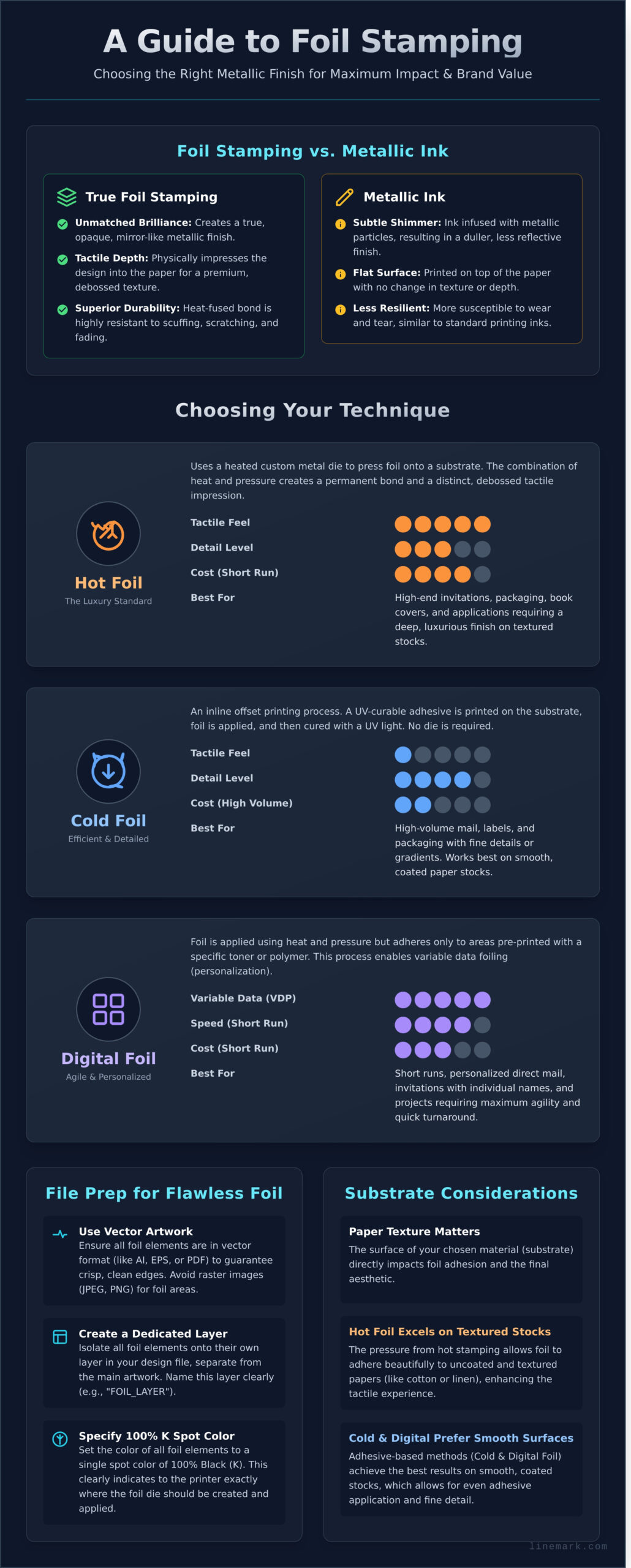
- Brightness and Opacity: Foil provides a true, mirror-like metallic finish because it is an opaque layer of metal applied to the surface. Metallic inks, by contrast, are inks infused with small metallic particles, which can appear duller and lack the same light-reflecting brilliance.
- Texture and Depth: The hot stamping process physically impresses the design into the substrate, creating a tangible depth and texture. This debossing effect adds a sophisticated, three-dimensional quality that invites touch and cannot be achieved with surface-level inks.
- Durability: The heat and pressure used in foil stamping create a permanent bond that is highly resistant to fading, scratching, and scuffing. This makes it the ideal choice for high-touch applications like book covers, business cards, and product packaging that must maintain their integrity.
Hot Foil vs. Cold Foil vs. Digital Foil: Choosing the Right Technique
Selecting the right foil application is a critical decision that directly impacts your project’s budget, timeline, and final aesthetic. The term foil stamping encompasses several distinct technologies, each engineered for specific outcomes. Understanding the operational differences between hot, cold, and digital foiling ensures your direct mail invitations achieve the desired effect with maximum efficiency and cost-effectiveness. The choice is dictated by project volume, the need for personalization, and the desired tactile experience.
Traditional Hot Foil Stamping
The benchmark for luxury and texture, traditional hot foil stamping is a meticulous process. It utilizes a heated, custom-engraved metal die to press a thin layer of foil onto the paper. This combination of heat and pressure physically impresses the foil into the paper fibers, creating a distinct, tactile deboss that cannot be replicated by other methods. It excels on premium, textured paper stocks and is the definitive choice for high-end custom invitations and stationery where a deep, luxurious finish is paramount. For example, invitations for events at upscale wedding venues Lancaster SC often use this technique to reflect the quality of the location.
Cold Foil and Digital Foil Innovations
Modern printing advancements provide agile and scalable alternatives to traditional methods. These innovations, tracked closely by industry authorities like the Foil & Specialty Effects Association, expand the strategic possibilities for high-impact print.
- Cold Foil: This technique is an inline process integrated with offset printing presses. A UV-curable adhesive is printed onto the substrate in the desired shape, and the foil is then pressed onto it. Cold foil is exceptionally fast, making it ideal for massive-scale projects where speed is critical, though it produces a flatter finish compared to the depth of hot foil.
- Digital Foil: Representing the pinnacle of flexibility, digital foiling is a die-less process. It applies foil using heat and pressure but without the need for a custom metal die, drastically reducing setup costs. This makes it the perfect solution for short runs, prototypes, and, most importantly, variable data printing (VDP). With digital foil, you can personalize each invitation with a unique name or message in brilliant metallic foil, a powerful tool for engagement.
Ultimately, the right technique aligns with your project’s scale. Hot foil offers unmatched depth for large, static runs; cold foil delivers speed for high-volume commercial jobs; and digital foil provides the agility for customized, short-run communications.
Substrates and Surfaces: Where Foil Stamping Works Best
The most common question we encounter is, “Will foil stamping work on my chosen material?” The answer depends on a precise combination of substrate characteristics, foil type, and application pressure. Achieving a flawless, high-impact finish requires a deep understanding of how these elements interact. The success of your project is engineered long before the die meets the paper.
The key to crisp, clean foil transfer lies in the surface texture, or “tooth,” of the substrate. Highly textured papers have microscopic peaks and valleys. During the stamping process, the foil may not adhere perfectly in the valleys, creating a mottled or speckled appearance known as the “orange peel” effect. For the sharpest results, a smoother surface is always preferred, as it provides a uniform foundation for the foil’s adhesive layer to bond completely.
Best Paper Stocks for Foil Adhesion
While many papers are suitable, certain specifications deliver superior results. We recommend considering the following for optimal foil adhesion and durability:
- Smooth vs. Textured: Smooth, uncoated stocks or coated papers (like silk or gloss cover) provide the ideal surface. They allow the die to make even contact, resulting in sharp, unbroken foil coverage.
- Weight and Thickness: Heavier stocks, typically 100 lb. cover or greater, are essential. They can withstand the required heat and pressure without bruising or showing an impression on the reverse side.
- Coated Stocks: Gloss, matte, or aqueous coatings can sometimes resist foil adhesives. As your single-source partner, we conduct rigorous testing to select the correct foil release formula, ensuring a permanent bond on any coated surface.
Specialty Materials: Beyond Paper
Our capabilities extend far beyond traditional paper products. We regularly apply foil to a range of specialty substrates for unique, high-value applications:
- Synthetics and Vinyl: For large-format graphics, packaging, or durable credentials, we use specialized foils and temperature controls to achieve a lasting bond on non-porous synthetic materials.
- Leather and Cloth: In high-end custom book manufacturing, foil stamping on leather and cloth bindings creates a timeless, premium finish that communicates exceptional quality.
- Direct Mail Considerations: For mailers, we ensure the foil application is perfectly smooth and has no raised edges that could snag in USPS automated sorting equipment, guaranteeing deliverability.
While foil stamping is ideal for hard surfaces like book bindings, achieving a premium, textured design on softer fabrics like apparel or accessories often involves different techniques. For those projects, using high-quality digital designs from a specialist like Embroidery n Sewing is a popular method for creating durable and sophisticated custom finishes.
Design Requirements: How to Prepare Your Files for Foil Stamping
Achieving a premium finish begins with precise file preparation. To translate your digital design into a stunning tactile experience, your artwork must be optimized for the die-making process. Following these technical guidelines ensures every detail is captured with clarity and precision, delivering the high-impact result your MD invitations deserve.
Here are the core steps for setting up your files correctly:
- Step 1: Create a Dedicated ‘Foil’ Layer. In your design software, such as Adobe InDesign or Illustrator, isolate all elements intended for foil onto a separate, clearly labeled layer. This layer should contain only the foil artwork, distinct from any printed ink layers.
- Step 2: Use 100% Spot Color (K). Define all artwork on the “Foil” layer using a single spot color set to 100% K (black). This solid black shape acts as a technical blueprint for creating the physical metal die; it does not represent the final foil color.
- Step 3: Account for Trapping and Bleeding. If foil elements abut printed ink, a slight “trap” (a minimal overlap) may be required to prevent gaps. For foil extending to the edge of the card, ensure it bleeds at least 1/8 inch beyond the final trim line.
- Step 4: Submit Vector Artwork. For the sharpest possible result, vector art is non-negotiable. Vector files (.AI, .EPS) use mathematical paths to create infinitely scalable lines, ensuring the die has clean, crisp edges. Raster images (.JPG, .PNG) will result in a pixelated, lower-quality finish.
- Step 5: Respect Minimum Stroke Weights. Extremely fine lines and intricate details can be lost or “plug” (fill in) during the stamping process. We recommend a minimum stroke weight of 0.5pt to ensure legibility and clean application.
Common Design Pitfalls to Avoid
Even with perfect file setup, certain design choices can compromise the final quality of your foil stamping. Be mindful of serif fonts under 8pt, as their delicate serifs may not transfer cleanly. Large, solid foil areas can be prone to “pinholing” (tiny air bubbles), which can be managed with specific foil types or by adding a subtle texture to the design. Finally, avoid layering foil directly over uncured finishes like UV coating, as adhesion can be an issue. For complex, multi-finish projects, it is always best to consult with your LineMark print partner.
Color Selection and Effects
The right foil transforms your design from standard to statement. Beyond classic gold and silver, a wide palette of options is available to match your brand aesthetic.
- Metallic Foils: Gold, silver, and copper remain timeless choices for elegance, with rose gold offering a popular modern alternative.
- Pigment Foils: These offer a matte, opaque finish that provides a ‘painted’ look, creating striking contrast on dark or colored paper stocks.
- Holographic and Clear Foils: Add a dynamic, iridescent effect with holographic foils, or use a clear foil to create a subtle, high-gloss ‘varnish’ look for sophisticated flair.
The Linemark Difference: Integrating Foil into High-Volume Production
Transitioning a brilliant foil design from concept to national distribution requires more than a press-it demands an integrated infrastructure. At Linemark, we operate as your single-source partner, managing your project from initial design consultation through to final fulfillment. Our 90,000-square-foot facility houses every capability under one roof, ensuring seamless quality control and logistical efficiency for even the most ambitious projects.
This unified approach is where true value emerges. Our foil stamping capabilities are not an isolated service; they are a vital component of a larger marketing engine. We combine the tactile appeal of foil with the precision of Variable Data Printing (VDP), allowing for personalized, high-impact direct mail that captures attention. Your foiled invitation or marketing piece can be customized for each recipient and integrated directly into a comprehensive mailing and logistics strategy executed by our in-house experts.
Scalability is at the core of the Linemark difference. We have the proven capacity to take your project from a single, approved prototype to a 100,000-unit national rollout without compromising on the meticulous detail that makes your design unique.
Foil Stamping for Direct Mail and Marketing
A foiled envelope or mailer immediately stands out, significantly boosting open rates. We ensure that premium finish withstands the rigors of transit with a process that includes:
- Durability Testing: We simulate USPS processing to guarantee your foil finish arrives intact and impressive.
- Inventory Management: We can produce and store your foiled collateral, ready for on-demand kitting and distribution for ongoing campaigns.
Custom Books and Professional Reports
Beyond invitations, foil elevates professional communications. We partner with non-profits and associations to add distinguished foil accents to annual reports, transforming them into premium donor materials. For publishers, we provide high-end book manufacturing, including durable case binding with elegant, foil-stamped spines that command attention on any bookshelf.
Whether you’re planning a sophisticated direct mail campaign or producing a prestigious annual report, our integrated production model is built to deliver. Consult with Linemark’s experts on your next foil project to see how we can bring your vision to scale with precision and impact.
Partner with Linemark for Flawless Foil Execution
As we have explored, a metallic finish is far more than an aesthetic choice-it is a strategic tool for elevating brand perception and creating a memorable tactile experience. Understanding the nuances between hot, cold, and digital techniques, along with proper file preparation, provides the foundation for a successful project that communicates undeniable quality.
For over 30 years, Linemark has been the single-source partner for brands seeking flawless execution. Our G7 Master Printer Certification and 90,000 sq. ft. high-capacity facility are your assurance that even the most complex, high-volume foil stamping projects are handled with unmatched precision. We have the technology and the expertise to bring your most ambitious designs to life.
Ready to see the LineMark difference? Request a Custom Quote for Your Foil Stamping Project and let our team build a customized solution that makes a lasting impression.
Frequently Asked Questions About Foil Stamping
Is foil stamping more expensive than metallic ink?
Yes, foil stamping typically represents a higher investment than printing with metallic inks. This is because it is a distinct post-press process requiring a custom-made metal die and specialized machinery to apply heat and pressure. While metallic ink offers a shimmer, foil stamping delivers a genuine metallic luster and a subtle, tactile impression that provides an unmatched premium finish. The result is a far more impactful and luxurious piece, justifying the cost for high-value communications like MD invitations.
Can I use foil stamping on both sides of a page?
Applying foil to both sides of a sheet is an advanced technique that we can execute with precision. Success depends heavily on the substrate; we strongly recommend using a thick, high-caliber cardstock, such as a 130 lb. cover or a duplexed sheet. This minimizes the risk of the impression from one side showing through on the reverse. Our production experts can guide you in selecting the ideal paper to ensure a flawless, high-end result for your two-sided design.
What is the difference between embossing and foil stamping?
While both are premium finishing techniques, they achieve different effects. Foil stamping uses a heated die to bond a thin layer of metallic or pigmented foil onto the surface of the paper, adding color and shine. In contrast, embossing uses a matched set of dies to physically raise the paper’s surface, creating a three-dimensional, tactile effect without adding any material. The two can also be combined in a process called foil embossing for a truly dynamic, multi-sensory finish.
How long does the foil stamping process take for a large order?
The timeline for a large-scale foil project is influenced by design complexity and order volume. The initial step, creating the custom metal die, typically takes 1-2 business days. Following that, machine setup and the stamping run itself can add approximately 3-5 business days to your project’s overall production schedule. As your single-source partner, we integrate this into a comprehensive timeline, ensuring your project is managed efficiently from start to finish for on-time delivery.
Does foil stamping affect the recyclability of the paper?
Modern foiling materials are designed with sustainability in mind. The foil layer is exceptionally thin-less than one micron-and it separates from the paper fibers during the re-pulping process. As a result, the vast majority of municipal recycling facilities accept foil-stamped paper products without issue. For projects with stringent environmental requirements, we can consult on material choices to ensure your final product aligns perfectly with your sustainability goals and brand values.
Can you foil stamp on dark-colored paper or cardstock?
Absolutely. In fact, applying foil to dark-colored stocks is one of its most powerful applications. Because foil is an opaque material that sits on top of the paper, its color and reflectivity are not dulled by the underlying stock. This allows for brilliant gold, silver, or even white foils to create a stunning, high-contrast effect on deep-colored papers like black or navy blue. It provides a level of vibrancy that is simply not possible with standard inks.
What is the smallest detail or font size possible with foil?
To ensure a crisp and legible result, we advise adhering to specific design parameters. As a general rule, we recommend a minimum line thickness of 0.5 points and a minimum font size of 8 points for clean, sans-serif typefaces. More intricate designs or delicate serif fonts may require a larger size to prevent the fine areas from filling in during the stamping process. Our pre-press team will review your artwork to guarantee it is optimized for a flawless foil application.
Do I need a special die for every different color of foil?
No, a separate die is not required for each foil color. The custom die is created based on the shape of your artwork-the area to be stamped-not the color of the foil. This provides significant flexibility and cost-efficiency. A single die can be used to apply gold foil on one portion of your print run and silver foil on another, allowing you to create different versions of your invitation or marketing piece without incurring the cost of additional tooling.