News
03/13/2026
Steve Bearden

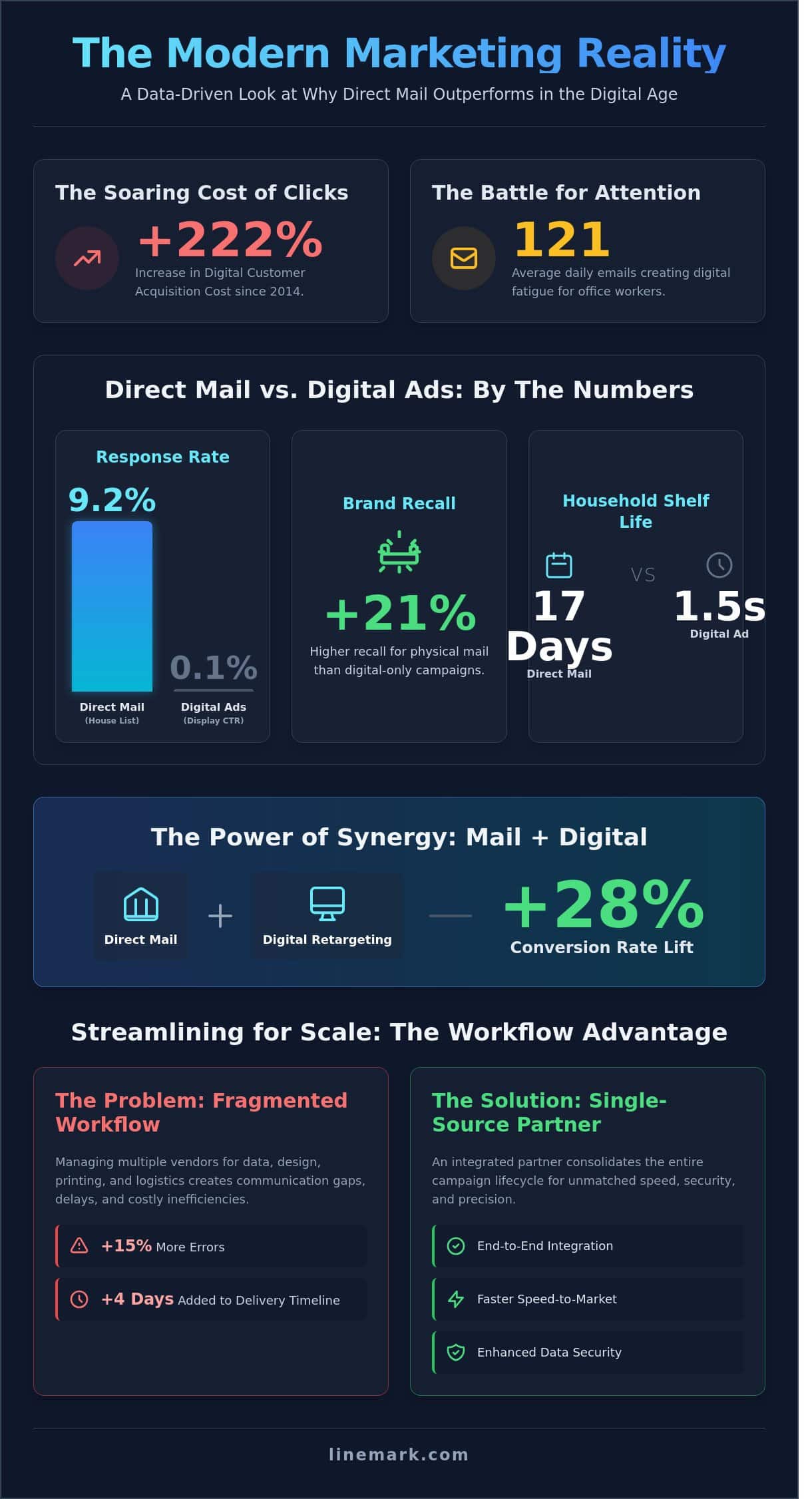
While digital customer acquisition costs have surged by 222% since 2014, direct mail response rates reached a staggering 9% for house lists in recent industry reports. You’ve likely felt the squeeze of saturated social feeds and the exhaustion of managing a fragmented supply chain of designers, list brokers, and printers. It’s difficult to scale when your data doesn’t talk to your distribution; it’s even harder when you’re unable to tie every dollar spent to a concrete conversion.

We’re here to bridge that gap. This guide provides the blueprint to master modern direct mail as a high-capacity, data-driven engine that cuts through the noise. You’ll discover how to leverage the Linemark difference to transform your outreach into a scalable acquisition channel. We’ll show you how a single-source partner integrates design, fulfillment, and logistics into one seamless operation. From automated print-on-demand to precise ROI tracking, you’ll learn the exact strategies required to drive measurable growth in 2026. Let’s explore the technological advancements and strategic shifts that turn physical mail into your most reliable competitive advantage.

Key Takeaways

  • Navigate digital fatigue by leveraging physical, tactile marketing strategies that bypass inbox clutter to command higher engagement rates.
  • Harness the power of Variable Data Printing (VDP) to transition from generic messaging to hyper-personalized, data-driven communications.
  • Apply the 40/40/20 rule to ensure your audience list and offer strategy remain the primary drivers of measurable campaign ROI.
  • Identify the optimal format-from cost-effective postcards to high-impact dimensional mail-to align with your specific conversion and retention goals.
  • Streamline your workflow and achieve national scale by integrating with a single-source direct mail partner focused on technological precision and logistics.

Why Direct Mail Remains the High-Impact Anchor of Modern Marketing

In 2026, marketing success hinges on breaking through the digital noise. This channel has evolved into a high-tech, tactile experience that commands undivided attention. While the history of direct mail dates back decades, its modern application is driven by precision data and sensory engagement. It bypasses the 121 emails the average professional receives daily, landing physically in a prospect’s hands. This tangibility builds a 21% higher brand recall than digital-only campaigns, according to neuro-marketing studies conducted in 2025. Physical touch triggers the brain’s ventral striatum, the area responsible for valuation and desire, making your offer feel more real to the DC Metro consumer.

Data from the 2025 Association of National Advertisers (ANA) report shows that house lists now achieve a 9.2% response rate. Prospect lists follow at a respectable 4.8%. These figures dwarf the 0.1% click-through rate typical of social media display ads. Physical mail creates a haptic experience. When a recipient touches a high-quality cardstock or textured mailer, they form a cognitive connection with your brand that pixels cannot replicate. It’s a matter of shelf life. A digital impression is gone in a blink. A well-designed piece of mail often sits on a kitchen counter or office desk for an average of 17 days, serving as a constant visual reminder of your value proposition.

Direct Mail vs. Digital Advertising: The ROI Reality

The cost to acquire a customer (CAC) through digital channels rose by 25% between 2023 and 2025 due to increased bidding competition. Physical marketing offers a stable alternative with superior longevity. A digital ad vanishes in 1.5 seconds; a physical mailer stays in a household for weeks. This permanence fuels omnichannel success. When we sync mail with digital retargeting, conversion rates often jump by 28% because the physical piece reinforces the fleeting digital message. In the competitive DC Metro market, where trust is a primary currency, the physical presence of your brand at a prospect’s home address signals stability and commitment.

The ‘Single-Source’ Advantage in Direct Mail

Fragmented workflows kill campaign momentum. Managing separate vendors for data, printing, and logistics creates 15% more errors and adds 4 days to delivery timelines. We believe in a different model. Linemark operates as your single-source partner, housing 90,000 square feet of integrated production technology. This scale ensures your data remains secure while your mail moves from press to post office without leaving our facility. Our agile approach transforms complex logistics into a streamlined growth engine. By consolidating the entire lifecycle of a campaign under one roof, we eliminate the communication gaps that plague multi-vendor projects. This integration allows for real-time adjustments and faster speed-to-market, ensuring your message reaches the mailbox exactly when your data indicates it will have the highest impact.

The Technology Behind High-Response Direct Mail: Data and VDP

Generic “Current Resident” mailings are a relic of the past. Modern direct mail relies on technical precision to cut through the noise of the DC Metro market. Data from the Association of National Advertisers indicates that personalized mail pieces can see a response rate increase of up to 135% compared to static versions. We move beyond basic salutations by leveraging database logic that dictates every pixel on the page. This transition from mass broadcasting to narrowcasting ensures that your message resonates with the specific needs of a Montgomery County homeowner or a high-level government contractor in Arlington.

The U.S. Small Business Administration on direct mail highlights that this medium remains a high-trust anchor in a crowded digital marketplace. Trust is built when the recipient feels the content was crafted specifically for them. By integrating CRM data directly into physical print workflows, we create automated triggers that respond to consumer behavior. If a customer abandons a high-value service inquiry on your website, our system can trigger a personalized follow-up piece to land in their mailbox within 48 to 72 hours.

Variable Data Printing: The Secret to 1-to-1 Marketing

Digital presses now process complex datasets in real time, allowing for the simultaneous output of thousands of unique pieces without slowing the production line. Variable Data Printing is the bridge between database logic and physical ink. We utilize this technology to swap images based on a recipient’s zip code or include a custom map-to-store graphic showing the exact driving distance from their front door. Name-in-image technology allows us to render a prospect’s name within the creative itself, such as on a personalized membership card or a custom-rendered storefront sign, capturing attention within the first 3 seconds of the mail being handled.

Wasted postage is a silent budget killer that erodes the effectiveness of any direct mail campaign. USPS data indicates that approximately 12% of the population moves every year, meaning an outdated list is a liability. Without rigorous list hygiene, including NCOA (National Change of Address) and CASS certification, your ROI suffers. We perform these scrubs before every run to ensure your brand isn’t associated with the frustration of misdirected mail. This technical diligence prevents brand damage and ensures that your marketing dollars are spent on reachable, high-intent prospects.

Data Security and Privacy in Mailing

Handling sensitive files requires more than just a printer; it requires a secure, industrial-grade infrastructure. We maintain SOC 2 Type II compliance to ensure that every record, from non-profit donor lists to sensitive corporate notifications, remains encrypted and protected. Processing PII (Personally Identifiable Information) in-house minimizes the risk of data breaches associated with third-party handoffs. Our facility uses 256-bit encryption during file transfer and secure data silos during the production cycle, providing the peace of mind necessary for large-scale operations in the highly regulated DC corridor.

For those seeking a single-source partner to manage these technical complexities, our team ensures every variable field is verified for accuracy before the first sheet hits the press.
Direct Mail Marketing in 2026: The Comprehensive Strategic Guide - Infographic

Choosing Your Format: Postcards, Self-Mailers, and Dimensional Mail

Strategic success in the DC metro market requires a precise alignment between your physical format and your campaign objective. Selecting a medium isn’t merely a creative choice; it’s a logistics and conversion decision. High-performing direct mail campaigns rely on matching the format to the specific stage of the customer journey. Whether you’re driving immediate local retail traffic or securing a multi-million dollar government contract, the weight, shape, and “open-ability” of your mailer dictate your initial engagement rates. Linemark serves as a single-source partner to ensure these formats are produced with industrial precision and scalable efficiency.

Postcard Printing: Efficiency and Visibility

Postcards remain the high-speed workhorse of modern marketing because they eliminate the friction of the envelope. They offer a 100% “open” rate because the recipient sees the primary message the moment they pull it from the mailbox. In 2023, industry data from the Association of National Advertisers indicated that postcards deliver one of the highest ROIs for local service providers. Choosing between a standard 4×6 card and an oversized 6×11 version involves a calculated trade-off. While standard cards minimize postage costs, oversized versions offer 35% more visual real estate to dominate the recipient’s attention. You can view our technical specifications for high-ROI postcard printing to determine which size fits your current budget and visibility goals.

Self-mailers and multi-panel brochures provide the necessary space for complex value propositions that a postcard cannot hold. These formats are ideal for DC-based non-profits or B2B firms that must present detailed case studies or technical specifications. A tri-fold or gate-fold design allows for a narrative flow, leading the reader from a specific business challenge to your proprietary solution. This format provides the structural integrity needed for high-volume automated sorting while maintaining enough surface area for compelling imagery and long-form copy.

Dimensional Mail and Custom Kitting

Dimensional mail, frequently called “lumpy mail,” is the premium choice for breaking through to C-suite gatekeepers. When a package has physical depth, it bypasses the standard screening process because it’s perceived as a high-value gift or a personal delivery rather than a solicitation. Research from 2022 showed that dimensional formats can achieve response rates as high as 5.3%, which is nearly double the rate of standard flat mail. This is where the Linemark difference becomes most apparent. Our integrated fulfillment services handle the complexities of custom kitting, ensuring that every component of a multi-item package is assembled with meticulous attention to detail.

High-value lead magnets often include custom book printing as a central component of these kits. Sending a professionally bound, 50-page industry report or a “how-to” guide positions your brand as a primary authority in the capital region. Our kitting and fulfillment teams manage the entire lifecycle of these complex projects, from the initial print run to the final delivery. This holistic approach ensures that your most expensive direct mail assets arrive in pristine condition, ready to make a lasting impression on your most valuable prospects. By utilizing our advanced tracking and logistics technology, you gain total transparency into the delivery window of these premium assets.

Designing for Response: A Practical Framework for Direct Mail ROI

Success in any direct mail campaign depends on a structured methodology rather than creative guesswork. We apply the 40/40/20 rule to every project. This industry standard dictates that 40% of your campaign’s success comes from the quality of your mailing list, 40% from the strength of your offer, and only 20% from the creative execution. If your data targeting is off by even 5%, your ROI will suffer regardless of how visually stunning the mailer appears. In the competitive DC Metro market, precision is your most valuable asset. We help you identify the right demographics so your message reaches the 15% of households most likely to convert.

Your call to action must be impossible to miss. Physical media offers a tactile experience that digital ads lack. We recommend using bold typography and high-contrast colors for your CTA buttons. Direct response copywriting should focus on a single, clear objective. Don’t overwhelm the recipient with multiple choices; instead, give them one irresistible reason to act now. High-performing mailers often include a sense of scarcity, such as an expiration date within 14 days of receipt, to drive immediate engagement and prevent your piece from being set aside and forgotten.

The Anatomy of a High-Converting Mailer

A strategic visual hierarchy leads the recipient’s eye from the headline directly to the CTA. We utilize specialized finishes like spot UV or soft-touch lamination to increase dwell time. According to 2024 industry data, tactile elements can extend the time a recipient spends with your mailer by 20% compared to standard uncoated paper. Your copy should be benefit-driven and concise. Use short sentences to maintain momentum. Every word must justify its place on the page, focusing on the specific problem your service solves for the DC professional.

Tracking and Attribution in 2026

Modern direct mail is no longer a “send and pray” medium. We integrate digital tracking tools to provide 100% transparency for every dollar spent. USPS Informed Delivery now has over 62 million active users, allowing recipients to see a digital preview of their mail before it even arrives in their physical box. This creates a double-touch opportunity. By using unique QR codes and Personalized URLs (PURLs), we track every interaction in real-time. This data allows us to calculate your true ROI by comparing total spend against the Customer Lifetime Value (CLV) of the leads generated.

Testing is the final pillar of a scalable strategy. We suggest A/B testing specific variables such as headlines or offer amounts to see what resonates with your specific audience. A 2023 pilot study showed that changing a “10% off” offer to a “Save $50” offer increased redemptions by 18% in the Northern Virginia corridor. By isolating these variables, we refine your approach until we find the most efficient path to conversion. As your single-source partner, we provide the technical infrastructure to execute these tests with surgical precision.

Ready to optimize your next campaign? Partner with a single-source partner to ensure your design translates into measurable revenue.

Scaling Success with a Single-Source Direct Mail Partner

Scaling a campaign from a local DC pilot to a national rollout requires more than just a larger printer. It demands a sophisticated logistics infrastructure that can handle the transition from thousands to millions of pieces without a dip in quality. As a single-source partner, Linemark provides the industrial authority needed to manage these complexities. Our 90,000-square-foot facility serves as the nerve center for nationwide distribution, combining advanced print technology with strategic postal optimization. This centralized approach eliminates the friction often found when managing multiple vendors, ensuring your direct mail reaches its destination with surgical precision.

High-volume distribution shouldn’t mean high-cost postage. We utilize advanced commingling techniques and strategic regional distribution to drive down costs. By aggregating your mail with other streams, we often secure postage discounts of up to 30% compared to standard rates. This isn’t just about moving paper; it’s about collaborative problem-solving. We analyze your distribution map to identify the most efficient entry points into the USPS system, reducing transit times and ensuring your message arrives exactly when your marketing calendar dictates. The LineMark experience is built on this transparency and operational excellence.

MarCom On-Demand: Controlling the Brand at Scale

Corporate marketing teams often struggle to maintain brand integrity across dozens of local branches. Our MarCom On-Demand services solve this by providing a centralized portal where local managers can customize approved templates. This 24/7 access allows for local personalization while keeping the core brand assets locked. The system also automates inventory management for recurring direct mail programs. When stock levels for a specific kit hit a 15% threshold, the system triggers an alert, ensuring you never miss a scheduled drop due to a supply shortage.

Logistics, Warehousing, and Nationwide Fulfillment

Efficient fulfillment is the backbone of the “last mile” in any marketing campaign. Our 90,000-square-foot facility isn’t just for printing; it’s a high-tech warehouse designed for complex kitting and on-demand fulfillment. Whether you’re sending a simple postcard or a multi-piece dimensional mailer, our team manages the entire lifecycle from storage to the mail truck. We’ve streamlined the workflow to ensure that even the most intricate kits are assembled with 100% accuracy. This level of integration provides the scalability needed to pivot quickly when market conditions change. Partner with Linemark for your next direct mail campaign to experience a seamless transition from strategy to mailbox.

Success in the DC Metro area and beyond relies on a partner who understands that every detail matters. We don’t just execute orders; we build scalable systems that grow with your business. By integrating printing, technology, and logistics under one roof, we provide the steady hand and innovative spirit required for modern marketing success. You’ll find that our team functions as an extension of your own, dedicated to precision and results.

Mastering the Future of High-Impact Outreach

Success in 2026 demands a strategic shift toward integrated, data-driven direct mail that bridges the gap between digital noise and physical connection. By leveraging advanced Variable Data Printing and selecting formats that command attention, your brand creates a tangible anchor for its broader marketing ecosystem. The transition from simple mailings to high-response campaigns hinges on technical precision and a commitment to scalable, customized solutions. Our team doesn’t just print; we engineer responses through technical excellence and logistical mastery.

Linemark supports this evolution with over 30 years of industrial printing authority and a 90,000 sq. ft. high-capacity production facility built for speed and accuracy. We handle your most sensitive information through SOC 2 compliant data protocols, providing the security you need for complex personalization at scale. As your single-source partner, we’ve optimized the entire logistics chain to ensure your message reaches its destination with maximum impact and zero friction. It’s time to move beyond the transactional and embrace a partnership focused on your long-term growth.

Request a Strategic Direct Mail Consultation with Linemark to begin your next high-performance campaign. We’re ready to build something remarkable together.

Frequently Asked Questions

Is direct mail still effective in 2026?

Direct mail remains a cornerstone of high-performance marketing in 2026 because it cuts through digital fatigue. It works. Recent 2025 data from the Association of National Advertisers shows that physical mail response rates for house lists averaged 9 percent. This outperforms the 1 percent average seen in email campaigns. As a single-source partner, we ensure your physical outreach complements your digital presence for a 28 percent increase in overall ROI.

What is the average response rate for direct mail campaigns?

The average response rate for direct mail campaigns is 9 percent for house lists and 4.9 percent for prospect lists. These figures, sourced from the 2025 ANA Response Rate Report, highlight the medium’s superior engagement compared to digital channels. Your results depend on list quality and creative precision; it doesn’t happen by accident. We utilize advanced data cleansing to help you achieve these benchmarks or exceed them through targeted, data-driven messaging.

How much does a direct mail campaign cost per piece?

A standard physical campaign typically costs between $0.50 and $2.00 per piece. This investment covers your design, printing, postage, and mailing list acquisition. For example, a high-volume run of 10,000 postcards using USPS Marketing Mail rates often sits at the lower end of that scale. Our integrated fulfillment model reduces overhead by managing the entire lifecycle within a single facility. It’s the most efficient way to scale.

What is the difference between EDDM and targeted direct mail?

EDDM delivers your message to 100 percent of households on a specific postal route without using names. In contrast, targeted campaigns use data-driven lists to reach specific individuals based on 500 plus demographic or behavioral filters. While EDDM offers lower postage costs, targeted outreach yields a 3.5 times higher conversion rate by reaching the most relevant prospects. We help you choose the right path for your specific growth goals.

How do I track the ROI of a physical direct mail campaign?

You track the ROI of a physical campaign by using unique identifiers like QR codes, personalized URLs, or dedicated tracking phone numbers. A 2025 industry survey found that 84 percent of successful campaigns now utilize QR codes to bridge the gap between physical mail and digital conversion. We provide the technical infrastructure to monitor these touchpoints in real-time. This allows you to measure exact customer acquisition costs without any guesswork.

What is Variable Data Printing (VDP) and why do I need it?

Variable Data Printing (VDP) is a digital printing process that allows you to change elements like names, images, or offers on each individual piece within a single run. You need this technology because personalized mail generates a 135 percent increase in response rates compared to generic templates. It transforms a standard postcard into a one-to-one communication tool. Our high-capacity digital presses handle these complex data sets with absolute precision.

How long does it take to print and mail a large-scale campaign?

A large-scale campaign generally takes 5 to 10 business days to move from final proof approval to the post office. We streamline this timeline through our 48-hour digital proofing process and high-speed offset capabilities. Once printed, your project enters our internal logistics flow for immediate sorting and induction. This efficiency ensures your time-sensitive offers reach DC Metro doorsteps exactly when your strategy dictates. It’s the LineMark difference in action.

Can direct mail be integrated with my digital marketing software?

Physical outreach integrates seamlessly with your CRM or marketing automation software through secure API connections. This allows you to trigger a mailer automatically when a lead reaches a specific milestone in your digital funnel. Currently, 60 percent of enterprise firms use these automated triggers to maintain brand presence across multiple channels. We act as your strategic communications ally to bridge these technological gaps and ensure your data flows securely.