

 11/16/2026
 Steve Bearden
The print run is only one part of a first book’s printing estimate. Book printing for first-time authors is priced according to the project’s specifications, including page count, trim size, paper, color, binding, and quantity. There is no single cost that fits every book. A useful estimate starts with the format you want and the number of copies you need.
It’s easy to focus on copy count, but production choices also affect the finished book and its cost. A text-heavy paperback, for example, has different requirements from a full-color book with image-rich pages or a hardcover edition.
This guide explains how printers build an estimate, which decisions affect cost and quality, and how print-on-demand compares with a batch run. You’ll also learn what information helps scope a project accurately, so you can plan your first book with a clearer understanding of the production choices ahead.
Key Takeaways
- Build a useful print estimate by defining the book’s format, specifications, and intended quantity before production is scoped.
- Match trim size, margins, and typography to the manuscript so the pages read comfortably and reproduce cleanly.
- Choose a production approach by weighing order volume, inventory needs, finish options, and how printing affects your sales margin.
- Plan print quantities around how you expect to distribute the book, then align production with the support you need for a polished result.
How much does professional book printing cost for a first-time author?
A professional printer estimates a book based on its production specifications, not the author’s experience. Page count, trim size, paper, color, binding, and quantity determine the scope. Request an estimate once these choices are clear.
For independent authors in the United States, a suitable printing service can prepare files, produce a proof, and print copies to match the project. Common risks include submitting an unapproved file, overlooking layout errors, or ordering more copies than distribution requires.
- Define the print-on-demand workflow. Provide the finished manuscript and cover files, plus the required trim size, page count, paper, color, and binding. The printer checks production files, prepares the book for the selected specifications, and produces a physical proof. Review that proof for page order, legibility, and visible layout issues before authorizing the run.
- Match publicity to the book’s readers. Identify influencers and publications whose interests align with the book’s genre, themes, or subject. For example, a local-history title may suit regional publications better than broad entertainment accounts. Use social media to build awareness, but prioritize audience relevance over reach alone.
- Coordinate media outreach with the publisher. If a traditional publisher is involved, align outreach timing, press materials, and review-copy plans with its publicity team. Independent authors can create a simple schedule linking announcements to availability. Send print copies to reviewers or media contacts when a physical edition serves a clear purpose.
- Prepare practical publicity materials. Assemble a concise book description, author biography, cover image, publication details, and contact information into a press kit. Keep the files consistent with the approved cover and final manuscript. These materials help publications and influencers assess the book without repeated requests for basic information.
- Choose a route before investing in production. Traditional publishing typically involves submitting work to agents or publishers, while independent publishing gives authors more control over production decisions. Agents and publishers may receive hundreds of submissions a week, so a printing estimate supports planning, not a guarantee of a publishing deal. Keep outreach and print quantities aligned with the release plan.
Print formatting, trim size, margins, and fonts
Choose a trim size and finish that suit the book’s content and reading experience. The printer uses these choices to set the interior layout and prepare files for production.
- Select the trim size. Common options include 6 x 9 inches and 5.5 x 8.5 inches. A larger trim can accommodate charts or spacious layouts, while a smaller page may suit a compact novel. The chosen dimensions affect page design and the finished book’s feel.
- Match paper to the content. Uncoated paper suits novels and text-heavy books; coated paper works well for photography, images, and color-heavy layouts. A printer can help align paper choice with how the pages should look and feel.
- Choose a binding and finish. Perfect binding is common for paperbacks, saddle stitch suits shorter booklets, and case binding offers a durable hardcover option. Coordinate the cover finish with the interior and intended use. Book binding and finishing can help shape the final presentation.
How a professional printer formats the book interior
Provide the final manuscript and chosen trim size so the interior can be laid out to the book’s dimensions. Review the margins, gutter near the binding, page numbers, chapter openings, and font consistency. A crowded inner margin, for example, can make text harder to read after binding. Consistent typography also helps each page feel finished.
How a professional printer prepares printer-ready files
Send the cover and interior files in the format and specifications agreed for production. Include the final trim size, page count, color requirements, and binding choice, as these details guide file preparation. Have the files reviewed for layout or production issues before printing, then check a physical proof for alignment, legibility, and cover placement. Correcting a file before production prevents the same issue from appearing in every copy, whether the run is small or eventually reaches thousands.
What’s the difference between print-on-demand and offset printing?
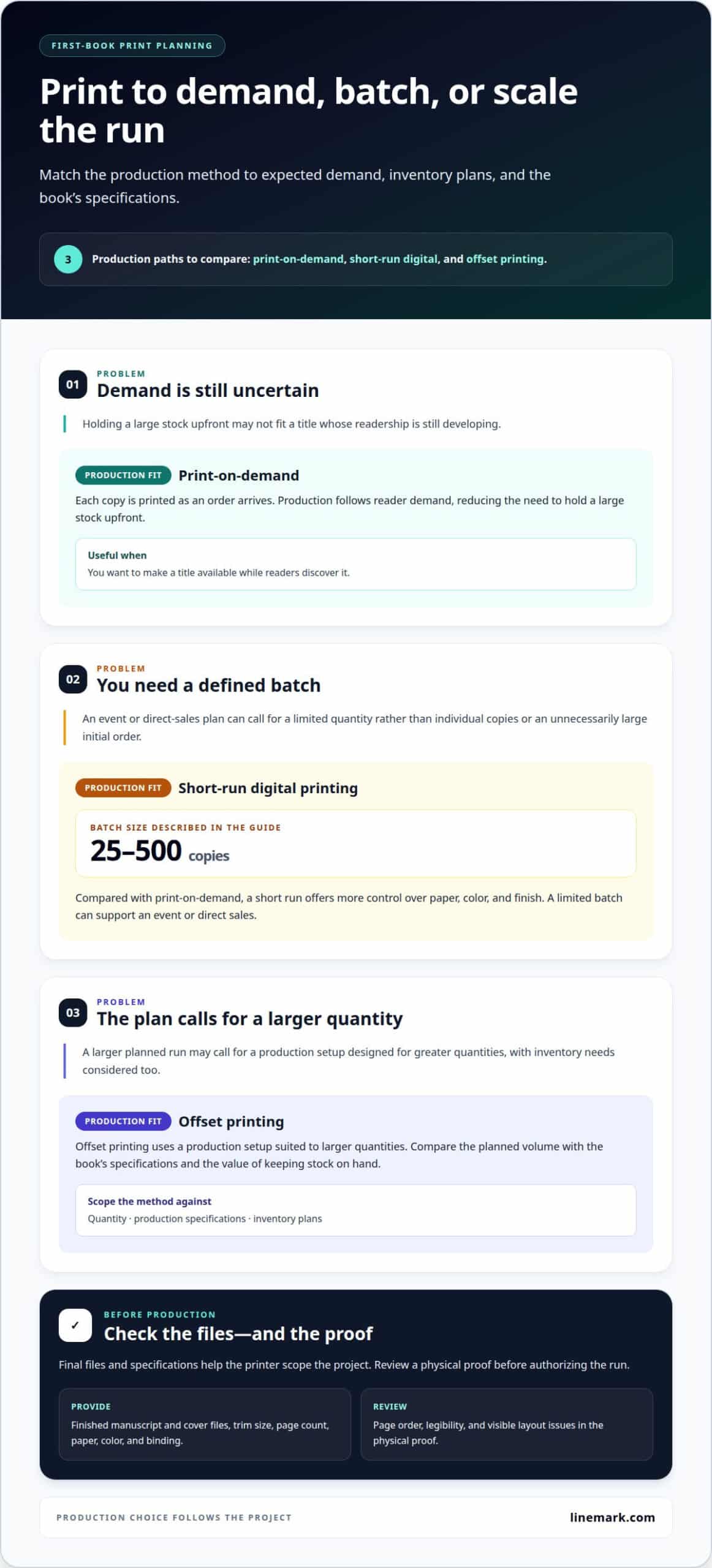
Independent authors can choose print-on-demand, short-run digital printing, or offset printing. The right option depends on expected demand, inventory plans, and the book’s production requirements.
- Choose print-on-demand to limit inventory. Each copy is printed as an order arrives, connecting production to reader demand. This reduces the need to hold a large stock upfront. For book printing for first-time authors, it can provide a practical way to make a title available while readers discover it.
- Compare short-run printing when you need a batch. Short-run jobs can involve batches of 25-500 copies. Compared with print-on-demand, this approach offers more control over paper, color, and finish. A limited quantity can support an event or direct sales, while avoiding an unnecessarily large initial order.
- Assess offset printing against the planned volume. Offset printing uses a production setup suited to larger quantities, while print-on-demand produces copies individually. The best fit depends on quantity, specifications, and the value of keeping stock on hand. A printer can scope the production method against the final book files and order requirements.
- Test demand before scaling. Start with print-on-demand or a controlled short run while you actively promote the book. Track orders, event interest, and reader responses through social media and direct sales. If demand grows, use that evidence to plan a larger offset run instead of committing to stock before readers respond.
- Include royalties and distribution in the decision. Profit per sale depends on the selling price, printing expense, and deductions from the sales channel or distributor. Print-on-demand can make copies available through online ordering, while author-sold batches require a plan for storing and fulfilling orders. Compare the resulting margin, not just the production method.
For a finished manuscript, publishing a book can take four to eight weeks. Shipping follows its own schedule, shaped by production completion, destination, and fulfillment arrangements.
Printing costs and print runs
Build a print budget around the finished book’s specifications and planned quantity. Printing costs depend on page count, trim size, paper, color, binding, and quantity. Each estimate is project-specific and provided after a quote request.
- Set a realistic quantity. Estimate how copies will reach readers: online orders, events, direct sales, or review outreach. Avoid committing to a large run, such as 5,000 copies, before demand supports that stock. A smaller initial quantity can help limit unsold inventory while you learn which channels generate orders.
- Compare production methods by use. Print-on-demand produces books as orders arrive, while a print run creates copies in a planned batch. Ask how each option fits your quantity, specifications, and fulfillment needs. For example, an author selling at a local event may need copies together, while online orders may suit on-demand fulfillment.
- Separate printing from publishing expenses. Editing, cover design, formatting, distribution, and promotion affect the full publishing budget, but they are distinct from physical production. Track each item separately. This gives you a clearer view of how printing changes the total amount you invest in the book.
- Calculate the sales margin. Compare the book’s sale price with printing expenses and any deductions from the sales channel or distributor. Amazon royalties depend on the platform’s terms and the book’s sale details, so use the applicable royalty calculation rather than assuming every sale returns the cover price. Include shipping or fulfillment expenses when you sell copies directly.
- Review the estimate before approving production. Confirm that the quote reflects the final manuscript’s page count, selected format, and requested quantity. Changes to editing or layout can affect the finished file and production scope. Resolve questions about specifications and included work before authorizing the run, then keep the approved estimate with your publishing budget.
For a project-specific estimate based on your book’s specifications and quantity, request a custom book printing estimate from Linemark.
Linemark: Custom Book Printing
Linemark provides Custom Book Printing for authors ready to turn a final manuscript into professionally produced copies. It’s a natural next step once you’ve settled on a format and want production planned around the book’s specifications and intended quantity.
Share the print-ready interior and cover files, along with the selected trim size, paper, color, binding, and quantity. These details define the production scope and help align the finished book with your publishing plans. For printed materials to support a launch, Linemark also offers Commercial Printing and Direct Mail.
For a coordinated production conversation about your book, contact Linemark.
Give your book a clear path to readers
Your first print edition can be part of a broader launch plan. Consider how the physical book will support readings, community outreach, or a campaign to introduce your work to new audiences. A thoughtful production plan helps your publishing decisions serve the book beyond its first release.
For book printing for first-time authors, the next step is to match your finished project with the right production partner. Linemark offers Custom Book Printing, while Direct Mail and Large Format Graphics can support related promotional efforts when they suit your launch.
Bring your book’s production needs and plans for reaching readers into one conversation. Contact Linemark about your book to discuss the next step. Your first book is a significant creative milestone; move forward with a plan that reflects the work you’ve put into it.
Frequently Asked Questions
How does print-on-demand compare with offset book printing?
Print-on-demand produces copies individually as orders arrive; offset printing produces a planned batch. At Linemark, digital printing is optimal for 1-500 units, while offset printing is optimal for runs of 500 or more. A debut title with uncertain demand may suit digital production, while a larger planned release can be assessed for offset. Compare inventory needs and distribution workflow alongside production quantity.
How much does it cost to print a book in the United States?
There’s no single U.S. price for printing a book. The estimate depends on the final page count, trim size, paper, color, binding, quantity, and production method. Budget separately for editing, cover preparation, and distribution, as these are distinct from physical printing. Linemark provides project pricing after a quote request, based on the book’s specifications and production requirements.
What is the minimum order quantity for book printing?
Linemark can produce print-on-demand orders starting with one copy, allowing an author to order a single presentation copy or proof. That minimum doesn’t automatically apply to a batch made using another method. For a batch, plan the quantity around the production approach and intended use, such as sending review copies, selling at an event, or fulfilling reader orders.
What steps are involved in preparing and ordering a printed book through a professional printer?
Start by providing the final manuscript and cover, and confirming the edition, quantity, and delivery destination. The printer scopes production, prepares files for the selected format, and provides a proof for review. After approval, production and finishing proceed before the copies are packed and dispatched. Keep one approved file version and specification sheet to prevent outdated artwork from entering production.
How do ISBNs, copyright, and book distribution work for self-published print books?
An ISBN identifies a book edition for retail and platform systems; paperback and hardcover editions need separate ISBNs. A barcode is typically generated from the ISBN and placed on the back cover. Copyright concerns rights in the manuscript and artwork, so resolve permissions for images, quotations, and contributions before printing. Distribution is a separate decision about sales channels and how copies reach buyers.