

 11/15/2026
 Steve Bearden
The best shelf sign isn’t always the biggest; it’s the format that fits the fixture and makes a product message easy to notice. A shelf talker is a small point-of-sale sign attached to a shelf edge or placed in front of a product to highlight information, features, or a promotion. Effective retail shelf talker printing starts by matching the sign’s size and mounting style to the available space.
Shelf talkers work alongside shelf labels and aisle signage to guide attention and communicate product details. The right format depends on what you’re promoting, how much information shoppers need, and how the sign fits the display. Here are common formats, practical selection criteria, and ways printed pieces can work together across an aisle.
Key Takeaways
- Match a talker’s size and mounting style to the shelf fixture, product, and message it needs to carry.
- Keep shelf-edge labels, talkers, and aisle signs coordinated so each serves a clear role in the shopper’s path.
- Compare print methods and materials against the display conditions, desired appearance, and campaign needs.
- Use commercial printing and large-format graphics to align product-level messages with broader in-store signage.
What is a shelf talker?
A shelf talker is a small point-of-sale sign attached to a shelf edge or placed in front of a product. It draws attention to an item with a feature, benefit, price, or promotion. In a grocery store, for example, a talker might call out a new flavor or a limited-time offer beside the matching product. Common sizes range from 2 × 3 inches to 3.5 × 5.5 inches, with the fixture and display space helping determine the right fit.
In the United States, retailer requirements may specify a talker’s size, placement, or adhesive based on the store and fixture. Use product details and offers approved for that retailer, and keep the message consistent with the displayed item. A promotion beside the wrong product can confuse shoppers, so accurate placement matters as much as clear wording.
A shelf label typically identifies a product or communicates its price; a talker gives one item added emphasis. It can explain a benefit, introduce a product, or make an offer easier to spot. A pharmacy display might use one to highlight a product feature, while a bookstore could call attention to a backlist title. The goal is a focused message, not a crowded shelf of competing signs.
Each talker works best with a brief, easy-to-scan message. A single point helps shoppers understand it quickly, and a headline of five words or fewer keeps the main idea prominent. Shoppers may give an individual product facing roughly one second of attention, so cluttered copy can be hard to process. Retail shelf talker printing should balance readable text, a suitable format, and a clear connection to the product. Across a wider campaign, custom talkers with consistent design can help stores present the same promotion across displays.
Choosing a format based on product and available space
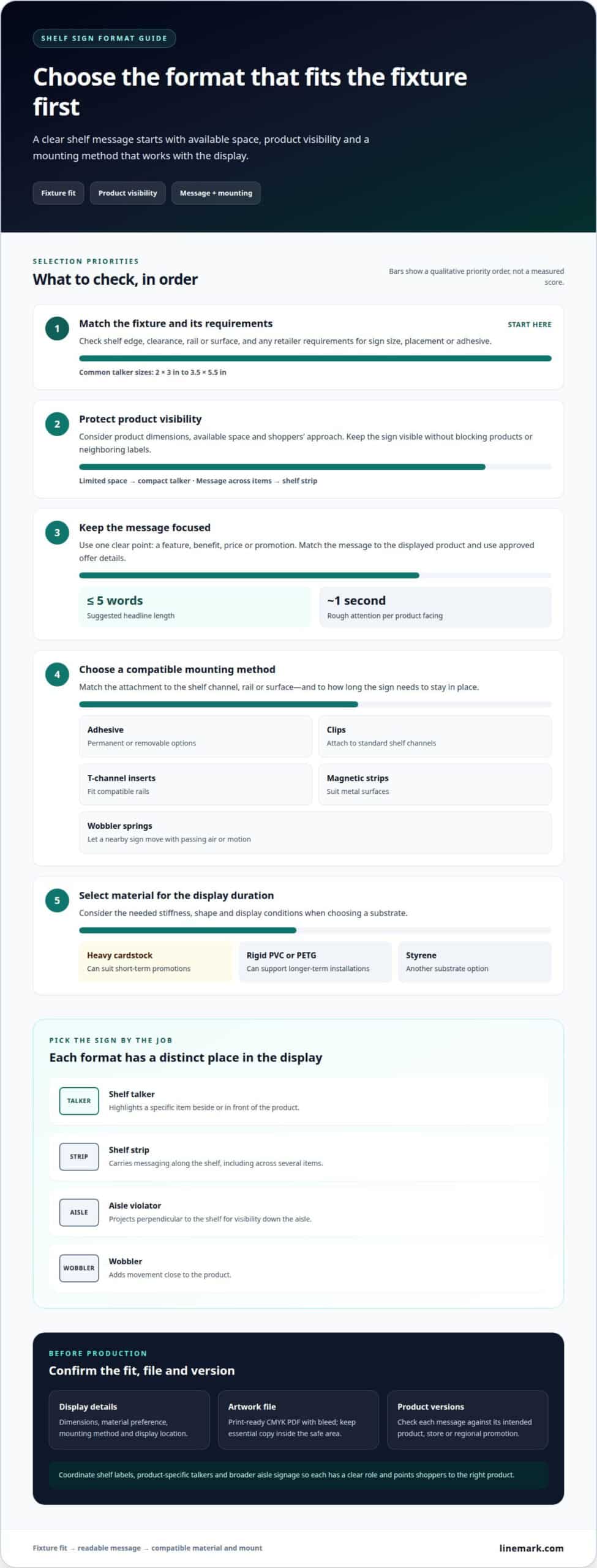
Match the sign format to the shelf fixture, product, and message. Consider the shelf edge, available clearance, shoppers’ approach, and whether the promotion needs a fixed or moving sign. A compact product with limited shelf space may suit a small talker, while a message spanning several items may work better as a shelf strip. The sign should be visible without blocking products or neighboring labels.
Mounting options depend on the fixture. Adhesive-backed signs can use permanent or removable adhesive. Clips attach to standard shelf channels, while T-channel inserts fit compatible rails. Magnetic strips suit metal surfaces, and wobbler springs let a sign move with passing air or motion. Compare the options with the retailer’s fixtures and campaign duration to choose a practical format.
Material affects a sign’s appearance and performance in its display environment. Heavy cardstock can suit short-term promotions; rigid PVC or PETG can support longer-term installations. Styrene is another substrate option. Consider the needed stiffness, shape, and intended use alongside the available space. Holders and clips secure the sign while keeping its message visible, and the right attachment depends on the shelf channel or surface.
For a broader point-of-purchase setup, a shelf strip carries messaging along the shelf, while an aisle violator projects perpendicular to it for visibility down the aisle. A wobbler adds movement close to the product. The provider helps weigh each format against product dimensions, message length, fixture compatibility, and the level of presence needed. For coordinated commercial print production, align the sign format with the campaign’s display requirements and artwork.
Printing shelf labels, shelf talkers, and signage in the aisle
Shelf labels, talkers, and aisle signage play different roles in a store display. Coordinated artwork helps shoppers connect each message with the right product or promotion.
Artwork and File Specifications for Shelf Talker Printing
Artwork specifications describe the digital file and layout a printer needs to produce a finished shelf sign. Supply a print-ready CMYK PDF with bleed, sized to the finished piece. Keep essential wording and product details within the safe area, away from trim edges. Use clear type and strong contrast so shoppers can read the message from a few feet away. A standard printed talker is around 3 by 5 inches, but the fixture determines the final dimensions.
Planning and Ordering Custom Shelf Talkers with a Printing Provider
Align the campaign message, display requirements, and production details before printing. Gather the sign dimensions, material preference, mounting method, and number of versions. Match the artwork to the product, such as a flavor callout or price promotion. Then prepare the production file and check that each version corresponds to its intended product and display location.
Clear versioning matters when shelf labels and talkers show different prices, product details, or regional promotions. Organize distinct artwork versions for the relevant store or region so each sign reaches its intended display. Review the final copy alongside its product association, especially when a campaign includes several SKUs or offer variations.
Coordinate the sign’s visual hierarchy with nearby aisle signage. Shelf labels should remain easy to identify, talkers should emphasize product-specific messages, and broader signage should support aisle-level navigation. Heavy cardstock with UV coating can suit short-term promotions; rigid plastic options, including PVC or PETG, can serve longer-term installations. Choose the substrate and print treatment to suit the display conditions and the information shoppers need to see.
What printing options are available for shelf talkers, including digital and offset?
Digital, offset, and screen printing can all be used to produce shelf talkers, depending on the design and production needs. Talkers can be digitally or screen printed on rigid substrates, then die-cut into custom shapes. Digital printing accommodates multiple artwork versions, such as different SKU callouts or promotional messages. Offset printing can suit a coordinated run with consistent designs. Choose based on the artwork, versioning, material, and production plan.
For campaigns with regional or product-specific variations, digital printing can help manage separate versions within a shared visual system. One store group may need a different product callout from another, even when both signs use the same overall design. Variable data printing supports changing information across printed pieces. Offset printing, by contrast, suits consistent designs when the same artwork is needed throughout the run. Weigh versioning needs alongside the substrate and finishing requirements.
Screen printing is another option for rigid shelf talkers, particularly when the construction and finish call for printing directly on the substrate. Die-cut the shape to suit the product display or campaign design. For example, a custom outline can make a product callout stand apart from a standard rectangular sign. The format still needs to fit the shelf fixture and keep product information easy to read.
Choose a process by considering how often the artwork changes, how many versions the campaign uses, and what material the display requires. A fixed message across stores points toward a consistent production setup; multiple SKU or regional callouts favor a versioned approach. The print method is only one part of the result: clear artwork, suitable substrate, and accurate trimming all contribute to a sign that fits its intended display. Plan your shelf talker printing project around its artwork, material, and version requirements.
Linemark
Linemark helps organizations plan printed communications that support product messaging across retail displays. Its Commercial Printing and Large Format Graphics offerings can help connect shelf-level messages with broader in-store signage. For example, a campaign may pair product information with coordinated aisle graphics, keeping the visual system consistent across the display.
Turn to Linemark when your project calls for coordinated print materials or large-format signage, especially when product messages need to work alongside wider campaign communications. The right format depends on the fixture, material, artwork, and intended placement. Aligning those decisions early keeps production focused on the display’s practical requirements.
Contact Linemark to discuss your retail print project.
Move your next retail message into production
Treat shelf communication as part of the wider customer experience. Consider how a product message connects with the materials shoppers encounter before, during, and after their time in the aisle. This broader view makes retail shelf talker printing one component of a coordinated communications effort.
Linemark offers Commercial Printing, Large Format Graphics, Direct Mail, and Custom Book Printing. These services support organizations with varied print and communications needs, including campaigns that bring printed materials and retail signage together. Contact Linemark to discuss your project requirements and production approach.
Contact Linemark about your printing needs and take the next step toward a clear, cohesive campaign. Your next retail message can start with a well-planned print project.
Frequently Asked Questions
How can a printing provider help determine the right quantity of shelf talkers?
Estimate quantity from the number of product displays, participating stores, and people likely to see the signs. Account for different product versions or regional campaign messages, since these affect how many of each design are needed. For example, a rollout with several SKU callouts needs quantities separated by version, rather than one total treated as a single design.
What should you consider when choosing color or black-and-white shelf talker printing?
Choose color when the sign relies on detailed images or substantial text, and consider black and white when a dark-colored design needs stronger contrast. The key is whether shoppers can distinguish the message quickly from nearby packaging and signage. A product photo may benefit from color, while a bold offer on a dark background may read more clearly with a simpler black-and-white treatment.
How can a printing provider help choose the right shelf talker format?
A printing provider can match the sign to the shelf fixture, available clearance, attachment method, and message. Share the display requirements and whether the sign should sit flat, extend from the shelf, or move. A narrow shelf channel may suit an insert, while a sign intended to catch attention from farther down an aisle may need a perpendicular format. Product visibility remains central to the choice.
What is a retail shelf talker and what is it used for?
A retail shelf talker is a small point-of-sale sign placed at a shelf or beside a product. Retailers use it to draw attention to a feature, explain a benefit, introduce an item, or highlight an offer. Unlike a general aisle sign, it focuses shoppers on a particular product. For example, a talker beside a new item can call out what distinguishes it from neighboring choices.
What are common shelf talker sizes, materials, and finishes?
Common sizes range from 2 × 3 inches to 3.5 × 5.5 inches, with the fixture and design influencing the finished dimensions. Materials include heavy cardstock, rigid PVC, PETG, and styrene. Heavy cardstock with UV coating can suit a short-term promotion, while rigid plastic substrates are suitable for longer-term installations. Die-cutting can create a custom outline when the display calls for a distinctive shape.
How durable are printed shelf talkers, and what materials resist moisture, fading, and handling?
Durability depends on the substrate, finish, installation period, and display conditions. Rigid PVC and PETG are suitable for long-term retail installations, while heavy cardstock with UV coating is an option for short-term promotions. These material descriptions don’t establish specific moisture or fading resistance. For signs subject to frequent handling or wear, match the substrate and finish to the intended use.