

 11/14/2026
 Steve Bearden
Office glass can protect privacy and carry a brand at the same time. Privacy window film with custom branding uses printable film applied directly to glass, combining graphics with a chosen level of visibility. Frosted, etched, perforated, transparent, or clear printed designs can shape how a workspace looks and feels.
Glass partitions keep offices open, but they can also leave meeting rooms and work areas exposed. The right film creates a visual boundary while preserving natural light, or makes glass a more visible part of your company’s interior design.
This guide covers the main film options and how they balance branding, privacy, visibility, and light. You’ll also learn what shapes the finished design and how a graphics partner can coordinate artwork, specifications, and production.
Key Takeaways
- Plan logo placement, colors, and graphics around the glass surface and the office’s visual identity.
- Use clear printable film to tailor privacy bands to the visibility the space needs.
- Choose between frosted, etched, perforated, and transparent finishes based on privacy, light, and sightlines.
- For branded office glass, Linemark’s Window Graphics and Large Format Graphics connect design goals with professional production.
What Is Commercial Custom Graphic Film?
Commercial custom graphic film is printable material applied to glass to display graphics, branding, or privacy details. Privacy window film with custom branding can turn an office partition or storefront into a designed feature. Depending on the film’s placement and purpose, the print can face inward or outward.
Start the design with your logo, color palette, and viewing distance. A detailed logo needs enough contrast against the glass and surrounding interior to stay legible. For example, place a company mark within a horizontal band and use larger graphics for campaign messaging across adjacent panes. Consistent colors connect the glass design with other brand materials.
Promotional window graphics can highlight a seasonal message, new location, or service. A storefront wrap can cover more glass, while a smaller graphic can draw attention to an entrance or display. Plan the artwork around doorways, handles, and sightlines so key text and logos remain visible from the intended approach.
In the United States, businesses must use certain markings on glass panels and doors to maintain safety and comply with applicable requirements. Building, signage, and fire-safety rules depend on local codes and site conditions. First-surface film is applied to the exterior; second-surface film is applied inside, with the graphics facing outward and protected from direct weather exposure.
Commercial graphic films typically last 5 to 10 years, depending on sun exposure, cleaning habits, and film type. Cleaning and maintenance affect longevity, so use care suited to the film and its printed surface. Glass compatibility, film selection, and removal method affect the risk of damage; warranty terms depend on the window and film involved.
Some commercial graphic films are removable without damaging the glass, making them suitable for seasonal promotions or rebranding. First-surface window films are applied to the exterior of the glass and are suitable for promotional graphics or short-term campaigns. Wide storefronts used for larger window-graphic applications can span 10-30+ feet.
Many commercial graphic window films block up to 99% of harmful UV rays. Frosted, etched, and patterned commercial films can create visual barriers while allowing light and maintaining an open feel. Commercial graphic films can be installed in compliance with local building and safety codes and may help meet privacy or ADA signage requirements in offices or medical settings.
Clear printable film and custom privacy bands
Clear printable film adheres directly to glass and can carry corporate colors, logos, or subtle patterns. It can also create custom-sized privacy bands, with visibility shaped by the design and coverage. For example, a band across a meeting-room partition can interrupt direct sightlines while leaving the upper and lower glass open. The visual effect depends on the artwork, film opacity, and how much glass it covers.
White ink adds opacity, depth, and layered effects to full-color graphics. A logo printed with white beneath selected colors can appear more distinct against glass than color alone. Designers can also reserve clear areas to preserve views through the surface. 3M offers printable and privacy film options; the film selected determines how the intended print and privacy design work together.
Large-format production starts with approved artwork and glass measurements. The layout is prepared for each pane, accounting for seams, edges, doors, and hardware. White ink can strengthen color or increase opacity where the design calls for it. The printed material is then finished to the specified format, helping a long privacy band or matching panels carry consistent graphics.
Custom graphic film can be ordered as 1 piece. Production time depends on artwork readiness, dimensions, finishing, and production scheduling; these factors shape the project timeline. For accurate measurement, professionals record each pane’s width and height, then note obstructions such as handles, frames, and mullions. Provide the number of glass panels, intended placement, artwork, brand colors, and privacy goal when ordering.
A fading gradient can transition from more opaque coverage to clearer glass, balancing privacy with an open interior. Clear printable film can also place a logo within a band, keeping corporate messaging visible without covering the entire window.
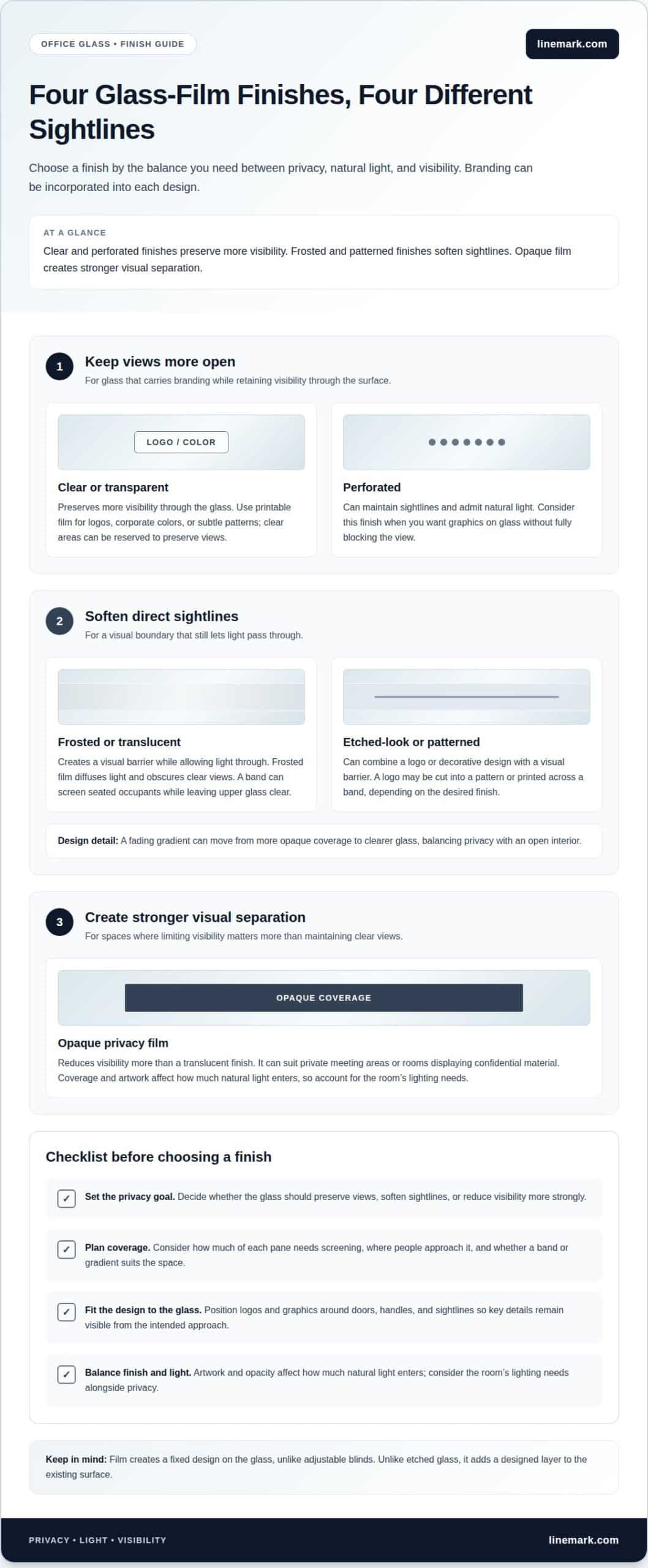
Frosted, etched, perforated, and transparent films
Film finishes balance privacy, natural light, and brand visibility in different ways. Choose based on whether the glass should soften sightlines, preserve views, or carry a decorative graphic.
Frosted and Translucent Finishes
Frosted and translucent finishes create a visual barrier while letting light pass through, helping an office feel open. A band across a conference-room partition can screen seated occupants while leaving the upper glass clear. The finish can cover selected widths, and a fading gradient can transition from stronger privacy to clearer glass. Consider how much of each pane needs screening and where people approach it.
Opaque Privacy Film
Opaque film reduces visibility more than a translucent finish, while frosted film diffuses light and obscures clear views. These options suit spaces where visual separation matters, such as private meeting areas or rooms displaying confidential material. Artwork and opacity affect how much natural light enters, so balance coverage with the room’s lighting needs. Branding can be incorporated into the covered area.
Decorative Film and Branding Options
Frosted, etched-look, and patterned films can combine logos with a visual barrier. Clear or transparent films preserve more visibility, while perforated designs can maintain sightlines and admit natural light. A logo can be cut into a decorative pattern or printed across a band, depending on the desired finish. These styles turn plain glass into branded interior graphics without treating every pane the same way.
Unlike blinds, film creates a fixed design on the glass rather than an adjustable screen. Unlike etched glass, it adds a designed layer to the existing surface. Custom-branded options include frosted, translucent, opaque, patterned, perforated, and transparent films. The finish determines the balance of privacy, visibility, and light.
Perforated and transparent commercial films can maintain visibility and let natural light through, while frosted or opaque films reduce visibility and diffuse light. Frosted and translucent window films can provide privacy while allowing natural light to flow through a space.
For businesses, frosted or decorative window film can be cut to different widths to improve privacy, and some films allow light through. Office privacy window film can be customized with varying opacity and fading gradients. The opacity and finished design determine how much natural light passes through.
Custom printed window film for branding, privacy, and design
Printed film combines a graphic treatment with a chosen level of privacy. Its effect depends on measurements, design coverage, opacity, and placement on the glass.
Branding, Design, and Privacy Uses
A custom design can mark a glass meeting room, reinforce corporate identity, or display a campaign on storefront windows. Account for pane edges, door hardware, sightlines, and viewing distance in the artwork. A commercial supplier can coordinate artwork, measurements, printing, and installation as one project. Review how the proposed layout fits each glass surface and serves its intended audience.
For example, a company logo can anchor a privacy band while adjacent panes carry supporting graphics. This keeps the visual system consistent without repeating the same artwork across every surface.
Privacy Performance
Film adheres to glass, and its design and opacity determine how much light passes through and how clearly people can see across the surface. Frosted or opaque areas reduce visibility; transparent or perforated designs preserve more sightlines. No finish provides the same privacy in every setting. Consider the room’s use, viewing angles, lighting, and whether the aim is to screen activity or block specific views.
Custom printing can place a logo or pattern within the covered area. The amount of film and its opacity determine the balance between privacy and openness.
Cost per Square Foot
In the United States, the price per square foot depends on the project and is provided after a quote request. Cost factors include measured glass area, film type, print complexity, coverage, finishing, and installation scope. A simple band and a multi-pane branded layout require different production planning. Accurate measurements define material quantities and help avoid pricing based on incomplete surface area.
Provide pane dimensions, artwork, desired coverage, and installation details to get a project-specific quote. These details give the estimate a clear scope.
Plan custom window graphics around your brand, glass measurements, and privacy goals.
Linemark: Custom Book Printing
Linemark helps businesses carry their visual identity across office glass with custom Window Graphics. Turn to Linemark when meeting rooms, interior partitions, or storefront windows need branded graphics that support privacy and design goals. Share the artwork, glass measurements, placement, and intended visibility to define the project scope. For coordinated communications, Window Graphics can work alongside Large Format Graphics or Direct Mail, connecting workplace branding with other campaign materials.
Linemark also offers Custom Book Printing for organizations producing branded publications. The right format depends on the project’s purpose and audience.
Contact Linemark to discuss your window graphics project.
Make Your Office Glass Part of the Brand
Office glass can do more than divide a room. It can express how your organization welcomes visitors, supports focused work, and presents its identity across a shared space. Treat the design as part of the workplace experience, not as an isolated graphic. This approach helps privacy window film with custom branding feel intentional within the broader environment.
As teams move, spaces change, and campaigns evolve, consider how each glass graphic will fit the next stage of your workplace. A clear design brief connects brand priorities with the practical role of each surface, giving the project direction from the start.
Linemark can help businesses bring that direction to life through Window Graphics, aligned with their broader communications needs. Share the goals for your space and begin shaping an approach that fits the way your organization works. Discuss your window graphics with Linemark, and take the next step toward a more considered office environment.
Frequently Asked Questions
What Is It Used For?
Custom-branded window film gives office glass a visual purpose while supporting space planning. It can identify a conference suite, mark reception, or distinguish a staff-only area. Coordinated graphics can help visitors find their way without another freestanding sign. Film can also carry an internal campaign message or reinforce an organization’s identity across shared workspaces.
What are the options for custom window film printing, colors, patterns, and opacity?
Options include full-color artwork, brand colors, logos, typography, and custom patterns, with opacity chosen for each glass area. A corporate palette can continue across adjoining panels, while a restrained gradient or repeating motif creates a different effect. Artwork can vary by pane, such as a prominent logo at reception and a simpler design beside offices. The layout determines how much glass remains visually open.
What is the minimum order quantity and typical production time for custom privacy window film?
Custom graphic film can be ordered as 1 piece. Production time depends on artwork readiness, dimensions, finishing, and production scheduling.