

 11/13/2026
 Steve Bearden
The strongest office branding does more than put a logo on the wall. Office interior design with branded graphics works best when reception signage establishes identity, directional and room signs make spaces easier to navigate, and window graphics, murals, timelines, or displays bring the company’s story into the workplace. In the United States, permanent room signs are subject to the 2010 ADA Standards for Accessible Design, according to the U.S. Department of Justice.
A cohesive visual environment can reinforce a company’s identity and help employees and visitors navigate the space. The key is to balance brand expression with practical needs, including readable wayfinding, privacy, and how people use each area. This guide to office interior design with branded graphics covers useful sign and display formats, how to integrate them into an office, and ways timelines and motivational visuals can support workplace culture.
Key Takeaways
- Build a signage hierarchy that helps visitors identify the company, find their way, and recognize rooms; permanent room signs must follow the 2010 ADA Standards for Accessible Design.
- Use murals and window graphics with purpose, balancing brand expression with privacy and the function of each space.
- Turn company history and employee recognition into visual displays that make workplace culture visible and meaningful.
- Plan timelines and motivational graphics around clear stories, suitable wall conditions, and artwork that fits the space.
1. What Are the Best Types of Signage for Office Interior Branding?
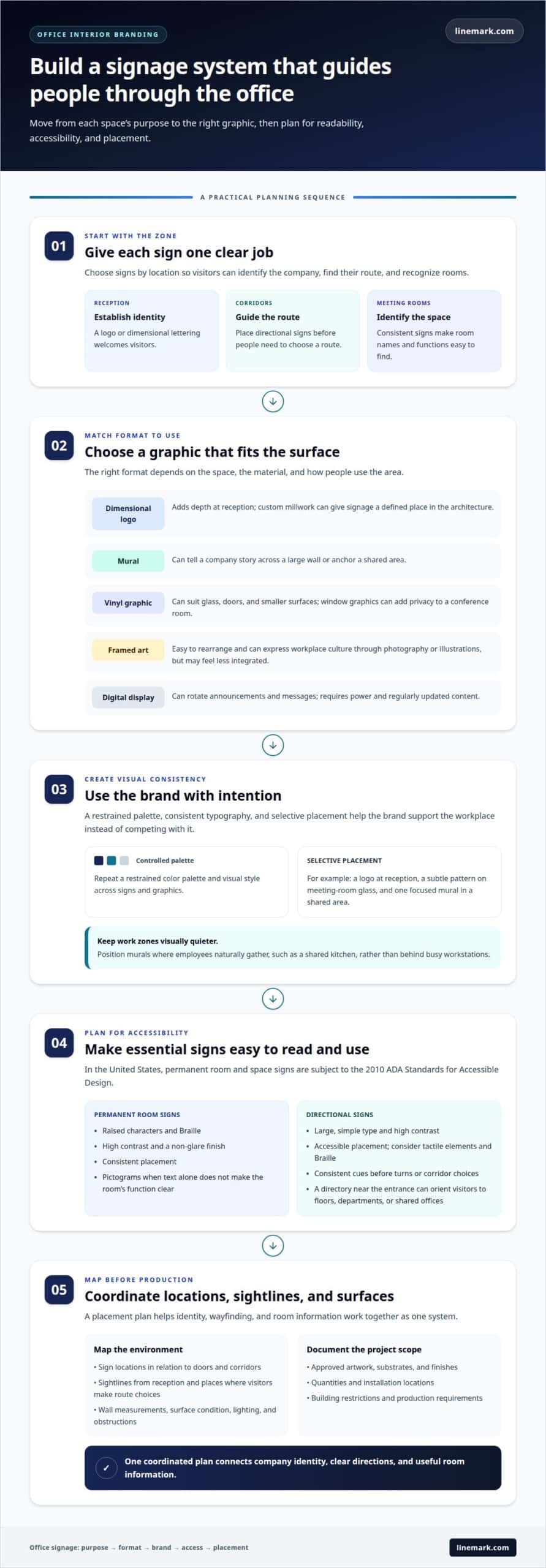
Choose signage by zone, and give each sign a clear purpose. At reception, a logo or dimensional lettering establishes the company identity and welcomes visitors. In corridors, directional signs should appear before people need to choose a route. Outside meeting rooms, consistent signs make room names and functions easy to find. This hierarchy creates a considered environment without making every wall compete for attention.
Custom murals can tell a company’s story across a large wall, while vinyl graphics can suit glass, doors, and smaller surfaces. Framed art is easy to rearrange and can express workplace culture through photography or illustrations, but may feel less integrated. Digital displays can rotate announcements and messages, but require power and regularly updated content. Match the format to the space and how it is used.
Office graphics can reflect a brand without overwhelming the workspace. Use a controlled palette, consistent typography, and selective placement. For example, feature a logo at reception, a subtle pattern on meeting-room glass, and one focused mural in a shared area. Keep work zones visually quieter, so the brand supports the environment rather than dominating it.
Custom millwork can make signage feel like part of the architecture. A reception desk with an integrated logo panel or shelving beside a branded feature wall gives the identity a defined place. Plan the sign’s scale and contrast alongside cabinetry, lighting, and sightlines, so visitors can see it without obscuring functional surfaces.
Permanent room and space signs in the United States are subject to the 2010 ADA Standards for Accessible Design, according to the U.S. Department of Justice. Permanent room signs use raised characters and Braille, with high contrast, a non-glare finish, and consistent placement. Pictograms are included when text alone doesn’t make a room’s function clear.
Wayfinding can use brand colors and fonts while keeping directions easy to read. Consider tactile elements, Braille, high contrast, accessible placement, and large, simple type. Keep directional signs consistent and place them before turns or corridor choices. A directory near the entrance can orient visitors to floors, departments, or shared offices.
Before production, map sign locations in relation to doors, corridors, and sightlines from reception. A placement plan helps identity, wayfinding, and room information work together as one system.
2. What is Corporate Office Space Design?
The principles of office interior design with branded graphics are purpose, consistency, and fit. Start with the office’s work zones, then choose visuals that support each one. A custom mural, for example, can anchor reception, while window graphics can add privacy to a conference room. Repeat a restrained color palette and visual style for a cohesive result.
A mural can express company culture through a landscape, product story, or abstract pattern based on brand colors. A large supergraphic can turn a blank wall into a visual landmark, while smaller graphics can identify collaboration or break areas. Dimensional logos add depth at reception, especially against a simple wall finish. Keep text brief and readable from the usual viewing distance.
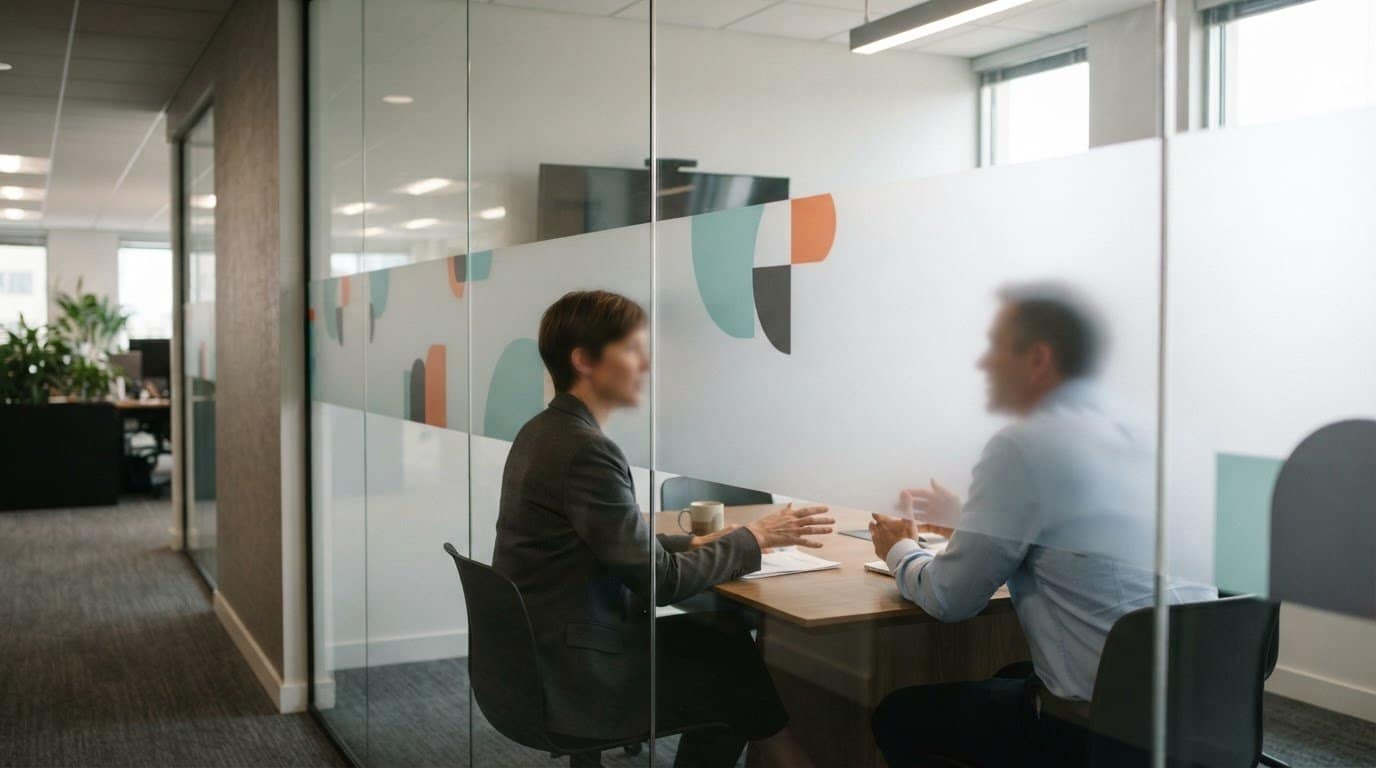
Placement matters. Position a mural where employees naturally gather, such as a shared kitchen, rather than behind busy workstations. Use window graphics on glass partitions to define meeting spaces without closing them off visually. A frosted pattern can provide privacy, while a logo or subtle color band connects the glass to the wider environment.
Installation requires careful attention to surfaces and materials. Vinyl may not adhere well across deep mortar lines or heavily textured walls. A primer or rigid panel overlay can provide a more suitable surface. Adhesives and coatings may create odors during installation, so specify materials and plan ventilation according to product instructions. Preparing the surface can also reduce the risk of paint or finish lifting during application or removal.
For a graphics project, the scope should document approved artwork, substrates, finishes, quantities, installation locations, and building restrictions. Include wall measurements, surface condition, lighting, and obstructions before artwork goes to print. A project team can then align the visual design with production and installation requirements. Large-format graphics can bring murals and window designs into one coordinated plan.
3. How do custom interior graphics improve employee engagement?
Visual details shape employees’ everyday experience of an office. A history wall can connect the workplace to its beginnings, milestones, and community contributions. Use dated photographs, concise captions, and a clear timeline to make the company story easy to follow. These elements can show how shared values and current work fit into a broader history.
Recognition displays can make appreciation visible without turning it into a competition. Feature team achievements, employee projects, or customer milestones, and refresh the content as work evolves. A rotating display near a break area, for example, can highlight contributions across departments. Choose images and materials that suit the company’s character, and keep names and stories accurate and respectful.
Graphics can support wayfinding by distinguishing visitor, employee, and service routes. Trace how a guest moves from reception to a meeting room, how employees reach shared spaces, and how deliveries access service areas. Then place clear cues at decision points. Color-coded zones or floor graphics can distinguish destinations, while a consistent visual style ties directions to the company’s culture.
A well-planned system can improve both employee engagement and the visitor experience. Visitors can see where to go, while employees encounter familiar values and achievements throughout the workplace. Keep routes unobstructed, and avoid busy graphics where people need to read directions or focus. In a corridor, use a simple directional marker and save detailed storytelling for a lounge or shared area.
Well-being depends on how the whole environment functions, not on graphics alone. Pair a calming mural in a break area with comfortable seating, plants, or natural light where available. In focused work zones, use restrained patterns and limited text. This balance lets branded elements reinforce identity without overwhelming daily work or making shared spaces harder to use.
4. Company timeline and motivational wall displays
A company timeline can communicate brand identity through founding milestones, product launches, community work, and team achievements. Arrange events chronologically, then pair each date with a concise caption and a relevant photograph or graphic. A clear visual sequence helps employees and visitors understand how the organization’s story has developed. Place the display in a lobby or shared corridor where people can pause without interrupting workplace traffic.
Motivational murals can bring a mission statement, short quote, or company value into daily view. Choose language employees recognize and pair it with imagery that reflects the organization’s work. A values-focused graphic in a collaboration space can encourage conversation, while a quieter illustration may suit a break area. Keep text brief and legible from the usual viewing distance.
Removable wall decals offer flexibility when messages or campaigns change. Use them for seasonal themes, team principles, or temporary wayfinding, then refresh the space as needs evolve. A gallery wall can combine framed achievements with decals for a more personal feel than one large graphic. Align the arrangement with nearby furniture and functional areas, so it does not obstruct movement or work.
Before artwork goes to print, review wall measurements, surface condition, lighting, and obstructions such as doors or switches. These details affect panel sizing and placement. Matte or satin finishes diffuse light and help preserve color fidelity. Gloss laminates under direct downlights can create hot spots that wash out colors. Paneling a large mural can also make it possible to replace a damaged section without reproducing the entire display.
Coordinate the timeline, motivational message, and visual materials as one system. A consistent palette can connect separate spaces, while distinct imagery gives each display a clear role. Plan your office wall murals around the story, surface, and lighting they need to serve.
Linemark
Linemark produces large-format graphics and other printed materials for office environments. When you are preparing branded wall displays, timeline graphics, or other large-scale visuals, Linemark can support production based on your approved artwork and project requirements.
Large Format Graphics can support prominent office displays, while Commercial Printing can help carry the same visual system into supporting materials. Share the intended placement, final artwork, dimensions, and preferred materials so production can align with the space and brand standards. This approach keeps the project focused on the communication goals, from visitor-facing graphics to workplace storytelling.
Contact Linemark to move your office graphics project forward.
Put Your Office Graphics Plan Into Motion
Make the next step practical: define the story each space should communicate, choose visuals that support it, and align the artwork with production needs. A clear plan helps your office feel intentional and keeps graphics connected to how employees and visitors use the space. The right office interior design with branded graphics can extend beyond the walls, creating a consistent visual thread across workplace and business communications.
Linemark can support a broader communications plan with Large Format Graphics, Custom Book Printing, and Direct Mail. These services can carry related messages into office displays, printed publications, and outreach materials, helping teams coordinate how the organization presents itself across formats.
Bring your priorities and project direction together, then start a conversation with Linemark about your office graphics. A focused plan is a strong foundation for a workspace that feels unmistakably yours.
Frequently Asked Questions
What Are the Best Types of Signage for Office Interior Branding?
Effective office signs provide the information people need at each point in their visit. A building directory can orient guests on arrival, department markers can clarify shared areas, and branded identification can make reception easy to recognize. For a unified system, use consistent terminology across signs, directories, and internal maps, so visitors do not encounter different names for the same destination.
How do custom interior graphics improve employee engagement?
Custom graphics can make workplace values tangible by connecting them to employees’ everyday experiences. A team-created illustration or display of project outcomes, for example, can show how people’s work contributes to shared goals. Invite employees to share stories or creative input, then curate the material so the finished display feels authentic, inclusive, and relevant across teams.
What is Corporate Office Space Design?
Corporate office design organizes a workplace to support business activity and express a company’s character. It brings together functional areas, furniture, lighting, technology, finishes, and visual communication. A useful plan considers how employees move between focused work, meetings, and breaks, while shaping what clients experience in reception and conference spaces. Graphics contribute to that plan, but work best as part of the overall environment.
What materials are best for long-term corporate wall graphics?
Choose materials to suit the wall surface and conditions. Smooth, clean walls can accommodate printed graphics, while textured masonry may need a rigid panel overlay rather than film applied directly to the surface. For sun-exposed walls, consider UV-stable inks and a protective laminate to help reduce fading. In busy corridors, specify finishes that can be cleaned without abrasive products.
What types of branded graphics work best in offices, such as wall murals, signage, and window film?
Choose the format according to its main purpose. Murals can tell a visual story across a broad wall, signs identify destinations or give directions, and window film can add privacy to glass partitions. An office might use a mural in a shared lounge, clear room signs outside meeting spaces, and a restrained film pattern on conference-room glass.
What materials and printing methods are best for durable office wall graphics?
Durability depends on matching the printed material and finish to the surface, light exposure, and expected handling. Printed graphics on a compatible substrate suit broad wall coverage, while rigid panels can help bridge uneven masonry. Digital printing supports short runs or personalized versions; offset printing suits larger, consistent production runs. Confirm the artwork, dimensions, and finishing requirements before production.