


 09/30/2026
  Steve Bearden
A kit’s components may arrive on time, but that doesn’t mean packaging, assembly, or delivery is included in the service you selected. Marketing kitting services can bring printed collateral, samples, and campaign materials together, but only when the provider’s scope matches your needs. Before choosing a partner, confirm exactly which steps it will manage.
This guide explains how to define your kitting scope and compare providers using practical operational criteria. You’ll learn what to ask about print production, assembly, inventory storage, order handling, and distribution, as well as which packaging requirements need separate confirmation. Linemark offers commercial printing, kitting and fulfillment, inventory management, direct mail, and nationwide distribution. Use the questions below to align components, responsibilities, and delivery plans before a campaign begins.
Key Takeaways
- Match marketing kitting services to your campaign’s audience, contents, volume, timing, and distribution needs.
- Map the workflow from component planning and production through assembly, quality checks, and delivery so responsibilities are clear.
- Compare providers using the same project brief, checking print coordination, inventory reporting, quality processes, and distribution scope.
- Specify packaging requirements for protection, dimensions, presentation, and shipping, then confirm what the provider can supply or coordinate.
- Build an intake checklist before discussing a program with a potential partner, including campaign goals, quantities, and timing.
What Marketing Kitting Services Include, and When They Help
Marketing kitting services combine specified items into a coordinated package or shipment for a campaign. A kit might include brochures, postcards, product samples, event materials, or other client-selected items. Choose the contents based on the audience and the action you want the campaign to encourage.
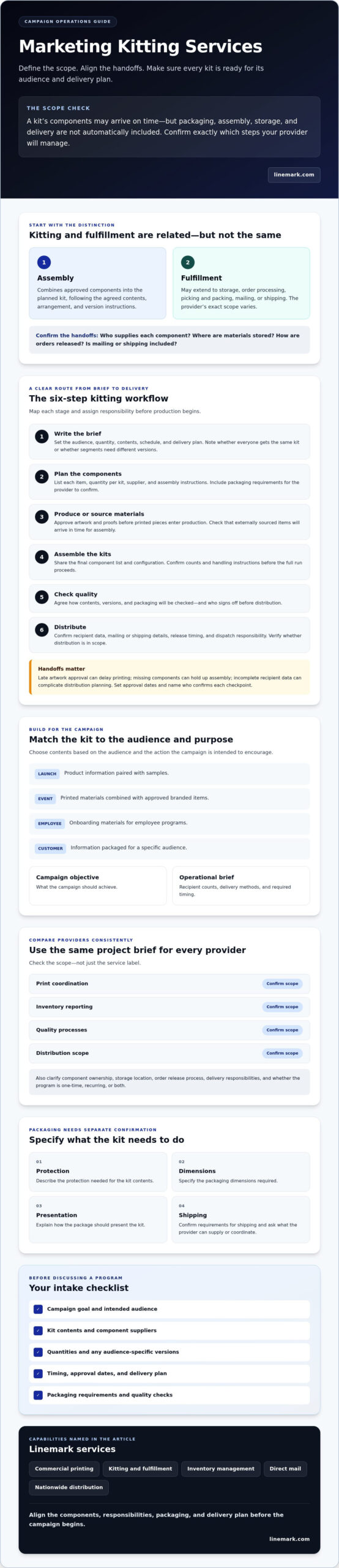
Assembly and fulfillment are related, but they cover different work. Assembly means combining approved components into the planned kit. Fulfillment may also include storing components, processing orders, picking and packing, mailing, or shipping. A fulfillment house may handle these logistical tasks, but its scope varies. Confirm who owns each step instead of assuming assembly includes storage or distribution.
For a quick overview of the kitting concept, watch this video:
What is marketing kitting, and how does it differ from standard fulfillment?
Kitting begins with a defined set of components and an assembly plan: what goes into each package, how items are arranged, and whether all recipients receive the same combination. Fulfillment is the broader handling of orders or shipments, which may continue over time. One campaign might need assembly only; another may require ongoing storage and distribution as requests arrive.
Before selecting a service, clarify the handoffs. Ask who supplies each component, where materials will be stored, how orders are released, and whether mailing or shipping is included. These details help determine whether the scope fits a one-time campaign, recurring requests, or both.
Which campaigns benefit from marketing kits?
Kits can support product launches, trade shows and other events, employee communications, and customer outreach. A launch package might pair product information with samples. An event kit could combine printed materials with approved branded items. Employee programs may need onboarding materials, while customer outreach can package information for a specific audience.
Audience segments can receive different combinations of approved materials when versions and assembly instructions are clearly defined. Keep the campaign objective separate from the operational brief: the objective explains what the campaign should achieve, while recipient counts, delivery methods, and required timing guide production and distribution.
Let the campaign goal determine the kit contents, then use the audience and delivery plan to define how each kit is assembled and distributed.
How Marketing Kit Components, Assembly, and Fulfillment Fit Together
A coordinated kit moves through clear handoffs, from campaign planning to delivery. Map the stages before production begins so artwork, components, recipient information, and timing stay aligned. A defined workflow also makes it easier to compare what different marketing kitting services include and where your team needs to provide input.
How does the marketing kitting workflow work?
- Write the brief. Define the audience, quantity, kit contents, schedule, and delivery plan. Note whether everyone receives the same kit or whether audience segments need different versions.
- Plan the components. List each item, its quantity per kit, who supplies it, and any assembly instructions. Record packaging requirements for the provider to confirm.
- Produce or source materials. Approve artwork and proofs before printed pieces enter production. Confirm that externally sourced items will arrive in time for assembly.
- Assemble the kits. Share the final component list and configuration with the provider. Confirm counts and handling instructions before the full run proceeds.
- Check quality. Agree on how contents, versions, and packaging will be checked, and who signs off before distribution.
- Distribute. Confirm recipient data, mailing or shipping details, release timing, and responsibility for dispatch. Check whether distribution is included in the provider’s scope.
Each checkpoint depends on the previous one. Late artwork approval can delay printing, missing components can hold up assembly, and incomplete recipient data can complicate distribution planning. Set approval dates and identify who confirms counts, quality, and delivery details at each handoff.
How do print and inventory management support campaign kits?
Printed inserts, brochures, postcards, and other collateral can be specified as kit components. If the project calls for personalized pieces, variable data printing may support different content for approved audience segments. Confirm data, versions, and production requirements with the provider. Linemark offers commercial printing, variable data printing, kitting and fulfillment, and inventory management, which can help coordinate print and kit planning.
Inventory visibility helps teams check what materials are available, plan replenishment, and compare stock with campaign demand. Ask what reporting is available, how inventory is recorded, and who authorizes reorders. If your kit supports a mailed campaign, Linemark’s direct mail marketing guide offers related planning context. For a broader view of the sector, see Future Market Insights’ Kitting And Assembly Packaging Services Market report.
For a program combining print, inventory, and distribution, review Linemark’s print and fulfillment capabilities against your project brief.
How to Compare Marketing Kitting Services Providers
Give each provider the same brief, including the component list, estimated volume, audience variations, and campaign timing. Otherwise, proposals may cover different scopes, making differences in price or capability hard to assess. Look for processes you can verify, not broad claims without project context.
| Capability | What to confirm |
|---|---|
| Service scope | Are assembly, storage, inventory management, and distribution included, or separately scoped? |
| Print coordination | Can the provider coordinate specified printed components, and what artwork or proof approvals are required? |
| Inventory reporting | What stock information is available, how often is it updated, and how are replenishment needs communicated? |
| Quality checks | How are kit contents, versions, counts, and discrepancies checked and documented? |
| Distribution | Which mailing or shipping responsibilities are covered, and what recipient data and delivery details must you supply? |
Which service capabilities should buyers compare?
Ask how the provider handles component shortages, damaged items, substitutions, and quality discrepancies. Establish whether substitutions need your approval before a kit is assembled. Confirm who makes each decision and how issues are reported. A defined approval and communication process helps preserve the intended kit contents and presentation.
Request a sample report or a description of the reporting available. Also identify the checkpoints where your team reviews proofs, kit configurations, counts, and dispatch details. These details are more useful than an accuracy claim without context. If a provider cites performance, ask what was measured and how the result was verified.
How can you assess fit, control, and scalability?
Ask each provider to map its proposed workflow to your components, quantities, kit versions, and delivery schedule. For segmented campaigns, find out how instructions distinguish each version and how the team checks that the correct approved materials are grouped together. Evaluate the process rather than relying on assurances about brand consistency.
Scale matters only when it fits your program. A large facility or high-volume claim doesn’t show whether a provider can meet your specific requirements. Ask how repeat campaigns and quantity changes would affect storage, component availability, approvals, and distribution. Linemark reports operating a 90,000-square-foot facility and offers commercial printing, kitting and fulfillment, inventory management, and distribution. For any provider, confirm the arrangements for your project rather than inferring capacity or service details from a headline figure.
How to Specify Custom Printed Boxes and Packaging for Marketing Kits
A kitting provider may assemble a kit without producing or sourcing its box. Treat custom printed boxes and packaging as defined project requirements, not automatic parts of marketing kitting services. Before choosing a provider, confirm who handles design files, production, sourcing, storage, assembly, and shipment. Some responsibilities may require separate suppliers.
What should a marketing kit packaging brief specify?
Give suppliers one clear specification. Describe the kit contents and item dimensions, intended presentation, protection needs, branding requirements, and packing instructions. Note whether all recipients receive the same packaging or whether segments need different versions. For printed branding, provide approved files and clarify who reviews proofs and authorizes production.
Set checkpoints before materials are produced and kits are assembled. Ask whether samples are available, which approvals are required, and when each component must arrive. Tie those milestones to the campaign delivery deadline, and make clear who is responsible if a proof is revised or a component arrives late.
- Protection and fit: Confirm that the packaging accommodates all components and suits the intended handling and delivery method.
- Dimensions and presentation: Share the contents and desired arrangement so suppliers can assess fit and the unboxing experience.
- Brand requirements: Specify approved artwork, required versions, and who signs off on proofs.
- Timing: Set deadlines for samples, approvals, production, component arrival, assembly, and dispatch.
How should buyers confirm packaging responsibility and fit?
Request a responsibility matrix that names the party accountable for each task. One supplier might source the box, another print the inserts, and the kitting provider assemble the contents. Identify who resolves a mismatch between packaging dimensions and kit components, approves changes, and confirms the final shipment configuration.
Check the proposed packaging against the actual items and delivery method. Confirm fit and presentation with the relevant suppliers. A box suitable for display may not also suit mailing or shipping. Packaging materials, assembly configurations, storage arrangements, and distribution options all need project-specific confirmation.
Linemark offers commercial printing, kitting and fulfillment, inventory management, and distribution. Custom box production isn’t a confirmed offering, so ask whether it can be accommodated or requires a separate supplier. Discuss your print and kitting requirements with Linemark as you define the project scope.
Plan a Marketing Kitting Program with Linemark
Start a project discussion with a clear view of the campaign and its operational needs. Linemark offers commercial printing, kitting and fulfillment, inventory management, direct mail, and distribution. Discussing these requirements together can help clarify how printed components and kit handling may fit together. Confirm responsibilities and capabilities for your project before production begins.
What information should you prepare before requesting a project discussion?
A concise brief helps the team assess the work and identify open questions before they create production or delivery issues. Include:
- Campaign goal and audience: What should the kit support, and who will receive it?
- Contents and artwork: List every component, note which items are printed, and indicate whether artwork is approved, in development, or still needed.
- Quantity and versions: Provide estimated kit counts and identify audience-specific combinations or personalized materials.
- Timing: Share key campaign dates, approval milestones, and the required delivery window.
- Recipient and distribution needs: Clarify whether kits will be mailed, shipped, or distributed another way, and what recipient information is available.
List storage, inventory visibility, assembly, mailing, and distribution as separate requirements. A provider may handle some steps but not others. If the project calls for custom printed boxes or other specific packaging, flag that requirement and ask what can be accommodated or needs a separate supplier. Don’t assume packaging production is part of a kitting scope.
How can integrated print and fulfillment simplify execution?
Planning print production alongside assembly gives the project team a clearer view of component readiness, approvals, and handoffs. Linemark offers printing, kitting and fulfillment, inventory management, and distribution. For campaigns combining kits with direct mail or distributed marketing materials, its MarCom On-Demand guide may provide useful planning context.
Use the discussion to confirm which materials Linemark can produce, which items you’ll supply, how inventory and storage will be handled, and who owns each distribution step. Comparing those answers with your brief can help surface gaps early. Clear answers matter more than assumptions about what marketing kitting services include.
Bring your component list, quantities, timing, and distribution requirements to the conversation. Discuss your marketing kitting requirements with Linemark to explore how its print and fulfillment services may fit your program.
Build a More Coordinated Marketing Kit Program
A strong kit program starts with a clear campaign goal and a practical plan for its contents, assembly, and delivery. When comparing marketing kitting services, confirm which steps are included, who manages each handoff, and how quality and inventory will be tracked. Treat packaging as a separate specification until the provider confirms what it can support.
Linemark offers kitting and fulfillment alongside commercial and direct mail printing. The company reports operating a 90,000-square-foot facility and having more than 30 years of experience. For your project, confirm the specific production, storage, packaging, and distribution responsibilities rather than relying on general assumptions.
Prepare your campaign goal, audience, component list, estimated quantity, schedule, and delivery requirements. A well-defined brief gives you a stronger basis for evaluating scope and coordinating execution. Discuss your marketing kitting requirements with Linemark to explore how its services may fit your program.
Frequently Asked Questions
What do marketing kitting services include?
Marketing kitting services generally assemble specified items into coordinated packages for a campaign. A kit might include printed brochures or postcards, product samples, and other client-selected materials. Depending on the provider and project scope, services may also include storage, inventory management, order handling, mailing, or shipping. Confirm which steps are included, which require separate suppliers, and who supplies, approves, and tracks each component.
How does marketing kitting differ from fulfillment?
Kitting is the assembly of specified components into a planned package. Fulfillment can cover a broader range of logistics, such as storing materials, processing orders, picking and packing items, and arranging distribution. A project may need assembly only or ongoing storage and delivery as well. Ask providers to define each included service and handoff rather than treating the terms as interchangeable.
Can marketing kitting services include custom printed boxes and packaging?
Custom packaging can be specified as a project requirement, but don’t assume the kitting provider produces or supplies it. Confirm who handles design files, sourcing, printing, storage, and assembly. Check dimensions against the kit contents and intended mailing or shipping method, and clarify who reviews samples and approves proofs. Linemark offers printing and kitting and fulfillment, but custom printed box production isn’t a confirmed offering, so ask about the project scope directly.
How do I choose a marketing kitting services provider?
Compare providers using the same campaign brief, estimated volume, kit versions, and timing. Check whether assembly, storage, inventory reporting, quality checks, and distribution are included or separately scoped. Ask how the provider handles missing or damaged components, substitutions, discrepancies, approvals, and reporting. Choose a workflow that addresses your requirements, and evaluate performance claims in context by asking what was measured and how it relates to a comparable project.
What information is needed for a marketing kitting project?
Prepare the campaign goal, intended audience, component list, estimated quantity, schedule, and distribution plan. Include artwork status, the number of kit versions, recipient requirements, and any personalization needs. List storage, inventory visibility, assembly, mailing, and shipping as separate requirements so responsibilities are clear. If the project needs particular packaging, provide its dimensions and presentation requirements, then confirm which supplier can source or produce it.
Can marketing kits include personalized printed materials?
Yes. Kits may include personalized inserts, brochures, postcards, or other printed pieces when the project calls for distinct content for recipient segments. Variable data printing can produce approved variations, subject to the provider’s capabilities and the project’s data and production requirements. Confirm the content versions, recipient information, proofing process, and how each version will be matched with the correct kit before production and assembly.
How should inventory be managed for a marketing kit campaign?
Track inventory by kit component, not just by finished package. Confirm which quantities are recorded, how stock levels and usage are reported, who can view updates, and who approves replenishment. Align inventory planning with campaign demand, assembly timing, and distribution releases. For repeat campaigns, clarify how remaining components are handled and how quantity or content changes will be reflected in inventory records and project instructions.