


 04/17/2026
  Steve Bearden
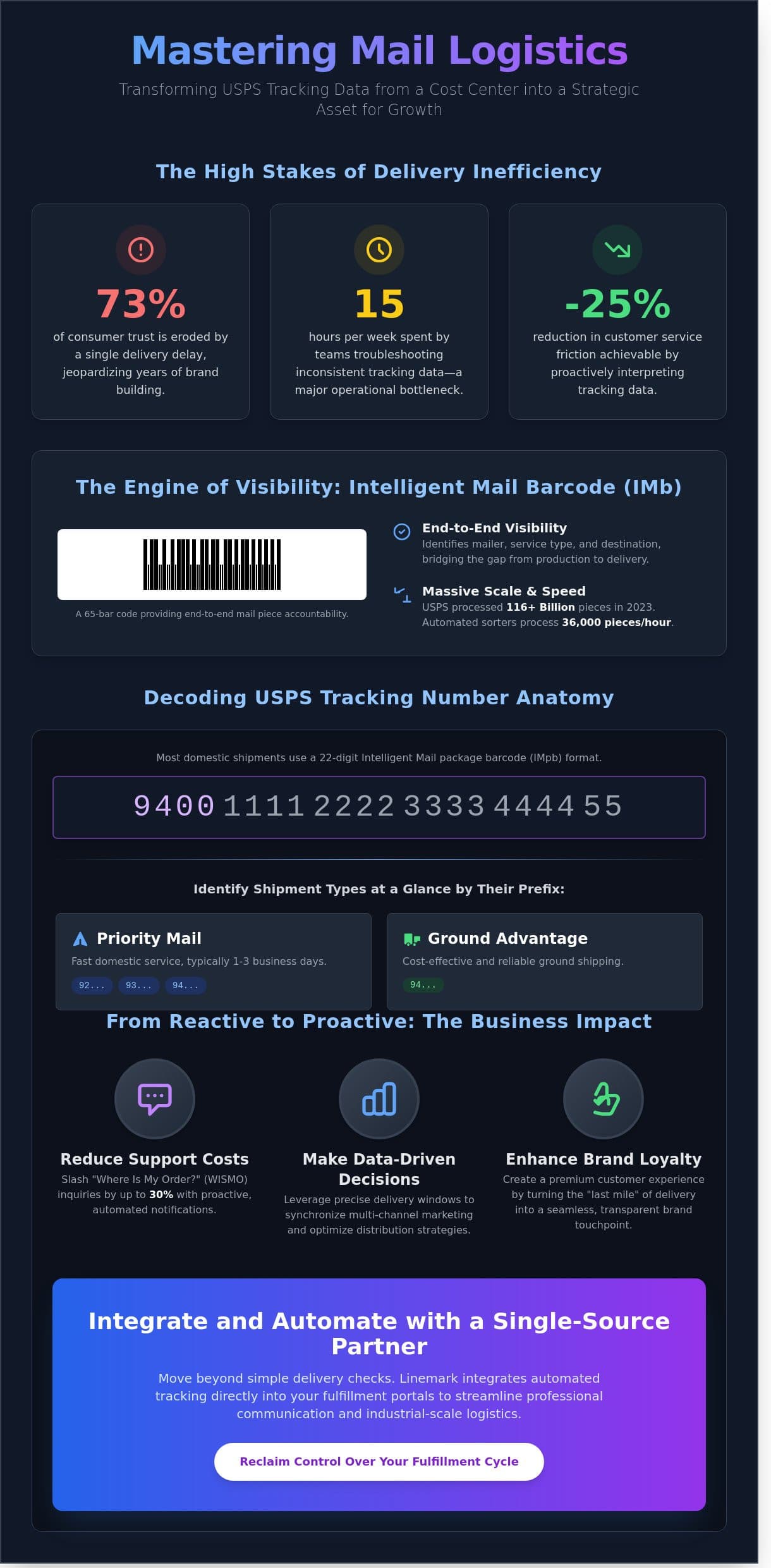
A single delivery delay doesn’t just stall a package; it erodes the 73% of consumer trust that high-growth brands work years to build, according to 2023 industry data. You understand that logistics is more than a cost center. It’s the final, critical touchpoint of your brand promise. When your team spends 15 hours a week troubleshooting inconsistent data from a usps tracking number tracker, the lack of automated visibility becomes a measurable operational bottleneck. We agree that inconsistent updates are a drain on your resources and your reputation.
By mastering the technical nuances of mail logistics, you can reclaim control over your fulfillment cycle. This guide provides the industrial authority you need to interpret complex tracking formats and reduce customer service friction by 25%. We’ll show you how to leverage these data points as a single-source partner, moving beyond simple delivery checks to strategic integration within your marketing workflows. You’ll gain a clear blueprint for using tracking data to enhance transparency, improve direct mail visibility, and drive long-term customer loyalty.
Key Takeaways
- Understand how the Intelligent Mail Barcode (IMb) provides end-to-end visibility, transforming standard mail into a sophisticated logistics asset for your business.
- Learn to decode the standard 22-digit format and service prefixes to effectively navigate any usps tracking number tracker and identify shipment types at a glance.
- Master the interpretation of common status codes to proactively manage delivery delays and resolve misconceptions regarding label creation and transit times.
- Discover how to synchronize multi-channel marketing efforts by leveraging precise delivery windows to trigger timely sales follow-ups and automated customer emails.
- Explore how a single-source partner integrates automated tracking into fulfillment portals to streamline your professional communication and industrial-scale logistics.
Understanding the USPS Tracking Number Tracker Ecosystem
Precision in mailing begins long before a parcel hits the sorting facility. The modern usps tracking number tracker isn’t just a status update; it’s a sophisticated data stream that provides end-to-end visibility for every mail piece. For high-volume mailers, this ecosystem relies on the Intelligent Mail Barcode (IMb), a 65-bar code that identifies the mailer, the service type, and the destination. This technology bridges the gap between industrial print production and final delivery, ensuring that every piece of mail is accountable from the moment it leaves the production floor.
Understanding the history of package tracking reveals how the industry moved from simple delivery confirmation to real-time logistics. In 2023, the USPS processed over 116 billion pieces of mail, making automated visibility a requirement for operational success. Businesses must distinguish between basic delivery confirmation, which only records the final drop-off, and full-journey tracking. Full-journey tracking captures every touchpoint across the national network, providing a level of transparency that was once reserved for premium courier services.
To better understand how this system works for the end user, watch this helpful video:
The Technology Behind the Scan
The system operates through a combination of active and passive scanning points. Active scans occur when a postal employee manually scans a barcode with a handheld device, typically during pickup or final delivery. Passive scans are generated by automated sorting equipment as mail pieces move through the 250 plus Processing and Distribution Centers (P&DCs) across the country. This data moves instantly from the facility to the usps tracking number tracker database, allowing for granular oversight of transit times. This automated equipment can process up to 36,000 pieces of mail per hour, ensuring that real-time visibility doesn’t slow down the logistics chain.
Benefits for High-Volume Senders
Transparency directly correlates with customer satisfaction and operational efficiency. By integrating tracking data into CRM systems, companies can reduce “Where Is My Order” (WISMO) inquiries by as much as 30%. This proactive approach builds brand trust. Instead of waiting for a customer to complain about a delay, a single-source partner uses this data to trigger automated notifications. This ensures the delivery experience is a seamless extension of your brand’s promise. Key benefits include:
- Reduced Customer Support Costs: Fewer inquiries mean your team can focus on complex issues rather than routine tracking updates.
- Data-Driven Decisions: Use transit time data to optimize mailing schedules and regional distribution strategies.
- Enhanced Brand Loyalty: Proactive communication during the “last mile” of delivery creates a premium customer experience.
Decoding USPS Tracking Number Formats and Anatomy
Understanding the architecture of a tracking number is vital for managing complex logistics. Most domestic shipments utilize a 22-digit format known as the Intelligent Mail package barcode (IMpb). This isn’t just a random string. It’s a precise data packet that communicates service type, mailer ID, and unique package identifiers. When you use a usps tracking number tracker, you’re accessing a database that interprets these specific sequences to provide real-time updates. The LineMark difference is built on this level of technical granularity, ensuring that every piece of mail is accounted for within a larger strategic framework.
Common Tracking Number Sequences
Identifying the service level of a package often requires only a quick glance at the prefix. The following sequences are the most prevalent in domestic and international shipping:
- Priority Mail: Usually starts with 92, 93, or 94.
- Ground Advantage: Often utilizes the 94 prefix following the July 2023 service consolidation.
- Certified Mail: Typically begins with a 70 sequence for legal verification.
- Registered Mail: Starts with “R” followed by 9 digits and “US”.
- Global Express Guaranteed: Utilizes a 10-digit numeric sequence.
International shipments following the Universal Postal Union (UPU) standard use a 13-character alphanumeric code. This format allows for cross-border interoperability between different national postal services, ensuring your usps tracking number tracker can pull data from foreign carriers once the package leaves domestic soil.
Why Format Accuracy Matters for Integration
Accuracy is the foundation of scalable fulfillment. A single digit error breaks the link between your warehouse and the customer. Most professional systems use checksum digits, the final number in the sequence, to validate the entire string. This mathematical safeguard ensures that your 3PL software or internal tracking tools don’t process “ghost” numbers. Preventing manual entry errors in fulfillment workflows reduces customer service inquiries by as much as 30 percent. Professional mailers use Strategic Tracking for Direct Mail to quantify the ROI of every drop, moving beyond simple delivery confirmation to true performance analytics. Integration with third-party logistics software requires these formats to be perfect to maintain a seamless data flow from the printing press to the recipient’s doorstep.
LineMark serves as a single-source partner to ensure these technical nuances never disrupt your operations. Our team manages the complexity of barcode generation and sequence validation so you don’t have to. Experience the LineMark experience and see how our integrated fulfillment solutions streamline your most demanding projects.
Troubleshooting Tracking Statuses and Delivery Delays
Managing high-volume mail campaigns requires more than just a usps tracking number tracker; it demands an understanding of the logistics behind the digital data. When a status remains stagnant, it’s often a result of automated systemic logic rather than a physical bottleneck. The “Label Created, Not Yet Received” status is a frequent point of friction. This update indicates the shipping manifest has been electronically transmitted to the USPS, but the physical pallet hasn’t received its initial induction scan at a Network Distribution Center (NDC). In a high-efficiency fulfillment environment, this gap typically closes within 12 to 24 hours.
Stalls at major distribution hubs often occur when regional volume exceeds processing capacity by 10% or more. This is common at high-capacity facilities like the Chicago or Jersey City NDCs. If a package shows a “Delivered” status but the recipient claims non-receipt, the solution lies in the Geolocation data. USPS scanners record the precise GPS coordinates of the final scan within a 6-foot radius. Utilizing a usps tracking number tracker to identify the exact delivery event time allows your team to verify if the mailpiece reached the correct loading dock or residential mailroom. This level of precision is part of the LineMark experience, where we treat every data point as a tool for operational excellence.
Deciphering the “In Transit” Loop
The “In Transit to Next Facility” update is often an automated system trigger. If a mailpiece doesn’t receive a physical scan at a new location within 24 hours, the USPS system generates this message to indicate the item is still moving through the network. It’s fundamentally different from “Arrived at Hub,” which confirms a physical scan. We advise clients to wait 7 business days before initiating a Missing Mail Search Request. This window allows the network to resolve temporary logistical surges without premature manual intervention.
Proactive Exception Management
Identifying “Undeliverable as Addressed” (UAA) flags early is a critical component of strategic mail management. Industry data shows that approximately 4.2% of domestic mail is undeliverable due to incorrect address information, which can lead to significant waste in postage and materials. By integrating tracking data directly into your CRM, you can clean mailing lists in real time. This proactive approach transforms a delivery exception into a data optimization opportunity. As your single-source partner, we help you communicate these exceptions to your customers with professional reassurance, ensuring that a simple delivery delay doesn’t compromise your brand’s reputation for reliability.
Strategic Tracking for Direct Mail and Marketing Campaigns
Direct mail functions as a high-impact catalyst when it’s integrated into a broader digital ecosystem. Utilizing a professional usps tracking number tracker strategy allows marketing teams to move beyond broad delivery estimates and toward precision execution. By leveraging Intelligent Mail Barcodes (IMB), we provide the visibility needed to align physical mailings with digital reinforcements, ensuring your brand stays top-of-mind during the critical 24-hour window following delivery. This proactive approach transforms mail from a static medium into a dynamic trigger for multi-channel engagement.
Synchronizing Mail with Digital Touchpoints
Effective campaigns thrive on timing. When tracking data confirms that 85% of your mail pieces have reached their destination, it’s the ideal moment to trigger a coordinated email blast or a targeted social media ad. This creates a seamless phygital experience where the physical touchpoint reinforces the digital message. You can explore how these tactics are evolving by reviewing our strategic guide on direct mail marketing in 2026. Additionally, USPS Informed Delivery now reaches over 62 million users as of 2024, providing a digital preview of the mailpiece that generates an average open rate of 68%. This effectively doubles your brand’s impressions before the envelope is even opened.
Data-Driven Campaign Optimization
Logistics data is a goldmine for marketing intelligence. By analyzing delivery speeds across different postal zones, brands can identify geographic bottlenecks that might be dampening response rates. This level of detail enables several strategic advantages:
- A/B Testing: Compare response rates between regions where mail arrived in 3 days versus 5 days to determine optimal drop dates.
- ROI Correlation: Match conversion spikes, such as a 12% to 18% increase in web traffic, directly to confirmed delivery dates in specific zip codes.
- Sales Alignment: Notify outbound sales teams to follow up exactly 48 hours after a high-value prospect receives a dimensional mailer.
As your single-source partner, we focus on turning these complex logistics into a streamlined path for growth. We don’t just print and ship; we provide the technological framework to ensure every piece of mail is an actionable data point. This commitment to operational excellence means your campaigns are always backed by hard evidence and precise timing. By monitoring the usps tracking number tracker data at a granular level, we help you identify exactly which distribution centers are moving your collateral most efficiently, allowing for real-time adjustments to your outreach strategy.
How Linemark Integrates Tracking into Professional Fulfillment
The MarCom On-Demand Advantage
Distributed teams often struggle with fragmented data and inconsistent branding. Our MarCom On-Demand portals solve this by centralizing tracking access while maintaining strict brand control. When a local agent or regional manager triggers a mailing, the system automatically generates tracking data. This allows corporate headquarters to monitor nationwide distribution programs in real time through a single dashboard. It’s a scalable solution that removes the guesswork from logistics, providing customized reporting that highlights delivery performance across different regions. This level of transparency empowers marketing leaders to make data-driven decisions based on actual arrival dates rather than estimates.
Partnering for Logistics Success
Successful mailing campaigns require more than just delivery; they require a strategic ally. We take a consultative approach to help you select the right mail class and tracking level, ensuring your budget aligns with your delivery expectations. The LineMark difference lies in our precision kitting and intelligent distribution systems. We synchronize the printing process with postal logistics to minimize lag time and maximize efficiency. Our team monitors the data from your usps tracking number tracker to ensure that high-priority kits reach their destinations as planned. If you’re ready to streamline your operations and gain better visibility into your mail stream, Contact Linemark for your next high-volume project. We provide the technical expertise and industrial capacity needed to turn complex logistics into a competitive advantage.
Mastering the Future of Professional Mail Logistics
Success in modern direct mail hinges on visibility and precision. By decoding tracking anatomy and leveraging a sophisticated usps tracking number tracker, your organization gains the clarity needed to troubleshoot delays before they impact your bottom line. Professional tracking isn’t just about knowing where a package sits; it’s about using that data to refine your marketing strategy and ensure your message reaches the right hands at the right moment. Integrating these insights allows for a more agile approach to customer engagement and campaign timing.
Navigating these logistical hurdles requires a single-source partner with the infrastructure to deliver at scale. Linemark combines 30+ years of industrial print expertise with advanced MarCom On-Demand technology integration to streamline your entire workflow. Operating from our 90,000-square-foot high-capacity facility, we transform complex mailing requirements into predictable, high-performance results. You’ll benefit from the LineMark difference where technical precision meets collaborative partnership. We’re ready to help you turn your next campaign into a logistical triumph through our commitment to operational excellence.
Partner with Linemark for seamless print and mail fulfillment
Frequently Asked Questions
How long does it take for a USPS tracking number to update?
Most tracking numbers update within 24 to 48 hours after the initial scan at a local post office or distribution center. This delay occurs because the usps tracking number tracker system relies on physical scans at key transit points. For high-volume mailers, data typically populates after the package reaches one of the 250 Network Distribution Centers across the country. If you don’t see an update after 72 hours, the package might be between transit hubs.
Why is my USPS tracking number not showing any information?
Your tracking number won’t show information until the first physical scan occurs at a USPS facility. This often happens within 24 hours of the label creation. If the status remains “Label Created, Not Yet in System” for more than 48 hours, the carrier likely hasn’t picked up the shipment or the barcode is unreadable. Precision in barcode printing is vital for 100% visibility in the logistics chain.
What is the difference between USPS Informed Delivery and standard tracking?
Informed Delivery provides a digital preview of letter-sized mail and manages incoming packages for a specific residential address. Standard tracking focuses solely on a single package’s journey from origin to destination using a unique identifier. While 50 million users enrolled in Informed Delivery as of 2024, standard tracking remains the primary tool for B2B logistics. It’s the difference between a daily digest and a dedicated shipment monitor.
Can I track a USPS package without a tracking number?
You cannot track a package through the public USPS portal without a valid tracking number. If you’ve lost the number, check your confirmation email or the physical receipt from the post office. Businesses using integrated fulfillment systems can often retrieve these numbers from their internal databases. For residential recipients, the Informed Delivery dashboard displays incoming packages even if the sender didn’t provide the number directly.
What does “Delivered, Front Desk/Reception/Mail Room” mean for businesses?
How long does USPS keep tracking information available online?
USPS maintains tracking records for standard shipments for 120 days after the delivery date. For services like Signature Confirmation, the data remains accessible for 1 year; Registered Mail records are kept for up to 2 years. We recommend archiving your logistics data monthly to maintain long-term records. This ensures your customer service team has access to delivery proof even after the USPS online portal purges the history.
Is USPS tracking available for all international shipments?
Full tracking is available for approximately 180 countries when using Priority Mail Express International. However, First-Class Package International Service only offers delivery confirmation to a limited list of about 35 countries. If you’re shipping to regions with less developed infrastructure, tracking often stops once the package leaves the U.S. border. Choosing the right service level is critical for maintaining visibility on global shipments.
What should a business do if a tracked package is lost in transit?
You should file a Missing Mail Search Request on the USPS website if a package hasn’t arrived within 7 business days of the expected date. For insured shipments, you can submit a claim for the value of the contents after 15 days. As a strategic partner, we suggest proactively monitoring your usps tracking number tracker data to identify delays before they impact customer satisfaction. Rapid intervention often resolves 60% of transit issues.