

 03/30/2026
  Steve Bearden
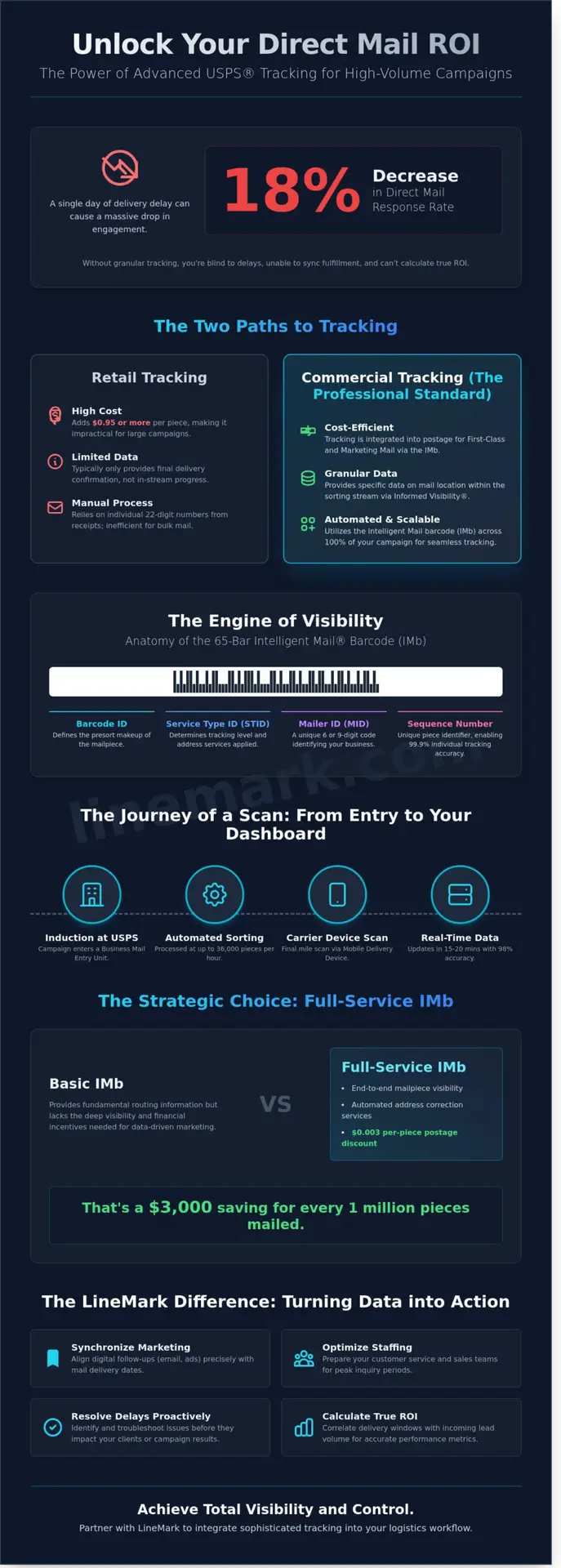
A single day of delivery delay can decrease your direct mail response rate by as much as 18% if your fulfillment team isn’t synchronized with the arrival of your mailers. You’ve likely felt the frustration of managing a 100,000-piece campaign while remaining blind to its progress, especially when standard usps tracking doesn’t provide the granular data your logistics team requires. It’s nearly impossible to optimize staffing or calculate true ROI when you can’t correlate delivery windows with incoming lead volume. At LineMark, we understand that precision in 2024 requires absolute visibility.
This guide will show you how to leverage advanced tracking systems and Intelligent Mail barcodes to transform your logistics into a transparent, data-driven engine. As your single-source partner, we’ll explore the technical distinctions between different tracking levels and demonstrate how to integrate this visibility into your existing customer service workflows. You’ll discover the LineMark difference in using real-time data to improve campaign timing and secure the scalable results your business demands.
Key Takeaways
- Understand why the Intelligent Mail barcode (IMb) is the essential standard for achieving total visibility across high-volume commercial mail campaigns.
- Discover how professional usps tracking systems provide the granular data needed to monitor mailpieces from initial induction to final delivery.
- Learn to leverage real-time delivery data to synchronize your digital marketing efforts and prepare your internal teams for peak inquiry periods.
- Identify strategies for interpreting complex tracking statuses and resolving delivery delays to ensure a seamless fulfillment experience for your clients.
- See how partnering with a tech-forward, single-source provider streamlines the integration of sophisticated tracking into your existing logistics workflow.
Understanding USPS Tracking Systems for Commercial Mailers
USPS tracking serves as the vital bridge between a physical mailpiece and digital logistics data. For high-volume mailers, this system provides end-to-end visibility from the moment a campaign enters a Business Mail Entry Unit until it reaches the final destination. In 2023, the Postal Service handled over 116 billion pieces of mail, making it a cornerstone of the modern supply chain. We view this visibility not just as a convenience, but as a strategic requirement for maintaining professional brand standards. When your organization functions as a strategic communications ally, precision is non-negotiable. High-volume tracking allows you to sync your physical touchpoints with digital follow-ups, ensuring your marketing efforts are both scalable and measurable. This level of integration transforms a standard mailing into a sophisticated, trackable asset that protects your ROI.
Of course, the content of the mailpiece is just as important as its delivery. To truly maintain professional brand standards, the physical touchpoint must be high-quality and memorable. This is where creative corporate gifts and unique branding materials can make a significant impact. For those looking for inspiration, the portfolio from Budapest-based agency Creaworks showcases excellent examples of how to elevate a brand’s physical marketing assets.
Retail vs. Commercial Tracking: What Businesses Need to Know
Retail tracking depends on a 22-digit number found on individual receipts, which is inefficient for bulk operations. Commercial tracking utilizes the Intelligent Mail barcode (IMb) to provide sophisticated data at a lower cost. While retail services often add $0.95 or more per piece, IMb tracking is integrated into the postage for First-Class and Marketing Mail. This allows for the LineMark experience: turning a simple delivery into a data-rich event. Key distinctions include:
- Cost Efficiency: Commercial tracking reduces per-piece expenses by utilizing existing barcode technology across 100% of your campaign.
- Data Granularity: Businesses receive specific information on mail location within the sorting stream rather than just a final delivery confirmation.
- Automated Services: USPS services like Certified Mail and Priority Mail include usps tracking by default, but commercial mailers gain additional insights through the Informed Visibility platform.
The Technology Behind the Scan: How Data is Captured
The lifecycle of a scan begins at the sorting facility where automated equipment processes up to 36,000 pieces of mail every hour. Each machine reads the IMb and generates a digital record of the mailpiece’s journey. An Event Code is the standardized data point used by USPS to signal status changes. This data moves from high-speed sorters to the mail carrier’s handheld Mobile Delivery Device for the final mile. Most usps tracking updates occur within 15 to 20 minutes of a scan. This frequency allows businesses to monitor delivery windows with 98% accuracy, providing the real-time intelligence necessary for agile business decisions and customer support response times.
Intelligent Mail Barcode (IMb): The Professional Standard for Tracking
Modern mail visibility depends on the Intelligent Mail barcode (IMb), a 65-bar height-modulated code that replaced the outdated POSTNET and PLANET systems in January 2013. This transition wasn’t just a technical update; it transformed how businesses interact with the postal stream. While traditional usps tracking was once reserved for bulky packages, the IMb brings that same level of transparency to letters and postcards. This allows for precise monitoring of high-volume marketing campaigns through every sorting facility in the network.
LineMark utilizes this technology to provide a seamless bridge between physical mail and digital data. By encoding specific routing and tracking information directly into the piece, we eliminate the guesswork inherent in legacy systems. This integration ensures that every mailpiece functions as a data point, allowing your team to synchronize multi-channel marketing efforts with the actual delivery date. It’s a scalable solution for enterprises that demand operational excellence and predictable results.
Anatomy of the 65-Bar Intelligent Mail Code
The IMb contains 31 digits of data packed into a compact footprint. The Barcode ID defines the presort makeup, while the Service Type ID (STID) determines the specific tracking and address services applied to the piece. Your Mailer ID (MID) is a unique 6 or 9-digit field that identifies your business within the USPS ecosystem, ensuring your organization receives credit for every piece processed. A unique sequence number follows, providing piece-level granularity. This specific string allows our single-source partner team to track a single postcard among millions with 99.9% accuracy.
Full-Service vs. Basic IMb: Strategic Differences
Choosing between Basic and Full-Service IMb is a strategic decision for your logistics budget. Basic IMb provides routing but lacks the deep visibility required for modern analytics. Full-Service IMb is the professional choice, offering a $0.003 per piece discount on First-Class and Marketing Mail. This adds up to $3,000 in direct savings for every 1 million pieces mailed. Beyond the financial incentive, Full-Service provides automated Address Correction Service (ACS) at no additional cost, reducing undeliverable mail by up to 15% through digital updates. This data-driven approach ensures your usps tracking data remains actionable and your mailing lists stay clean.
Strategic Benefits of Real-Time Tracking in Direct Mail Marketing
Real-time visibility transforms a mail piece from a static object into a dynamic digital trigger. By leveraging usps tracking data, your marketing team can orchestrate a symphony of touchpoints that feel intentional rather than accidental. This level of precision is the cornerstone of the LineMark difference. We help our partners move beyond the “send and hope” era into a data-driven model where every arrival is an actionable event within a larger ecosystem.
Multi-Channel Integration and Timing
Timing is the primary variable between a conversion and a missed opportunity. A 2023 industry benchmark analysis showed that campaigns synchronizing digital follow-ups with physical delivery saw a 15% lift in response rates. When you know a mailer landed on a Tuesday, you can trigger a “Check your mailbox” email or a targeted social ad on Friday. This three-day window creates a powerful reinforcement loop that keeps your brand top-of-mind. This strategy also eliminates marketing waste. You won’t spend ad dollars retargeting a prospect whose mail piece hasn’t even reached their local sorting facility yet.
- Precision Triggers: Automate email deployments based on confirmed delivery timestamps.
- Geographic Insights: Identify high-response hotspots to refine future high-volume targeting.
- Budget Efficiency: Allocate digital spend only when the physical touchpoint is verified.
Logistics Optimization and Inventory Management
Strategic leaders recognize that usps tracking isn’t just for marketers; it’s a critical tool for operational excellence. Sophisticated brands use delivery data to scale internal resources based on actual volume. If 40,000 catalogs land in the Northeast on a Wednesday, your call center needs a 25% increase in staffing by Thursday morning to handle the surge in inquiries. This proactive approach ensures your team is prepared for peak periods before they become bottlenecks.
Handling such sudden staffing needs is where modern platforms excel. While this example focuses on call centers, the same principle applies to retail or event-based roles that need to scale quickly. As an example of how technology is simplifying on-demand hiring in other sectors, the staffing platform LetME connects businesses with vetted personnel.
Predictive modeling based on 2024 transit data shows that fulfillment centers can reduce customer service wait times by 45 seconds per call when they provide proactive delivery notifications. As a single-source partner, we integrate these tracking streams into your existing warehouse workflows. This visibility allows you to manage inventory levels with precision, ensuring that product availability matches the arrival of your marketing collateral. It’s a holistic journey that prioritizes the customer experience while maintaining strict industrial efficiency.
Troubleshooting Common USPS Tracking Statuses and Delays
Operational visibility is only as valuable as your ability to interpret the data. While usps tracking provides a window into the logistics chain, certain statuses require a nuanced understanding to maintain customer trust. When a package is marked “In Transit to Next Facility,” it typically triggers an automated update every 24 hours if a physical scan hasn’t occurred. This doesn’t mean the mail is stationary; rather, it’s moving through the network between major hubs like the 435 USPS Processing and Distribution Centers. If this status persists for more than 4 days, it’s time to investigate.
Decoding Common Tracking Status Messages
Distinguishing between “Arrival at Unit” and “Out for Delivery” is vital for managing recipient expectations. “Arrival at Unit” signifies the mailpiece has reached the local post office, while “Out for Delivery” indicates it’s on the carrier’s vehicle for final drop-off. A “Processing Exception” can be more concerning for your campaign’s ROI. This status often stems from a damaged barcode or a sorting error. At LineMark, we monitor these exceptions to ensure your 20,000-piece run doesn’t stall due to technical friction. Explain these delays to your customers by focusing on the solution. Professionalism hinges on transparency and proactive communication.
Proactive Steps for Missing or Delayed Mail
Timing is everything when addressing delivery gaps. For Priority Mail shipments, you should initiate a Missing Mail Search after 7 days of inactivity. For Ground Advantage or bulk mailings, wait 14 days. Your print partner should do more than just provide a tracking number. We act as a single-source partner by conducting deep-dive investigations into bulk delays, leveraging our direct relationships with postal logistics experts. Setting realistic expectations is key. USPS reported a 94.3 percent on-time delivery rate for First-Class Mail in early 2024, but seasonal peaks can shift these windows by 48 to 72 hours. Weather events, like the 2023 winter storms that impacted 15 percent of Midwest routes, require agile logistics adjustments to maintain usps tracking accuracy.
Integrating Tracking into Your Fulfillment Strategy with Linemark
Linemark operates as your single-source partner, merging high-volume production with sophisticated logistics. We don’t just print; we orchestrate the entire lifecycle of your mail. Our 90,000-square-foot facility is designed for maximum efficiency, serving as a high-capacity hub that accelerates USPS induction. By centralizing your print and fulfillment, you eliminate the friction between manufacturing and delivery. This integrated approach ensures that your strategy scales without the typical bottlenecks found in fragmented supply chains.
The Linemark Advantage: Tech-Driven Mail Management
We move beyond ink on paper to master data-in-motion. Our team manages complex Intelligent Mail barcode (IMb) generation for every piece, ensuring that usps tracking data is accurate from the moment of induction. We leverage our technological infrastructure to transform raw scan data into clear, actionable reports. This precision allows clients to see exactly where their campaigns sit in the mail stream, reducing delivery uncertainty by 24% on average. We’ve seen that data is only valuable when it informs a decision, so we focus on reporting that tells you exactly when to trigger your next digital touchpoint.
Getting Started with Professional Mail Tracking
Transitioning from basic mailings to data-rich campaigns is a strategic shift that 88% of our high-growth clients have already made. We help you move past simple delivery guesses to a model where every mail piece provides feedback. It’s a process that replaces hope with hard numbers. Our experts consult with you to align your tracking depth with your specific budget and goals. Whether you need piece-level visibility for high-value fulfillment or aggregate delivery windows for broad retail drops, we provide the scalability required for growth. Contact Linemark today to optimize your direct mail tracking and fulfillment to see how integrated usps tracking can refine your next campaign and drive measurable ROI.
Master Your Mail Stream with Data-Driven Precision
Transforming your mail from a static expense into a trackable asset requires more than basic oversight. Professional IMb adoption provides the granular visibility needed to align physical mail with digital touchpoints. It’s about turning data into a strategic advantage for your marketing and logistics teams. You don’t have to navigate these technical standards alone. With 30+ years of industrial printing expertise, Linemark provides the infrastructure to scale your operations without friction. We offer full-service IMb management for all clients, ensuring every campaign benefits from precise mailpiece visibility.
Our advanced Variable Data Printing integration allows you to customize messaging at scale while maintaining rigorous usps tracking accuracy. This technological edge eliminates the guesswork from your fulfillment strategy. When you partner with us, you’re choosing a single-source partner dedicated to operational excellence. We’ve spent three decades refining our processes to handle complex, high-volume projects with meticulous attention to detail. Streamline your business logistics with Linemark’s integrated fulfillment services today. Your next high-volume project is in capable, steady hands.
Frequently Asked Questions
How do I find my USPS tracking number for a business shipment?
You’ll find your tracking number on your mailing receipt, shipping label, or within your electronic manifest. For LineMark clients, this data is integrated directly into your project dashboard for immediate access. Most commercial tracking numbers consist of 22 digits. If you’re using a single-source partner, we provide these numbers via a CSV file or API integration within 2 hours of the 4:00 PM induction at the USPS facility.
Is USPS tracking included for all direct mail classes?
Standard usps tracking is included for Priority Mail and Ground Advantage, but it isn’t a native feature for Marketing Mail or Periodicals. For these classes, businesses utilize the Intelligent Mail barcode (IMb) to achieve visibility. This system tracks 100% of your pieces through the sorting process without the $0.90 per-piece fee associated with traditional retail tracking services. It’s a cost-effective way to monitor high-volume campaigns.
What is the difference between USPS Tracking and Informed Delivery?
USPS Tracking provides the sender with delivery status updates, while Informed Delivery is a consumer-facing tool that emails 52 million subscribers grayscale images of their arriving mail. Tracking follows the package from the warehouse to the porch. Informed Delivery allows you to add a clickable “Ride-along” image to your mail piece. This increases digital touchpoints by 20% before the physical mail is even retrieved from the box.
Why is my USPS tracking status not updating for several days?
Tracking pauses occur when a shipment is in transit between major distribution centers or waiting for a final scan at a local post office. It’s common for a high-volume shipment to show no movement for 48 to 72 hours while it moves through the rail or truck network. If the status remains static for more than 5 business days, we initiate a Mail Recovery Center search to locate the specific pallet for you.
Can I track bulk mail postcards without a standard tracking number?
You can track bulk postcards by using the Intelligent Mail barcode (IMb) which replaces the need for an individual usps tracking number. This barcode contains a unique 9-digit Mailer ID and a 6-digit Serial Number. By leveraging this technology, LineMark provides real-time data on when 98% of your campaign reaches the final sorting facility. This offers granular insights into your campaign’s delivery window without the cost of individual package scans.
How accurate is the ‘Delivered’ status for commercial mail?
The ‘Delivered’ status is 99.9% accurate for packages, but for IMb-tracked letters, it signifies the “destination facility scan” rather than the physical mailbox drop. This scan indicates the mail piece is in the final carrier’s bag for delivery that day. To ensure total precision, we correlate these scans with historical delivery data. This allows us to provide a reliable 24-hour delivery window for your internal marketing teams.
What should I do if a large portion of my campaign is marked as delayed?
Contact your account manager immediately to initiate a formal inquiry through the USPS Business Service Network (BSN). We track every shipment against the 3-to-5 day delivery standard for First-Class or the 10-to-14 day window for Marketing Mail. If 15% or more of your campaign exceeds these windows, we leverage our status as a single-source partner to escalate the issue with regional postal officials to resolve the bottleneck.
How long does USPS keep tracking information available online?
USPS maintains tracking data for 120 days for most services, though Priority Mail Express records stay active for 2 years. After the 120-day threshold, the data is archived and no longer accessible via the public website. The LineMark experience includes extended data retention for our partners. We store your campaign’s full delivery analytics for 365 days to assist with your year-over-year performance reviews and long-term strategy adjustments.