

 03/24/2026
  Steve Bearden
Scaling a direct mail campaign to 50,000 pieces shouldn’t mean sacrificing the color integrity that defines your brand identity. You’ve likely felt the frustration when a critical marketing asset arrives with inconsistent hues or when unit costs erode your ROI on high-volume projects. It’s a common hurdle for growing enterprises managing complex logistical demands. We understand that your reputation relies on the mechanical precision of offset printing to deliver a uniform, professional finish every time.
You deserve a production process that scales as fast as your ambitions without adding unnecessary complexity to your daily workflow. In this strategic guide, you’ll discover how the Linemark difference leverages advanced technology to provide flawless Pantone color matching and a lower cost per unit for runs of 1,000 or more. Precision matters. We’ll show you how a single-source partner integrates high-capacity production with streamlined fulfillment to eliminate inventory headaches and drive measurable results for your bottom line.
Key Takeaways
- Understand the lithographic mechanics and technical logic that ensure consistent, high-fidelity image quality across your most demanding production runs.
- Identify the critical break-even point where high-volume production transitions from a standard expense to a strategic, scalable financial advantage.
- Learn how to optimize your marketing ROI by selecting offset printing for large-scale projects that demand unmatched color precision and unit-cost efficiency.
- Master the collaborative pre-press phase to ensure high-resolution accuracy and flawless execution from initial file preparation to the final impression.
- Discover how to leverage a single-source partner to seamlessly integrate complex print production with global distribution and multi-channel communication strategies.
Understanding the Industrial Power of Offset Printing
Precision defines the industrial standard for high-volume commercial production. Offset printing is a sophisticated lithographic process that relies on the chemical repulsion of oil and water to transfer images with surgical accuracy. Unlike digital methods that apply toner or ink directly to the surface, this system uses a series of rotating cylinders. A metal plate carries the image, transfers it to a rubber blanket, and finally presses it onto the substrate. This “offset” logic protects the plate from wear and ensures a crisp, consistent image that doesn’t degrade over long cycles. For Maryland businesses ordering 1,000 units or more, this method remains the undisputed leader in cost-efficiency and professional finish. It provides a level of saturation and detail that remains unmatched by standard office equipment or entry-level digital presses.
To see these mechanical components in motion, watch this technical overview of the process:
Linemark has operated as a single-source partner since 1985, refining these mechanical nuances to deliver scalable results for complex marketing needs. Our facility utilizes advanced multi-color presses that handle the heavy lifting of modern commerce with ease. We don’t just print; we act as a strategic ally in the logistics of high-volume communication and brand management. Our expertise in offset printing allows the team to maintain a 99.8% accuracy rate on brand-critical colors, providing a level of reliability that ensures your 10,000th brochure looks exactly like your first. This 30-year history is built on the ability to merge technical pride with agile problem-solver mentalities. We focus on the relationship over the transaction, ensuring that every project benefits from the meticulous attention to detail usually reserved for boutique shops, but delivered at an industrial scale. This is the foundation of the LineMark experience.
The Mechanics of Modern Lithography
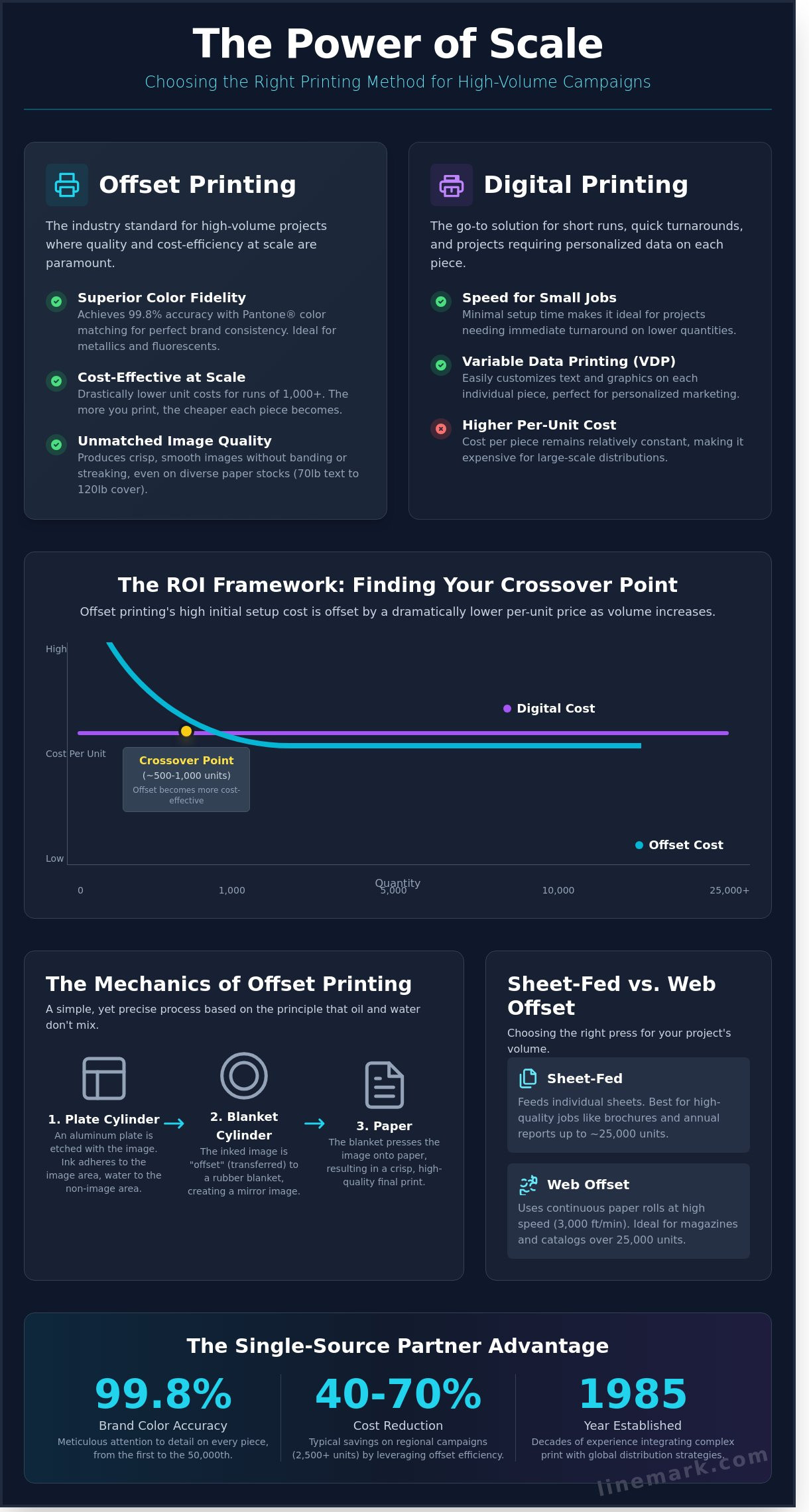
Modern lithography functions on a foundational chemical truth: oil and water don’t mix. We treat aluminum plates so the image area attracts oil-based ink while a dampening system applies water to the non-image areas. This ink transfers to a flexible rubber blanket before reaching the paper. This intermediate step prevents plate wear and ensures clean impressions on diverse textures, from 70lb text to 120lb cover stock.
Sheet-Fed vs. Web Offset: Which Fits Your Scale?
The choice between sheet-fed and web offset depends on your volume. Sheet-fed presses process individual pre-cut sheets, making them the superior choice for high-quality 100lb gloss brochures and annual reports. When projects exceed 25,000 units, web offset becomes the efficient path. These presses use continuous rolls of paper and reach speeds of 3,000 feet per minute, offering significant cost reductions for massive catalog or magazine distributions.
Strategic Advantages: When Offset is the Scalable Solution
Offset printing remains the primary driver of cost-efficiency for high-volume production because it rewards scale with mathematical precision. While digital setups provide speed for short runs, they lack the dramatic unit-price decline found in traditional lithography. Once the initial aluminum plates are etched and the press is calibrated, the marginal cost of each additional impression becomes negligible. For Maryland businesses executing regional campaigns of 2,500 units or more, this efficiency typically translates into a 40% to 70% reduction in total project expenditure. It’s a scalable solution that turns high-capacity requirements into a significant competitive advantage.
The technical superiority of the process is rooted in its mechanical consistency. The inking apparatus of an offset printing machine utilizes a sophisticated series of rollers to distribute ink with extreme uniformity, resulting in a level of image “smoothness” that digital dry toners cannot replicate. This method eliminates the common “banding” or “streaking” often seen in large areas of solid color on digital devices. It also allows for the seamless integration of specialized inks, such as metallic silvers or vibrant fluorescents, which add a premium tactile feel to annual reports and high-end lookbooks. For multi-location corporate entities, this process guarantees that a brochure printed for a Baltimore office is an exact match to one distributed in Bethesda.
Unmatched Color Precision with PMS Matching
Standard digital printing relies on the CMYK four-color process, which “builds” colors by layering small dots of cyan, magenta, yellow, and black. This can lead to subtle shifts in hue between different machines or print windows. In contrast, offset printing utilizes the Pantone Matching System (PMS) to apply pre-mixed “spot” inks. This ensures 100% color accuracy for specific brand elements like logos or corporate headers. Pantone colors act as a universal language for designers and printers, ensuring that a brand’s visual identity remains consistent across every geographic market. This level of precision is why offset is considered the gold standard for maintaining brand equity and professional integrity.
Substrate Versatility Beyond Standard Paper
Offset presses provide the mechanical pressure and ink control needed to master “difficult” surfaces that often cause jams or poor adhesion in digital equipment. Whether your project requires 130lb heavy cardstock, deep-etched linen textures, or synthetic tear-resistant materials, the ink saturation remains deep and permanent. This versatility gives marketing teams the creative freedom to select materials that reinforce their brand’s message through touch and weight. You can further enhance these specialized materials with advanced print finishing techniques like soft-touch laminates or spot UV coatings. These tactile details are a core part of the LineMark experience, turning a standard piece of collateral into a high-impact sensory tool that commands attention. Our role as a single-source partner ensures that these complex substrate choices move through production and into fulfillment without a single hitch in the supply chain.
The ROI Framework: Offset vs. Digital Printing
Choosing the right production method isn’t just a matter of price. It’s a strategic calculation that balances speed, customization, volume, and precision. You shouldn’t view this as a binary choice between old and new technology. Instead, think of it as selecting the right tool for a specific business objective. While digital offers agility for short-run projects, offset printing remains the undisputed leader for high-volume efficiency and color fidelity. As a single-source partner, LineMark helps Maryland businesses identify the exact moment when a project should shift from a digital engine to a heavy-duty press.
Of course, these tactical decisions are most effective when guided by a cohesive marketing strategy. For growing B2B companies that need senior leadership to navigate these choices but aren’t ready for a full-time executive, it’s wise to explore Fractional CMO services to ensure every dollar is spent effectively.
A common misconception persists that digital is always the faster route. If you’re printing a dozen personalized pitch decks, digital is the clear winner. However, if your marketing plan requires 15,000 catalogs, the math changes. A modern offset press can process 15,000 sheets per hour. Once the initial setup is complete, the speed of production far outpaces digital alternatives. We act as an agile problem-solver, analyzing your deadlines and distribution needs to ensure your timeline stays intact. We don’t just print; we optimize your communication logistics.
Calculating the Total Cost of Ownership (TCO)
The financial logic of offset printing hinges on the relationship between fixed and variable costs. Offset requires a front-loaded investment in plate-making and press calibration. Digital printing avoids these setup fees but carries a higher variable “per-click” cost for every page that passes through the machine. According to data from the PRINTING United Alliance, the economic crossover point typically occurs when a project exceeds 1,000 to 1,500 units, depending on the complexity of the piece.
- The 500-Unit Scenario: For a 500-unit run of a 16-page brochure, digital is often the most cost-effective path. You avoid the $400 to $600 setup costs associated with plates.
- The 5,000-Unit Scenario: On a 5,000-unit run, the lower per-unit cost of offset absorbs the setup fee. The total cost might drop by 35% compared to digital production.
Quality Benchmarks: The “Good Enough” vs. “Premium” Debate
Quality isn’t just about resolution; it’s about the physical interaction between the ink and the substrate. In digital printing, toner or ink sits on top of the paper. In the offset process, the ink is absorbed into the paper fibers, creating a rich, matte finish that feels integrated rather than applied. This is why 82% of high-end custom book publishers still insist on offset for their flagship titles. The tactile experience of a premium brand identity is difficult to replicate with digital approximations.
You must ask if your brand can afford a “good enough” finish. If you’re using specific Pantone colors or heavy textured stocks, offset provides a level of saturation and consistency that digital cannot match. We maintain the meticulous attention to detail of a boutique shop while operating at a massive industrial scale. This ensures that whether you’re printing 2,000 or 200,000 pieces, the color remains identical from the first sheet to the last. Our integrated services turn these technical advantages into a scalable solution for your growing business.
The Pre-Press and Production Journey
Offset printing requires a higher level of technical synchronicity than digital alternatives. It’s a collaborative dance where our engineers and your design team align on every technical specification. This phase transforms a digital concept into a physical reality through a series of meticulous steps. We start with the creation of custom aluminum plates. Each color in the CMYK spectrum gets its own plate, etched with laser precision to ensure 100% image fidelity. This isn’t just a mechanical step; it’s the moment your brand’s visual identity is locked into a tangible medium.
Once these plates move to the press floor, the “make-ready” process begins. This is where our press operators calibrate the ink-to-water balance and register the plates with microscopic accuracy. It’s a high-stakes setup phase. In high-volume environments, a 0.5 millimeter misalignment can ruin a 20,000-unit run. We don’t settle for “close enough.” Our team monitors the press continuously, adjusting ink flow and pressure until the output reaches the 99% color consistency our partners expect. This level of control is why the LineMark experience is synonymous with industrial reliability.
File Preparation and Proofing Protocols
Precision starts at the file level. We require all high-resolution assets at 300 DPI or higher to prevent pixelation on the final product. Your files must include a standard 0.125-inch bleed and clearly defined trim marks to ensure the cutting process is seamless. While digital proofs are excellent for layout verification, they can’t replicate how ink interacts with specific paper stocks. Checking a physical press proof is the final safety net for large runs because it provides the only true representation of color density and paper absorption before the full investment is committed.
The Final Touch: Binding and Finishing
A project isn’t complete until it’s bound and finished to reflect your brand’s quality. Our facility handles everything from simple saddle stitching for brochures to sophisticated custom book manufacturing featuring perfect binding or durable case binding. We also offer specialized aesthetic enhancements like foil stamping and custom die-cutting. These finishes add a tactile dimension that digital-only shops often struggle to provide at scale. Our integrated approach ensures that the high standards set during the printing phase carry through to the final boxed product. This single-source partner model eliminates the risks associated with moving projects between multiple vendors.
We treat every project as a strategic communication asset rather than a simple print job. By combining technical expertise with state-of-the-art equipment, we ensure your high-volume runs are executed with surgical precision. Our team is ready to guide you through every technical hurdle, from initial file prep to the final bindery stage.
Beyond the Press: Integrating Offset with Global Communications
Success in the Maryland market requires more than just a vendor; it demands a single-source partner capable of scaling with your growth. While the technical precision of offset printing provides the foundation, the true LineMark difference lies in how we integrate that manufacturing power into your broader marketing ecosystem. We’ve moved past the era of simple transactional printing. Today, our facility functions as a strategic hub where high-speed production meets sophisticated logistics. This holistic approach ensures that your materials aren’t just printed beautifully, but are also stored, managed, and delivered with surgical accuracy. By bridging the gap between manufacturing and marketing, we help you eliminate the friction of moving pallets between separate vendors, which often reduces project lead times by 48 hours or more.
Direct Mail and Fulfillment Integration
Direct mail remains a powerhouse for non-profits and associations, yet its complexity often leads to logistical bottlenecks. We solve this by kitting large-scale offset runs with highly personalized digital components. Imagine producing 250,000 static brochures via offset printing to capture the lowest unit cost, then overprinting them with variable data tailored to specific donor segments. Doing this under one 90,000-square-foot roof eliminates the 3 to 5 days typically lost to third-party shipping. Our internal logistics team handles everything from data hygiene to final induction into the postal stream. This streamlined direct mail fulfillment process is the logical next step for any commercial print project that needs to reach a nationwide audience without a hitch. Clients who consolidate these services frequently see a 12% reduction in total project costs through optimized postage and handling efficiencies.
MarCom On-Demand: Modernizing the Offset Workflow
Static inventory is a liability if it isn’t accessible. Our MarCom on-demand solutions modernize the traditional workflow by giving corporations 24/7 access to their print libraries through custom web-to-print portals. You can order 500 copies of an offset-printed manual or 5,000 recruitment folders with a single click. Our facility manages the heavy lifting of distribution for over 400 national organizations, providing a centralized solution for complex needs:
- Secure climate-controlled warehousing for high-volume offset stock.
- Customized kitting and assembly for complex membership packets and welcome kits.
- Automated inventory triggers that alert your team when stock hits 15% of its initial volume.
- Nationwide shipping reach that leverages our proximity to major East Coast logistics hubs.
Our system tracks every SKU in real-time, providing data-driven insights that prevent stockouts and reduce inventory waste by an average of 18% annually. This level of control allows marketing directors to focus on high-level strategy rather than tracking pallets in a remote warehouse. It’s about creating a scalable engine that supports your brand’s physical presence across the country. If you’re ready to move beyond basic production and embrace a more integrated approach, contact Linemark for a scalable commercial printing solution that aligns your manufacturing needs with your long-term business goals.
Scale Your Impact with Industrial Precision
Success in high-volume commercial production requires a balance of technical mastery and logistical agility. Choosing offset printing allows your organization to capture significant cost efficiencies while maintaining the highest level of color accuracy across every sheet. LineMark operates from a 90,000-square-foot advanced production facility, providing the physical infrastructure needed to manage your most complex projects. We’ve built over 30 years of industrial printing expertise, ensuring that your brand’s voice remains consistent from the first impression to the last. As your single-source partner, we integrate print, mail, and fulfillment into a unified workflow that saves you time and reduces overhead. It’s about more than just ink on paper; it’s about building a reliable pipeline for your global communications. Our team focuses on the details so you can focus on your broader business strategy. Let’s work together to bring your largest visions to life with the precision they require.
Request a Custom Quote for Your High-Volume Print Project
We’re ready to start when you are.
Frequently Asked Questions
Is offset printing better than digital printing?
Offset is the superior choice for high-volume production where color fidelity is paramount. For orders exceeding 1,000 units, the unit price drops by 40% compared to digital alternatives. While digital excels at short runs, the LineMark difference lies in our ability to deliver 100% color consistency across a 50,000-piece catalog run using high-speed lithography. This ensures your brand remains sharp and professional across every single page.
What is the minimum order quantity for offset printing to be cost-effective?
A minimum of 500 to 1,000 units marks the threshold where offset printing becomes the most economical solution for your business. Because the initial setup involves creating physical plates, the fixed costs are higher than digital. However, once the press is running at 15,000 impressions per hour, the cost per piece decreases significantly, providing the scalability needed for major Maryland marketing campaigns and large-scale distribution.
Can I use variable data with offset printing?
You cannot use variable data directly on a standard offset press because each metal plate carries a static image. To achieve personalization, we utilize a hybrid workflow where we print the high-quality shells via offset and then run them through our digital systems for addressing. This integrated approach allows for 100% customization while maintaining the premium feel of traditional lithography, acting as a catalyst for your direct mail growth.
How long does a typical offset printing run take from start to finish?
A typical offset production cycle requires 3 to 5 business days from proof approval to final fulfillment. This timeline accounts for plate production, ink drying times, and precision cutting. While digital offers same-day turnaround, our streamlined 24-hour prepress department ensures your high-volume projects move through the facility with industrial efficiency. We manage every step to ensure your project stays on a steady, predictable schedule.
Why is the term “offset” used in this printing method?
The term offset refers to the process where the inked image is transferred from a metal plate to a rubber blanket before finally reaching the paper. This indirect application prevents the plate from wearing out and results in a sharper, cleaner image. It’s a hallmark of the technical precision we bring to every complex project as your single-source partner, ensuring that your final product reflects a high-touch, professional standard.
What are spot colors, and why do they require offset presses?
Spot colors are specific ink formulations, such as those in the Pantone Matching System, that ensure exact brand consistency. While digital presses approximate colors using a 4-color mix, offset presses use the actual premixed ink. This method guarantees a 100% match for corporate logos; that’s why 9 out of 10 global brands insist on offset for their core identity materials. It’s the only way to achieve perfect color saturation.
Does offset printing work on recycled paper or sustainable substrates?
Offset printing technology is highly compatible with a wide range of sustainable substrates, including 100% post-consumer waste recycled paper. The liquid inks used in this process penetrate the fibers of textured or porous eco-friendly stocks better than digital toners. We offer 15 different FSC-certified paper options to ensure your project meets environmental standards without sacrificing the professional aesthetic of your brand or the precision of the final print.
What industries benefit most from high-volume offset printing?
Healthcare systems, educational institutions, and retail chains benefit most from the scalability of high-volume runs. When a Maryland hospital needs 25,000 patient guides or a university requires 50,000 recruitment brochures, offset provides the necessary precision. The LineMark experience focuses on these sectors, providing the logistical support and inventory management required to handle such massive communications projects effectively. We transform large-scale challenges into streamlined, professional solutions.
Beyond printed materials, these industries also frequently leverage other promotional products to build brand loyalty and create memorable event experiences. For example, universities often use custom towels for sporting events, and corporations include them in welcome kits. If you’re exploring options for wholesale promotional gear to complement your print campaigns, you can learn more about Rally Towels.